Secret police instructional publication on Russian Orthodox clandestine groups
Item
-
Title
-
Secret police instructional publication on Russian Orthodox clandestine groups
-
Секретний посібник по нелегальним Істинно-православним групам
-
Секретное пособие по нелегальным Истинно-православным группам
-
Description
-
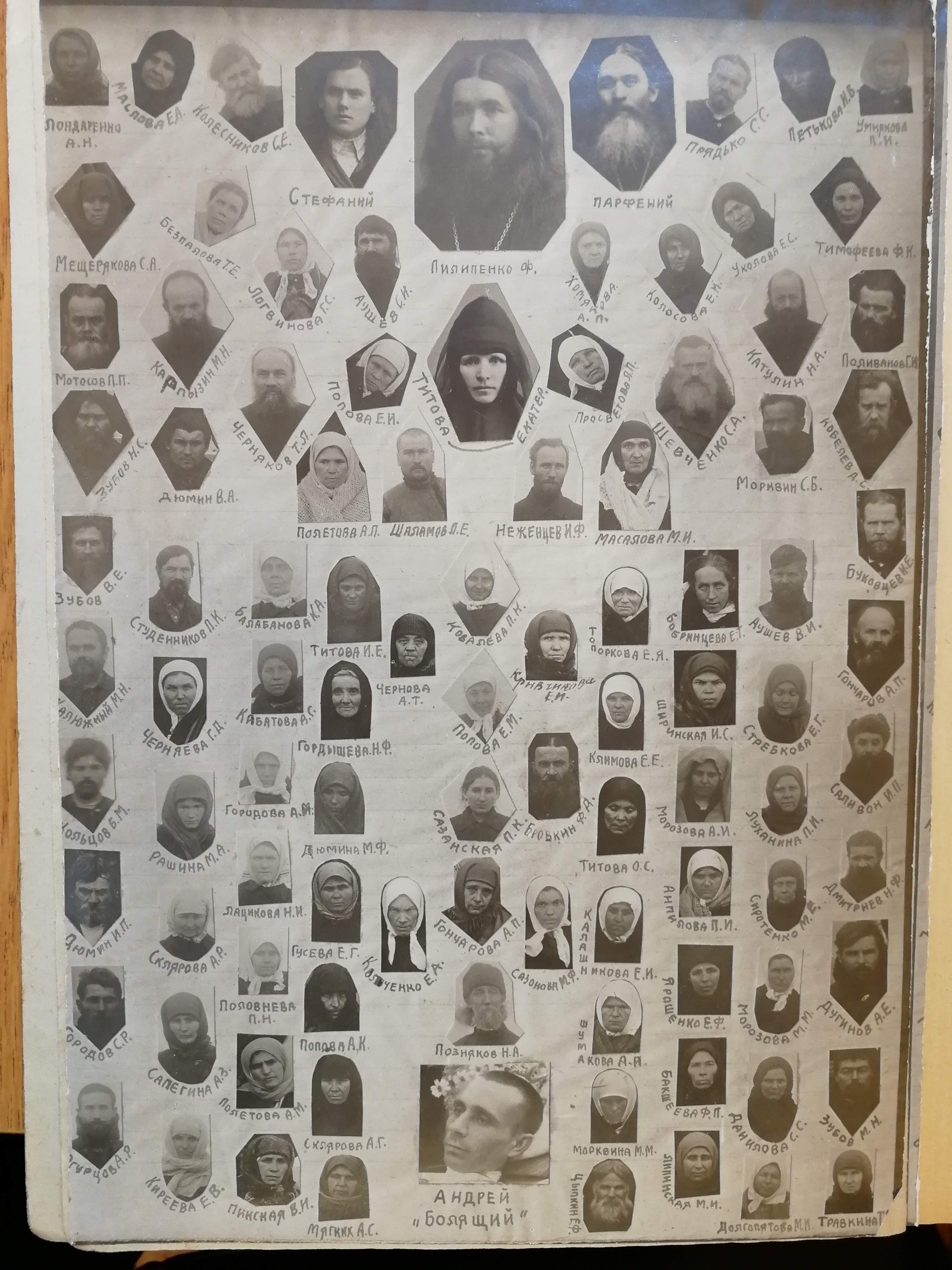
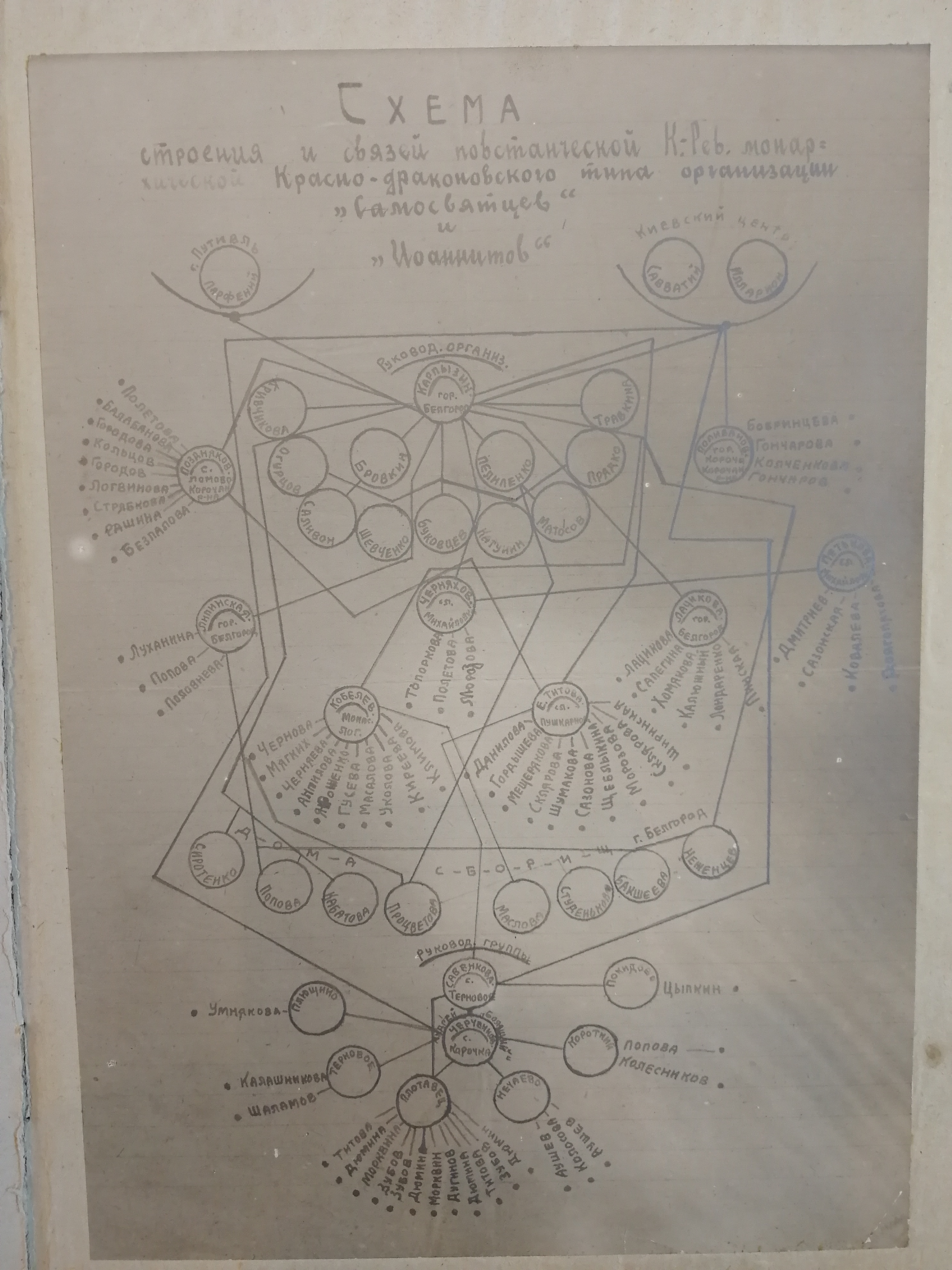
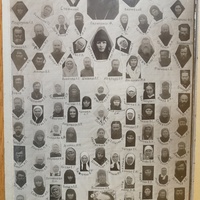
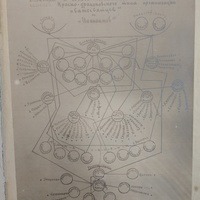
The images are a photo-collage and scheme of a “liquidated” religious network produced as part of a closing indictment in a collective penal case against one hundred believers, followers of underground popular Orthodox movements, referred to as the Samosviatsy and the Ioannits. The group on trial were monks and nuns from closed Orthodox monasteries and ordinary believers from the Ukrainian and Russian countryside. They rejected both Soviet power and the Russian Orthodox Church authority as they believed the Orthodox Church was compromised by collaboration with the Bolsheviks. The network, which was referred to as the Samosviatsy (deriving from the term for "self-consecration"), also included some followers of the Russian Orthodox archpriest Ioann of Kronstadt, referred to as the Ioannits. One of the arrested was a popular charismatic leader, Andrei the Ill (Bolaschii), a prophet and a holy fool (yurodivyi), active in southern Russia and Ukraine.
The network scheme and photo-collage show how the Soviet secret police represented dispersed communities of peasant believers and monks from different Ukrainian and Russian towns and countryside. The visual representations portray the community as a hierarchical secret organisation, showing the interconnections and relationships between members. Representing religious groups in this way was part of the typical strategy of politicisation of dissenting religious groups, in order to validate repressive action.
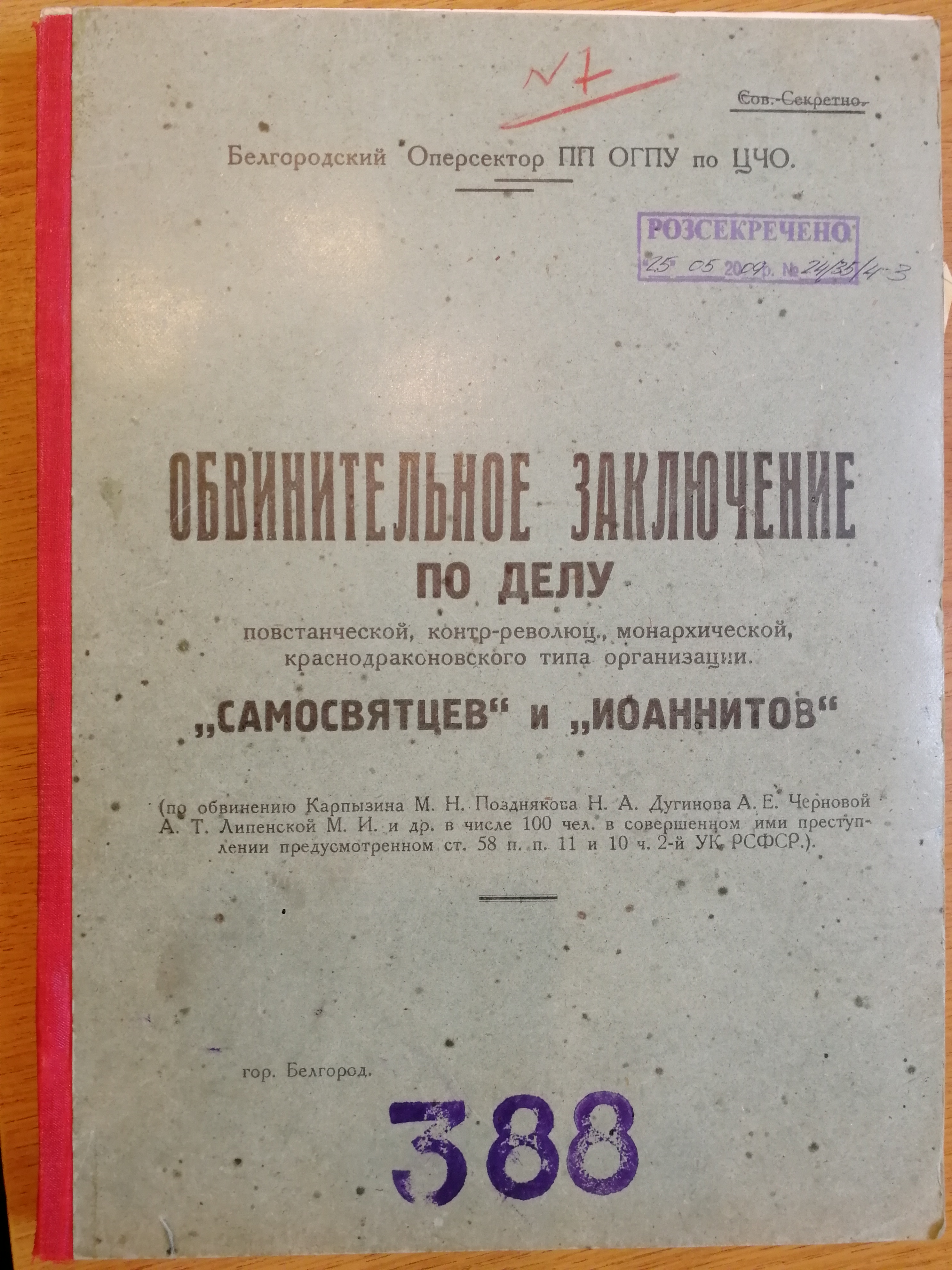
The indictment was published in 1930 as a top-secret document by the Soviet secret police (OGPU) in Belgorod, Russia. The document was then circulated among other branches of the OGPU, including the one in Kiev, as an exemplary collective penal case – a sort of a manual of the OGPU’s struggle against the so-called “ecclesiastical-monarchist underground”. On the cover of the file, the Samosviatsy and the Ioannits are defined as "insurgent, counter-revolutionary, monarchical red-dragon-type organisation".
As well as the network scheme, it contains material with long citations, in largely formulaic secret police language, taken from interrogations of arrested individuals and witnesses. These were intended to reveal political conspiracies disguised as religious practices. The main charges against the believers were of anti-Soviet propaganda and counter-revolutionary activities, including inciting the peasants to revolt against collectivization.
After the Bolshevik Revolution in 1917, political repression turned against the Russian Orthodox Church. The majority of monasteries and churches were closed down and many former priests, nuns and monks continued their religious practises underground, in private houses and apartments, wandering from village to village. The perceived political corruption of the Church, the repression of the Church hierarchy and mass closure of churches and monasteries triggered the development of popular forms of Orthodox dissent. These movements had an apocalyptic vision of a radically changing world. Numerous prophets, holy fools (yurodivye) and former monks and nuns preached the arrival of the Apocalyptic Red Dragon personified by the Communists, hence the name "red-dragon-type organisation". Soviet power was seen as the power of the Antichrist or Satan. In 1930-1933, Stalin’s secret police (OGPU) launched the all-Union “liquidation campaign” against the growing Orthodox dissent movements, which they collectively referred to as the “ecclesiastical-monarchist underground”. Among the repressed groups were numerous communities of the catacomb True Orthodox Church, the Samosviatsy, Ioannits, and many other ordinary believers.
The documents come from the State Archive Branch of the Security Services of Ukraine, fond 13, spr. 388, SBU Archive (Kiev, Ukraine). The file also contains a full list of the people put on trial, the historical outline and the social structure of the movement as perceived by the secret police, and evidence of its insurgent, counter-revolutionary activities, based on majorly distorted and formulaic statements of arrested individuals and witnesses.
For related entries see:
-
Religious network schemes
-
True Orthodox Church
-
Irish Research Council project on Religious Minorities in Ukraine
-
Subject
-
Communism and Christianity--Europe, Eastern
-
Communism--Europe--History--20th century
-
Secret police (secret service)
-
Totalitarianism
-
Material culture--Religious aspects
-
Religion and politics--Europe
-
Religious groups
-
Christian sects--Soviet Union
-
Soviet Union--Obʺedinennoe gosudarstvennoe politicheskoe upravlenie
-
Communism--Soviet Union--History--Sources
-
Identification photographs
-
Trials (Political crimes and offenses)--Soviet Union
-
Creator
-
Tatiana Vagramenko
-
Source
-
Галузевий державний архів Служби безпеки України
ГДА СБУ ф. 13, спр. 388
https://ssu.gov.ua/
-
Publisher
-
This project has received funding from the European Research Council (ERC) under the European Union’s Horizon 2020 research and innovation programme No . 677355
The research for this entry was funded by Irish Research Council, GOIPD/2017/764
-
Date
-
1930
-
Rights
-
Copyright for these images belongs to the State Archive Branch of the Security Services of Ukraine
https://ssu.gov.ua/
-
Format
-
Image/ jpg
-
Photo
-
Language
-
RU
-
Type
-
Image
-
Identifier
-
SBU Archive f. 13, spr. 388
https://ssu.gov.ua/
-
Coverage
-
20th Century
-
Soviet Union
-
Soviet Russia
-
Soviet Ukraine
-
Date Created
-
2018