Items
-
 The photograph shows a page from a wall calendar published in 1929 by the Kyiv branch of the publishing house Knyhospilka. A copy of this calendar was sent by Yukhym Kryvets, Deputy Head of the Odesa District Department of the GPU (State Political Directorate), to the Secretary of the Odesa District Committee of the CP(b)U, noting that this page, despite having received permission from the Odesa Okrlit for printing and release (No. 2642, print run of 30,000 copies), was deemed by the state security authorities to have an “apparently religious-mystical character.” The report also states that the entire print run of the calendar was confiscated. The probable grounds for such an assessment may have been related to the compositional structure of the image, organized around a central element – a solar disk with a human face, surrounded by twelve zodiac signs. Such motifs are characteristic of astrological symbolism, rooted in pre-Christian and occult notions of cosmic order. In the view of the GPU, this visual scheme could appeal not to a materialist worldview but to ideas of cosmic harmony, the interconnection between human beings and celestial bodies, and the dependence of human destiny on the cosmos – that is, to the realms of mysticism, astrology, natural philosophy, and religious perception of the world. In this context, attention may also have been drawn to two female figures placed near the so-called “circle of time,” whose iconography recalls allegorical images from classical antiquity or biblical tradition and allows for various symbolic interpretations. Such symbolism, in the interpretation of the state security authorities, could lend the image features of an esoteric, spiritually symbolic understanding of the universe, potentially coming into conflict with the official Soviet doctrine of scientific materialism and the policy of state atheism. Thus, within the context of the cultural policy of the late 1920s, this calendar page may have been regarded by the Soviet authorities not as a purely decorative or artistic composition, but as an ideologically problematic visual artifact capable, under certain readings, of stimulating religious-mystical modes of thought incompatible with the course of Soviet cultural construction and state atheism in the USSR.
 -
 The photographs originate from a criminal case file initiated on 16 October 1958 by the KGB against the Pentecostal bishop Viktor Belykh and were used during the investigation as material evidence, in particular for a forensic handwriting examination, the results of which formed the basis of the charge of “anti-Soviet activity” brought against him. Photographs 2–3 contain Christian poems and psalms (“Abel,” “As the Deer Longs for the Spring” (an allusion to Psalm 42:1), “How Wonderfully Saved by Christ I Am”), as well as a fragment of Belykh’s autobiography. The investigation interpreted these texts as allegories of the suffering of a believer persecuted by the authorities and “sent to distant lands” (an allusion to arrest and exile). Photograph 4 contains a letter intercepted by the KGB, in which the author, using allegorical language, sought to inform fellow believers of the arrest of the leaders of the Pentecostal underground headed by Afanasy Bidash and of his own illegal status. Photograph 5 includes fragments of dogmatic texts of Pentecostal doctrine, regarded as extremist in the USSR, bearing handwritten annotations. All these materials were obtained by the secret police in the course of operational–investigative measures and were incorporated into the case as material evidence. The handwriting examination, conducted at the initiative of the KGB, established that the handwriting in all the documents belonged to one and the same person – Viktor Belykh. Thus, agent-operational materials, the results of intercepted correspondence, and forensic examinations were integrated into a single evidentiary framework, enabling investigators to comply formally with the requirements of “socialist legality” while simultaneously securing a conviction. The resort to combinations of investigative methods such as this can be explained by the transformation of the Soviet security system in the post-Stalin era, when punitive practices gradually took on the appearance of “legal legitimacy” instead of overt violence. In the late Stalin years (up to 1953), investigations against individuals accused of anti-Soviet crimes were largely formal – the required “confessions” were obtained through physical or psychological coercion. Due to the poor quality of investigations, in August 1954 alone, regional and district courts of the Ukrainian SSR returned 216 cases to the KGB for additional investigation. The decree of the CPSU Central Committee dated January 19, 1955, “On Measures for the Further Strengthening of Socialist Legality and the Enhancement of Prosecutorial Supervision,” abolished the extrajudicial bodies of the Ministry of Internal Affairs and the Ministry of State Security, which had previously possessed the authority to issue sentences even in absentia. The “principle of socialist legality” was reinstated, declaring that no one could be found guilty without a court verdict, whilst prosecutorial supervision over KGB operations was reinforced. By decree of the Presidium of the CPSU Central Committee dated May 24, 1955, special departments were created within the offices of the Prosecutor General of the USSR and the union republics to oversee legality within the KGB system. KGB anti-religious divisions were instructed to gather indisputable evidence of the “criminal activity” of monitored individuals through intelligence and operational measures. In such operations, a wide range of special means was employed: – wiretapping of telephone conversations (code “N”), – external surveillance (code “NN”), – censorship of correspondence (code “PK”), and others. Investigative departments, in turn, were required to legalize materials obtained by such means – that is, to present them as formal evidence admissible in criminal proceedings. On the basis of these documents, investigators were expected to “substantiatedly” prove the guilt of the accused while adhering to the official ban on physical or psychological coercion. After the investigation was completed, criminal cases against organizers of “anti-Soviet sectarian groups” and their closest associates were to be submitted to court, while for ordinary believers – in the absence of serious offenses – “preventive measures” such as warnings or surveillance were recommended. In summary, the case of Bishop Viktor Belykh became a revealing example of the new model of Soviet repression in the late 1950s – a shift from overt violence and fabricated confessions to “legally formalized” methods of control. It reflects the transition of the KGB from Stalinist terror to a system of “legalized persecution” of religious leaders, where the document and expert signature replaced the instruments of torture and forced confession.
 -
 These photographs are taken from the criminal case file opened on October 16, 1958, by the KGB against the Pentecostal bishop Viktor Belykh (Photos 1, 2). Holding a high spiritual position, Belykh was a member of the episcopal collegium that oversaw the life and activities of all Pentecostal congregations in the USSR. By virtue of his pastoral work, he personally knew the entire leadership of the Pentecostal movement, which made him a valuable source of information for the state security organs. Since the Pentecostal movement at that time operated deeply underground and was carefully concealed, information about its structure and leadership was of particular interest to the KGB. During one of the first interrogations, investigators asked Belykh to provide details about the highest leadership of the Pentecostal movement and to identify them from a photograph seized from him during the investigation. Having previously worked for the KGB as a covert agent and, likely, hoping to mitigate his potential punishment, Belykh agreed to cooperate with the investigation. Photo 3 is of the official identification protocol carried out by Belykh, with the attached photograph depicting leading figures of the Pentecostal movement in the USSR. On the right in the center sits the closest associate of the first chairman of the Union of Pentecostals of the USSR, Ivan Voronaev – the secretary of the Union’s board, Mikhail Luchinets. On the left in the center is the bishop of the Piatykhatky diocese and the head of all underground Pentecostal congregations in the country, Afanasy Bidash. To his left is the bishop of the Pentecostals of Belarus, A. Kasperovich, and behind him stands the bishop of the Pentecostals of Ukraine, Ivan Levchuk, among others. In addition to information about the leadership, Belykh also provided the KGB with data on underground Pentecostal communities in the Cherkasy region. He identified believers from the village of Ruska Polyana in the Cherkasy district (Photo 4), among whom were those he had personally baptized in water. These photographs, once given to him as tokens of gratitude, were confiscated by the KGB and later used for operational purposes. The story of Viktor Belykh reveals how deeply the KGB penetrated the religious underground, exploiting human weaknesses and using photographic materials to compromise members of the community and to establish control. This episode reflects the tragedy of an era when faith and devotion often collided with the pressure of a repressive system, forcing spiritual leaders to become instruments of the state apparatus.
 -
 The photographs were taken from folder No. 3 (material evidence) of a seven-volume criminal case initiated by the KGB against five leaders of the underground Pentecostal Union in the USSR in 1957. The arrest of these individuals was a key stage in the KGB’s implementation of the centralized intelligence operation "Fanatics." These photographs were confiscated by the KGB during a search of the Pentecostal bishop Ivan Antonovich Levchuk. Levchuk was a leader of the Pentecostal children's and youth ministry, where he taught children and young people the fundamentals of faith. The photographs capture moments when Ivan Levchuk was working with young sisters in the community. As a young, unmarried bishop, he naturally attracted the attention of single sisters, some of whom gave him their photographs. One such photo (Image no. 4) has an inscription on the back in Russian: "To brother Vania from sister Valia as a keepsake. I give it as I am but promise to improve. December 31, 1956". It is possible that these photographs, as well as certain aspects of Ivan Levchuk’s personal life known to the KGB, were intended to be used as leverage for recruiting the bishop. The intention to recruit Ivan Levchuk as a secret KGB agent using compromising evidence was mentioned in a top-secret work plan of the 5th Department of the 2nd Directorate of the KGB of the Ukrainian SSR in the third quarter of 1960. This plan was approved and signed on July 6, 1960, by Colonel Sivovol, head of the 2nd Directorate of the KGB of the Ukrainian SSR. However, for unknown reasons, according to KGB documents, the recruitment work with Ivan Levchuk at that time was never completed. The KGB returned to this matter in April 1969, when it was established that Levchuk had married one of his fellow believers, who was more than 10 years younger than the bishop. Marriages with such an age gap were generally not approved by the Pentecostal leadership. According to the top-secret plan of agent-operational measures regarding the Pentecostals of Ukraine in 1969–1970, approved on April 28, 1969, by the Deputy Chairman of the KGB of the Ukrainian SSR, Colonel Nikolai Troiak, it was proposed to use the fact of Levchuk’s marriage and his subsequent desire to withdraw from underground religious activities due to fear of another arrest to recruit the bishop as a secret KGB agent. The file is stored in the State Temporary Archive of the Security Service of Ukraine in the Dnipropetrovsk Region, Fund P(6), Inv. 1, File П-24610. The file includes numerous photographs, arrest forms of repressed believers with photographs of the arrested individuals, numerous interrogation reports, verdicts, and other documents.
 -
 The photographs were taken from folder No. 3 (material evidence) of a seven-volume criminal case initiated by the KGB against five leaders of the underground Pentecostal Union in the USSR in 1957. The arrest of these individuals was a key stage in the KGB’s implementation of the centralized intelligence operation "Fanatics." These photographs were confiscated by the KGB during a search of the Pentecostal Bishop Ivan Antonovich Levchuk. The photographs capture the meeting of two bishops, Viktor Ivanovych Bilykh and Ivan Antonovych Levchuk, after the latter's release from a labor camp. Other fellow believers were also present at the gathering. The last time the bishops had seen each other on March 16, 1948, in Dniprodzerzhynsk (modern-day Kamianske), Dnipropetrovsk region, at an underground congress of leaders of clandestine Pentecostal communities in the USSR. As part of the MGB’s secret operation "Prophets," the entire leadership of the underground Pentecostals was arrested. By decision of the Special Council of the MGB of the USSR, Levchuk was sentenced to 10 years in labor camps, while Belykh received 8 years. According to operational and investigative materials, Belykh disclosed to the MGB all information about Levchuk’s underground activities and those of other Pentecostal leaders. Given this fact and other aspects of his biography, Belykh was recruited by the Soviet secret services as a secret agent and tasked with infiltrating and monitoring his fellow believers. In photograph no. 3, the act of Christian greeting in the form of the "kiss of love" (see 2 Corinthians 13:12; 1 Peter 5:14) is captured, performed by the co-religionists after a long separation. This commandment presupposes the presence of heartfelt love for one’s brother, which should be expressed through a kiss. In the absence of such love, the "kiss of love" can easily turn into a "Judas kiss." In photograph no. 4, the “kiss of love” is captured between Bishop Belykh and Bishop Levchuk but given the former’s betrayal of the later we might question whether this was truly a "kiss of love," or a "Judas kiss"? The photographs are preserved in Folder No. 3 (material evidence) of a seven-volume criminal case initiated by the KGB against the leadership of the Pentecostals, which operated in Pyatykhatky, Dnipropetrovsk Region. These photos are kept in the State Temporary Archive of the Security Service of Ukraine in the Dnipropetrovsk Region, Fund Р(6), Vol. 1, File P-24610. The case includes numerous photographs, arrest warrants of repressed believers with photos of the detainees, extensive interrogation reports, the verdict, and other documents.
 -
 The photographs were taken from folder No. 3 (material evidence) of a seven-volume criminal case initiated by the KGB against five leaders of the underground Pentecostal Union in the USSR in 1957. The arrest of these individuals was a key stage in the KGB’s implementation of the centralized intelligence operation "Fanatics." These photographs were confiscated by the KGB during a search of the Pentecostal bishop Ivan Antonovich Levchuk. They reveal previously unknown pages of the bishop’s biography, namely his service as a soldier in the Soviet Army during World War II. Ivan Antonovich Levchuk was born on December 27, 1920, in the village of Soshichne, Kamin-Kashyrskyi district, Volyn region, into a large Protestant family. At that time, this territory was part of Poland. On September 17, 1939, under the Molotov-Ribbentrop Pact, the Soviet Army occupied Western Ukraine and annexed it to the USSR. The Sovietization of these regions began and lasted until 1941. It was at this time (1940) that Levchuk was baptized upon his faith in the village of Kachin, Kamin-Kashyrskyi district, Volyn region, by presbyter Luka Stolyarchuk. From 1941 to 1944, these territories were occupied by the Wehrmacht. On January 18, 1944, Soshichne was liberated by Soviet forces, who then launched a mass mobilization of young people into the Soviet Army. Ivan Levchuk was drafted into the 389th Rifle Division, where, according to the bishop, he served as a signalman-telephone operator. He participated in battles in Poland, where in January 1945, during another battle with the Nazis, he suffered concussion. In February 1945, after hospitalization, he was transferred to the supply platoon of the 172nd Rifle Division, 134th Artillery Regiment of the 13th Army, 1st Ukrainian Front. According to Levchuk, he continued to serve as a signalman-telephone operator and later as a tailor. At that time, the Ukrainian Front was commanded by Marshals Georgy Zhukov (March–May 1944) and Ivan Konev (May 1944–May 1945). The units in which Levchuk served participated in a series of major military operations. Top-secret KGB materials indicate that Levchuk was discharged from the Soviet Army on August 15, 1946, with the rank of sergeant. During his military service, the future bishop was awarded two medals ("For the Liberation of Prague" and "For Victory over Germany") and two military badges ("Guards Badge" and "Excellent Artillerist"). According to official sources, the Guards Badge was awarded to soldiers of military units that demonstrated mass heroism, courage, and high military skill on the battlefield. These units received honorary titles and were transformed into Guards units. The "Excellent Artillerist" badge was awarded to soldiers who demonstrated "outstanding achievements in artillery shooting and anti-tank rifle fire" on the battlefield. In photograph No. 4, it is visible that Ivan Levchuk (sitting in the center with an open book in his hands) wore a Soviet military uniform with sergeant's shoulder boards after his discharge, as well as the aforementioned awards. The file is stored in in the State Temporary Archive of the Security Service of Ukraine in the Dnipropetrovsk Region, Fund P(6), Inv. 1, File П-24610. The file includes numerous photographs, arrest forms of repressed believers with photographs of the arrested individuals, numerous interrogation reports, verdicts, and other documents. For more examples of the confiscated materials from operation “Fanatics” see entry “Material evidence from the centralized intelligence case “Fanatics” against Pentecostals in Ukraine”.
 -
 The photograph depicts an Orthodox prayer belt with an inscription for protection against enemies. According to KGB report , this belt was discovered by a police officer, Sergeant Vadim Bursikov, who was guarding the state bank. On January 2, 1979, at 12:30, he found the belt on a barrier near cashier window No. 9. In response, Bursikov submitted a report to Lieutenant Colonel L.D., Ganin, the chief of the bank's security. The report stated that the belt had been intentionally left in the bank by an unknown individual for anti-Soviet purposes. The basis for this conclusion was the religious inscription on the belt: “Let God arise, and let His enemies be scattered; let those who hate Him flee from before His face. As smoke vanishes, so let them vanish; as wax melts before the fire, so let the demons perish before the face of those who love God and are marked with the sign of the cross, rejoicing as they proclaim: Rejoice, O most pure and life-giving Cross of the Lord, which drives away demons by the power of Him who was crucified on you!”. The individual responsible for this “anti-Soviet act” was never identified. Therefore, it remains unclear whether the incident was indeed an anti-Soviet act or merely someone’s lost property.. However, the KGB classified the event as an anti-Soviet act and suspected members of the Baptist community to be behind it. The KGB often regarded Baptists, like other non-Orthodox denominations, as "spies for Western intelligence agencies." As a result, the preliminary operational investigation materials, along with the belt itself, were preserved in the classified case file maintained by the KGB regarding Evangelical Christian Baptists.This case shows that even during the Brezhnev era, which followed Khrushchev's notorious anti-religious policy, such seemingly insignificant actions could be interpreted by the KGB as an anti-Soviet act worthy of their attention. This belt was enclosed in case No. 1131 (File No. 135 "Evangelical Christian Baptist Sectarians and the Council of Churches of Evangelical Christian Baptists"), volume 6, fond 11 of the HDA SBU. The case contains numerous photographs, agent reports, and KGB summaries on secret operations targeting both legal and underground ECB communities. More about this case see: 1. Korotaiev, O. Diialnist orhaniv derzhavnoi bezpeky sered yevanhelskykh konfesii v URSR (1940-vi – seredyna 1960-kh rr.). Kvalifikatsiyna naukova pratsya na prykhvakakh rukopysu. Dysertatsiya na zdobuttya naukovogo stupenya doktora filosofії (PhD) za spetsial'nist'yu 032 «Istoriya ta arkheologiya». — Poltava: Poltavskyi natsional'nyi pedahohichnyi universytet imeni V. H. Korolenka, 2022. 2. Lakhno, O. Tserkovna opozytsiia yevanhelʹsʹkykh khrystyian-baptystiv v Ukraini (1940-1980 rr.).Poltava: Drukarsʹka maisternia, 2009. 3. Sawatsky, W. (1981). Soviet Evangelicals since World War II. Ontario & Scottdale, PA: Herald Press, 1981. 4. Vysoven, O. (2021). Hromady yevanhelʹsʹkykh khrystyian-baptystiv radiansʹkoi Ukrainy v politychnykh, sotsialʹnokulʹturnykh vymirakh totalitarnoi doby (40-80-i rr. XX st.): Dys. dokt. ist. nauk. Pereiaslav-Khmelʹnytsʹkyi derzhavnyi pedahohichnyi universytet im. H. Skovorody. Pereiaslav, 2021.
 -
 This photo-montage, printed on a piece of light cardboard the size of a postcard, was produced in 1952 as a souvenir for visitors and pilgrims to the Vladimireşti Convent of the Mother of God. The six photographs were commissioned and arranged by Father Iovan, an important monk living at the convent, and were taken by a photographer known only as “I.R.”, who served ten years in prison for his part in producing them (Hanganu 2004). By 1952 the convent had become a focal point for pilgrims in western Moldavia, with people travelling long distances to hear the charismatic preaching of Father Iovan and to take part in collective confession, as well as to witness the prophecies and healings of the convent’s founder and mother superior (stareţă), Mother Veronica. Iovan and Veronica actively cultivated the convent’s popularity, and produced the photo-montage as part of a religious marketing strategy. Blessed by the Saviour and the Mother of God, and sitting alongside a Bible and a chalice, the photos are arranged in a Latin cross bottony common in Eastern Orthodoxy. Three of the photos feature Mother Veronica; in front of the convent, surrounded by priests, and speaking to a crowd of pilgrims. Another shows the interior of the church, but the first three tell the miraculous story of the convent’s beginnings. In October 1937, when she was still only seventeen years old, Mother Veronica – then known as Vasilica Barbu – had a vision. She said, “I saw a young man of unusual beauty, dressed as a shepherd (mocan). He said to me, ‘Vasilica, go to the priests and the mayor in your village and tell the villagers to erect a cross with the image of the Savior, Jesus Christ, on it, for the forgiveness of sins’" (Barbu 1940). The young man later introduced himself as St. Symeon the Stylite, and appeared to her again a week later together with Jesus himself, when she was working in the corn fields with her sister. The photograph at the top of the montage shows the cross that she erected on in the field where she first met Jesus, evoking both her rural roots and reminding pilgrims that Vasilica had obeyed God’s commands. Vasilica continued having visions, and travelled around the area recruiting other pious young women and raising the money necessary to start a convent. Despite receiving no financial support from the Church, the women pooled their dowries and donations and began building in September 1939. Meanwhile, they lived in a dugout house, where they worshipped, farmed, and faced a number of dangers as a group of young women living in an isolated part of the countryside. The second photo, featuring their first house, stands in sharp contrast to the third, which is of the completed oratory – a testament both to their dedication and to God’s blessing of their work. Taken in order, the images tell a story of continuous growth emerging out of obedience to God’s initiative in revealing himself to a teenage girl. Beyond its function as a souvenir for visitors, the photo-montage also served as evidence against Mother Veronica and Father Iovan when the Securitate arrested them and closed the monastery in 1956. Secret police reports accused them of harbouring fugitive fascists and of spreading anti-Communist propaganda. Several important theologians helped the Communists’ cause by writing denunciations of Mother Veronica as a visionary and condemning Father Iovan’s practice of collective confession as heretical. Although in itself the photo-montage appears quite harmless, in the context of the Securitate’s investigation it ‘proved’ that Mother Veronica was encouraging a personality cult around herself as a seer and a visionary, and spreading ‘unhealthy’ mystical currents to a credulous and easily misled community. A number of the convent’s leading figures spent years in prison following the forced closure of the convent, and alongside many others, Mother Veronica was terrorized into becoming an informant for the secret police. ReferencesȘ Gabriel Hanganu, “«Photo-Cross»: The Political and Devotional Lives of a Romanian Orthodox Photograph,” in Photographs, Objects, Histories: On the Materiality of Images, eds. Elizabeth Edwards and Janice Hart (London: Routledge, 2004), 156–74. Vasilica Barbu, Minunile din comuna Tudor Vladimirescu, Jud. Tecuci, 2nd Edition (Galaţi: Tipografia “Cultura Poporului”, 1940), 24.
 -
 These photographs were taken from a case file compiled by the KGB on underground communities of Evangelical Christian-Baptists in the Kherson region, Ukrainian SSR. The informal leader of these communities was Mikhail Ishchenko. The communities were affiliated with the Council of Churches of Evangelical Christian-Baptists,one of the largest religious movement in the USSR that functioned underground. Unlike legal Baptist communities, the activities of underground Baptist communities were strictly suppressed by the KGB and other Soviet authorities. The Kherson community of the Council of Churches, led by Ishchenko, consisted of approximately 50 members. The community was divided into several smaller “home groups,” which maintained close relationships with one another. The case revealed that the underground Baptist communities were well-organized, had central leadership, and maintained an underground publishing press. The KGB’s goal in conducting surveillance was to identify all members of the community, their connections with other underground communities, and their links to the leadership of the Council of Churches, particularly Gennadii Kryuchkov and Georgii Vins. They also sought to uncover the members of the editorial board of the underground religious journal Christianin (“The Christian”). The plan was to sever the communities’ ties to the Council of Churches’ leadership, bring them out of hiding, and integrate them into the All-Union Council of Evangelical Christians-Baptists (AUCECB) — an umbrella organization for various Evangelical communities that was officially registered in the Soviet Union and tightly controlled by the state.. Agents working on this mission included “Petrovskii” (identified as Konstantin Kalibabchuk, senior presbyter of the AUCECB for the Kherson and Mykolaiv regions), “Patriot,” and “Svetlana.” With their assistance, the KGB identified and photographed active Baptists under surveillance, including individuals codenamed “Kosina”, Tatiana Kusacheva (Image 1, Person I), “Grigorii” and his wife (Image 2) and “Klava” (Image 3, Person II), among others. The fourth photo shows a bus that was operating an intercity route from Kherson to Odesa. This route was used by believers to travel between cities. The tragedy of the situation lay in the fact that the KGB used Baptists from the legally operating AUCECB to combat the underground communities. This deepened the division between these two factions — a split that persists to this day. The photographs come from the case No. 1131 (File No. 135 "Evangelical Christian Baptists and the Council of Churches of Evangelical Christian Baptists"), volumes 1 and 3, fond 11 of the HDA SBU. The case contains numerous photographs, agent reports, and KGB reports on the secret operations among both legal and underground ECB communities. More about this case see: 1. Korotaiev, O. Diialnist orhaniv derzhavnoi bezpeky sered yevanhelskykh konfesii v URSR (1940-vi – seredyna 1960-kh rr.). Kvalifikatsiyna naukova pratsya na prykhvakakh rukopysu. Dysertatsiya na zdobuttya naukovogo stupenya doktora filosofії (PhD) za spetsial'nist'yu 032 «Istoriya ta arkheologiya». — Poltava: Poltavskyi natsional'nyi pedahohichnyi universytet imeni V. H. Korolenka, 2022. 2. Lakhno, O. Tserkovna opozytsiia yevanhelʹsʹkykh khrystyian-baptystiv v Ukraini (1940-1980 rr.).Poltava: Drukarsʹka maisternia, 2009. 3. Sawatsky, W. (1981). Soviet Evangelicals since World War II. Ontario & Scottdale, PA: Herald Press, 1981. 4. Vysoven, O. Hromady yevanhelʹsʹkykh khrystyian-baptystiv radiansʹkoi Ukrainy v politychnykh, sotsialʹnokulʹturnykh vymirakh totalitarnoi doby (40-80-i rr. XX st.): Dys. dokt. ist. nauk. Pereiaslav-Khmelʹnytsʹkyi derzhavnyi pedahohichnyi universytet im. H. Skovorody. Pereiaslav, 2021.
 -
 The photos were taken from the 7-volume criminal case file initiated by the KGB against five leaders of the underground Union of Pentecostals in the city of Piatykhatky, Dnipropetrovsk Region, Ukraine in 1957. The photographs were confiscated from Pentecostal believers and used as criminal evidence of their illegal activities. The arrest of these individuals became a key stage in the KGB's implementation of the centralized intelligence case “Fanatics.” These photos provide valuable insight into the daily life of Pentecostal communities, which they operated underground. The materials from the file show that the Pentecostals had centralized leadership, a sizeable community in Piatykhatky with an underground Sunday school for children. The first photograph depicts the leadership of the underground Pentecostal Union of the USSR. It was taken during their clandestine meeting in Pіatykhatky, Dnipropetrovsk Region, in June 1956. Standing (from left to right): the secretary of the Pentecostal Union Ivan Poddubnyi, presbyter Vladimir Shepel, and bishop Moisei Murza. Seated (from left to right): the first person is unidentified, followed by bishop Ivan Levchuk, senior bishop Afanasiy Bidash, and presbyter Kyrylo Kruzhko. Tragically, two of them were KGB agents: agent “Aleksandrov” (Ivan Poddubnyi) and “Donetskii” (Moisei Murza), who had been recruited by KGB earlier in their careers, ultimately leading to the arrest of many active members of the faith community. In the following years, the main Pentecostal leadership were arrested and sentenced to 3 to 10 years in labor camps: Afanasii Bidash, Ivan Levchuk, Vladimir Shepel, Kyrylo Kruzhko, Fedot Koriniaka. For Bidash, Levchuk and Kruzhko, this was their second sentence. The second photograph depicts an underground Pentecostal community in the city of Piatykhatky, led by Bidash. The community consisted of ordinary, and most probably poorly educated people. Yet, in the secret police file, they were accused of being secret agents of Western intelligence services, who worked to “undermine” Soviet authority. The third photograph shows Bishop Ivan Levchuk with the children of believers who attended the underground Sunday school of the community. This photograph was used as evidence during Levchuk's trial, where he was accused of teaching children religion, was an activity prohibited by Soviet law. In the fourth photograph, Ivan Levchuk teaches young sisters the basics of faith, specifically how to greet one another according to the Gospel model. In line with Pentecostal belief, followers are taught to greet each other with the words “Peace be with you!” or “Greetings!” (see Matt. 10:12). The file is stored in State Archive of the Security Service of Ukraine in the Dnipropetrovsk region, Fund R(6), Inventory 1, Case P-24610. The file includes numerous photographs, arrest forms of repressed believers with photographs of the arrested individuals, numerous interrogation reports, verdicts, and other documents.
 -
 Initiated on 13 May 1965 by Jadwiga Jakubowska, the miracle of Zabłudów met with a growing social response in June and July. Despite the lack of any media coverage of the miracle, thousands of pilgrims from all over the country come to Zabłudów. The plan of their stay usually included two points. The first was to visit the Jakubowski family’s property in order to meet or at least see Jadwiga Jakubowska, a girl who saw the Marian apparition. The second point, for the pilgrims, was the miraculous meadow where the apparitions and other miraculous events occurred. There, on Sunday, 30 May, a riot took place when riot police attacked the people, waiting for the next apparition, with truncheons and tear gas. These actions were ineffective and the police units had to withdraw. The pilgrims treated this fact as a new miracle, and it made the miracle of Zabłudów famous throughout Poland. Pilgrims who came to the miraculous meadow in June and early July prayed, sang Marian hymns and talked about other miracles. The phrase “Our Lady of Zabłudów” appeared in litanies. They often left different votive offerings, such as flowers, ceremonial towels, candles and rosaries. People collected water from a dug pit, which was treated as a spring, and soil, which were considered to have miraculous curative properties. With the beginning of the quarantine of Zabłudów, whose real aim was to eradicate the miracle, access to the miraculous meadow was forbidden, guarded by a 24-hour police post. Pilgrims who tried to break through to the site of the Marian apparition were punished with a typhoid vaccination and a fine. Among the pilgrims in the miraculous meadow, there were also undercover secret police officers. Their task was to observe the behaviour of the people who came there, eavesdropping on conversations and taking surveillance photos, which were then entered into a special album. The presented photographs of pilgrims come from this album. The caption under the top photo reads: “A woman is hanging rosary on cross. Date 11.VII.1965”. The caption under the bottom photo reads, “A woman is collecting soil from the alleged ‘miracle’ site. Date 11.VII.1965”.
 -
 The photographs show a 14-year-old girl, Jadwiga Jakubowska, who saw the Marian apparition on 13 May 1965. The apparition, which took place on a meadow near Zabłudów, a small town in north-eastern Poland, led in the following months to a series of events known as the miracle of Zabłudów. It was one of the most significant miraculous phenomena during the Polish People’s Republic era and became particularly famous after the riots of 30 May 1965. Then, on the day of the next announced apparition, thousands of people clashed with the riot police, who tried to disperse the gathered pilgrims by force. As this was also the day of the “election” to the communist parliament of the Polish People’s Republic, the miracle of Zabłudów acquired a political dimension. For this reason, the communist authorities wanted to eradicate it as soon as possible. This was achieved in July 1965 by declaring the quarantine of Zabłudów, blocking the place of the apparition with round the clock police patrols and repressing the Jadwiga Jakubowska’s family and supporters of the miracles. The Polish communist secret police (in the Polish context – the Security Service) played a huge role in the elimination of the miracle. They entangled the Jakubowski family, supporters of the miracles and the local clergy with a network of secret collaborators who kept them informed of the mood and plans of those under surveillance. Furthermore, undercover secret police officers secretly observed the Jakubowski family’s property and the behaviour of pilgrims in the miraculous meadow. During these activities, they took about 300 photos with a hidden camera and some of them were later placed in a special album. The presented photographs of Jadwiga Jakubowska come from this album and have been captioned “Photo No. 1/29, 1/31, and 1/33 shows a ‘miraculous girl’ who was riding a bicycle in her backyard on 4.07.65 at 5.45 pm”.
 -
 The photographs show the cover and table of contents for the collective work entitled “Niektóre problemy pracy polityczno-operacyjnej związanej z występowaniem rzekomych cudów” (Some Problems of Political and Operational Work Related to the Occurrence of Alleged Miracles). It was something like a manual for the secret police (in the Polish context – the Security Service) to combat miracles in the Polish People’s Republic. It was commissioned by Department IV of the Ministry of the Interior, which dealt with surveillance of churches and religious associations (both legal and illegal) operating in Poland and combating religious life in general. The work was written a year after one of the most famous miraculous phenomena in communist Poland, the miracle of Zabłudów from 1965. The volume editors were Captain Józefa Siemaszkiewicz and Major Ryszard Wójcicki from the Department of Personnel and Training of the Ministry of the Interior. This book, which is a copied typescript with the “classified” status, is 147 pages long and divided into nine chapters and a bibliography. The first chapter presents the understanding of a miracle by the secret police as “a political phenomenon, with unfavourable overtones and sometimes great social harm”. Then, it describes measures to be taken to eliminate the miracles that still appeared in Communist Poland as effectively as possible, with the least possible involvement of resources and damage of a political nature. Subsequent chapters depict the most famous miraculous phenomena that took place in Poland after the Second World War, such as the miracle of Lublin in 1949 or the miracle of Nowlipki, which occurred in Warsaw in 1959. Chapter 8, entitled “Rzekomy cud w Zabłudowie w 1965 r.” (The Alleged Miracle in Zabłudów in 1965), was compiled by Captain Jerzy Porowski from Department IV of the Białystok Security Service. It presents the course of events connected with the miracle of Zabłudów, the participants’ accounts and the actions taken and inspired by the secret police to eliminate it. The work ends with an appendix entitled “Wybrane z teologii zagadnienia dotyczące rzekomych cudów” (Selected Theology Issues Concerning Alleged Miracles). It describes the Church’s attempts to develop a theology of miracles from St Augustine to the First Vatican Council and the activities of the Roman Catholic Church in promoting miraculous phenomena in various places and times.
 -
 These pictures depict the handwritten and transcribed version of a Catholic hymn addressed to the Virgin Mary of Honvédhalom. The 33 verses of the hymn were noted down by an informer. The hymn seemed dangerous from the perspective of the secret police as it encouraged participation at Honvédhalom, a pilgrimage site of regional importance in the Eger Archdiocese, in northern Hungary. Apparitions at this site, and the associated pilgrimages, date back to the late 18th century but the popularity of the place reached its peak between 1947 and 1975. The Archdiocese did not approve of believers visiting the Honvédhalom pilgrimage site nor the local holy well and the Church authorities prohibited attendance at the illegal pilgrimage site. A circular was issued by the archbishopric in 1975 in order to prevent people from going to the “anti-religious and fake pilgrimage site.” In the circular, the Archbishop of Eger expresses his request that all statues and alters be removed from the site and housed in nearby churches and graveyards. It is also revealed in the circular that the water of the holy well at Honvédhalom had been inspected by the Heves county Public Health and Disease Control Office and the water was found to be infected. Eventually, in 1975 state authorities decided to take the drastic measure of blowing up the holy well of Honvédhalom. The file in which the hymn is found consists of reports on various issues from the Eger Archdiocese between 1957 and 1960. Among many other ecclesiastical issues, agent ‘Asztalos János’ collected information on the illegal pilgrimage site of Honvédhalom. The reports from 1959-60 recount the history of the pilgrimage site, introduce some of the main propagators and organizers of rituals. Asztalos also notes that locals collected money in order to build a chapel at Honvédhalom. The detailed description in the file also gives us a good understanding of the rituals that evolved around the pilgrimage site. We learn that pilgrims – mainly Catholics but Baptsits as well - arrived from various locations on horse carriages and buses in organized groups. According to the accounts, pilgrims pray, preach the end of the world and some have visions of the Virgin Mary when at the pilgrimage site. These apparitions are shared with the pilgrims and they listen in awe. Collective singing formed an organic part of these pilgrimages. Asztalos reports that he finds the hymn especially dangerous as the 33-verss local Marian hymn contains messages against the socialist system and irredentist lines such as asking Virgin Mary to restore the ‘Great Hungary’. The translation of verses 14, 15 and 16 reads as follows: 14. Oh, healer of the sick, Consoler of sufferers. Our Lady of Ransom, we beg you to bring them home. Protect their body and soul, and martyr life. […] 15. We were better Christians before, we have faulted. Blasphemy, desecration, you hear more than devotion. If we do not convert, We are doomed eternally. 16. Virgin of Honvédhalom, Hungaria is lost and wasted we are persecuted for our faith and our hearts numbed. Give use your sacred heart, and embrace your people. The agent also recounts a legend according to which the building materials carried away by the local council could not be used for anything by the authorities as they were collected for the Honvédhalom pilgrimage site and when they tried to use it for building the ‘hand of God’ appeared in the form of a fire or illness. In the 2000s, the local community decided to restore the holy well, however, its popularity does not compare to that between 1947-1975. The handwritten and transcribed version of the hymn is included in file ÁBTL 3.1.2 M–13238. For related entries see:
 -
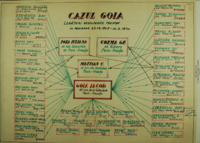 The image represents a funding scheme of the Greek Catholic underground from abroad drawn up by the secret police officer. The scheme links Fr. Iacob Goia, a Dominican monk who emigrated from Romania in 1946 and lived in Paris with the persons he was financing in the Greek Catholic underground. The scheme is detailed providing the members of the diaspora sending money and objects into Romania with their addresses but also the names and addresses of the recipients of the funds. A note tells the reader that these connections were revealed to the secret police gradually between August 1969 and February 1970. In documents describing the network, the officers caution that the correspondence that is intercepted should not lead to interrogation in order to give the officer sufficient time to uncover the entire network. Ample descriptions were offered of the ingenious ways in which the financial help reached the Greek Catholic underground (various goods were sent to Romania (even mystery novels) to be sold and money used to finance religious services of underground clergy). The image comes from file CNSAS D69 (volume 69). The file has over 100 volumes on the Catholic problem in Romania and documents and photographs on financing the Catholic underground appear throughout the file. Along with this image there are interrogation reports, correspondence, surveillance reports. For related items see:
 -
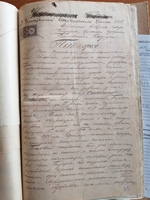 The image contains the cover page of a petition by the Jewish community of Birzula, a town located in the northern part of Odessa oblast of Ukraine. On the 20th of June 1923 the Jewish community of Birzula sent a petition to the central authorities, which requested an intervention by Moscow and Kharkiv (the capital of Soviet Ukraine) in support of their congregation whose synagogue had been seized by local authorities and turned into a club-theatre. The petition describes the recent experience of building a common religious space by a community that had been steadily growing in numbers. The authors of the petition present the synagogue not only as a piece of religious heritage but also as part of Jewish national patrimony and a physical and material evidence of who they are. The final decision of the central authorities was to divest the Jewish community of its synagogue, which was subsequently used as an venue for gatherings of local workers. The petition is contained in a file compiled by the provincial authorities in Odessa in order to facilitate the examination of the status of the synagogue by the central authorities. The file 5-1-2190 is from the Central State Archives of Ukraine.
 -
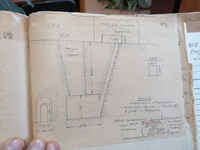 The image contains the sketch of the underground shelter built by Archangelist leaders, Alexandru and Grigore Culiac, and by their followers in Vadul-Leca village, Moldova. The sketch was produced by the Soviet state security service in 1945 after a police raid of the Archangelist community on the 3rd of February. The sketch contains technical details regarding the dimensions of the underground space and about the hiding techniques used by Archangelists to protect their leaders. The shelter was built four meters deep under an orchard, and its entrance was hidden by a shed. The underground space was 1.75 meters high, 2.5 meters long and had two airways. From the 1920s the Archangelists developed the technique of building hidden underground spaces being forced to hide their religious life firstly from the Romanian authorities who persecuted them through interwar decades and latter, after the region was occupied by the USSR in 1944, from Soviet regime whose secret police and propaganda apparatus launched systematic campaigns aimed at eliminating this religious movement. The sketch is enclosed in file R-3401-2-4934 from the National Archive of the Republic of Moldova. For related entries see:
 -
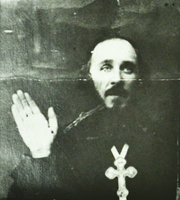 These photographs are of the Catholic monk N. F. Gumenski, who was arrested by the Soviet secret police in 1935. The first image was cropped from a photo icon and in this photograph Gumenski wears a large pectoral cross on his chest and holds his right palm open. The second image is a photo which depicts Gumenski in a white clerical habit with a prayer rope in his left hand and with his right hand holding a cross. These photographs were attached to a Soviet secret police report from 9 November 1935. The report is signed by Nikolai Sharov, the chief of NKVD department of Kiev oblast, and informs the head of Soviet Ukraine’s secret police, Balitsky, about the arrest of a number of religious leaders. The Catholic monk N. F. Guminski was among the arrested and the leader of the religious movement presented in the report as Apocalypsists (Apokalipsisty in Russian). According to the police report, the Apocalypsists preached the impending collapse of the Soviet regime, which they imagined as “the kingdom of the Apocalyptic Beast”. Sharov attached the two photographs to his report in order to prove to his superior the distinctiveness of this religious movement and the special status of Gumenski. The police report to which the photo icons are attached is enclosed in the file 16-1-0032 from State Archive Branch of the Security Services of Ukraine. The file does not contain other images or confiscated texts. For related entries see:
 -
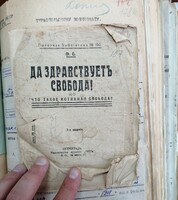 The image depicts the cover page of a booklet published in 1917 in Saint Petersburg. The booklet is entitled “Long live freedom! But what is the true freedom?” and was published at the printing house named “The seventeenth year”. The year 1917 was a turning point in Russian history, marked by a democratic revolution followed by the Bolshevik cue d'etat in October the same year. The Revolution eliminated the restrictive confessional policies imposed by the old Tsarist regime, and in 1917 the Baptists and other minority religious groups were granted unprecedented freedom to practice their religion. The Revolution was welcomed by Baptist communities, and the question of what is real freedom and how to use it had become central to their religious life. The Evangelical literature of the time compared the Revolution to a spiritual resurrection and the booklet shown here explores the idea of freedom from a religious perspective. The booklet “Long live freedom! But what is the true freedom?” was confiscated by the secret police from a group of believers in Soviet Moldavia in 1937, in a period in which Baptists were perceived by the Soviet state as a threat. The booklet was enclosed in the criminal investigation case file and served as evidence of illegal religious activity of nine arrested Baptists. The main accusation against the arrested believers was that they were Romanian spies. Four of them were sentenced to the death penalty, and five to 10 years of imprisonment. The booklet is enclosed in the file R-3401-1-3308 from the National Archive of the Republic of Moldova. The file does not contain any other confiscated materials. For related entries see:
 -
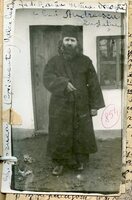 These two photographs were confiscated in 1936 by the police from an Old Calendarist monk, Gheorghe Ștefan Dorneanu, also known as father Grichentie. The first photograph shows Dorneanu dressed in monastic clothes in front of what seems to be a small house or a skete. The left and upper edges of the photograph contain a handwritten text that states: „Gh. Dorneanu (Grichentie) Valea lui Ion jud. Bacău mâna dreaptă a lui Andreescu Eustațiu,” which can be translated as „Gh. Dorneanu (Grichentie) Valea lui Ion, Bacău County, the right hand of Andreescu Eustațiu.” The second photo depicts a group of Old Calendarist believers, and we can see a small hand-drawn cross that was meant to identify Corneanu. Both the small cross and the text were most probably written by the agent that confiscated the photographs from Corneanu’s house when it was searched. In addition to these photos, the agent also confiscated letters that the monk exchanged with numerous other Old Calendarist monks that were being looked for by the police or who have already been imprisoned. One of the monks that frequently wrote to Dorneanu was Eustațiu Andreescu himself. The latter had been arrested in 1936 and sent to Iezeru Monastery from where he wrote letters to Dorneanu in order to encourage him to continue with the construction of the Old Calendarist church in Zănești, Neamț County, and to ask him for help, food, and clothes. In one of the letters, Andreescu disclosed to Dorneanu the place where he had hidden some money, that was also confiscated by the police. Gheorghe Corneanu was accused of conducting illegal church services, as well as spreading false information against the new calendar. He was arrested in 1936 and sent to Cheia Monastery, Prahova County. The Holy Synod of the Romanian Orthodox Church officially decided in October 1936 that the fate of the Old Calendarist nuns and monks was to be sent to detention at isolated sketes, where they were forced to accept the new calendar. One of the monasteries where Old Calendarist nuns were sent in order to correct their behaviour and, presumably, accept the new calendar, was Vărzărești Monastery, while the monks were sent to Cheia or Iezeru Monastery. Based on archival information such monasteries also existed in other places in the country, however, details related to those cases are either insufficient or unavailable to scholars, for the time being. These photgraphs can be found in the file CNSAS, D 015261. Apart from these photos, the file also contains police reports, lists of names, letters, and statements. For related entries see:
 -
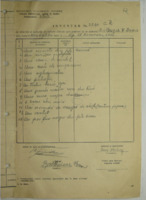 This two-sided document is a list of personal effects confiscated upon imprisonment from the Roman Catholic priest Ioan Baltheizer. This is a typical document found in all penal files. The list shows how his clerical identity, that was represented by several objects, was confiscated by the prison officers. He brought with him a prayer book and a religious services book, an Epitrachelion (stole) and prayer beads. These objects were confiscated. The reverse side of the document lists the objects that remain in possession of the prisoner, constituting several articles of clothing. This document comes from the file CNSAS, P73, volume 3. The volume contains the prison documentation for Father Ioan Baltheizer after his imprisonment in 1953.
 -
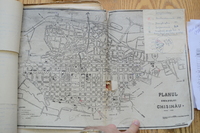 This map was attached to a report produced on 1st December 1941 by the Chișinău Bureau of the Siguranța, the Romanian State Security Police. It shows the numbers of members of four religious sects in Chișinău and the location of their places of worship, all of which are listed as being closed with the exception of one of the churches belonging to the Lipovan (Russian Old Believer) community. The report was produced following Romania’s reincorporation of Bessarabia after the Soviet occupation of June 1940-June 1941. Of the four religious communities discussed by in the state security report, two – the Baptists and the Brethren (Creștinii după Evanghelie) are reported to be a risk to state security, whilst the Molokans (a religious group that originated amongst Orthodox believers in the Russian Empire) and the Lipovans are reported to not represent a threat to the state. The report also describes the treatment that each of these sects received whilst under Soviet occupation and lists the names and addresses of members of all the communities.
 -
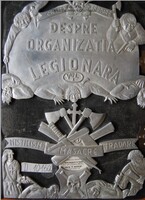 This two-volume manuscript, totalling over 800 handwritten A4 pages, can be found in the Documentary Collection of the Archives of the National Council for the Securitate Archives. It was written during the early 1960s by 105 members of the Collective of Cultural and Educational Clubs at Aiud prison. These prisoners had been charged with being associated with the fascist Legion of the Archangel Michael, also known as the Iron Guard. They wrote this book as part of their “re-education” before being released as part of a general amnesty to political prisoners in 1964. A number of memorialists later accused Valeriu Anania, the future Metropolitan of Cluj, Alba, Crişana and Maramureş, of being the primary author of much of the book, but it was clearly a collective effort and a close examination of Anania’s own secret police files suggests that he only wrote small sections of the book. Moreover, almost every page contains rich, hand drawn illustrations by different prisoners, many of whom signed their artworks. Both volumes are bound in leather and engraved with silver, making them look like medieval Bibles. The book purports to be a history of the Legion from 1919 to 1944, followed by a long epilogue describing prison life and the re-education program at Aiud between 1959 and July 1964. Unlike the stories told by legionaries during the 1930s and 1940s, however, this book is full of salacious gossip. It begins by attacking the leader of the Legion, Corneliu Zelea Codreanu (1899-1938), claiming that his ancestors were not Romanian, that his father was a hypocrite, alcoholic, a child abuser, and sexual pervert, and suggesting that Codreanu in turn had inherited these traits, and more. All of Codreanu’s promises and actions were fabricated, the book claimed: “Codreanu was not just a photogenic actor, he was a great director” who “only thought of theatrical solutions” to any given situation. Legionaries spoke frequently about having a divine mission during the 1930s, and the book’s authors did their best to undermine these claims. “Codreanu made God into an ally, dumping all responsibility for his actions on Him”, they wrote. “He became aware of a divine mission and behaved accordingly”. Attacking Ion Dumitrescu-Borşa, one of the most prominent priests involved in the movement, they wrote that “he took a mistress and worked harder to convert glasses of brandy than people who had strayed from the ways of the Church”. First in 1941 and then again during the late 1950s and early 1960s, some legionaries survived torture and the hardships of prison life by embracing ascetic prayer. Known as “the mystics” by the other prisoners, their spiritual experiences become somewhat legendary and continue to encourage people to see the Legion as a religious movement rather than as a fascist movement to this day. The book has especially harsh words for these mystics, describing their spiritual practices as “holy legionary madness” and calling them “fanatics”. Although it does reflect genuine factionalism amongst legionary prisoners, the book was first and foremost an attempt to force the prisoners to slander those things that they considered most sacred. By accusing themselves of hypocrisy and perversity, the logic went, they could prove that they no longer harboured attachments to fascism and were ready to reintegrate into socialist society. Related entry:
 -
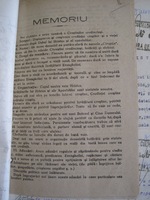 This "Declaration" (Memoriu), also known as "The Short Statement on the Doctrine of the Brethren" appears in a Ministry of Religions and Arts file from 1925. In Romanian the Brethren are called Creștini după Evanghelie, or Christians of the Gospels. It was composed between 1924 and 1925 by The Brethren community which, up to that point was not recognized as a legal religious association in Romania. Following the adoption of the new Constitution in 1923, which provided for more freedom of faith than the previous Romanian Constitutions, religious communities required to submit such Statements in order to gain recognition. At the time when the Declaration was written, the Brethren had a few small churches București, Ploiești, Iași, Sibiu, Brașov, Dolj, and Teleorman counties. The present Statment was sent to the Ministry of Religions and Arts in January 1925, for the second time, by the community from the city of Ploiești in an attempt to remind the authorities that such a document exists and that they are allowed to function legally, according to the laws in force. The letter that accompanies the Statement highlights the fact that the church in Ploiești had been active since before the First World War, when they were regularly visited by the Romanian authorities of the time, and found to be of no danger for the state. This booklet appears in ANIC – fond. Ministerul Cultelor și Artelor 172/1925 amongst diverse documents relating to a range of so-called sects and especially the problem of their presence within the military. Also included is in this file is a similar declaration of faith entitled Short statement on the principles of the Churches of God (Pentecostals) submitted to the Romanian authorities as part of their requests for official recognition. For further reading see: Dorin Dobrincu, Dănuț Mănăstireanu, Omul evanghelic. O explorare a comunităților protestante românești, Polirom, 2018. For related entries see:
 -
 These images come from a documentary file on Hungarian underground Catholic youth movements. They show the photocopies of the rules and regulations (1st image) and the vow (2nd) of a female Catholic group – designated an “illegal clerical-fascist youth organisation” by the secret police. The group was lead by Gabriella Fekete, a former catechism teacher and KLOSZ (National Confederation of Catholic Girls) member who became involved with underground Catholic movements after 1948, when church run schools were taken over by the state. Those who took the oath vowed to profess poverty, to resist the desires of the flesh, and to dedicate all their energy and material means to bring the youth closer to God. According to the rules and regulations this meant that they had to refrain from buying expensive food or clothing, could only spend money on entertainment if „it was important for artistic, scientific or educational purposes” and each group was supposed to support a poor family with many children. They were allowed to rest only as much as they needed to stay healthy and to have enough energy to carry out their mission. The rules and regulations also specified how they had to practice their religion: they were supposed to take the sacrament at least weekly, to make confession to their spiritual father every two weeks, meditate and pray the rosary daily, search their souls twice a day, and practice self-denial every day and offer their sacrifice for the sake of the Hungarian youth. To stay under the radar, they were forbidden to wear specific garments or symbols that would distinguish them from other people. The regulations stressed that their primary purpose in life was to bring young people to the Christian faith – everything else such as earning a living had to come second. According to a tapped conversation between Fekete and agent “Kőrösi”, a Catholic priest whom she hoped to win as the next spiritual father for her group, the idea of the vow and the regulations emerged in the Budapest group lead by her, after the leading figures of the movement were arrested by the secret police in 1952. With the vow and the regulation they wanted to acknowledge and emphasise that participation in the group was more than just a pass time, it was a vocation for life. However, taking the vow was optional even in the core group lead by Fekete, and those who had taken it had to renew it every year on 15th August. As part of the organisation’s protective policy, group members were only allowed to learn about its existence if they had been leaders of a local group for at least one year. The organisation focused on children of both sexes from kindergarten to secondary school, and in Budapest it even had a group for mothers and one for fathers. It was a network of loosely connected local units having 4-5 students in Budapest and some other cities such as Győr, Veszprém or Miskolc. All group leaders were supposed to gather once a year, while heads of local group in Budapest met on a monthly basis. Members of the core group who all had their own group saw each other even more frequently: they gathered together every Wednesday to discuss their work and to listen to lectures on apologetics given by their spiritual leader. There’s no information in the file as to how the secret police got hold of the vow and the rules and regulations, but most probably it was through agent “Kőrösi”. These images are from file ÁBTL 3.1.5 O-11959/4a. Apart from these documents the file includes confiscated personal letters, informer’s reports, reports on shadowings, transcriptions of tapped conversations, and summary reports on the case. For related entries see:
 -
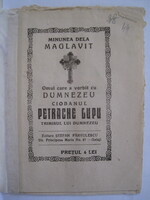 These booklets appear in a Romanian General Directorate of Police file from September 1935, having been confiscated almost immediately after they were published. By this time hundreds of thousands of pilgrims had begun to descend on the small village of Maglavit, causing the authorities to take an interest in published reports about what was happening there. A shepherd from the small village of Maglavit near the Bulgarian border, Lupu described several visions he had had of God while he was watching his sheep in May and June that year. Despite apparently having a speech defect – some sources say he was almost mute – he began calling people to repent, telling his listeners to not to raise their hands against the weak, not to steal, and not to deceive. His village quickly became a pilgrimage site attracting so many people that, according to this author, there was not even a tiny corner where one could stay. Doctors and government officials worried about the public health risks posed by large numbers of peasants – many of them sick and infirm – gathering in one place with insufficient food, water, and shelter. Conflicts also arose between skeptics and believers, but according to the sources these were usually resolved through supernatural judgement of the skeptics, not through person-to-person violence. Fascists attempted to make use of the phenomenon for political means, and Lupu began preaching an anti-government message against the Romanian Communist Party in the late 1940s, but during the 1930s the overwhelming concern of the police seems to have been with the potential for profiteering. Rumours abounded about deceitful individuals collecting money to send to Maglavit that they actually kept for themselves. The commercial aspect of these booklets is apparent from the fact that it was published at a commercial press in the town of Galaţi rather than at a church publishing house or somewhere close to Maglavit. The author’s name is missing, although most of the first booklet reproduces the text from Vasile Popa’s (see link to related entry below) The Miracle of Maglavit almost word for word, making one wonder whether Popa knew that his work was being reprinted or received any money from it. Unlike many of the religious tracts about Petrache Lupu, this one contains no strong polemic against atheists or Protestants, and focuses instead on providing a clear, simple, and slightly sensational account of what was said to have happened to Lupu. The sensationalism increases dramatically in the second booklet, and in the last part of the first booklet when it departs from Popa’s original text. The additional material focuses on Lupu’s misfortune of losing his father at a young age, on his speech problems and his crushing poverty, before providing dramatic accounts of his healing a paralised woman, converting a man who abused his animals into an animal lover, and confronting a priest who had doubted him in private. It ends with a call from Petrache Lupu’s bishop, Vartolomeu Stănescu, acknowledging the veractiy of the miracles and encouraging people to donate money and to undertake a pilgrimage themselves. Related entries:
 -
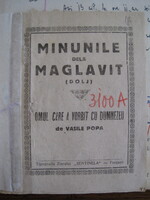 This booklet, which was published in 1935, appears in a file from the General Directorate of Police from the same year. It concerns a shepherd by the name of Petrache Lupu (1907-1994) who reported having seen an “old man” (moşu) on 31 May 1935, who commanded him to “tell people you meet, people off the streets” to repent and worship God. Lupu’s supernatural visions and the accompanying miracles soon turned his village, known as Maglavit, into Romania’s largest pilgrimage site and the shepherd became a national celebrity. This 15-page booklet testifies to the nationwide interest and commercial potential that “the phenomenon of Maglavit” generated in 1935 and its insertion into a police file on the events also points towards the significance that the authorities placed on this kind of unofficial religious literature generated in interwar Romania. Written and published less than two months after Lupu’s first vision, it was printed at a commercial press in Focşani – a town on the other side of the country – as part of an order by Costache Blaga from the village of Parava, in Putna County. Blaga ordered 1,000 copies, which he intended to sell at the monthly market in Bârlad, a town over 500 kilometers away from the site of Lupu’s visions. The booklet is one of scores that were produced and sold in markets and churches across the country to believers, skeptics, and potential pilgrims. The author, Vasile Popa, began his booklet by emphasizing Lupu’s saintliness through stories about him returning a large sum of money he had found on the road and about how he never beat his wife. Popa then provided a brief account of Lupu’s first three visions, followed by the shepherd’s decision to tell others what he had seen and heard. Lupu’s message was apparently believed almost immediately, and Popa finished by recounting the crowds of people who were already flocking to Maglavit by mid-August. There were so many, Popa wrote, that one group of 150 pilgrims from Timişoara left disappointed that they had been unable to even lay eyes on Lupu because of the crowds. Unlike many writers, Popa did not recount specific miracles or healings that Lupu performed other than that he had seen God and had predicted that it would rain in two days time. Instead, he closed with the words of Jesus in Luke 11:28: “Blessed rather are those who hear the word of God and obey it!” Related entries:
 -
 This map showing the “Zones of activity and distribution of illegal sects in Cernăuți county”, which is preserved in a 1941 folder of the Romanian General Inspectorate of the Genndarmerie, actually dates from 1st July 1942 (the date appears in the bottom left corner of the map in very small writing). It was created following the reincorporation of the province of Bucovina, of which Cernăuți county was a part, into Greater Romania following the Axis invasion of the Soviet Union in June 1941. The map shows the distribution of five banned religious communities, Nazarenes, Reformed Adventists, Lipovans (Old Believers), Pentecostals and Stilists (Old Calendarists). Under Marshall Antonescu, Romania’s wartime dictator, Romania pursued an extremely harsh anti-sectarian policy that effectively banned most religious associations and sects. The Antonescu regime, considered religious sects as especially dangerous as they undermined the unity of the ethnic Romanian population, which according to state ideology should be exclusively Orthodox. Some groups such as the Nazarenes, Adventists, Jehovah’s Witnesses and Inochentists also refused military service, which was considered a threat to the Romanian war effort. The mapping of religious communities was a necessary step in order to facilitate the systematic appropriation by the state of their property, and the arrest and imprisonment of leaders. This map comes from Archivele Naționale Istorice Centrale ANIC – fond. Inspectoratul General al Jandarmeriei (Romania), dosar. 160/1941
 -
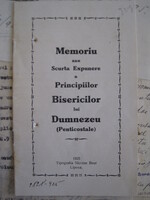 This booklet, which was published in 1925, appears in a Ministry of Religions and Arts file dated the same year. This booklet was the second official declaration of Pentecostal faith submitted to the Romanian authorities as part of their requests for official recognition. The first appeal by a Pentecostal believer came in 1924 but this was rejected by the Ministry of Religions in Decision no. 5734 of the 29th January 1925. The Ministry declared that the ‘Declaration of True Foundation’ (Declararea [sic] fundamentului adevărat) did not offer sufficient guarantees to meet the conditions of article 22 of the Constitution. A new declaration in the form of this booklet entitled 'Short statement on the principles of the Churches of God (Pentecostals)’ was attached to the second request for official recognition. This was also rejected with Decision no. 24536 of 1928 in which it was reaffirmed that Pentecostal communities remained on the banned list. This booklet appears in ANIC – fond. Ministerul Cultelor și Artelor 172/1925 amongst diverse documents relating to a range of so-called sects and especially the problem of their presence within the military. Also included is in this file is a similar declaration of faith simply entitled Declaration (Memoriu) submitted to the Ministry of Religions and Arts in January 1925 by representatives of The Brethren (known as Creștin după Evanghelie, Christians of the Gospels in Romanian) from the city of Ploiești as part of an appeal for recognition of their community. For further reading see: Ciprian Bălăban, Istoria Bisericii Penticostale din România (1922-1989) - instituție și harisme. Oradea: Editura Scriptum, 2016. For related entries see:
 -
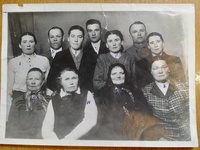 This photograph was enclosed in a KGB surveillance file from 1952-1955 on Jehovah’s Witnesses in the Rivno region, western Ukraine. The image pictures a group of Jehovah’s Witnesses from the Rivno region. It was enclosed in an envelope along with 6 other confiscated or intercepted photographs. Each depicted person was marked with a number and on the reverse side a secret police officer wrote their names, date of birth, information on their origin and place of residence, as well as their role within the Jehovah’s Witness organization, such as: “ordinary member of the underground,” “active Jehovist,” preacher, group elder, or “courier of the Jehovist underground”. Nearly all of them were marked as objects of surveillance as part of the agent operation “Zavet”. Another envelope enclosed copies of intercepted Jehovah’s Witness literature: several booklets and 12 issues of the Watchtower journal. As evidenced from one of the documents, it was an informer under a codename Poliakov (a Jehovah’s Witness recruited by the KGB) who passed the literature to the secret police. From his report we learn that he met a Witness courier named Varvara Senkevich (marked 5 in the photograph) and several other believers in Rivno. Senkevich gave this literature to a believer not knowing that he was a KGB informer. She asked him to distribute the Watchtower journals among brothers and sisters. The agent meeting with Senkevich and her co-believers in Rivno was part of a secret operation “Zavet”, the aim of which was to recruit Witnesses as agents and informers in order to intercept detailed information on the organization’s leadership in western Ukraine, disclose underground printing presses in the region and believers’ communication channels with exiled or imprisoned Jehovah’s Witnesses, as well with those living in other regions or abroad. Senkevich herself was also a potential target for recruitment by the KGB because her role as a Jehovah’s Witness courier could reveal sensitive information on clandestine communication channels within the organization. In the 1950s, the Ukrainian secret police launched several secret operations that targeted Jehovah’s Witness leadership and aimed to disclose Witness clandestine groups and their system of communication. The agent network was believed to be the main weapon in the fight against the religious dissent. There were about 200 agents and informers working in the Witness underground in the mid-1950s in western Ukraine. Most of them were recruited from within the Witness organization, many had tragic experiences with their close families imprisoned or exiled. Some of them had been and would be (after their service with the security police) arrested and tried. All of them were recruited by straightforward blackmail. However, as some historical accounts reveal, Witnesses were aware of agent infiltration and KGB surveillance and knew names of many agents and informers. They were also aware of some secret operations carried out against them. While being shadowed by the secret police, they shadowed KGB officers too. Counter-infiltration was another pattern of their everyday resistance. Some believers intentionally entered the informers’ network or were chosen to become collaborators by their own congregations. Appointed agents delivered partial or less sensitive information in exchange for getting to know KGB plans and operations. Other believers wrote fake denunciations to mislead the secret police. The photograph comes from the SBU archives, fond 2, sprava 2592. The file contains materials on several agent operations amongst Jehovah’s Witnesses in the Rivno region, information on agent recruitment, compromising evidence that could be used as blackmail during recruitment, surveillance reports, and correspondence between KGB branches. For related entries see: