
Religious network schemes
Item set
- Title
- Religious network schemes
- Description
-
The religious network scheme was a visual tool developed by the secret police to envision underground religious communities as centralized and hierarchical organizations. The schemes depict the network of insurgent religious and political organizations from bottom to top and include complex sets of social links and hierarchical relations as perceived by the secret police. Local religious groups are routinely represented as interconnected and subordinated ‘cells’ of highly organized vertical networks. All groups were made to fit the same organizational logic whether this reflected reality or not.
At the same time, the schemes were also used to show the results in progress of secret police operations against the targeted groups. The schemes sometimes indicate which individuals had been arrested within the network and the number of arrested believers in the repressed group as well as showing which groups and individuals remained free or under surveillance.
The network schemes were either printed using photo-printing technology or were hand-drawn. They were attached to secret reports or exemplary criminal files, where they served as secret police manuals of best practice. - Creator
- Tatiana Vagramenko
- Publisher
- This project has received funding from the European Research Council (ERC) under the European Union’s Horizon 2020 research and innovation programme No . 677355
- Bibliographic Citation
- http://hiddengalleries.eu/digitalarchive/s/en/item-set/290
- Date Created
- 2018
Items
-
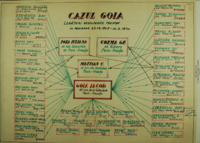 The image represents a funding scheme of the Greek Catholic underground from abroad drawn up by the secret police officer. The scheme links Fr. Iacob Goia, a Dominican monk who emigrated from Romania in 1946 and lived in Paris with the persons he was financing in the Greek Catholic underground. The scheme is detailed providing the members of the diaspora sending money and objects into Romania with their addresses but also the names and addresses of the recipients of the funds. A note tells the reader that these connections were revealed to the secret police gradually between August 1969 and February 1970. In documents describing the network, the officers caution that the correspondence that is intercepted should not lead to interrogation in order to give the officer sufficient time to uncover the entire network. Ample descriptions were offered of the ingenious ways in which the financial help reached the Greek Catholic underground (various goods were sent to Romania (even mystery novels) to be sold and money used to finance religious services of underground clergy). The image comes from file CNSAS D69 (volume 69). The file has over 100 volumes on the Catholic problem in Romania and documents and photographs on financing the Catholic underground appear throughout the file. Along with this image there are interrogation reports, correspondence, surveillance reports. For related items see:
 -
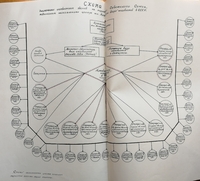 This network scheme of the Jehovah’s Witness organization comes from a four-volume top-secret file titled LKB, Legendirovannoe Kraevoe Biuro (Regional Bureau Covert Operation). It was produced by the Ukrainian secret police in 1953 and shows Jehovah’s Witness districts and circuits located in the Soviet Union with the organization’s country committee (called by that time the Regional Bureau) as the governing body of Soviet Jehovah’s Witnesses. The scheme shows the connections of Soviet-based groups of believers with the Jehovah’s Witness organization abroad: the East-European Bureau in Poland, the Romanian branch, the European centre in Switzerland and the Jehovah’s Witness headquarters in the USA on top of the network scheme. The secret operation (Regional Bureau Covert Operation) was launched by the Ukrainian MGB office in 1951, the same year the state organized a large-scale deportation of Witnesses from the western borderlands. It was suspended in 1954, soon after Stalin’s death. The operation aimed at infiltrating the Jehovah’s Witness underground organization in Ukraine (and later the entire Soviet Union) and to organize a Witness country committee as a covert operation. The plan was designed such that the Soviet security service became the head of the Jehovah’s Witnesses organization, and the headquarters of the official Watch Tower Bible and Tract Society (hereafter the Watch Tower Society), located in Brooklyn, became a channel in their counter-intelligence operations against the US. The scheme comes from the SBU Archives, fond 2, sprava 2432. The file also contains correspondence between the MGB office in Kiev and regional offices in western Ukraine, agent reports, surveillance reports, information on the structure of the Jehovah’s Witness organization in Ukraine, intercepted letters and samizdat publications. More about the secret operation and agent infiltration of Jehovah’s Witnesses in Soviet Ukraine see: Tatiana Vagramenko, KGB “Evangelism”: Agents and Jehovah’s Witnesses in Soviet Ukraine. Kritika: Explorations in Russian and Eurasian History, (forthcoming 2021) For related entries see:
 -
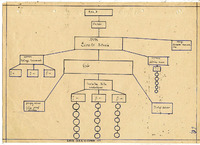 This network scheme is from a file on a Hungarian Catholic underground movement. Hand drawn and sketchy, it is a less sophisticated version of its more elaborate and detailed – and sometimes almost artistically executed – Soviet and Romanian counterparts. The purpose of network schemes was to map the connections of groups or individuals; in this case it shows the people István Divald, a young Piarist monk recruited to the Catholic underground movement lead by György Bulányi. Amongst the recruits we find a canon, three parish priests and a catechism teacher from three settlements in north-western Hungary, Győr, Sopron and Csorna. According to the scheme, two of the recruits headed three subgroups, while one of them lead only one. Since the scheme comes without any notations, it is unclear what the little circles below some of the groups stand for, but most probably they indicate the number of members in each group. The scheme also shows that Divald communicated with the Budapest centre of the movement via “couriers” who, according to various reports in the file were mostly university students. We don’t know the exact date of the network scheme but it should have been drawn sometime in 1951 or early 1952. István Divald joined the underground Catholic movement in 1949 or – according to some sources – 1950. After his monastery was closed in 1950 he worked as a chaplain in Kóny, a village near the county capital Győr, and this is where he started to organise the underground cells shown in the network scheme. According to reports in the file Divald regularly visited and lead the cells he helped organise, and was especially successful in engaging young people: he frequented pubs, played cards and bowls and organised the local volleyball team. Authorities deemed the whole movement extremely dangerous and alleged that it “did not only try to ideologically influence its members but prepared them for terrorist activity and diversive action.” Divald was dispelled from the diocese in 1951 and from 1952 – the year the movement’s leaders were arrested – had various non-ecclesiastical jobs. His relationship with the secret police took a turn sometime in 1954 when he was officially roped in as agent “Dusek”. From then on he regularly reported on the resurgent cells of various Catholic underground movements such as Catholic women’s groups and scouts groups with which he was also actively involved as an occasional lecturer. In the summer of 1956, before the planned arrest of the second generation of underground Catholic group leaders, Divald emigrated with the help of the secret police first to Austria and in 1957 to the USA. Between 1962 and 1965 he reprised his role as an active agent under the cover name “Broger”. The network scheme is included in file ÁBTL 3.1.5 O-11959, which also contains summary reports, confessions under interrogation, reports on shadowing and informer’s reports.
 -
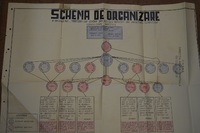 This network scheme comes from a documentary file on Jehovah’s Witnesses in the former administrative region of Cluj. Titled as “Organisation Scheme of the organisation “Jehovah’s Witnesses” in Cluj Region, it shows the structure of the group with names, ranks and connections of each of the functionaries (indicated by circles). The blue box at the top stands for the national leaders, while the rectangular boxes at the bottom represent the six territorial units in the region with the number of their subunits and members. The scheme also informs the viewer of the progress the authorities had made in their measures against the group: arrested “elements” are indicated with red, while those still free are coloured with blue. The scheme is an attachment to an interim report written in 1955 and visualises the results of an ongoing "informative–operative" operation conducted by the Securitate’s Cluj regional directorate. The operation started in 1953, two years after the leadership of Jehovah’s Witnesses in Cluj region (35 people) were arrested and convicted. The aim of the operation was to identify the new leaders and functionaries of the reorganised regional units, to map their connections within and beyond the regional structure, and to gather information about their activities and whereabouts. To further this goal, the Securitate employed several informants to work on the group and relied on information gathered during interrogations of members arrested during the operation (in 1951 or after 1953). As the scheme aims to show, Jehovah’s Witnesses as an organisation had a hierarchical structure. The basic units were the local congregation, each having its leader called servant (this emic term was used for all leaders, and as the scheme shows, it was also adopted by the Securitate). On a territorial basis congregations formed circuits (there were 6 of them in the Cluj region with altogether 146 congregations) with circuit servants responsible for coordinating the work of congregations, supplying them with religious materials and acting as mediators between them and the regional servant. The regional servant in turn was responsible for coordinating the work of circuit leaders: he collected reports, money or other types of donations, distributed teaching materials and mediated between the circuits and the national leaders. His work was helped by evangelisers called pioneers who took an active part in proselytising and organising new congregations; they were mainly young, unmarried and devoted men already living illegally for having refused military service. Communication between the levels was carried out with the help of couriers who transported messages, reports, reading materials and donations. Interaction within the group was highly secretive: most servants and pioneers used cover names even with other group members, all reports were coded and couriers met with the leaders in crowded public places and used prearranged signs to get in touch with one another. Authorities found the highly organised structure of the group and the discretion with which they carried out their interactions suspicious and considered this evidence of the group’s conspiratorial nature. Before 1990, apart from two short periods between 1933–1937 and 1945–1949, Jehovah’s Witnesses did not enjoy a legal status in Romania. They suffered intense persecution at the hands of inter-war democratic governments and the wartime and post-war totalitarian regimes. The main reasons given by the authorities for their harassment were their proselytising activity, the lack of transparency in their organisation, their refusal to perform military service or to participate in elections and other civic duties, their ties to their American headquarters, and their heralding of the end of the regime and the onset of a theocratic kingdom. Throughout the communist period, Jehovah’s Witnesses were closely surveilled by the Securitate with many being imprisoned or sent to labour camps. In spite of the repressive environment, however, their number grew from 15000 in 1949 to 35000 in 1990. These images come from file CNSAS D 014428. Beside the network scheme it contains a 17-page report and several crime scene or evidence photographs of various hidden materials (a typewriter, a loudspeaker fake IDs, religious brochures, coded reports). For further readings on Jehovah’s Witnesses and the Romanian state see: Pintilescu, Corneliu – Fătu-Tutoveanu, Andrada, 2011, Jehova’s Witnesses in Post-communist Romania: the Relationship Between the Religious Minority and the State (1989-2010). Journal for the Study of Religions and Ideologies, vol. 10, issue 30 (Winter): 102–126. For related entries see:
 -
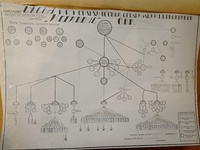 These two images come from two exemplary closing indictments against the so-called "ecclesiastic-monarchist, counter-revolutionary organisation", the True Orthodox Church. They were published as top secret brochures by the Soviet secret police (OGPU) in 1931. Network schemes were carefully and precisely designed and printed using very advanced photo-printing technology for the time. Through complex sets of social links, the schemes represent religious communities as centralised insurgent political organisations. At the very bottom are “local (rural) cells” (sel’skie iacheiki) – basic religious groups located in farms, villages and settlements. A dot (triangle, circle, or rectangle) shows the number of arrested people in a repressed community. A shaded sign signifies a “not liquidated” group that was still under surveillance. The network scheme from the Samara OGPU (image 1) pictures a network of the counter-revolutionary organisation in the Middle Volga region and its complex links of relations between cells and centres. Miniature images of churches indicate “basic cells” (nizovye iacheiki) centred around some churches that remained open. Basic cells are grouped and linked to form regional sets of cells. Circles twice crossed refer to local leaders – a kulak, a priest (pop), a monk, a bishop, or simply indicate surnames with no details. Regional sets of cells are linked to a senior centre of the “counter-revolutionary organisation” in Kashirin region. This link is not direct, but is established through groups of couriers (sviaznoi), schematically pictured as shadowed circles. Through a similar group of couriers, the regional centre is connected eventually to the top – two all-union centres of the counter-revolutionary organisation the “True Orthodox Church” with its political centre in Moscow and administrative centre in Leningrad. Image two shows an all-encompassing representation of the religious network. The scheme is signed by Evgenii Tuchkov, the head of the so-called “Church department” of the OGPU and one of the leaders of the 1920s-1930s anti-religious campaigns who headed security police operations against the ROC and the ecclesiastical underground. The scheme “reveals” the hidden connections of branches and cells in the entire country (Central, Caucasian, Black sea, Central Black Earth, Volga regions, Ukraine etc.). Shadowed circles refer to those cells and branches that had supposedly developed significant insurgent activities. The scheme gives two types of social connection: a direct link between the cells (full lines) and an indirect link (kosvennaia sviaz’, dotted lines). It is unclear what an indirect link means here but it allows for every group, branch and cell in the entire Soviet Union to be interconnected and at the same time subordinates them altogether to regional and superior centres. Two hexagons – two all-union centres in Moscow and Leningrad – crown the scheme. In this way, an ideal and comprehensive image of the insurgent, espionage, terrorist, counter-revolutionary, conspiracy organisation could be fully realised. It is pictured as a vertical network, which is built not as a web but as a vertical hierarchical scheme where all links and dots come to a centre. The documents come from the State Archive Branch of the Security Services of Ukraine, fond 13, sprava 386, 387 (Kiev, Ukraine). Apart from visual materials, the internal publications contain a list of accused persons with information on their social origins, the insurgent political platform and the structural composition of the organisation as perceived by the secret police. Numerous quotations from interrogations of arrestees and witnesses were supposed to prove the point. For related entries see:
 -
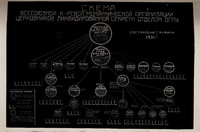 This scheme of a religious network was produced as part of a review of criminal cases against believers of the True Orthodox Church. It was published in 1931 as a top-secret document by the Soviet secret police (OGPU) in Moscow. This image has been given the title "Scheme of the All-Union Counter-Revolutionary Monarchist Organisation of Churchmen (the 'True Orthodox Church'), liquidated by the Secret Political Department OGPU". Schemes such as this one were designed to represent the religious movement as an organised hierarchical structure, where the "ecclesiastical political centre" in Moscow and the "ecclesiastical administrative centre" in Leningrad were connected to religious groups in other towns in Russia, the Caucasus region and Ukraine. These top-secret internal publications were circulated among other branches of the OGPU, including the one in Kiev, as exemplary collective penal cases – a sort of textbook for the OGPU’s struggle against the so-called “ecclesiastical-monarchist underground”. Clichéd citations from the interrogations and false confessions of arrested believers intended to reveal the political conspiracy disguised behind religious practices. It was a typical strategy to translate religious dissent in terms of political insurgency. The main charges against the believers were anti-Soviet agitation and propaganda and counter-revolutionary activities, including inciting the peasants to revolt against collectivisation. The Russian True Orthodox Church, also known as the Catacomb Church, was formed in the early years of the Soviet Union as a reaction against the collaboration of the Russian Orthodox Church hierarchy with the Bolsheviks. After Metropolitan Sergii issued a declaration of loyalty to the Soviet regime in 1927, many Orthodox communities ceased to communicate with the Moscow Patriarchate, renounced the Soviet power and continued their religious life underground. True Orthodox believers were severely persecuted throughout the entire Soviet period. In 1930-1933, the Stalin’s secret police (OGPU) launched the all-Union “liquidation campaign” against the growing Orthodox dissent movements, which they collectively referred to as the “ecclesiastical-monarchist underground”. The True Orthodox Church was the main target. The wave of repression particularly affected religious communities in southern Russian provinces and in Ukraine, where popular religious dissent was notably influential among the peasantry. Hundreds of priests, monks and ordinary believers were repressed as a result of the campaign. This document comes from the State Archive Branch of the Security Services of Ukraine, fond 13, spr. 385 (Kiev, Ukraine). Two internal publications in this archive fond also provide the OGPU's description of the so-called "ecclesiastical-political centre": its origins, political platform, leadership and its supposed "counter-revolutionary, anti-kolkhozes and insurgent activity". The description of religious criminal evidence are corroborated by standardised and formulaic statements of arrested individuals and witnesses. For related entries see:
 -
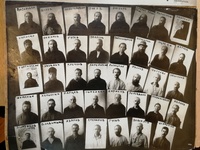 This photo-collage and scheme of a religious network were produced as part of an exemplary collective penal case against members of the catacomb True-Orthodox Church. The photo-collage shows a group of believers put on trial - thirty eight True Orthodox believers headed by Alexii Bui, bishop of the Voronezh diocese (top row, fourth from the left). The network scheme represents the movement as a centralised organisation, uniting religious centres in Leningrad and Moscow with numerous "cells" (as the OGPU called them) in southern regions of Russia (Voronezh, Belgorod, Kursk, etc). It shows repressed communities and those under surveillance, the number of arrested individuals and the names of local leaders. The indictment was published in 1931 as a top-secret document by the Soviet secret police (OGPU) in Voronezh, Russia. The document was then sent to the Ukrainian OGPU, because numerous communities belonging to the religious network were located in Ukraine. This secret publication was supposed to be a sort of textbook in the OGPU’s campaign against the Buevtsy (as the secret police referred to the followers of Alexii Bui). The exemplary indictment provided a structure, linguistic formulas and incriminating political crimes used against believers that could utilised for further repression of the True Orthodox Church in Ukraine. Bishop Alexii (whose birth name was Semion Bui) was one of the leaders of the Russian True Orthodox Church. He united under his leadership communities of True Orthodox Christians in about forty districts in southern provinces of Russia and in Ukraine. Alexii Bui was arrested in 1929 as the leader of the “counter-revolutionary ecclesiastical-monarchist organisation” (as the Soviet secret police referred to dissenting Orthodox communities). After several trials he was sentenced to ten years in labour camps and eventually was shot dead by the NKVD in Sandarmokh, Karelia on 3rd November, 1937. The documents come from the State Archive Branch of the Security Services of Ukraine, fond 13, spr. 390. The file also contains a full list of the convicted persons, the historical outline and the social structure of the True Orthodox Church as perceived by the secret police, and evidence of its politically subversive, counter-revolutionary activities, based on majorly distorted and formulaic statements of arrested individuals and witnesses. For related entries see:
 -
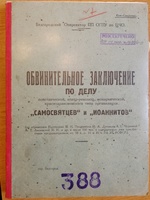 The images are a photo-collage and scheme of a “liquidated” religious network produced as part of a closing indictment in a collective penal case against one hundred believers, followers of underground popular Orthodox movements, referred to as the Samosviatsy and the Ioannits. The group on trial were monks and nuns from closed Orthodox monasteries and ordinary believers from the Ukrainian and Russian countryside. They rejected both Soviet power and the Russian Orthodox Church authority as they believed the Orthodox Church was compromised by collaboration with the Bolsheviks. The network, which was referred to as the Samosviatsy (deriving from the term for "self-consecration"), also included some followers of the Russian Orthodox archpriest Ioann of Kronstadt, referred to as the Ioannits. One of the arrested was a popular charismatic leader, Andrei the Ill (Bolaschii), a prophet and a holy fool (yurodivyi), active in southern Russia and Ukraine. The network scheme and photo-collage show how the Soviet secret police represented dispersed communities of peasant believers and monks from different Ukrainian and Russian towns and countryside. The visual representations portray the community as a hierarchical secret organisation, showing the interconnections and relationships between members. Representing religious groups in this way was part of the typical strategy of politicisation of dissenting religious groups, in order to validate repressive action. The indictment was published in 1930 as a top-secret document by the Soviet secret police (OGPU) in Belgorod, Russia. The document was then circulated among other branches of the OGPU, including the one in Kiev, as an exemplary collective penal case – a sort of a manual of the OGPU’s struggle against the so-called “ecclesiastical-monarchist underground”. On the cover of the file, the Samosviatsy and the Ioannits are defined as "insurgent, counter-revolutionary, monarchical red-dragon-type organisation". As well as the network scheme, it contains material with long citations, in largely formulaic secret police language, taken from interrogations of arrested individuals and witnesses. These were intended to reveal political conspiracies disguised as religious practices. The main charges against the believers were of anti-Soviet propaganda and counter-revolutionary activities, including inciting the peasants to revolt against collectivization. After the Bolshevik Revolution in 1917, political repression turned against the Russian Orthodox Church. The majority of monasteries and churches were closed down and many former priests, nuns and monks continued their religious practises underground, in private houses and apartments, wandering from village to village. The perceived political corruption of the Church, the repression of the Church hierarchy and mass closure of churches and monasteries triggered the development of popular forms of Orthodox dissent. These movements had an apocalyptic vision of a radically changing world. Numerous prophets, holy fools (yurodivye) and former monks and nuns preached the arrival of the Apocalyptic Red Dragon personified by the Communists, hence the name "red-dragon-type organisation". Soviet power was seen as the power of the Antichrist or Satan. In 1930-1933, Stalin’s secret police (OGPU) launched the all-Union “liquidation campaign” against the growing Orthodox dissent movements, which they collectively referred to as the “ecclesiastical-monarchist underground”. Among the repressed groups were numerous communities of the catacomb True Orthodox Church, the Samosviatsy, Ioannits, and many other ordinary believers. The documents come from the State Archive Branch of the Security Services of Ukraine, fond 13, spr. 388, SBU Archive (Kiev, Ukraine). The file also contains a full list of the people put on trial, the historical outline and the social structure of the movement as perceived by the secret police, and evidence of its insurgent, counter-revolutionary activities, based on majorly distorted and formulaic statements of arrested individuals and witnesses. For related entries see: