Items
-
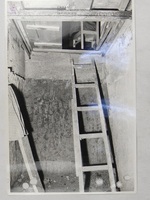 The 4 images are taken from a secret police personal file and were used as evidence of an Old Calendarist underground monastery in Bucharest. The community was led by the Old Calendarist bishop Evloghie Oța. According to the communist state legal framework, the Old Calendarist Orthodox Church was an illegal entity. These pictures documented a sweep operation of the secret police that ended in the destruction of the underground church and the arrest of the bishop. We cannot date the pictures precisely because the community kept rebuilding the underground chapel and the secret police destroyed it each time from 1965 until 1983. The community dated from 1964 when their bishop was released from prison and was held together under his charismatic leadership. During the 26 years of the community existence under communism their number increased gradually. They had several brothers in the monastery and a parish that consisted of regular church goers and people that came from time to time from various places across Romania. The bishop visited and maintained a correspondence with the geographically distant members of his flock. This form of parish is typical for an Old Calendarist community in the communist period but not typical for a regular Romanian Orthodox Church parish. For this reason the numbers of believers cannot be accurately assessed. The file contains several other pictures (14 in total) and two maps of the house and the underground chapel. The pictures follow standard crime scene photographic principles, illustrating the exterior, means of entry to the underground chapel as well as the main incriminating evidence and close up details of particular elements that elucidate the crime. They also show the methods by which the building was transformed from a house into an illegal underground chapel including photos linking the bishop and parishioners to the site. The pictures selected here, illustrate common tropes of illegal religious activity: the route of entry via a ladder to the underground chapel; the ritual space; and the means by which the community financed itself. The third picture reveals the altar table and icons surrounding it together with religious service books, candles and items of from episcopal paraphernalia. Note particularly the crosier and the mitre, both elements that indicate the rank of the officiant that is not present in the picture. The forth picture in this entry shows the money next to several diptychs (several lists of names for whom religious service has to be held are observable in the picture). A stole and a censer can also be seen in this picture, religious objects and garments effectively linking the money to the religious service provided. Although the secret police implied that the community was hiding underground the Old Calendarist subterranean religious spaces and/ or underground chapels were not necessarily used for hiding in. There is an Orthodox Christian monastic tradition of locating sites of worship in cave and subterranean spaces. For related entries see:
-
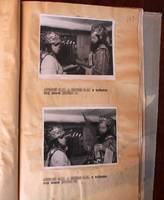
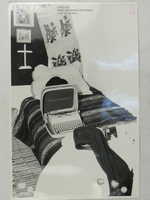 The two photographs are part of an evidence file of an underground Old Calendarist community. They are successive images of a typewriter and the typewriter with its owner taken by the Securitate for an evidence file constructed against the underground group. The first photograph has the typewriter placed near a Kalimavkion (monastic head gear in the Orthodox Church) which visually links the object with the owner. They are placed in the dormitory on the bed and what appears to be some literature is visible next to the typewriter. The second picture presents the owner of the typewriter with the open typewriter. The room is more visible in this image and on the bed several leaflets and books are spread to reinforce the link between the person, the typewriter and the use to which it was put. The person, identified in the file as Evloghie Oța was dressed in a cassock and has a bandage on his left hand which may indicate he may have been subject to physical violence at an earlier stage. It was common practice for the secret police to bring suspects back to the (crime) scene in order to produce stage photographs as incriminating evidence. In interviews with Old Calendarist Orthodox monks that knew bishop Evloghie it appears that his hand was broken at the time and this was not an outcome of his imprisonment. Evloghie Oța is described in the secret police file as a Stilist Bishop. The typewriter along with other equipment used to disseminate information and proselytize (i.e. tape recorder, magnetophone, video recorder, video player) was among the clearest evidence to demonstrate illegal creation, production and reproduction of materials. These types of images are recurrent in evidence files. The Romanian legislation during the communist period incorporated rules for typewriter ownership. Every typewriter was registered with the state administration and a page with the typewriter’s letters and signs was kept in a police file so the user could easily be identified. The images come from file CNSAS fond Informativ, I 161963, Vol. 1. The Informative file includes several other evidence photographs, notes from informants, intercepted letters, secret police reports on the everyday activity of Evloghie Oța and the Old Calendarist community in Bucharest. For related entries see:
-
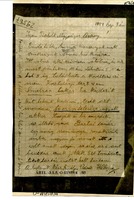 The image shows the photocopy of a handwritten letter from Budapest, September 1954, recommending a cathecism teacher who gave clandestine classes to children. Written on a piece of checkered paper the letter provides precise information about when and where to contact this person. It also contains instructions on how to get to the location of the meeting, a private flat. The visit of the person addressed in the letter, a doctor’s wife who was looking for a religious teacher for her daughters, was already expected by the catechism teacher, who had been notified of her intentioned visit. Near the end of the short and rather straightforward text the writer, a widow, notes: „This has to be kept in secret, obviously”. The envelope belonging to the letter with the names and addresses of sender and adressee was also copied and attached to the file. Although there is no additional information in the file about the identities of the corresponding partners, the letter gives some clues about their relationship and social background. The writer uses a form of address "My honourable Lady” typical of the old regime and notes at the very end of the letter that "the clothes are ready”. This allows us to assume that she may have been a seamstress or a laundress and the addressee was one of her clients. It is also apparent from the letter that the sender knew the cathecism teacher and wrote of him with utmost repsect, describing him as an extraordinary person and a superb speaker whose sermons were attended by "thousands”. The letter was written four years after the Hungarian government made the previously compulsory cathecism classes optional in schools. Although getting religious education remained technically possible, parents were strongly discouraged against enrolling their children in these classes. As a 1955 informant report from another file reveals, even cathecism teachers in schools were confidentially instructed to try to reduce the number of students in their classes. For those wanting to learn about religion, private cathecism classes held by one of the several clandestine religious organisations and movements were the only option. The authority deemed these classes illegal and pursued their teachers: priests, former monks and nuns, or lay activists. Getting involved in these classes in any way was risky and as this letter illustrates, finding a teacher or accepting a student was a matter of trust in which people relied on their personal relations. The letter comes from a documentary file on underground Roman Catholic religious groups that were connected to a movement lead by György Bulányi, a piarist monk. Though the letter only mentions the surname of the cathecism teacher, "Barlai”, he is most probably identical with Ödön Szabolcs Barlay, a former cistertian monk and teacher, who is featured in many other ÁBTL files. He was imprisoned in 1958 and 1961 for organizing illegal religious youth groups and giving illegal cathecism classes. Interestingly however, he was not in touch with those groups that were the targets of this particular file, and apart from the letter his name is not mentioned in it. The letter is included in file ÁBTL 3.1.5 O-11959/4. Apart from this letter the file contains copies of personal letters and postcards, confessions under interrogation, reports on illegal gatherings, transcripts of tapped phone calls and recorded gatherings and detailed reports on shadowings. For further readings see: Bögre Zsuzsanna – Szabó Csaba 2010 Törésvonalak. Apácasorsok a kommunizmusban. Budapest, Metem–Historia Ecclesiastica Hungarica Alapítvány–Szent István Társulat. Mezey András 2014 Az első hazai bázisközösségek: a Bulányi-jelenség és a Katolikus Egyház az 50-es évek elején In Barna Gábor – Povedák Kinga (ed.): Lelkiségek, lelkiségi mozgalmak Magyarországon és Kelet-Közép Európában.
-
 This songbook is located in a police file from 1938 and it appears to have been confiscated from two Tudorist believers, both of whom were women, who were distributing brochures, calendars and other religious literature to various people on the street. The images uploaded are the front cover and the contents page of a 30 pages long book. The first image depicts the cover of the book which has the name “Tudor Popescu”, the founder of the religious group and its title, Christian Songs (Cântări creștinești). The number “47” refers to the total number of songs that are contained in the songbook. The printing press and its location are mentioned at the bottom of the page. The second image depicts the content of the book, i.e. the list of the songs which are included in the book, in alphabetical order. These songs were collected, translated and some of them composed by Dumitru Cornilescu in circa 1921. He was a former Orthodox priest, biblical scholar and translator and religious reformer. He was a close friend of Tudor Popescu. This was the first songbook produced by the Tudorist community and remained the standard song collection for some years until. According to the biography of Dumitru Cornilescu, these songs were first learnt by heart by the members of the community and only later was he able to collect them together and to publish the songbook. The Tudorists appeared in the 1920s’ and formed as a religious group around the figure of Tudor/Teodor Popescu, a former Orthodox priest. The initial name of the community was the Scriptural Christians but they were soon known as the Tudorists, after the name of their founder. For a very long time the group was outlawed, but in 1939, in order to gain officail ecognition, they were compelled to unify with the Brethren (this was the common term used for creștini după evanghelie/ Evangelical Christians) as it was believed that they shared doctrinal similarities. However, they continued to have a distinct identity inside this larger group and are nowadays known as a second branch of the Brethren. The Tudorists rejected icons and important aspects of Orthodox tradition and for this reason they were seen as a threat for both the Orthodox Church and the state. As part of the Hidden Galleries research project, this songbook was later shown to a member of the community who explained its value to the community as this songbook is extremely rare. This songbook can be found in the file CNSAS, I 259046. The file is one of the informative files on Tudor Popescu compiled by the Securitate from Siguranța files. It contains more brochures that were confiscated by the police, some personal letters of Tudor Popescu, as well as declarations and arrest warrants of Tudorist members that were caught by the police distributing religious literature. For further references see: Alexandru Măianu, ”Viața și lucrarea lui Dumitru Cornilescu”, București, 1995. For related entries see:
-
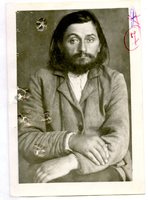 These mugshots were confiscated in 1952 by the Securitate from Onofrei V. Onofrei, an Old Calendarist monk, who was also the secretary of the Old Calendarist community. The mugshots of Glicherie Tănase, one of the most important Old Calendarist leaders, were taken in 1936, when he was arrested after the first confrontations between the Old Calendarists and the state authorities in Neamț county. He was arrested again, in 1952, and numerous attempts were made by members of the group to set him free. According to the penal file of Onofrei V. Onofrei, described as one of the youngest members of the group and also as a mystical member, he obtained these mugshots from a militiaman, who was working in Neamț county, and managed to make copies of them at a photostudio in the same county. Even though this is a police photograph, it was distributed as a devotional material. Onofrei made 45 copies of the mugshots in an attempt to encourage the community to remember their imprisoned spiritual leader . He went on to distribute 25 of these images to the monks of Slătioara Monastery, the largest Old Calendarist monastery, and to other Old Calendarist members. In this file the police report that they managed to confiscate four copies, two of which were included in this file. However, other copies of the same image can be found in his second penal file, P 0068482. Onofrei's actions were considered dangerous by the state and seen as an attempt to agitate the Old Calendarists against the regime. He was arrested and measures were taken in order for the rest of the copies to be confiscated from all the individuals he had managed to distribute them to. These images can be found in the file CNSAS, P 0022247, which is one of the penal files of Onofrei V. Onofrei. Copies of the same photos can be found in his second penal file, P 0068482. Apart from these two images, the file contains other pieces of evidence against Onofrei V. Onofrei, mostly in the form of declarations taken from people that were approached by him and even from the photographer that helped him replicate the mugshots. For related entries see:
-
 This photograph, reproduced as a postcard, was confiscated by the police in 1936, from Pavel Caras, a former monk, who was wandering the villages in Bessarabia distributing these post cards to people. The photo was taken during the 1930s in Albineț, Bessarabia(today Republic of Moldova), which was one of the most important centres of Old Calendarist activity during the period. It depicts the Old Calendarists from Albineț standing in front of their church which appears to be under construction. The photo contains a small description in the lower right hand corner which states: ”In memory of the Church in Albineț, followers of the old calendar”, without mentioning the specific date or year when the photo was taken. Even though little information is given about its context, there are small details that reveal important aspects about the community and about the event captured in the photo. We can see that one man holds a bucket in his hand, which may contain holy water, that could indicate that the community was celebrating the consecration of their church. Considering the opposition that the Old Calendarists were facing during the 1930s, the priest in the photo might have been a local one, or he might have traveled to Albineț from a nearby village. It was common practice at this time for priests to move from one village to another. These activities were followed closely by the secret police. The composition of the photograph suggests that the members of this Old Calendarist church cooperated with the photographer, as all of them face the camera, while some of them are even smiling, preparing to capture this important event in the life of their small community. Even though this photograph seems to depict a peaceful and relatively small community of Old Calendarist believers, the reality is that Albineț was considered one of the most dangerous places in Bessarabia during the 1930s. The Old Calendarists in the area were deemed rebellious and dangerous, defenders of Nicolae Climovici and Ieremia Pletosu, two of the most important priests, looked for by the Gendarmerie. According to the archival documents, the photo was used by the Old Calendarist church in Albineț as a propaganda tool, in an attempt to draw attention to itself, for which reason they chose Pavel Caras as their main colporteur. These images can be found in the ANIC, Inspectoratul General al Jandarmeriei, D 25/ 1935. Apart from these images, the file also contains declarations, newspaper articles and Gendarmerie reports about the problems caused by the Old Calendarists in Bessarabia. For related entries see:
-
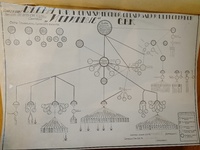 These two images come from two exemplary closing indictments against the so-called "ecclesiastic-monarchist, counter-revolutionary organisation", the True Orthodox Church. They were published as top secret brochures by the Soviet secret police (OGPU) in 1931. Network schemes were carefully and precisely designed and printed using very advanced photo-printing technology for the time. Through complex sets of social links, the schemes represent religious communities as centralised insurgent political organisations. At the very bottom are “local (rural) cells” (sel’skie iacheiki) – basic religious groups located in farms, villages and settlements. A dot (triangle, circle, or rectangle) shows the number of arrested people in a repressed community. A shaded sign signifies a “not liquidated” group that was still under surveillance. The network scheme from the Samara OGPU (image 1) pictures a network of the counter-revolutionary organisation in the Middle Volga region and its complex links of relations between cells and centres. Miniature images of churches indicate “basic cells” (nizovye iacheiki) centred around some churches that remained open. Basic cells are grouped and linked to form regional sets of cells. Circles twice crossed refer to local leaders – a kulak, a priest (pop), a monk, a bishop, or simply indicate surnames with no details. Regional sets of cells are linked to a senior centre of the “counter-revolutionary organisation” in Kashirin region. This link is not direct, but is established through groups of couriers (sviaznoi), schematically pictured as shadowed circles. Through a similar group of couriers, the regional centre is connected eventually to the top – two all-union centres of the counter-revolutionary organisation the “True Orthodox Church” with its political centre in Moscow and administrative centre in Leningrad. Image two shows an all-encompassing representation of the religious network. The scheme is signed by Evgenii Tuchkov, the head of the so-called “Church department” of the OGPU and one of the leaders of the 1920s-1930s anti-religious campaigns who headed security police operations against the ROC and the ecclesiastical underground. The scheme “reveals” the hidden connections of branches and cells in the entire country (Central, Caucasian, Black sea, Central Black Earth, Volga regions, Ukraine etc.). Shadowed circles refer to those cells and branches that had supposedly developed significant insurgent activities. The scheme gives two types of social connection: a direct link between the cells (full lines) and an indirect link (kosvennaia sviaz’, dotted lines). It is unclear what an indirect link means here but it allows for every group, branch and cell in the entire Soviet Union to be interconnected and at the same time subordinates them altogether to regional and superior centres. Two hexagons – two all-union centres in Moscow and Leningrad – crown the scheme. In this way, an ideal and comprehensive image of the insurgent, espionage, terrorist, counter-revolutionary, conspiracy organisation could be fully realised. It is pictured as a vertical network, which is built not as a web but as a vertical hierarchical scheme where all links and dots come to a centre. The documents come from the State Archive Branch of the Security Services of Ukraine, fond 13, sprava 386, 387 (Kiev, Ukraine). Apart from visual materials, the internal publications contain a list of accused persons with information on their social origins, the insurgent political platform and the structural composition of the organisation as perceived by the secret police. Numerous quotations from interrogations of arrestees and witnesses were supposed to prove the point. For related entries see:
-
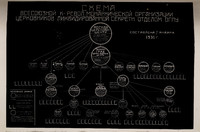 This scheme of a religious network was produced as part of a review of criminal cases against believers of the True Orthodox Church. It was published in 1931 as a top-secret document by the Soviet secret police (OGPU) in Moscow. This image has been given the title "Scheme of the All-Union Counter-Revolutionary Monarchist Organisation of Churchmen (the 'True Orthodox Church'), liquidated by the Secret Political Department OGPU". Schemes such as this one were designed to represent the religious movement as an organised hierarchical structure, where the "ecclesiastical political centre" in Moscow and the "ecclesiastical administrative centre" in Leningrad were connected to religious groups in other towns in Russia, the Caucasus region and Ukraine. These top-secret internal publications were circulated among other branches of the OGPU, including the one in Kiev, as exemplary collective penal cases – a sort of textbook for the OGPU’s struggle against the so-called “ecclesiastical-monarchist underground”. Clichéd citations from the interrogations and false confessions of arrested believers intended to reveal the political conspiracy disguised behind religious practices. It was a typical strategy to translate religious dissent in terms of political insurgency. The main charges against the believers were anti-Soviet agitation and propaganda and counter-revolutionary activities, including inciting the peasants to revolt against collectivisation. The Russian True Orthodox Church, also known as the Catacomb Church, was formed in the early years of the Soviet Union as a reaction against the collaboration of the Russian Orthodox Church hierarchy with the Bolsheviks. After Metropolitan Sergii issued a declaration of loyalty to the Soviet regime in 1927, many Orthodox communities ceased to communicate with the Moscow Patriarchate, renounced the Soviet power and continued their religious life underground. True Orthodox believers were severely persecuted throughout the entire Soviet period. In 1930-1933, the Stalin’s secret police (OGPU) launched the all-Union “liquidation campaign” against the growing Orthodox dissent movements, which they collectively referred to as the “ecclesiastical-monarchist underground”. The True Orthodox Church was the main target. The wave of repression particularly affected religious communities in southern Russian provinces and in Ukraine, where popular religious dissent was notably influential among the peasantry. Hundreds of priests, monks and ordinary believers were repressed as a result of the campaign. This document comes from the State Archive Branch of the Security Services of Ukraine, fond 13, spr. 385 (Kiev, Ukraine). Two internal publications in this archive fond also provide the OGPU's description of the so-called "ecclesiastical-political centre": its origins, political platform, leadership and its supposed "counter-revolutionary, anti-kolkhozes and insurgent activity". The description of religious criminal evidence are corroborated by standardised and formulaic statements of arrested individuals and witnesses. For related entries see:
-
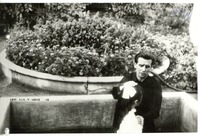 These images were confiscated from an underground Pentecostal community in Budapest-Pesterzsébet in 1972. The first image depicts a baptism where pastor József Németh is baptising a young girl. The second image is a group-picture of pastor József Németh and another five congregants in white who had just been baptised. They are standing with presumably other congregants and family members. The third image depicts pastor József Németh preaching to his congregation in their hidden house church. Prior to confiscation, the photos belonged to pastor József Németh. The photos were taken by a member of the community named in the file. 12 images were confiscated altogether along with several other religious materials by the secret police during a house raid on September 26th, 1972 during a regular Tuesday service. The images were used as incriminating evidence against the leading figures of the community including pastor József Németh himself. József Németh had separated from the officially recognised Evangelical Christian Church (Evangéliumi Keresztény Egyház), which was the recognised Pentecostal organisation, in 1968 after being accused of a series of "misdemeanors" by the Church. Following this, the secret police initiated an investigation on the grounds that the religious group held no official permit to operate. In 1972 the secret police decided to take action and according to the investigation file the following objectives were set out: a) end the illegal religious activity, b) collect evidence for the illegal activity and c) assess the valuables of the illegal community. The main accusation against József Németh and his congregation was the misuse of the right to freedom of association. The secret police used an anonymous note written by a citizen as a pretext (a common practice of the Hungarian secret police) in order to justify a raid on the community. After the house search József Németh and other leading figures in the community were interrogated on several later occasions. Pastor József Németh received a suspended sentence of 3 months. As part of the Hidden Galleries research project, these photos were later shown to the community. From them we know that the hidden house chapel was no longer used following the house raid and due to ongoing surveillance the community dissolved. József Németh only succeeded in planting a new community ten years later in 1982. The new community began to gather again in the same hidden house chapel. However, by this time pastor József Németh had become a member of the officially registered Free Christian Church (Magyarországi Szabadkeresztyén Gyülekezet). We also learned that the girl in the picture is the daughter of the pastor, who was 12 years old at that time, and that the baptism took place in the garden of the hidden house church in a specially constructed font. The confiscated images serve as evidences proving the secret religious activities of the religious group. The photographs come from file ÁBTL 3.1.9. V-160122. Along with the confiscated images the file contains interrogation reports, the trial sentence, 27 crime scene photographs and other confiscated documents including a diary and the community’s cash book. For related entries see:
-
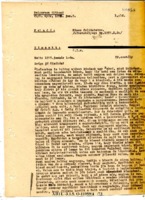 This word-for-word transcript of a typewritten personal letter tells about a secret home christening held in Budapest in December 1954. Amongst other deeply personal matters, the author, the child’s grandmother, briefly reports about the baptism. From this we learn that the child was baptised by a Piarist monk in the presence of the extended family, altogether 22 people. For the occasion the child’s grandfather erected a makeshift altar. As the letter-writer notes, he "made a beautiful altar. He made it so exceptionally nice that everybody was weeping with emotion. My entire home looked like a stage. Everything was shining bright.” Although in theory the Hungarian state granted freedom of religion even in the harshest years of the communist regime, the years of Mátyás Rákosi's rule (1947-1956), many people chose to refrain from openly practicing their faith in fear of various kinds of retribution. The secret baptism is a good example of how people tried to reconcile their religious needs with their desire to avoid conflict with the authorities by withdrawing their religious activities into the domestic sphere. It also nicely illustrates how people creatively turned their everyday environment into a sacred ritual space, even temporarily. And finally, this home-held ritual is also an illustrative example of silent resistance against the regime: as the letter goes on we learn that in his baptismal sermon the Piarist monk made derogatory metaphorical references to communism, much to the approval of the author. As her request at the end of the letter, „please burn this letter after reading” shows, however, she was very much aware of the risk her family was taking in conducting the baptism and in writing this letter. This transcript comes from a file on "illegal" organizations that were connected to a movement lead by a Piarist monk, György Bulányi. The goal of his movement was to keep Christianity alive through small secret local cells where members – mostly young people – could have access to religious education and spiritual guidance. The Bulányi movement started in 1945, and gained momentum after 1948, when the nationalization of church-owned schools excluded historical churches from educational activities and drastically decreased their access to young people. While most of its leaders came from the Piarist order, one of the four monastic orders that were allowed to keep some of their schools and were granted legal status after the dissolution of religious orders in 1950, many of the movement's activists were former members of other banned monastic groups. The secret police considered the movement an "illegal clerical-fascist organization" which, under the disguise of religion, was working to undermine democracy and the building of socialism. For this reason, the secret service had been gathering information about the movement since its early days. As a result, Bulányi and other leading figures were arrested and condemned in 1952. The movement, however, did not cease to exist and the ÁVH, the Hungarian secret service at the time, continued to surveil its activities extensively for at least another decade. The letter comes from a documentary file containing diverse materials, and focusing on groups mainly lead by lay female activists and former nuns. It includes no additional information concerning the letter; apart from their names we don’t know who the correspondents were, what their social background was or what kind of relationship they had with each other. Neither is there any direct information about their involvement in the movement or about the way the secret police got hold of the letter. However, the context of the file allows us to assume that the addressee was a member of a religious cell, officially deemed illegal. The letter is placed in the file among other letters, which indicate that it may have been used as evidence of the clandestine religious activity of Piarist monks. The letter is included in file ÁBTL 3.1.5 O-11959/4. Apart from this letter the file contains copies of personal letters and postcards, confessions under interrogation, reports on illegal gatherings, transcripts of tapped phonecalls and recorded gatherings, and detailed reports on shadowings. For further readings see: Bögre Zsuzsanna – Szabó Csaba 2010 Törésvonalak. Apácasorsok a kommunizmusban. Budapest, Metem–Historia Ecclesiastica Hungarica Alapítvány–Szent István Társulat. Mezey András 2014 Az első hazai bázisközösségek: a Bulányi-jelenség és a Katolikus Egyház az 50-es évek elején In Barna Gábor – Povedák Kinga (ed.): Lelkiségek, lelkiségi mozgalmak Magyarországon és Kelet-Közép Európában. For related entries see:
-
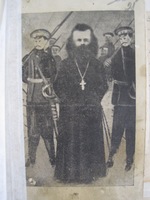 The images show postcards and mass produced photographs confiscated from a group of arrested Inochentists in February 1942 in the village of Cuibușor, in Romanian-occupied Transnistria. Image 1 and 2 show the front and reverse of a postcard. On the front, the monk Inochentie (1875-1917) is shown in a scene from his vernacular hagiography in which he is under arrest, surrounded by Tsarist soldiers after his attempted to escape from exile on Solovetsky island. The reverse of the postcard, comprises short quotes and adaptations from the New Testament. Here text and image were configured in a relationship designed to establish a parallel between Inochentie’s suffering and the passion of Jesus Christ. The text opens with an abridged and slightly altered version of Jesus’ discourse on the Good Shepherd from John 10: 14-16. In the section of the text that follows, this is taken one stage further with the torments suffered by Inochentie being equated to Christ’s passion. “Behold, the good shepherd whose life was given and is not given back. By his spiritual brothers, chased, cursed, shot [with a gun], insulted, given poison to drink, with hands tied behind his back, put in prison because he revealed the truth, not heeding what the Apostle says: Whoever hates his brother is a murderer, and the murderer will not enter the Kingdom of God (1 John 3: 15).” Image 3 is a photograph-icon of Inochentie that shows him with angels wings and a dove at his heart, a symbol which indicates his association in Inochentist belief with the third person of the Trinity, the Holy Spirit. This type of mass produced photo-postcard image were widely used by Inochentists to spread their message. These were carried from village to village across the Moldovan countryside, easily concealed about their person. There are reports of them being sold on markets from suitcases. Hidden under officially sanctioned religious icons and booklets, they were sold to knowing customers ‘on-request’ for the price of 10 lei. The Holy Synod took very seriously the danger posed by these subversive and heretical images and texts being produced by religious dissenters, not only Inochentists but also Old Calendarists, and passed a ruling in 1936, to be enforced by the Ministry of Internal Affairs through the Gendarmerie, requiring all religious icons, crosses and religious publications to be approved by the Church. Arrests were frequently made on the basis of possession of illegal icons and Inochentists were, by the 1940s, routinely sent to the military courts where they received anything between a small fine to 6 months in a labour camp. The file from which these items come reports the arrest of a group of 41 Inochentists, 9 men and 32 women, in an illegal “prayer house” in the village of Cuibușor. The village was located adjacent to the underground Inochentist complex of Gradina Raiului (the Garden of Paradise) that had been destroyed by the Bolsheviks in 1919/20. The area had recently been occupied by Romania following the Axis invasion of the Soviet Union in June 1941. In the 1942, there were a series of arrests of Inochentists from Bessarabia (which had become part of Greater Romania following the First World War) as they began to gather around their sacred centres of Balta and Gradina Raiului. It was illegal for Bessarabians to travel to the occupied territories without travel papers. The Romanian authorities noted that the rumour of deportation of sectants from Romania to Transnistrian concentration camps alongside Jews and Roma (Gypsies) seemed to have inspired some Inochentists to relocate to the place of origin of their movement. Both the postcard and the groups relocation to their sacred centre are expressions of the apocalyptic expectations of the group that intensified with the start of World War Two. These images come from the National Central Historical Archives of Romania [Archiva Naționale Istorice Centrale – fond. Inspectoratul General al Jandarmeriei (Romania) [Central National Historical Archive – General Inspectorate of the Gendarmerie], dosar. 120/1942, pp. 22-26. Alongside the two items reproduced here, there is a third postcard-icon and a brief description of other religious materials found at the hidden prayer house. For related entries see:
-
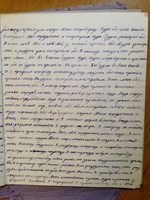 This is a manuscript with a Pentecostal prophesy confiscated in 1953 from an arrested Ukrainian woman, who was known as a Pentecostal prophetess. The prophecy is handwritten in a notebook and is 15-page long. It narrates the coming death of Ashur, who will be overthrown from his throne by God and will be shot dead. After his death, all the prisoners will be released and people will live in freedom. The prophecy also stresses a special religious role of Ukraine and Kiev, its capital, that will become a place of great spiritual awakening. The item comes from the 1953 MGB penal case against four Pentecostal believers, all Ukrainian women. The manuscript with the prophecy was used by the MGB as incriminating physical evidence of their “anti-Soviet propaganda”, including “dissemination of libels against Soviet leaders”. The “Anti-Soviet Agitation and Propaganda”, the infamous article 58 of the Penal Code, was a common criminal offence used to incriminate to religious believers in the Soviet Union. Officially believers could not be persecuted for their religious beliefs, as the Soviet Constitution granted religious freedom on paper. Penal cases against religious believers were fabricated in terms of extreme politicisation of religious practices. A KGB report from 1963 states, “We do not fight against believers or religion, but we do fight against the use of religion by anti-Soviet elements… in hostile to the Soviet state purposes”. The image of Ashur resembles Stalin, however, in one place of the prophecy Ashur is called Vyshinsky – the minister of foreign affairs in 1949-1953 and one of the main organizers of Stalin’s great terror, who signed thousands of death penalties in the 1930s. On the second image, the following sentences were underlined by an MGB officer, as supposedly having a distinct anti-Soviet meaning: “And liberty [volia] and freedom will follow soon; the days of freedom are approaching. For Ashur will be overthrown. And people will be called. I will call up people from many countries, and they will arrive and will [condemn] Ashur. The end has come, they call Ashur to death, for Ashur will be shot dead. Oh, oh, oh the storm will arrive for there will come the great bloodshed..." The prophecy goes on to recount how all prisoners will be released and how Kiev, the capital of Ukraine, will become the new Jerusalem. The "wandering prophetess", as she was described by the MGB, led a Pentecostal community in Kiev and travelled throughout Ukraine and as far as Siberia, preaching among religious communities. She was arrested in 1953 along with three other women pentecostal believers and sentenced to 25 years in labour camps. At this time there were a number of “illegal” religious groups in Soviet Ukraine referred to as the “religious underground”. They were regarded “harmful for the state by the very fact of their existence and the character of their activity”. In 1944, the All-Union Council of Evangelical Christians-Baptists was formed as the only recognised umbrella church body of all branches of Evangelical Christians. The communities that refused to enter the Council, including many Pentecostal groups, were considered criminal. Ukraine was the hotspot of Soviet-era religious persecutions as it was the place of the largest Christian Evangelical communities in the entire Soviet Union. Ukrainian Pentecostalism developed a particular culture of prophets, who were wondering across the wider region, preaching and gathering new communities. By the time of this penal case in 1953, according to the Soviet authorities, there were approximately 200 unregistered Pentecostal communities in Ukraine with over 200 prophets and prophetess. This manuscript comes from the State Archive Branch of the Security Services of Ukraine, fond 6, spr. 60259. The file contains records of arrest and transcripts of interrogations of four Pentecostal women on trial, transcripts of interrogations of witnesses, as well as a closing indictment, court records and a final court sentence. Two women (including the author of the manuscript) were sentenced to 25 years and two others to 10 years in labour camps. Alongside the manuscript reproduced here, the file contains one more notebook with handwritten religious writings and a press-cutting with an image of the American President Harry S. Truman. These confiscated items were also used as incriminating physical evidence against the arrested women. Twenty confiscated photographs and twenty one personal letters of believers were later destroyed as having no relevance to the case. For related entries see:
-
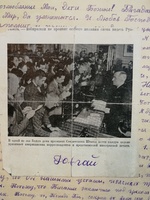 This press-cutting with an image of the American President Harry S. Truman was confiscated from an arrested Pentecostal woman in February 1953 in Ukraine. The first image shows Truman receiving an international delegation of journalists. The picture has a title in Russian, “In one of the halls of the White house, the president of the US receives American and international journalists almost every week”. The press-cutting was taken from an unknown, presumably Russian diaspora journal printed in the USA. The item comes from a 1953 MGB penal case against four Pentecostal believers, all Ukrainian women. The confiscated press-cutting was used as incriminating evidence of their anti-Soviet activities and pro-American propaganda. Reading or possessing an American journal was illegal in the Soviet Union, as the Soviet political censorship banned most foreign media, particularly of diaspora origins. One of the arrested women was known as a Pentecostal prophetess. As the numerous, mostly fabricated, interrogation reports show, the woman preached the advent of Truman, anointed by the Lord to Ukraine and the coming peace and freedom of the country. As Truman was a Baptist and a religious man, she appears to have genuinely regarded him as the liberator of all believers. She preached that Ukraine would become the Millennial Kingdom where all people would receive the baptism of the Holy Spirit. In 1937, the NKVD had arrested her husband, also a Pentecostal believer. The woman never heard of him again. The closing indictment contained in the file, additionally states that, during their religious meetings, the arrested women also read Soviet newspapers one of which included the UN Charter. This was also used to incriminate the group on trial as it stated that the women intentionally “perverted the message” of Soviet newspapers. “Illegal” religious groups and their members were not persecuted expressly for their religious beliefs as, on paper, the Soviet Constitution granted religious freedom. Most of the repressed religious believers were incriminated for “anti-Soviet agitation and propaganda” or “counter-revolutionary activity” and penal cases against them are characterised by an extreme politicisation of religious practices. As a KGB report from 1963 states, “We do not fight against believers or religion, but we do fight against using religion by anti-Soviet elements… hostile to the Soviet state”. This image comes from the State Archive Branch of the Security Services of Ukraine, fond 6, spr. 60259. The file contains records of arrest and transcripts of interrogations of four Pentecostal women on trial, transcripts of interrogations of witnesses, as well as a closing indictment, court records and a final court sentence. Two women were sentenced to 25 years and two others to 10 years in labour camps. Alongside the image reproduced here, the file contains two notebooks with handwritten Pentecostal prophecies and writings that were also used as incriminating physical evidence. Twenty confiscated photographs and twenty one personal letters later destroyed as having no relevance to the case. For related entries see:
-
 This photo-collage and scheme of a religious network were produced as part of an exemplary collective penal case against members of the catacomb True-Orthodox Church. The photo-collage shows a group of believers put on trial - thirty eight True Orthodox believers headed by Alexii Bui, bishop of the Voronezh diocese (top row, fourth from the left). The network scheme represents the movement as a centralised organisation, uniting religious centres in Leningrad and Moscow with numerous "cells" (as the OGPU called them) in southern regions of Russia (Voronezh, Belgorod, Kursk, etc). It shows repressed communities and those under surveillance, the number of arrested individuals and the names of local leaders. The indictment was published in 1931 as a top-secret document by the Soviet secret police (OGPU) in Voronezh, Russia. The document was then sent to the Ukrainian OGPU, because numerous communities belonging to the religious network were located in Ukraine. This secret publication was supposed to be a sort of textbook in the OGPU’s campaign against the Buevtsy (as the secret police referred to the followers of Alexii Bui). The exemplary indictment provided a structure, linguistic formulas and incriminating political crimes used against believers that could utilised for further repression of the True Orthodox Church in Ukraine. Bishop Alexii (whose birth name was Semion Bui) was one of the leaders of the Russian True Orthodox Church. He united under his leadership communities of True Orthodox Christians in about forty districts in southern provinces of Russia and in Ukraine. Alexii Bui was arrested in 1929 as the leader of the “counter-revolutionary ecclesiastical-monarchist organisation” (as the Soviet secret police referred to dissenting Orthodox communities). After several trials he was sentenced to ten years in labour camps and eventually was shot dead by the NKVD in Sandarmokh, Karelia on 3rd November, 1937. The documents come from the State Archive Branch of the Security Services of Ukraine, fond 13, spr. 390. The file also contains a full list of the convicted persons, the historical outline and the social structure of the True Orthodox Church as perceived by the secret police, and evidence of its politically subversive, counter-revolutionary activities, based on majorly distorted and formulaic statements of arrested individuals and witnesses. For related entries see:
-
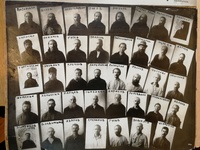
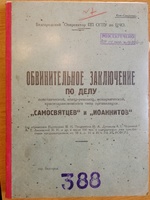 The images are a photo-collage and scheme of a “liquidated” religious network produced as part of a closing indictment in a collective penal case against one hundred believers, followers of underground popular Orthodox movements, referred to as the Samosviatsy and the Ioannits. The group on trial were monks and nuns from closed Orthodox monasteries and ordinary believers from the Ukrainian and Russian countryside. They rejected both Soviet power and the Russian Orthodox Church authority as they believed the Orthodox Church was compromised by collaboration with the Bolsheviks. The network, which was referred to as the Samosviatsy (deriving from the term for "self-consecration"), also included some followers of the Russian Orthodox archpriest Ioann of Kronstadt, referred to as the Ioannits. One of the arrested was a popular charismatic leader, Andrei the Ill (Bolaschii), a prophet and a holy fool (yurodivyi), active in southern Russia and Ukraine. The network scheme and photo-collage show how the Soviet secret police represented dispersed communities of peasant believers and monks from different Ukrainian and Russian towns and countryside. The visual representations portray the community as a hierarchical secret organisation, showing the interconnections and relationships between members. Representing religious groups in this way was part of the typical strategy of politicisation of dissenting religious groups, in order to validate repressive action. The indictment was published in 1930 as a top-secret document by the Soviet secret police (OGPU) in Belgorod, Russia. The document was then circulated among other branches of the OGPU, including the one in Kiev, as an exemplary collective penal case – a sort of a manual of the OGPU’s struggle against the so-called “ecclesiastical-monarchist underground”. On the cover of the file, the Samosviatsy and the Ioannits are defined as "insurgent, counter-revolutionary, monarchical red-dragon-type organisation". As well as the network scheme, it contains material with long citations, in largely formulaic secret police language, taken from interrogations of arrested individuals and witnesses. These were intended to reveal political conspiracies disguised as religious practices. The main charges against the believers were of anti-Soviet propaganda and counter-revolutionary activities, including inciting the peasants to revolt against collectivization. After the Bolshevik Revolution in 1917, political repression turned against the Russian Orthodox Church. The majority of monasteries and churches were closed down and many former priests, nuns and monks continued their religious practises underground, in private houses and apartments, wandering from village to village. The perceived political corruption of the Church, the repression of the Church hierarchy and mass closure of churches and monasteries triggered the development of popular forms of Orthodox dissent. These movements had an apocalyptic vision of a radically changing world. Numerous prophets, holy fools (yurodivye) and former monks and nuns preached the arrival of the Apocalyptic Red Dragon personified by the Communists, hence the name "red-dragon-type organisation". Soviet power was seen as the power of the Antichrist or Satan. In 1930-1933, Stalin’s secret police (OGPU) launched the all-Union “liquidation campaign” against the growing Orthodox dissent movements, which they collectively referred to as the “ecclesiastical-monarchist underground”. Among the repressed groups were numerous communities of the catacomb True Orthodox Church, the Samosviatsy, Ioannits, and many other ordinary believers. The documents come from the State Archive Branch of the Security Services of Ukraine, fond 13, spr. 388, SBU Archive (Kiev, Ukraine). The file also contains a full list of the people put on trial, the historical outline and the social structure of the movement as perceived by the secret police, and evidence of its insurgent, counter-revolutionary activities, based on majorly distorted and formulaic statements of arrested individuals and witnesses. For related entries see:
-
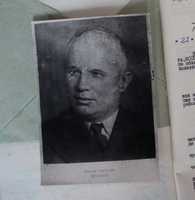 These mass produced postcard-sized portraits of three soviet leaders, Nikita Khrushchev, Lavrentiy Beria and Anastas Mikoyan, have been torn and inserted into an envelope as evidence in a secret police personal file referring to a collective penal case. They were found during the search of a house of an Inochentist leader on February 11th 1953, a few weeks before Stalin’s death. From the perspective of secret police, the disrespectful attitude towards the abovementioned leaders of those who had torn these pictures equated to an anti-Soviet act. The origin of the defaced images is open to a number of possible interpretations. Given the fact that the secret police officers claimed to have found the small portraits in the attic of the Inochentist leader’s house, the size of the portraits and the fact that the Soviet leader Joseph Stalin is missing from amongst them, the photographs may constitute fake evidence created by the secret police or somebody in collaboration with them. However, the tearing of the image of any of the Soviet leaders would have been a risky strategy even for high ranking secret police officers. Alternatively, the portraits may have been torn by the Inochentist community themselves. The case against the leaders of the community does not mention the torn pictures but instead translates the group’s actions into the language of the Soviet criminal code. The leaders of the group were convicted for creating an anti-Soviet sect, organizing illegal religious meetings and encouraging peasants not to fulfil their obligations towards the state. One of the two on trial was also convicted for having formerly collaborated with Nazi forces. This file is a good example of how problematic interpreting secret police files can be and the often ambiguous nature of the evidence presented within them. The Soviet regime had its own iconographic tradition, which aimed at dominating the gaze of Soviet citizens who were supposed to participate in the building of Socialism in USSR. Soviet policy in the Moldavian countryside was not only a project of transforming the social and economic life of the villages, but also aimed at replacing the culture of traditional peasant communities with a new Stalinist culture in which there was no place for religion. The Inochentist communities, which were perceived as anti-Soviet sectarians, represented an obstacle towards the projects of the Soviet state. As with Eastern Orthodoxy more generally, the vernacular tradition of the Inochentists attributed a major role to icons. The intrusion of atheist Soviet iconography into the everyday life of villages seriously disturbed Inochentist sensibilities. Later in the case file, a few days after Stalin’s death one of the witnesses reported having heard one of the Inochentist leaders saying “why do you hang his portrait, is he a saint to be viewed by everyone, or what?” This case nicely illustrates the battle to dominate the gaze of Soviet peasantry. Inochentism represents a form of local vernacular Orthodoxy drawing heavily on the conservative monastic tradition. During the first decades of the 20th century several versions of Inochentism emerged in Bessarabia. The abovementioned case refers to the followers of Ioan Zlotea. When the territory of Bessarabia was (re)occupied by Soviet forces in 1944, Inochentists once again became a target due to their maintenance of values opposed to Soviet policies applied in the countryside. Accusations included refusing the draft to the army, resisting mobilization for work on Sundays, refusing to vote in elections and refusing to join the Communist Youth Organizations. In the context of collectivization of agriculture and the recent famine in Moldova Inochentists shared a culture of apocalyptic rumor with many other religious groups in rural Russia and Ukraine. These images can be found in the file ASIS, 023171, Vol. 1-2. This file also contains nine mugshots of one arrested Inochentist and two other unknown persons produced by secret police and used in the secret police lineup. The identification of the arrested Inochentist took place in Soviet Ukraine, in the village where, according to the file, he served as a policeman during the German occupation. In addition, the file contains three mugshots of sentenced Inochentist leaders taken by secret police officers as a standard procedure during registration of the identity of the arrested persons. For related entries see:
-
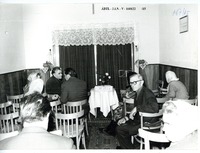 These pictures have been selected from the 27 crime scene photographs that were taken during a raid of pastor József Németh's community in a hidden house church created. The raid took place on September 26th, 1972 during a regular Tuesday gathering. The first photograph depicts the hidden house church in József Németh’s house in Pesterzsébet. On the picture we see nine congregants some of whom are facing the occasional table-alter, discussing the unfolding situation, others are turning towards the back of the room in order to follow events. Behind the alter, the double doors are covered with curtains which frame the alter. The house church is furnished with new chairs. The second image depicts the back of the room with congregants and possibly two officers. The third image presents the electric organ in the house chapel, while the fourth picture portrays the collection box. These three later photographs inform us of the intentions of the secret police to collect evidence for the supposed crimes of the community. The main interest of the secret police centered around finances of the illegal religious group. The secret police had a deep interest in finding out how the pastor could make a living only on the donations of the community without having a civil job and how the community could afford such a modern electric organ and new furniture. József Németh was expelled from the Evangelical Christian Church (Evangéliumi Keresztény Egyház), the recognized Pentecostal organization, in 1968 after a series of misdemeanors. The secret police initiated an investigation because the religious group held no official permit to operate. Németh’s community had been under surveillance since 1968. In 1972 the secret police decided to take action and according to the investigation file the following objectives were set out: a) end the illegal religious activity, b) collect evidence for the illegal activity and c) assess the valuables of the illegal community. The main accusation against József Németh and his congregation was the misuse of the right to freedom of association. The secret police used an anonymous note written by a citizen as a pretext (a common practice of the Hungarian secret police) in order to justify a raid on the community. After the house search József Németh and other leading figures in the community were interrogated on several later occasions. From the investigation file we find out that four police officers, a driver and a staff photographer participated in the operation. In the file the names of the officers participating in the house search are present without anonymization. After the raid, the hidden house church was no longer used and under ongoing surveillance the community dissolved. Pastor József Németh received a suspended sentence of 3 months. He later succeeded planting a new community in 1982. The community began to gather again in the same hidden house church. However, by this time pastor Németh had become a member of the officially registered Free Christian Church (Magyarországi Szabadkeresztyén Gyülekezet). The photographs come from file ÁBTL 3.1.9. V-160122. Along with the photographs of the crime scene there are confiscated images taken by the community, interrogation reports, the trial sentence and other confiscated personal documents including the community's cash book and diary. For related entries see:
-
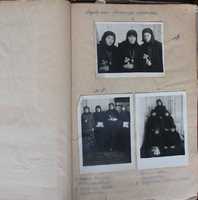 This page from an MGB investigation file from 1947 from Soviet Moldavia shows three images of women preachers from the Archangelist movement, a branch of Inochentism. The first image portrays the women holding crosses in their right hand, facing the camera and cut off at waist height. The composition and symbolism of this image reproduce the visual language of icons. Images of this kind could offend the sensibilities of Orthodox believers. The two lower images carry the same imagery but in a less obvious way. The women are dressed conservatively in dark clothes that are inspired by monastic dress, a common practice among all branches of Inochentism. The role of these photographs, which were found on the persons of the arrested individuals, were used by the secret police to both prove membership of the illegal religious group and to identify further members of the community. In the first image the central figure is identified by name as one of the significant women preachers of the group. In the lower two pictures, in a similar fashion, the secret police highlight certain individuals identified by name. Interrogation stenographs from other cases reveal that these types of images were produced by group members as mementos of group meetings. We do not know the circumstances in which the photographs were taken, but from the setting and the quality we can suppose that the photographer was invited to the community. This type of photographic practice was common and it appears to be important for the Archangelists of this period. The leader of the movement, Alexandru Culeac, produced numerous photographs of himself in large numbers to distribute to his followers. The Archangelist movement grew out of the earlier Inochentist movement in 1920s Bessarabia (present day Republic of Moldova) under Romanian rule and is one of a branches of the movement. It represents a form of local vernacular Orthodoxy drawing heavily on the conservative monastic tradition. When the territory of Bessarabia was (re)occupied by Soviet forces in 1944, Archangelists once again became a target due to their maintenance of values opposed to Soviet policies applied in the countryside. Accusations included resistance to mobilization to army, mass mobilization to work on Sundays, vote in elections, join the Communist Youth Organizations. In the context of collectivization of agriculture and the recent famine in Moldova, Archangelists shared a culture of apocalyptic rumor with many other religious groups in rural Russia and Ukraine. Beside the above-mentioned photographs, the quoted file (ASIS, 019520, vol.2) contains two Archangelist-Inochentist icons, a photograph of an Archangelist hagiographic icon and one brochure. For related entries see:
-
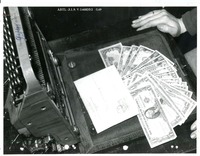 This picture depicts a Continental typewriter confiscated during a house search of a Hungarian Cistercian monk, Dr. Ferenc Piusz Halász (1909-1994) in 1961. The typewriter was photographed along with illegally held US dollars. Three photo images were taken by the secret agents in order to show how the US dollars were hidden in an envelope inside the typewriter. On the reverse of the photograph we find the following text: "Elismerem, hogy a fotokópia hátoldalán látható dollár az én tulajdonomat képezte, illetve azonos azzal a négyszázkilencvenhét dollárral, melyet a fotokópia hátoldalán látható írógépben rejtegettem. Budapest, 1961. június 12., Dr. Halász Ferenc" "I acknowledge that the dollars on the other side of this photographic image are my property and are identical with the 497 dollars that I hid in my typewriter which is found on the photo as well. Budapest, 12th June, 1961. Dr. Ferenc Halász." These pictures served as one of the main pieces of evidence against Dr. Ferenc Piusz Halász when he was given a 6 year prison sentence in 1961. This constituted the main evidence against Dr. Ferenc Piusz Halász, one of the main defendants of a show trial against the underground Cistercians. The images here follow the classic model how evidence was found. The sequence of shots demonstrate a classic photographic methodology of how secret police produced incriminating evidence. In this case we can assume that the dollars were planted by the secret police agents. Similar to show trials - where the authorities have already determined the guilt of the defendant(s) –house search scenario was usually constructed in a way that the forbidden western foreign money – in this case US dollars – was hidden and then found by the officers on the spot. The possession of foreign currency was considered a criminal offence according to the state and served as unambiguous evidence against the incriminated person. Typewriters of persons under surveillance or persecution had a significant role in the eye of the secret police as the uncontrolled typewriters provided means for the production and circulation of uncensored documents, messages or spiritual writings. For this reason, typewriter can also been seen as the symbol of free speech. By producing a sample from the typewriter, it is possible to identify the typewriter later and get an insight into the distribution network of religious samizdat and the volume of produced materials. Dr. Ferenc Piusz Halász was a member of the Cistercian order dissolved in 1950. He was one of the main defendant of the show trial against the underground Cistercian order after the dissolution of most Catholic religious orders in 1950. From 1946 he was the Prior of the austere, ascetic Borsodpuszta Cistercian community. He was active in producing religious writings. After the dissolution of the order, Dr. Ferenc Piusz Halász was a parish priest in Csatka from 1951-1961. The persecution against him began in 1961. According to the charges of the show trial he was one of the ideological leaders of priests and monks organizing the overthrow of the political system. During his allegedly subversive, anti-state efforts he copied and re-produced the sermon-collection “Preach the Gospel!” which served as an evidence for the trial. Dr. Ferenc Piusz Halász was convicted for 6 years of prison but was freed in 1963 as part of the collective political amnesty but convicted again in 1965 with a similar sentence. The photo image is found in ÁBTL 3.1.9. V-146835/3 For related entries see:
-
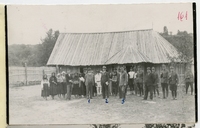 These photographs were taken in 1935, in the village of Cucova, in the county of Putna (nowadays Bacău), as evidence of the rebellions and problems caused by the Old Calendarists in the region. The term "Stilists" was also used by the state and the press in order to label them, referring to the fact that they were following the "old style" dates and calendar. The first image depicts some gendarmes, a few members of civil authorities and mainly women members of the Old Calendarist community, all of whom were arrested. The photograph was taken in front of the Old Calendarist wooden church, which was also surrounded by a wooden fence. The number of women depicted in this photograph supports the contemporary view that women played an important role in the Old Calendarist communities. The same assertion is supported by both secret police reports and numerous newspaper articles that accuse Old Calendarist women of attempting to lure and trick people into becoming members of the community. The second photograph offers a clear picture of the wooden church and the surrounding fence. The window frames of the church appear to have been removed, which could indicate the intention of the authorities to completely destroy it but keep the valuable material. According to the narratives of the Old Calendarists, the church was destroyed soon after this event. The third photo depicts the interior of the church and is of great value due to the fact that it allows us to see how objects and icons were originally displayed. It was taken from the inside of the church and captures the intrusive gaze of the three gendarmes (shown in the centre of the photo) into the sacred space. Large icons appear to have been removed from the wall and there are other numerous small icons. The random character of the small lithograph objects suggests that they were donated by members of the community. The events at Cucova, that were labelled by the authorities as rebellions, were part of a general religious dissent that began with the introduction of the calendar reform in Romania. It gave birth to a movement in the Eastern Romanian provinces of Moldova and Bessarabia which became known as Old Calendarists or Stilists, after the Romanian term “old style,” referring to their opposition towards the acceptance of the new Gregorian calendar. The context in which these photographs were taken is a very important one, especially for the history of the Old Calendarist church. The incidents that took place in Cucova, in 1935, are described as a massacre in various narratives of the Old Calendarists, while the archival documents portray the event in a different light, making the Old Calendarists appear as rebels and troublemakers. Even though it is not very clear what caused the incident, the fact that Cucova became a point of attraction for Old Calendarists from different places might have been a reason for the authorities’ intervention. Police reports mention that the Old Calendarist believers hid in their improvised church and soon became violent, forcing the Gendarmerie to use firearms. Based on some archival documents and other sources, five people were killed, 28 wounded and 40 arrested. In 1936, one year after this event, police reports state that the Stilist movement was no longer active in the region. Even though the wooden church in Cucova was destroyed in 1935, an Old Calendarist monastery was later rebuilt on the approximately same place, where it still stands today. These images can be found in the file CNSAS, D 015305. Apart from these 3 images, it contains 6 more photographs depicting what happened in Cucova, as well as more documents regarding the problems generated by the changing of the calendar, especially among the peasants. For further readings see: Andreea PETRUESCU, Mișcarea stilistă în Basarabia, 1935-1936. Cauze și soluții. Perspective locale (Stylist movement in Bessarabia, 1935-1936. Causes and solutions. Local perspectives), in Caietele CNSAS, Anul IX, nr. 1-2 (17-18)/2016, Editura CNSAS, Bucureşti, 2017. ”Anchetarea rebeliunii stiliste din Piatra Neamț” in Dimineața, No. 10683, September 19,1936, ”Femeile au un rol important în mișcarea stilistă” in Capitala, No.191, September 24, 1936. ”Încăierare cu stiliștii într-o comună din județul Putna. Doi morți și șapte răniți” in Universul, May 29, 1935. For related entries see:
-
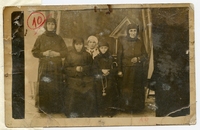 This photograph was confiscated in 1941 by the Siguranța, the Romanian secret police prior to Communism. It depicts four Old Calendarist nuns, also referred to as Stilists. A short handwritten text on the reverse states that it was taken on September 1st, 1939. The nuns are dressed in standard monastic clothes, their heads are covered and their black tunics entirely cover their bodies. In their hands, they hold “metaniere”, Eastern Orthodox prayer ropes. The “metaniera” is an important part of monastic dress and is used during prayer to aid concentration. The composition of the photograph and the screen with painted architectural features tells us that it was taken in a photo studio. Because the dress of Old Calendarist nuns was not distinguishable from those of Orthodox nuns from legally recognised monasteries, the women were able to travel freely without drawing undue attention of the authorities. The photograph was confiscated by the police from two nuns, Steliana Geancu and Anica Măzărel. They were discovered hiding in a hut, in the Pralea Woods, Bacău county. It was added to their penal file but it is unclear to which one of them it originally belonged. A short text on the reverse of the photograph suggests that it was used as a personal memento: “Aminitire, această fotografie este amia, Singlitichia, scoasă la 1 septembrie 1939. Aici este Ma. Chirichoia și Ma. Melania și Sara Iliana și M Singliticia Păcătoasa,” translated as “Memory, This photo is mine, Singlitichia, developed on September 1st 1939. Here are M. Chirichoia, M. Melania and Sara Iliana and M. Singlitichia the Sinner.” Both Steliana Geancu and Anica Măzărel were arrested and tried for Stilist propaganda in 1941. Old Calendarists emerged in 1924 after the introduction of the new calendar by the Orthodox Church. They were a group of Orthodox believers who rejected the newly adopted Gregorian calendar and went on to organize their religious life according to the “old style”, hence the name Stilists. They were condemned by both the Orthodox Church and state authorities which collaborated in identifying and prosecuting them. Often on the basis of local information provided by the Orthodox Church, the state deployed its security agencies, the police, the Gendarmerie and the Siguranța, to prevent Old Calendarist gatherings, arrest their leaders and disrupt the life of the community. In a number of cases, the intervention by the security services resulted in violence and casualties. State security archival sources report that the “Stilist phenomenon” had faded by 1940 and indeed, leading up to 1936, the most important leaders of the group had been arrested. However, the community continued to exist underground. Some began meeting in attics, cellars, or other secluded places, while others fled in the woods, where they hid in caves and huts. In this period the term “vagabond priests and nuns” was used to refer to those Old Calendarist members who wandered from community to community to avoid arrest. The photo image is found in the file CNSAS, P 096704. Together with the photo included in this entry, the police also confiscated Steliana Geancu’s and Anica Măzărel’s personal letters, icons and other objects. Of these, the letters, a handwritten prayer and a list of personal sins are included in the penal file. For further readings see: ”Primejdia stilismului în Basarabia și Moldova” in Universul, No. 52, February 22, 1936. For related entries see:
-
 This photograph which was taken by Soviet secret police officers appears to capture a ritual performed by Archangelists (a branch of the Inochentist movement) in one of their underground chapels. On closer inspection, however, it is evident that this is not a surveillance photograph but rather a staged reenactment performed for the camera. The framing, camera angle, lighting and mood of the photograph were all determined by the secret police photographer with the intention of creating a powerful image for use by the regime. Indeed, the two Archangelists, shown wearing ritual clothing and holding sacred objects, may not be performing a genuine ritual at all. The images from this secret police photo shoot, which later appeared in Moldovan newspapers alongside a dramatized account of the dangerous and subversive activities of this group of Archangelists, demonstrate the close co-operation between the secret police and the state media organs at the time. Re-stagings of religious ritual seem to have been produced consciously as both evidence for use in trials and as propaganda tools. With access to state security files on religious groups, the close cooperation between the state security and Soviet public media and propaganda organs becomes evident as the files clearly demonstrate how the secret police collected, produced and curated images of religion for popular consumption. The file in which these images appear contains photographic materials from several cases and seems to have been made available to journalists and authors for use in their works. These photographs can be found in ASISRM-KGB 020193. Altogether, this file contains 39 photographs, 6 loose pages handwritten and two handwritten notebooks with religious texts. The materials are derived from several different cases. For further reading see: Kapaló, James A. Inochentism and Orthodox Christianity: Religious Dissent in the Russian and Romanian Borderlands. Routledge, 2019. For related entries see: