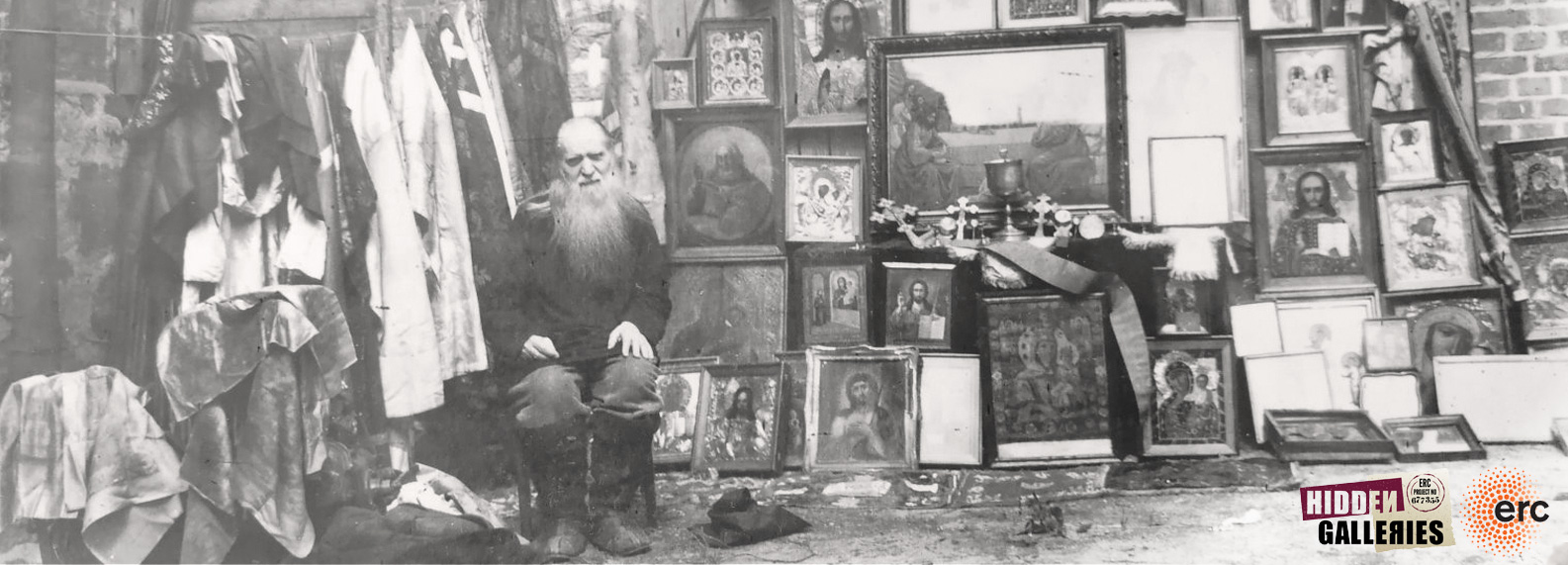
Items
-
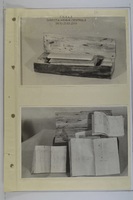 These crime scene photographs were selected from a documentary file on Jehovah’s Witnesses in the former administrative unit called Cluj region. The pictures were taken during various house searches conducted by the secret police in the homes of Jehovah’s Witnesses or people related to them. The photos in the first image show a "normal sized piece of firewood" with its inside carved out and the reports of the Huedin circuit (territorial unit within the Jehovah's Witnesses organisation) from 1951–1954 that were hidden inside it. It was found in the home of the already arrested Huedin circuit servant (leader of the circuit responsible for coordinating congregation work within his unit). The first photo on the second image shows a loudspeaker and accessories. The loudspeaker was found in the well of the arrested assistant of the Huedin circuit servant, while other parts of the equipment were hidden piece by piece underneath the pigsty. According to the report, the loudspeaker was used during meetings. In the second photo in this image we can see a coded report from the same circuit hidden amongst unused tiles. The third image is a statement about refusing military service. It was written by one of the pioneers (evangelisers actively taking part in the life of the congregations) who was also arrested by the time of the report. According to the secret police, the statement was distributed as a sample amongst young male members. The top picture on the fourth image portrays the arrested leader of the Abrud circuit seated beside a glass jar containing coded reports. The picture intends to capture the moment when the jar was dug up from its concealment, near the roots of a tree. The photo below offers a close-up of the material contained in the jar. The photos follow the common standards of crime scene photography of Eastern European secret services. These photos were often “re-enactments”, a common method to illustrate the crime and incriminate its perpetrator; the fourth image is an excellent example of this. All pictures were supplemented by detailed captions providing basic information about the items shown and the place they were found. The report included in the file emphasised that Jehovah’s Witnesses were exceptionally resourceful when it came to concealing “forbidden” materials, so much so that the services needed tips from their informers to find them. The photos in this file were used to support accusations (participating in a conspiratory and hostile organisation, producing and disseminating forbidden publications, encouraging young men to refuse military service, holding clandestine meetings etc.) against arrested members and helped authorities to convict them. Up to 1990, apart from two short periods between 1933–1937 and 1945–1949, Jehovah’s Witnesses did not enjoy legal recognition in Romania. They suffered intense persecution at the hands of interwar democratic governments as well as the wartime and post-war totalitarian regimes. The main reasons given for their repression were their proselytising activity, the lack of transparency in their organisation, their refusal to perform military service or participate in elections and other civic duties, their ties to their American headquarters, and their heralding of the end of regime and the onset of a theocratic kingdom. Throughout communism, Jehovah’s Witnesses were closely surveilled by the Securitate with many being imprisoned or sent to labour camps. In spite of the repressive environment, however, their number grew from 15000 in 1949 to 35000 in 1990. These images come from file CNSAS D 014428. Beside these images it contains several other crime scene or evidence photographs of various hidden materials (a typewriter, fake IDs, religious brochures, coded reports), a 17-page report and the network scheme of the groups active in the region. For further readings on Jehovah’s Witnesses and the Romanian state see: Pintilescu, Corneliu – Fătu-Tutoveanu, Andrada, 2011, Jehova’s Witnesses in Post-communist Romania: the Relationship Between the Religious Minority and the State (1989-2010). Journal for the Study of Religions and Ideologies, vol. 10, issue 30 (Winter): 102–126. For related entries see:
-
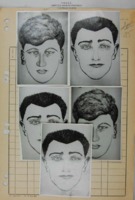 The four images of documents selected here come from a documentary file on the “Catholic problem” and represent clues and evidence used by the Secret Police in order to identify the culprit who wrote a leaflet that requested that at a certain hour on the feast of the Virgin’s Ascension all Greek Catholics, Roman Catholics and friends of the Church should go into the former Greek Catholic churches and say a prayer so that God would grant Nicolae Ceaușescu wisdom to legalize the Greek Catholic Church. The four documents come from volume 6, 10 and 39 of the file and represent forensic sketches used by the Secret Police in identifying the culprit who wrote the leaflet, two typed pages with typewriter alphabet and text, picture of fingerprints on photos from suspected individuals. All these were part of Securitate’s arsenal of methods in capturing the person that initiated the original leaflet. Operațiunea Apelul (Operation Leaflet) was the code name the Securitate gave to the search for the Greek Catholic person or group that wrote a leaflet/ series of leaflets signed by the Committee for the Salvation of the Romanian Greek Catholic Church in 1977. The leaflets were mailed to hundreds of addresses and spread to numerous catholic communities, apartments, churches quickly papering the whole country. Having the underground bishops and most of the more problematic voices of the Greek Catholic dissenters under surveillance the secret police was taken by surprise by this action especially because they had no idea who could have signed the leaflet and orchestrated this operation. From that moment onwards a huge sweep up operation began. The Securitate interrogated all their informants and all the underground bishops and priests. The secret police reactivated all their former informants and created new ones just so they could find who was responsible for the leaflet. For a long while they could not find anything, since nobody knew or was willing to talk about who the Committee for the Salvation of the Romanian Greek Catholic Church was. Thus, the Securitate officers changed tactics. They knew the post offices where the original letters were mailed from and had the original leaflet typed. They interrogated the post office employees and together with criminalists and a sketch artist they drew up several portrete robot (forensic sketches) that presumably represented the people who posted the letters and leaflets. They started to call in Greek Catholics, reactivating several databases of underground believers and clergy, to check their typewriter fonts so they would match the text the secret police had with the typewriter it was written on. This whole process extended over seven years with numerous resources put into the operation. Several arrests were made before they narrowed the search down to Fr. Mihai Pop, a Greek Catholic priest from Cluj. The images come from file CNSAS D69 (volume 6, 10, 39). The file has over 100 volumes on the catholic problem in Romania and documents and photographs on Operation Leaflet appear throughout the file. Along with these images there are interrogation reports, personal files, surveillance reports, surveillance images, confiscated leaflets and propaganda materials.
-
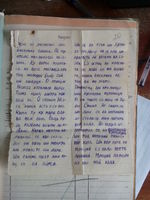 The images show an Inochentist handwritten hymn found by the Soviet secret police officers on an arrested Inochentist preacher in 1952 in Moldova. The hymn describes Jesus's preaching to his followers on the Mount of Olives about the End Time. The Apocalypse, according to the hymn, will begin when people would abandon the church. Then, according to the narrative, the wrath of God would descend on sinners and only those who do not abandon the true faith will be saved. The hymn is written in Romanian using the Cyrillic script. The preacher, who may not be the author of the text but was probably the copyist, wrote his surname at the end of hymn under a decorative drawing. The hymn served as evidence in the case file of the Inochentist preacher on whom it was found. The preacher was charged with sedition and anti-soviet propaganda and was sentenced to 25 years in a labor camp. From the perspective of the police investigation, the Inochentist narratives about the End Time were useful for their investigations because they labeled those “who left the Church” as sinners who were about to be struck down by God’s wrath. The officers perceived the hymn as an attempt by the Inochentist preachers to exploit the “religious superstitions” of the peasantry in order to label the Soviet regime and its representatives as “sinners” that were about to be punished by God. The hymn is attached to file number 3815, fond R-3401, from the National Archive of the Republic of Moldova. The file contains two mugshots and the above mentioned hymn. For related entries see:
-
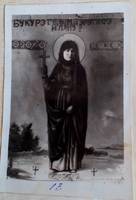 These photographs were confiscated by the secret police of the Moldavian SSR from a community of Archangelists in 1952. Archangelism inherited the iconographic tradition of Eastern Christianity and developed them creatively using modern techniques of photograph, photocopying, collage and multiplication. The first image was produced using the technique of photo collage. The creator of the image has utilised a copy of an Orthodox icon showing a female saint replacing the face of the saint with a photograph of the face of Elena Culiac, venerated by Archangelists as the embodiment of Virgin Mary or the Mother of God as she is more commonly referred to in Orthodox Christianity. She was the wife of Alexandru Culiac, one of the founders of Archangelism who was considered to be the embodiment of the Archangel Michael by the believers. Above the image of Elena Culiac, there is a writing similar to that used on classic orthodox icons that praises her as a saint and as an empress. The other two photographs show two groups of Archangelist women preachers. They are dressed monastic-style robes, holding icons and crosses in a stance similar to those seen in iconographic representations of saints. Archangelism emerged in Bessarabia from mainstream Eastern Orthodox Christianity but one of its distinctive features was the central role that women came to play. Unlike mainstream Christianity where only men can become priests, in Archangelism women hold leadership positions and officiate some religious services. The women had different roles and levels of status inside the community and these hierarchical differences are depicted in their visual representations. Elena Culiac was worshiped as the embodiment of Virgin Mary and she is represented according to sacred iconographic traditions. The first image creates a connection between these older representations of the Virgin Mary and Elena Culiac, encouraging the believer to worship her through this image. The clothes and stance of the women in the second and third photographs, who are shown standing or sitting in distinctive poses, underline their status as preachers. These icon-like images, however, do not gives them the same aura of sanctity associated with Elena Culiac. The small icons held in their hands may be intended to underline this difference. It is unlikely that these photographs fulfilled the same purpose as the photo-icon of Elena Culeac. The women depicted on the second and the third photographs were rather messengers of the embodied saints of the movement. There role was to deliver the word and the icons of the embodied saints to believers. It is no coincidence that three of five icons held by the preachers represent Virgin Mary. The Virgin Mary is the most venerated female saint in Christianity and for Archangelist women the association with her person was the highest mark of respect and status. Not all women in the second and in the third photographs share the same status. According to police records and as the images suggest, one of them held more authority. The women represented seating on the second photograph and sitting on the left side in the third picture held a leadership role in the community. Her status is marked by a special headscarf on the second picture, and by a handkerchief placed on her left lap on the second image. Both the headscarf and the handkerchief are decorated with crosses. On both photographs she is seated on the chair in a central position. These confiscated photographs were used by the police as evidence of the women's involvement in an illegal sect and as a means of identification of other members of the group. Through these photographs the police tried to reconstruct the network of Archangelists in the south of the Moldovan SSR. These photographs are attached to a secret police investigation case file created in 1952. Today the file is preserved under number 3716 at the National Archive of the Republic of Moldova, fond R-3401, inventory 1. It contains a total number of 14 photographs that include one mugshot, one picture showing confiscated religious items produced by the police and 12 confiscated photographs. For related entries see:
-
 The image shows a newspaper cutting of an article signed by Feodor Florea. Florea was a Romanian Orthodox priest who joined the Orthodox mission in Romanian-occupied Transnistria. The article contains a picture of Florea performing a religious service. This newspaper cutting was used by the Soviet secret police as evidence of his collaboration with Romania occupation in Ukraine. Following the Axis invasion of the USSR in June 1941, Romania liberated Bessarabia and Northern Bukovina, which had been briefly occupied by the Soviet Union, and continued military operations over the river Dniester on territories that had never before belonged to Romania. In the occupied south-western region of the Ukrainian SSR, which was named Transnistria by the Romanian military administration, the Romanian Orthodox Church organised a mission to revive local religious life and to reopen and rebuild churches closed or destroyed by the Soviet regime. From the perspective of the Soviet regime this Romanian Orthodox missionary activity was an attempt by the Romanian occupiers to propagate its Romanian national ideology. The preaching of the Orthodox missionaries in Transnistria had an “anti-Soviet character” in that it attempted to combat the anti-religious policies and propaganda of the Soviet regime. Feodor Florea had been Dean of Odessa, had taught in the local Seminary and had written several articles in the newspaper “Молва” and in the journal “Христианская Транснистрия”, a Russian language newspaper published daily in Transnistria during Romanian occupation. The article used as evidence against him outlines the role of “Молва” to reflect the life of society and to show it the path to a “bright future” through the promotion of Christian values and morality. Feodor Florea was arrested in 1945 for “active anti-Soviet propaganda” in the occupied territories and was sentenced to 10 years of prison. The newspaper cutting is contained in the investigation case file number 2028, compiled by the secret police of Soviet Moldavia in 1945, and preserved nowadays in the archival fond R-3401, inventory 1, in the National Archive of the Republic of Moldova. The file contains investigation documents regarding Florea’s activity during the war created by the police officers and a number of newspaper cuttings similar to the above mentioned article. For related entries see:
-
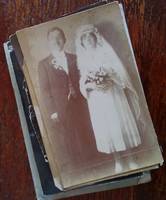 These photographs are part of a family album found on a woman who tried to cross the border between USSR and Romania that was confiscated by the Soviet secret police in 1940. They depict different moments from the life of the family, such as a wedding and a day spent at the seaside in Odessa. The album contains images of members of the family at different ages and of some of the family’s friends. For over a hundred years both banks of Dniester river were part of the Russian Empire until 1918 when Bessarabia united with Romania and the river became frontier between Romania and the Soviet Union. The new border and the hostilities between the Soviet Union and Romania brought numerous changes to the region but did not put an end to the personal ties between the people on the two banks of the river. In the winter of 1940, a woman of Bessarabian origin living in Odessa tried to join her family that lived on the Romanian side of the frontier by crossing the frozen river Dniester. The border was frequently transgressed from both sides by people seeking a better life or escaping repression. The number of illegal crossings from the Soviet side in Romania increased during the famines and during the collectivisation of agriculture. Some of the inhabitants of the villages located close to the river also crossed to visit their relatives across the border or were practiced smuggling. Those wanting to flee from the country were helped by the people living in the border area who knew the best places to cross Dniester. Many were arrested or even killed when trying to cross. The women whose family album was confiscated by the Soviet secret police tried to illegally cross the border with the help of a guide from Nezavertailovca, a village near Tiraspol. They were both arrested and sentenced to five and three years imprisonment respectively. Family albums were of interest to secret police as the the Communist Party’s project of social engineering required extraordinary powers of the state over the citizen, including in his/her family life. The Soviet state was therefore very attentive to kinship relations, which from the regime’s perspective could in certain conditions undermine ones devotion to the state and the party. From the secret police perspective, the arrest of a citizen could lead to the development of anti-soviet sentiments amongst the members of his family or friends, who could then also become involved in different kinds of conspiracies. Collecting family pictures, as well as registering data regarding family networks of those who had been convicted was part of the secret police’s attempt to identify those parts of the society from where anti-Soviet elements were more likely to come. The album shown here was found on a person who had relatives abroad as some of the persons depicted in the photographs lived in Romania. The album therefore could be used to prove the existence of cross-border networks that were perceived as dangerous and from the perspective of the secret police and may also have been used to identify other would be transgressors. Likewise, the family photographs could provide secret police with data regarding the past of the arrested persons. For example, the economic state of the family is reflected in the material items displayed on the photographs, (clothing, housing, the quality of the photographs and the workshops were they were produced). The photography revealed the social status of those depicted on it. Likewise, the photographs allowed the officers to identify places visited by the convicted persons, and to read on their reverse notes about personal impressions, fillings, and attitudes. The abovementioned photographs are part of the file number 595, found R-3401, inventory 1, preserved at the National Archive of the Republic of Moldova. The file contains approximately 20 family photographs belonging to the woman who tried to cross the frontier, her birth certificate and an autorisation to travel to Romania issued in 1937 by Romanian Royal Diplomatic Legation in Odessa. For related entries see:
-
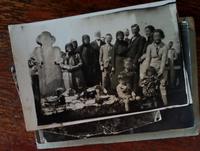 The photograph shows a family from Bessarabia in a cemetery of Chilia Nouă celebrating Paștele Blajinilor (in Romanian) or Radonitsa (in Russian), the day when the Orthodox Christian families commemorate their deceased relatives. Almsgiving has a central place in the commemoration of the dead in Orthodox Christian tradition. It is believed that by offering to each other bread, cookies, fruits, tableware items and drinks, the believers redeem the sins of their deceased relatives, and satiate the dead’s thirst and hunger. This is why the grave in the image is covered with various items that were due to be offered as gifts. Celebrated one week after the Orthodox Easter, Paștele Blajinilor or Radonitsa is a day when the entire family are gathered in the cemetery. This family used this occasion to take a picture, a copy of which was later sent to a relative who could not attend the commemoration and who was arrested by the Soviet secret police in 1940. The photograph was confiscated from a woman arrested when trying to flee from USSR to Bessarabia (at that time part of Romania). The photograph was important for the secret police investigation because it depicted cross-border family networks. The photograph have been attached to the investigation file 595 that is preserved in the archival found R-3401, inventory 1, at the National Archive of the Republic of Moldova. The file contains another 21 family photographs, a birth certificate and a visa issued in 1937 by the Romanian Royal Diplomatic Legacy in Odessa. For related entries see:
-
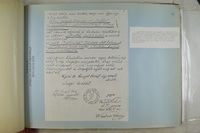 The first image comes from a photo album compiled by the Securitate on the Hungarian Calvinist Church Choir in the town of Ocna Sibiului (Vízakna). It shows a photocopy of a confiscated document, the last page of the choir’s president’s celebratory speech performed at the choir’s 80th anniversary. As with many of the group’s documents, it bears the official stamp of the choir. The second photo shows a document with a hand drawn replica of this stamp. This document, which is the last page of a handwritten copy of the choir’s Rules and Regulations from 1974 (its original was written in 1956), is still kept in the local Calvinist church. The stamp, along with a large part of the choir’s documentation was taken during a secret police raid in 1973 when authorities accused the choir of nurturing nationalist-irredentist ideals behind the façade of their church functions and of being hostile to the socialist Romanian state. It was claimed that the choir’s real aim was to maintain the national identity of the local Hungarian minority and to instil Hungarianess in the next generation. Although the choir was allowed to operate after the raid, it was “robbed of its past” since none of the confiscated items were returned. Some attempts were made to compensate for this loss: for example, several documents were recreated by the choir’s former secretary who, in lieu of the missing stamp, created a hand-drawn replica when necessary. This practice serves as an example of how groups that had been pursued by the secret police tried to cope with the loss of their belongings: in this case the loss of the choir's recorded history and an important symbol of its legitimacy, its stamp. The Ocna Sibiului Calvinist Church Choir was founded in 1889. From 1907 it officially operated as an association with a president, secretary, accountant and had its own banner and stamp. Its main task was to sing at the funerals of congregation members and at church services but was also central to organising community life for local Hungarians. The choir still functions today. The first image comes from file CNSAS D 015847. The second was taken during ethnographic fieldwork in 2018. For related entries see:
-
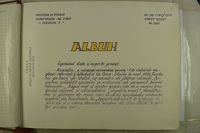 These images come from a photo album compiled by the Securitate on the Hungarian Calvinist Church Choir in the town of Ocna Sibiului (Vízakna), Transylvania. The first image shows the title page of the album with a short introduction to the choir and its supposed activity. In the second image, we can see photos which were most probably taken by the secret police displaying the decorated walls of the choir’s meeting place. The third image includes shots taken in the usual fashion of crime scene photographs of items confiscated from the choir during a secret police raid. The fourth image shows close-ups of confiscated musical scores with Hungarian themes, the national anthem of Hungary amongst them. In 1973, the choir was accused of nurturing nationalist-irredentist ideals behind the façade of their church choir and of being hostile to the socialist Romanian state. The album, which itself is a documentary file containing photos of confiscated documents and images owned by the group or taken by the secret police, was carefully designed to support this claim. It starts with a five and a half page report on the history and activity of the choir stating that the choir’s real aim was to maintain the national identity of the local Hungarian minority and to instil Hungarianess in the next generation. The reporting officer made efforts to portray the choir as a conspiratory group not independent of other equally dubious Hungarian organisations. He claimed that it had negative influence on the discipline of the local community. The album then continues with group photographs of choir members, exterior and interior photos of the group’s meeting room focusing on its Hungarian patriotic decoration, crime scene photos of confiscated materials, selected operative documentation of the choir (minutes of meetings, financial reports, membership lists etc.), its correspondence with past members or other organisations, musical scores and finally, several pages taken from confiscated notebooks written by the choir's former secretary, an elderly man who was an amateur local historian and an avid preserver of memories of the local Hungarian past. The photos are often amended with explanatory captions that give translations of the documents or point to the nationalistic nature of the choir; for example, under the 1971 group photo the officer writes: “the colour of the (previously Hungarian national) flag is now black, the symbol of mourning, and the Hungarian tricolour is carried secretly in the hearts of the members.” From the report we know that after the raid some leading members were interrogated by the secret police and were kept under surveillance afterwards. The choir was allowed to continue with its church related duties but local party leaders were ordered to “pay more attention to the proper education of local Hungarians.” Ethnographic fieldwork revealed that the Securitate’s attack on the choir is still part of the community’s memory and oral history. As several members recalled, the operation on the choir had been drawn up by an ethnic Hungarian officer who befriended the choir’s former secretary. Playing on his Hungarian roots he claimed to be interested in Hungarian historical matters and cajoled the old man to loan his historical writings to him. A couple of days later the Securitate launched a raid on the choir’s meeting place and confiscated most of its documentation and its official stamp. These items, as well as the notebooks taken from the ex-secretary were never returned. Loss of these materials meant the loss of a large part of the choir’s past. Fieldwork with surviving members of the choir has revealed that the community had made efforts to compensate for this loss: some of the notebooks had been rewritten or recreated since. Accusing religious groups with ethnic minority backgrounds of being nationalist or irredentist was common in socialist Romania. As this case shows it was not always religion or religious practice that the authorities were after but the supposed political affiliations of these groups. The Ocna Sibiului Calvinist Church Choir was founded in 1889. From 1907 it officially operated as an association with a president, secretary, accountant and had its own banner and stamp. Its main task was to sing at the funerals of congregation members and at church services, but was also central to community life for local Hungarians. The choir still functions today. The images come from file CNSAS D 015847. For related entries see:
-
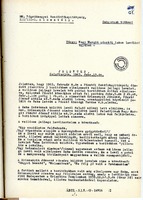 These images show the pages of a secret police report on an investigation concerning three letters with religious content. The letters were addressed to a candidate for the local Member of Parliament and the municipal council’s president of a small town in northern Hungary and were posted locally. They contain various religious narratives and a short section about the funeral of Pál Jávor, a famous Hungarian actor. The report comes from a documentary file titled “Religious sects” in Nógrád county which mainly deals with Baptist communities (belonging to an officially acknowledged free church), Baptist splinter groups and Jehovah’s Witnesses. This file demonstrates the fine line between tolerated and not tolerated religious activity, while also providing a glimpse into the investigative methods of the secret police. Sent to local political figures in sensitive times just before the upcoming elections, the letters immediately seemed suspicious: authorities considered them implicitly incendiary and an attempt to influence the addressees. Although one letter bears the name of the sender, a local woman from the Baptist community, the police carefully examined their content and graphic appearance to identify the writer. On the basis of their analysis, they concluded that the writer was someone with at least high-school education, was deeply religious, well versed in church teachings and an experienced typist. The author was most probably female, since “the letters were typed smoothly and evenly”, which is not characteristic of male typists. They also pointed to the peculiar features of the type-writer which could later help identify the machine: small and capital letters “e” were closely followed by the next letters and the small “a” showed certain differences to the small “á”. Authorities also concluded that the writer and the typist were the same person, who – they assumed – could even have been a church person. Although first thought not to be educated enough to be the real writer of the letters, the perpetrator turned out to be the woman whose name appeared on the envelope as sender. During her interrogation she proved to fit the description of the suspected writer: she was religious, finished four years of secondary school, studied as an office clerk and had access to a typewriter which was in poor condition. She confessed to having written the letters out of gratitude because both addressees had been helpful around the death of her brother. Due to her poor health – and also probably to the goodwill of the local authorities – she was not punished severely: she received an official reprimand and was warned not to send religious letters to people outside their “sect”. As this case shows, in Hungary of the 1960’s members of officially accepted and controlled churches could practice their religion as long as they confined their activities to their own circles and remained politically neutral. The letters also reveal something about how religious people may have understood their world: even if it seemed risky, the best way this woman could think of expressing her gratitude was in terms of her faith. The report is included in file ÁBTL 3.1.5 O–14916, containing informant reports and summary reports on religious sects. The letters in point were not included in the file. For related entries see:
-
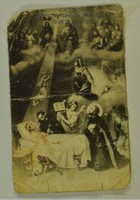 These images depicts a small icon that was confiscated by the secret police from an Old Calendarist believer. The first image shows the front of the icon, which portrays what seems to be the fight between good and evil, the holy trinity, angels, saints, numerous religious symbols, as well as two priests that are praying for the soul of a dying man. The second image shows the back of the small icon which has a short text. The first part of the text is indecipherable, but the second part states: “[...] Pray this prayer and feel that fear comes into your blood and body. Look at the dead man and how his soul is going up, towards the heavens.” It also mentions the name of the person to whom the icon belonged, which was “Păun”. According to the police reports included in the file, Păun was a “mystical person, a fanatic for his faith which was the old style,” referring to his adherence to the pre-reform Julian Calendar. He sent numerous requests to the state authorities, asking for the reopening of the Old Calendarist church in Păunești, Vrancea county. The church was closed in 1971, at which point Păun began sending letters in which he pleaded for the legalization of the Old Calendarist church. Apart from this small icon, the file contains a few papers on which he wrote Psalms and prayers. It is not certain if these items were confiscated from him by the police or if he attached them to the letters that he sent to the authorities. However, the reports state that he was threatened by the police on numerous occasions due to his insistent letters in which he would sometimes include “mystical materials.” This image can be found in the file CNSAS, I 1075010, vol. 4. Apart from this photo, the files also contains police reports, lists of names, three more photos and other items that belonged to Păun. For related entries see:
-
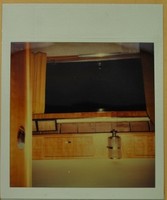 These photos were taken in 1984 and depict religious materials that were confiscated from three West German citizens who were trying to smuggle them into Romania. The first photo depicts the inside of the trailer that the tourists were driving. The material was carefully hidden inside it so that it would not be easily discovered by the Customs Officers. Based on the report that was attached to the photos, the materials were found in a specially designed place in the ceiling of the trailer. The second and third photos depict all the materials that were confiscated from the German citizens. Among them we can see many Bibles, New Testaments, brochures, calendars, cassettes and songbooks. The report mentions that they were bought from a printing house in Stuttgart and were destined for so-called Neo-protestant churches (in Romania smaller Evangelical or new churches are referred to using this term). According to the report present in the file, the three people belonging to the Evangelical Church tried to enter Romania in July 1984. The books and brochures that they were smuggling were supposed to reach the Evangelical Christian churches in Romania, as they had a lack of such materials. The officers rejected this assertion as fake propaganda that was being spread in Western countries. As usually happened in such cases, the materials were confiscated along with the list of names that they were supposed to be delivered to. The tourists were fined and not allowed to return to the country. Based on the information contained in the report, it seems that this case posed some problems for the Customs Officers and for the authorities. It made them ask for more thorough investigations in such cases in order to better understand the channels used by Western countries in order to smuggle these materials. The photos can be found in the file CNSAS, D 00003, vol. 1. Apart from these three photos, there is one other photo referring to this particular case, 25 photos concerning two similar cases, as well as other police reports and instructive materials for the officers on how to act in these types of situations. For related entries see:
-
 These photos were taken in 1985 and show the search by Customs Officers of a car belonging to three tourists who were trying to cross the border into Romania. This was a normal procedure and any attempt to smuggle religious materials into the country was considered dangerous and an attack against the regime. The first image depicts the three tourists together with all the religious material that they were presumably hiding in their car. Among the books we can see a few Bibles, brochures, calendars, some cassettes and songbooks. These materials were confiscated along with the list of names of the people that they were supposed to be delivered to. The second image shows the officers as they were uncovering the religious materials that were hidden in the car. These type of images are recurrent in evidence files and they are used to prove the guilt of the persons trying to smuggle religious or other forbidden materials in the country. Similar to the second image, the third and the forth photos depict the officers pulling religious books out from their hiding places. The photos were taken at the precise moment (or were staged to appear as such) in an attempt to emphasize the dramatic character of the situation and to further incriminate the smugglers. The books were hidden in various hard-to-reach places inside the car such as the engine area, as can be seen in the forth image. According to the report present in the file, the three people tried to enter Romania in September 1985 but there is no mentions of where they came from. However, based on the registration plate of their car, as depicted in some of the photos, it is safe to assume that they were West German tourists from Karlsruhe, presumably Christians belonging to a protestant or Evangelical church, that were trying to smuggle religious materials inside the country. The tourists were fined and denied access to the country. The photos can be found in the file CNSAS, D 00003, vol. 1. Apart from these four photos, there are seven other photos referring to this particular case, 18 photos concerning two similar cases, as well as other police reports and instructive materials for the officers on how to act in these type of situations. For related entries see:
-
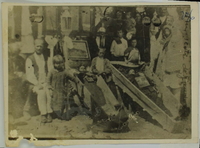 This photograph was taken in 1934 or 1935 in the village of Toporăști in the county of Vaslui. It depicts the funeral of two victims of the Romanian Gendarmerie following an attack on their church in an attempt to arrest the community's priest. The first image shows a few Old Calendarist believers surrounding the coffins of two people, a man and a woman. They seem to have two icons placed on their chests and we can see that three of the children present in the photo have their hands on the coffins, implying that this is their parents' funeral. There is a short note on the right edge of the photo that states: “Shot by the Gendarmes”, suggesting that they were killed during a direct confrontation with the Gendarmes. The second image shows the back of the photo which has a short text describing the event in the photo. The text states as follows: “From the massacre in Toporăști- Vaslui. Mother and father shot by the Gendarmes of the former regime for this belief,” referring to the Old Calendarist belief. It is unclear to whom the photo belonged or how it ended up in the file. The events that happened in Toporăști in 1934 are similar to the events in the village of Cucova, and mark the beginning of a series of confrontations between the Old Calendarists and the Gendarmes. Described as massacres, these attacks were meant to dissipate the Old Calendarist communities in the region. Even though it is not very clear what caused the incident in Toporăști, it seems that the Gendarmes surrounded the church in an attempt to arrest the Old Calendarist priest present there. Based on some archival documents and other sources, 12 Old Calendarists and 4 Gendarmes were wounded and 3 Old Calendarists were killed during the confrontation. In 1936, two years after this event, police reports state that the Stilist movement was no longer active in the region. This image can be found in the file CNSAS, I 1075010, vol. 4. Apart from this photo, the file also contains police reports, lists of names, two more photos and other confiscated items from an Old Calendarist believer. For related entries see:
-
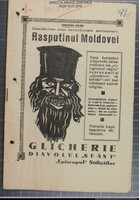 These four images are part of a brochure written in or around 1936 by Grigore Spiru, a well known Romanian journalist of the interwar period. The brochure, whose main characters are Glicherie Tănase and his alleged mistress, Maria Gârleanu, was meant to combat Old Calendarist ideas and to portray the Stilists (referring to "old style"), as Old Calendarists were referred to, in a negative manner. The first picture depicts the cover of the brochure, entitled “The Rasputin of Moldova. Glicherie, the holy devil and the Stilist bishop”, as well as a caricature of Glicherie. The comparison with the famous Rasputin was not coincidental and it mainly referred to Glicherie’s power of attracting large crowds of peasants, many of whom were women. The text also calls him “the black monk” and it makes references to the activities that were supposedly happening in various Old Calendarist churches, such as orgies, fake miracles and the use of real blood during the Eucharist. The second picture can be found on the inside of the brochure and it depicts a caricature of Glicherie, as well as the title “The childhood and…monasticism of Glicherie”. The caricature itself, as well as the term bishop written between quotation marks, are meant to mock Glicherie’s status amongst the Old Calendarists. The text goes on to describe Glicherie’s childhood in a very different manner from the way that it is recorded by the Old Calendarist church, portraying him as a charlatan from a very young age and motivated in his choice of the monastic path by financial reasons. The third picture can also be found on the inside of the brochure and it depicts a caricature of Maria Gârleanu. She was often described as the mistress of Glicherie Tănase, as well as his accomplice, especially in Glicherie’s attempts to stage various miracles in order to impress the peasants. In the brochure, Spiru depicts Maria Gârleanu as an adventurous woman, fascinated by various monastic figures, especially by Rasputin, whom Glicherie is said to have resembled. The forth picture depicts a caricature of Glicherie holding a bottle of alcohol, pointing to the Old Calendarists’ alleged immoral behaviour. Spiru goes on to describe how the Old Calendarist priests received gifts from naïve believers whilst spending their time drinking alcohol and luring young women. The brochure, which appeared in 1936, was meant to combat the Old Calendarist ideas and was part of a narrative that was encouraged and propagated by the Orthodox Church. These images, along with the brochure, can be found in the file CNSAS, D 013408, vol. 1. Apart from this brochure, it contains police reports, lists of names and newspaper articles that refer to the so-called Stilist rebellions from 1935- 1936. For further readings see: ”Isprăvile lui Glicherie episcopul stiliștilor” in Universul, No. 257, September 17, 1936. For related entries see:
-
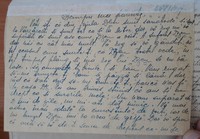 These images show a postcard sent by an Old Calendarist nun to her family whilst in detention. It is a particularly sensitive letter as it conveys the struggles of the nun who appears to have been rejected by her parents for reasons that are not clear from the information we have. The first image shows the face of the postcard and it contains references to the sufferings that the nun had endured for the last two years. From the message that she wrote to her parents, she seems to accuse them of having forgotten about her during these hardships and she reminds them that she is still their daughter and shares the same rights as her other sisters. The reason for her being treated like this by her parents are not described in the postcard but she makes a statement that might hint at it: “ I always cry and pray to God that He won’t abandon you, that you will get to know the good and the bad.” The statement could imply that her parents were religious and disagreed with her decision of becoming a nun or that they might have accepted the New Calendar, thus putting them at odds with her adherence to the Old Calendar. The second image shows the back of the postcard. It contains information that makes it clear that the postcard was sent from Vărzărești Monastery, one of the Orthodox monasteries where Old Calendarist nuns were detained and, according to some Old Calendarist literature, forced to accept the New Calendar. The nun asks her family to come and visit her, she wishes them happy holidays and asks for forgiveness. This postcard offers us a glimpse of the emotions and personal challenges faced by nuns and women who rejected the Orthodox Church calendar reform. This is contrasted by the very different image of Old Calendarist women that was portrayed in the press and Orthodox Church publications of the time. The author of this postcard chose to suffer because of her religious convictions. Although the archives do not preserve a reply to her postcard and we are not aware of her fate, she seems convinced that there is reason to her suffering for her faith. This is a recurrent theme in the letters and postcards written by Old Calendarist women in detention. These images can be found in the file ANIC, Insp. Gen. al Jand., D 25/1937. Apart from this postcard, it contains many more letters and postcards sent or received by Old Calendarist nuns that were detained at various Orthodox Monasteries in Romania. For related entries see:
-
 These images show a postcard sent by an Old Calendarist nun to her family in which she describes how she was arrested and sent to an Orthodox Monastery. The postcard was confiscated and attached to a file that contains many such postcards. They all date from approximately same period of time between 1936 and 1937. The first image represents the face of the postcard and includes important details about the fate of the nun. She describes to her family how she was arrested, where she was taken and what the conditions at the Monastery were like. Arrested by the Gendarmes on her way to the post office, the nun was taken from Oniceni (Neamț county) to Ciolanu Monastery (Buzău county), where all her things were confiscated. There were 70 nuns there altogether who were put into four rooms. She had to share a room with 20 other nuns. The second image shows the reverse of the postcard. It offers important information about the regime that the nuns lived under at the Monastery. She asks her parents to write back to her, but carefully, as their letters are first read by someone else implying that she may suffer consequences if the letter contained anything compromising. The image shows how the nun filled the entire postcard writing in order to convey as much information as possible. On the right edge of the back of the postcard she wrote a cramped note asking her family who was still alive in the village. This may have been due to her wish to pray for anyone that was deceased, or it might be a direct hint at the policy of violent repression and arrests that the Old Calendarist church was subjected to on the part of the Gendarmes. Written in 1937, a short time after a series of so-called Stilist "rebellions" in Besserabia, this postcard is proof of the waves of arrests that followed these events, which sometimes included nuns and Old Calendarist women. When caught by the Gendarmes in the woods, or during Silist agitations, women were arrested and most of the time fined or sent to detention in Orthodox Monasteries. Vărzărești Monastery was one of the main places where Old Calendarist nuns were brought and according to some Old Calendarist literature, they were forced to accept the New Calendar there. The intimate and private lives of the nuns in detention revealed by these postcards contrasts sharply with the way they were portrayed in the press of the time as dangerous and rebels. These images can be found in the file ANIC, Insp. Gen. al Jand., D 25/1937. Apart from this postcard, it contains many more letters and postcards sent or received by Old Calendarist nuns that were detained at various Orthodox Monasteries. For related entries see:
-
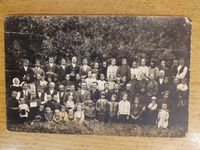 This photograph was confiscated in 1948 by the Soviet secret police from a Romanian peasant repressed as a follower of the Reformed Adventist Church in Chernivtsi oblast (former Northern Bukovina), Ukraine. The photograph was included in his criminal file. It pictures a community of Romanian Adventists who are festively dressed with most of them holding Bibles as a symbol of their faith. Apart from this photograph the police also confiscated a notebook with religious songs handwritten in Romanian language. According to the file, Vasilii Litvan was a poor, illiterate Romanian peasant who lived in the small village of Pripruttia all his life. He was born at the time when Northern Bukovina was part of Romania and he was baptised by a Romanian Adventist missionary in 1924. In 1931, following the teachings of missionaries from Transylvania, he joined the Reformed Adventist movement. Before the annexation of Northern Bukovina by the Soviet Union and during WWII, when Romania temporarily regained Northern Bukovina, Litvan was twice sentenced for his beliefs by the Romanian courts. His third sentence in 1948, was received from a Soviet court. This time he was sentenced to 10 years in a labour camp. As evidenced from the file, the secret police also created a separate criminal case against 17 other of Litvan’s fellow-believers from his village, including his wife. The Reformed Adventist movement, which had split from the Church of the Seventh-Day Adventists, was banned in the Soviet Union. Its followers rigorously followed the sixth commandment “Thou shalt not kill” and therefore refused military service, obligatory in the Soviet Union. They also had specific dietary restrictions and were vegetarians. Most of the repressed Reformed Adventists in the Soviet period were charged for their refusal to serve in the Red Army and for so-called anti-Soviet activity and propaganda. This photograph comes from the Archive of the Security Services of Ukraine in Chernivtsi oblast, spr. 5821-П. Apart from this image, the file contains Vasilii Litvan's arrest form with his mugshot arrest photograph, interrogation reports, the indictment, a confiscated notebook and a document relating to his rehabilitation issued in 1992. For further readings see: Kuromiya, Hiroaki. Conscience on Trial. The Fate of Fourteen Pacifists in Stalin’s Ukraine, 1952-1953. University of Toronto Press, 2012. Lohne, Alf. Adventists in Russia. Washington, DC: Review and Herald Pub. Association, 1987. Parasei A.F. and N.A. Zhukaliuk. Bednaya, brosaemaia bureiu… Istoricheskie ocherki k 110-letnemu iubileiu Tserkvi adventistov sed’mogo dnia v Ukraine. Kiev: “Dzherelo zhittia”, 1997. Sapiets Marite. True Witness: The Story of Seventh-day Adventists in the Soviet Union. Cambridge: Keston Institute, 1990. For related entries see:
-
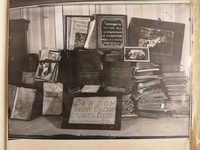 The images come from a 2-volume criminal case against fourteen followers of the Reformed Adventist movement in the provincial town of Bila Tserkva, Ukraine dating from 1952. All of the arrested believers were poor, barely literate Ukrainian peasants who practiced their faith privately in their homes. All of them were found guilty of anti-Soviet activity and refusal of military service and were deported to the Gulag. The photographs show religious manuscripts, books and photographs confiscated during their arrest. The images of the confiscated items were included in the file as evidence of the criminal activity of the group. The original books and photographs were later destroyed (a full list of confiscated items is included in the file). In the first image, along with the pile of manuscripts, we can see several photographs, including one picturing a collective baptism. The second image shows two photographs pasted over a sheet of a file. The upper photograph depicts handwritten manuscripts and published books and journals; in the bottom photograph we can see nicely framed posters with religious passages and citations from the Bible that seemingly were hung on the walls of their houses. The third image depicts confiscated journals with sheet music. It remains unclear why a group of believers defined in the criminal case as almost illiterate possessed such large number of religious books and manuscripts. These photographs come from the State Archive Branch of the Security Services of Ukraine in Kyiv, f. 6-fp, spr.58859. The file contains six photographs, arrest forms of the repressed believers with their arrest photographs, numerous interrogation reports, the indictment and other documents. More about this case see: Kuromiya, Hiroaki. Conscience on Trial. The Fate of Fourteen Pacifists in Stalin’s Ukraine, 1952-1953. University of Toronto Press, 2012. For further readings about the Adventist Church in Ukraine and the Soviet Union see: Lohne, Alf. Adventists in Russia. Washington, DC: Review and Herald Pub. Association, 1987. Parasei A.F. and N.A. Zhukaliuk. Bednaya, brosaemaia bureiu… Istoricheskie ocherki k 110-letnemu iubileiu Tserkvi adventistov sed’mogo dnia v Ukraine. Kiev: “Dzherelo zhittia”, 1997. Sapiets Marite. True Witness: The Story of Seventh-day Adventists in the Soviet Union. Cambridge: Keston Institute, 1990. Teppone, Vladimir. Iz istorii Tserkvi adventistov sed’mogo dnia v Rossii. Kaliningrad: Tserkov Khristian ASD, 1993. For related entries see:
-
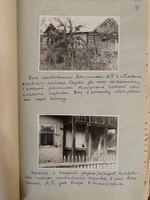 These images were included in a 14-volume criminal file against seven Jehovah’s Witnesses (JW) leaders from western Ukraine (former Drohobych and Stanislav region), 1955-1956. The photographs were produced during a police raid of an underground bunker printing press operated by the Witnesses in a rural location. The photographs were used as incriminating evidence of their clandestine illegal activities. The first image shows a rural private house in Smodne village under which the bunker was constructed. The place was also used as a safe house where several members of the JW organisation were hiding to avoid arrest. The top photograph from the second image shows a bunker air-way masked with sheaves. The third image shows the evidence found as a result of the police search: confiscated printing equipment (rotator, wax stencil, paper, typeface, and ink), samizdat religious materials, as well as an entrance box from the bunker. The bottom photograph on the third image pictures an arrested believer (and the owner of the house) sitting with the confiscated items. The bunker printing press was discovered by the police in 1955 as a result of a major secret operation against the JW leadership in Ukraine. Among the arrested persons was Bogdan Terletsky, the leader of the Jehovah’s Witnesses in the Soviet Union from 1953-1955, who had been on a secret police wanted list since 1950. Under intense pressure and after numerous interrogations, Terletsky’s spirit was broken and he agreed to cooperate with the secret police. Later, during the 1960s, he would give evidence in trials against other Jehovah’s Witnesses. The Soviet authorities considered the Witnesses an anti-Soviet organisation and denied it legal recognition. The Soviet secret police conducted mass arrests of the Witnesses, carried out two major deportations of the Witnesses and their families from the western Ukrainian borderland and Moldova (in 1949 and 1951), and ran numerous secret operations to disclose their complex underground networks. Despite state repression, the Witnesses in the Soviet Union proved remarkably resilience, with the number of members steadily growing throughout the entire Soviet period (see Baran 2014). The repression they endured made the Jehovah’s Witnesses in the Soviet Union an insular organisation, with internal hierarchy and leadership, a coded reporting system and finances, smuggling operations, and clandestine communication channels. They also ran a complex underground network of printing presses that were of particular targets to the secret police. The images come from the State Archive Branch of the Security Services of Ukraine in Kyiv. The file reference is: fond 5, sprava 42795, tom 13. The file consists of fourteen volumes and contains interrogation records of arrestees and witnesses, reports of the police raid, decisions of a commission of experts regarding the anti-Soviet message of confiscated religious literature, etc. The whole volume (No. 14) consists of confiscated Jehovah’s Witnesses material: coded financial and missionary reports, internal instructions, a list of names of arrested Witnesses with addresses of detention places, personal correspondence and photographs. For further readings see: Baran, Emily. 2014. Dissent on the Margins: How Soviet Jehovah's Witnesses Defied Communism and Lived to Preach About It. Oxford University Press. Berezhko, K.A. 2012. Istoriia Svidkiv Egovy v Ukraini: u 5 tomakh. Feodosiia: Art-Life. Ivanenko, S.I. 2002. Svideteli Iegovy – traditsionnaia dlia Rossii religioznaia organizatsiia. Moscow: Art-Busines-Center. For related entries see:
-
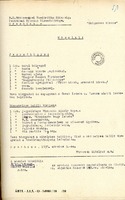 The image shows a typewritten copy of a list of confiscated items that were taken from the home and workshop of Mihály Virasztó during a house search on 5 March 1957. He was a former member and táltos (ritual specialist) of the Church of the Turan Believers of One God. The list contains several items that are directly linked to the group: a “turan stamp”, a “turul” stamp (turul is a mythological bird used as a national symbol in modern Hungary), a book of ceremony, a book written by the groups founder, Zoltán Bencsi, and various copies of “Turanist journals”, possibly referring to the radical Turáni Roham (Turan Attack) published between 1934 and 1939. Beside these, the secret police also expropriated a book on Hungarian history, a Hungarian travel atlas, a hand-drawn map, legal documents, photos, a poem, and two dossiers, one containing newspapers and the other private letters. The list comes from Virasztó’s surveillance file, which was opened in 1968 but contained various documents and informant reports from before this time. From these we learn that Virasztó was arrested on 12 March 1957, seven days after the house search, for the illegal possession of a firearm. It is interesting to note, however, that no weapons were mentioned in the list of confiscated items above, which suggests that another house search may have been conducted at the time of the arrest. The authorities’ action in 1957 was a result of his supposed activity in the 1956 Hungarian Revolution and his former involvement with the Church of the Turan Believers of One God. According to a summary report written before the house search on 26 February 1957, Virasztó had reorganised the Turan Believers after 1945, and had been hosting their meetings in his home and corresponding with other similar organisations. As the report claims his group was active in 1956, spreading rumours before the October events, and producing and disseminating anti-communist leaflets during the revolution. They also called for strikes. The report also briefly introduces the Church of Turan Believers characterising it as nationalist, chauvinist and racist. It even gives a short description of their initiation rites: “new members were anointed with jam. This procedure was formerly effected with blood; the Catholic Church has condemned this ritual as different from the usual ceremony of Christian baptism and launched a counter attack on the “Turanian” organisations.” Following the incident Virasztó was interned for 15 months, although the authorities could not prove his ownership of the weapon found. Mihály Virasztó had a long police record in both regimes before and after 1945. As a priest (táltos) and missionary of the Church of the Turan Believers of One God he was repeatedly condemned to prison at the end of the 1930’s for „agitation against religious denominations”. He remained on the radar of authorities in the communist regime for his anti-communist political views and activity, his relationships with right-wing figures abroad, and also for his past and supposedly present involvement with the Church of Turan Believers of One God. He had several clashes with the authorities: apart from his 1957 case, he was imprisoned for two months in 1952 for slander, and his mental health was investigated and he was sent to a mental hospital in 1964 and 1967. After his last release in the summer of 1968, he was placed under the guardianship of his wife. His file was closed in 1972. This image comes from the file ÁBTL 3.1.5 O-14980/18, which also includes confiscated personal letters and photographs, issues of Keleti Figyelő (The Orient Observer), two poems written by Virasztó, medical reports, interrogation minutes, and informant reports. For more on Virasztó and the Turan Believers of One God see: Ablonczy Balázs 2016 Keletre Magyar! A magyar turanizmus története. Budapest, Jaffa Kiadó. Fazekas Csaba 1996 Kisegyházak és szektakérdés a Horthy-korszakban. Budapest, TEDISZ–SzPA. Szécsényi Mihály 2013 Virrasztó Koppány és társai. A Turáni Egyistenhívők és a hatalom az 1930-as évek második felében. In Lukács Anikó (szerk.): Rendi társadalom – polgári társadalom 25. Budapest, Hajnal István Kör, 349–362. For related entries see:
-
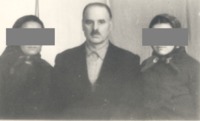 This confiscated photograph was included in a personal file of an Inochentist leader alongside several others collated by the Romanian Securitate. The image shows the male leader flanked by two women from the community. Such group and community photographs feature heavily amongst the corpus of confiscated images in the secret police archives in Romania as for the secret police they were a convenient means of tracing networks and personal relationships of the religious underground. The case file does not state when the images were confiscated but from an Informer Report that appears elsewhere in the personal file we learn that in February 1965 the members of a “sisterhood” of Inochentist women were being investigated by the Securitate because of their links to the leader in the photograph, a “Saint” referred to by his flock as the prophet “Elisha” with the initials C.A. The informer, “Dan Gheorghe” (not his real name), who had either infiltrated the group or been recruited from within it, after a conversation with the “sisters” reported the following: “She [one of the leaders of the group] told me that the militia man [who lived next door to her] got hold of a photograph of her with C. A. and M. and that if she is asked by the militia if she knows C. A., that she won’t say no because the militia have the photograph, but if she is asked about other “brothers” in the group she will say nothing even if they cut her into pieces. I asked her how the photograph reached the militia and she told me that she was photographed together with those I mentioned above, then she sent the photograph to C. A. through the post and in this way the militia had made a copy of the photograph” (CNSAS I 237454, vol. 3, 57.). This short extract from the Informers Report tells us a lot about the biography of this particular photograph revealing how the image was produced by members of the community, how it was shared, how it was intercepted by the secret police and finally how it was transformed into incriminating evidence that could be used to identify members of the underground community. This example serves to illustrate the text/image relationship as the Informers Report engages the photograph as evidence of the meeting with C.A. The image, however, is in stark contrast to the text that describes it; the text incriminates and implicates the image in a conspiratorial narrative, whereas the intention of the producers of the image was to commemorate a significant act of devotion to the group’s spiritual leader, which they preserved despite the risk that the photograph posed to the community. Three copies of a photograph, together with a number of others, appear compiled on a single page of the secret police file and are described as “photographs of the elements [meaning the individuals under surveillance] from the operation of group no. 70.” For related entries see:
-
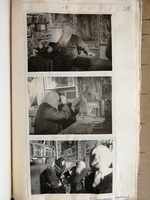 The photographs come from a 1959 KGB criminal case against three members of an Ioannite community in Cherkasy region, Ukraine. The images were designed as a photo album pasted into the secret police file. They portray father Mitrofan, the priest of the community in his house, which had been turned into a clandestine chapel. The first photo collage shows father Mitrofan dressed in Orthodox vestments against a background of icons, performing a religious service and talking to women, seemingly his followers. The second photo collage records the ritual washing of feet, also performed in father Mitrofan’s home. These photographs differ from typical secret police arrest or surveillance images. They intend to depict religious community life in an apparently natural context. At the same time the good quality of the photos, taken with a bright artificial light, indicate that these representation of rituals were staged. The last three images show the results of a police search of the clandestine chapel. The photos of cash confiscated during the police search and a table nicely served with food and drinks were used as incriminating evidence of the priest’s profiting from illegal economic activities. An image of a coffin and shelves with religious literature were intended to demonstrate the esoteric and fanatically sectarian nature of a repressed community. The last image constitutes a valuable source for the study of folk icons and handmade religious images circulated in the Soviet-era religious underground. It depicts confiscated and later destroyed icons used by the community. Apart from the portrait of father Mitrofan himself, there is an image of father John (Ioann) of Kronstadt, a famous Russian priest venerated by the community as a saint (hence the name of believers, the Ioannites). There is also a picture of Ambrose of Optina, placed together with the portrait of father John of Kronstadt in the same frame. Hieroschemamonk Ambrose was one of the most famous starets in Optina Monastery. He is pictured here on his deathbed. The choice of that image appears to be meaningful, as death and the afterlife were particularly sensitive issues for the community. The believers even built a clandestine Christian cemetery called “New Jerusalem”, photographs of which are also present in the secret police file as incriminating evidence. Ioannitism was a popular apocalyptic and chiliastic movement that emerged from the Russian Orthodox tradition at the beginning of the 20th century. The Ioannites were mainly peasant believers from the Russian and Ukrainian countryside, who venerated father John of Kronstadt (1829-1909), an archpriest from a town near St. Petersburg, one of the most popular religious personalities in late imperial Russia. A charismatic preacher, he was known as a blessed healer and wonder-worker, “the first modern Russian religious celebrity, with his image in souvenir scarves, mugs, placards, and postcard” (Kizenko 2000:2). During his lifetime, the pilgrimage to Kronstadt became a mass phenomenon, as thousands of believers all over Russia travelled to Kronstadt to see the “prophet.” Ioannitism, however, never constituted a unified religious movement, neither theologically, nor organisationally. It was rather constituted of dispersed peasant communities and individual wondering book-sellers, prophets and prophetess united by the common apocalyptic vision of the world, and centred around the figure of father John. Some believers remained within the Russian Orthodox Church, venerating father John as a blessed worshiper; others worshiped father John as the prophet Elijah or the embodiment of the Trinity, or Jesus Christ himself, thus, cutting themselves off from the official Church structures. In the early Soviet period, the Ioannites were persecuted as harmful ecclesiastic-monarchist sectarians. Driven underground, Ioannite communities built clandestine chapels and continued to live as underground monastic communities scattered from Western Siberia to Ukraine. Repression and shared underground experience drew the Ioannites together with catacomb True Orthodox communities. In the later years, this was even further facilitated by the Soviet secret services that made no distinction between the Ioannites and the True Orthodox Christians. Thus, the arrested believers in this criminal case were charged as the members of the True Orthodox Church. Father Mitrofan was known among believers as a miraculous healer. The village of Osytniazhka, where he lived, attracted numerous pilgrims who sought his blessing and spiritual help. The trial of father Mitrofan and his followers in 1959 was widely publicised. Apart from the official trial, a show-like civil trial was also held, which was recorded and later turned into a propaganda film titled “The End of a Spider.” The verbatim record of the civil trial is attached to the secret police file. Some photos found in the secret police file also appear in the film, which proves that the film was made under the direct supervision of the secret services. The photographs in this entry come from the State Archive Branch of the Security Services of Ukraine in Kyiv. The file reference is: fond 6, sprava 75174. The file consists of three volumes. Along with the photographs presented in this entry there are other images of the community and their religious artefacts. The file contains also numerous interrogation records of arrestees and witnesses. Three original Ioannite handwritten manuscripts of “The Dream of Father John of Kronstadt” are also attached to the file. Other confiscated religious writings, such as “The Explanation of the Apocalypse”, the brochure “Life story of starets father Mitrofan”, and Mitrofan’s homilies were destroyed as they are absent in the file. Their images, however, appear in the above mentioned propaganda film. For further readings see: Kizenko, Nadieszda. A Prodigal Saint: Father John of Kronstadt and the Russian People. Pennsylvania State University Press, 2003 Tepliakov, A.G. Ioannity Zapadnoi Sibiri v dokumentakh VChK-OGPU-NKVD (1920-1940 gody). Vestnik Tverskogo gosudarstvennogo universiteta. Seria: Istoria, 2010, vol. 30(4):128-136 Shugaeva, L. Ioannity: Techiia khiliastychno-eskhitalohychnoho spriamuvannia pravoslavnoho pokhodzhennia. Ukrainske relihieznavstvo. 2006, vol. 39:145-153 For related entries see:
-
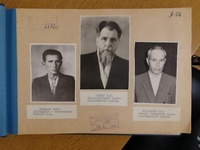 These photographs come from a KGB internal publication which is in the form of a photo album. It features arrested Ukrainian Greek Catholics, Josyf Slipyi, Ilia Blavatsky and Vasyl Kavatsiv and was published in Krasnoyarsk in 1958. The photographs of the arrested persons open the photo album (Image 1). The image of the metropolitan Josyf Slipyi, the head the Ukrainian Greek Catholic Church, is placed in the centre. Vasyl Kavatsiv (left), an underground priest and a secret monk, is defined under his photo as a nationalist, closely linked to Blavatsky. Ilia Blavatsky (right) was a Greek Catholic priest and one of the most trusted of Slipyi’s companions. The second image shows Slipyi’s desktop with manuscripts and newspaper cuttings confiscated during the police search. The third image shows Slipyi’s manuscript of the 5th volume of “The History of the Church in Ukraine” which was used as incriminating evidence against him. It was found by the police in the house of one of Slipyi’s friends. The fourth image shows religious items found by the police in Blavatsky’s house. The final image shows a barrack where Ilia Blavatsky, together with his parents and sisters, lived in exile. The house was located in a special settlement for exiled people in Krasnoyarsk (Eastern Siberia). Before it was moved to the secret police archive, the photo album had been kept in the internal “Chekist library” and seemingly served as an educational manual. It contains photographs of the police search with copies of confiscated manuscripts, correspondence and ritual items, as well as photographs of houses in the Siberian special settlements where religious leaders lived in exile after their release from prison. Apparently the photo album was based on the materials from a penal case against Josyf Slipyi, as most of the photographs place the police search of Slipyi’s residence in the home for disabled people in the Krasnoyarsk region in 1958. The police search was followed by his arrest and second imprisonment in 1959. He spent in total 18 years in labour camps. During the 1940-1950s, the organization of the Ukrainian Greek Catholic Church was virtually wiped out in the Soviet Union. The church was suppressed as it was accused of being closely related to the Ukrainian Insurgent Army (UPA) and the Organization of Ukrainian Nationalists (OUN), illegal in the Soviet Union. In 1945-1946, the Soviet authorities initiated a forced reunification of the Ukrainian Greek Catholic Church with the Russian Orthodox Church, Moscow Patriarchate. Stalin signed the directive on the liquidation of the church and the secret police were placed in charge of the operation. As a means of intimidation, all Ukrainian Greek Catholic bishops, the metropolitan and over 800 priests were arrested during the liquidation campaign. Those clergy and faithful believers that refused to a forced conversion to Orthodoxy were driven underground, forming the largest catacomb church in the Soviet Union. By the time of its liquidation, the Ukrainian Greek Catholic Church had 4 dioceses, one metropolitan, 7 bishops, over 2,400 priests, 1600 monastics, and nearly 4 million believers with only 30% of clergy having accepted the reunification with the Russian Orthodox Church. Believers and clergy were persecuted throughout the entire Soviet period. Thousands of them, including metropolitan Josyf Slipyi, were sent to GULAG or deported. The church received legal recognition only in 1989 during Perestroika. The images come from the State Archive Branch of the Security Services of Ukraine in Kiev. The file reference is: fond 13, sprava 584. For related entries see:
-
 These photographs were taken during a raid on an underground monastery by the Soviet secret police, the NKGB in 1945. The images provide visual representations of a vernacular subterranean architecture developed by True Orthodox Christian communities in Soviet-era Ukraine. The monastery was located in the underground vault dug out under a private house (see the first image) in the small town of Chuguev, near Kharkov, northeast Ukraine. The twenty two photographs enclosed in the secret police file give a detailed description of the underground construction. Images 2 and 3 depicts two entries to the hidden religious space. The main entry (image 3) was concealed within the wall of a vault by a wooden structure. Inside, the monastery had several bedrooms, a storage space with a stove and a mill, and an archway gallery (image 4) leading to an underground church. The last photograph shows the altar of the church. Apparently, this was not the only underground monastery in the region. As other secret police files on the True Orthodox Church reported, there was a network of underground churches and monasteries constructed in caves and underneath rural houses in the region. In the short period between 1945 and 1947, the Soviet security services discovered 14 similar monasteries and churches. In later years, at least until the 1960s, the police reported more underground True Orthodox communities and their hidden dwellings and places of worship. When the police raided the underground monastery in 1945, there were some 20 people (mostly monks and nuns) gathered for a religious service; nine of them were arrested and brought to trial. Among the arrested was hieromonk Seraphim (Shevtsov), the leading figure in the religious underground of the True Orthodox Church in that area. Records of his interrogations give a detailed account of how underground churches and monasteries were constructed and how the religious life of communities of dissenters was organised. Seraphim claimed that there were about 2000 believers under his leadership, from different parts of eastern Ukraine and southern Russia. The underground church could fit up to 300 people at a time, with a core group of 10-15 monastics who permanently lived there under the spiritual guidance of father Seraphim. Even in the religious underground, there was a constant mobility. As more people came, the subterranean structure was expanded and modified. When a place was discovered or became unsafe, believers built new underground churches, moving from village to village. In the interrogation report, Seraphim explains about an incident that happened in the underground monastery in 1941. The subterranean structure partly collapsed when a group of believers gathered for prayer. The tragedy took the life of four people who were then secretly buried in the same underground church where they died. Monks and nuns belonging to the community were also buried inside the underground church. Not all the monastics of the True Orthodox communities lived underground, many of them practiced secret monasticism. As Seraphim reported, he personally tonsured some fifty people into secret monasticism. For reasons of safety, new monks and nuns did not receive new monastic names (as is the tradition in Orthodox Christianity). Continuing to live in the secular world, they followed the monastic code (prayers, celibacy, asceticism, non-possession of material goods and monastic obedience). They kept their monastic vows in secret even to their immediate circle of family and friends and never spoke about their monastic life with anyone (for more on secret monasticism see Wynot 2002). The police continued to arrest Seraphim’s followers after his detention. In 1948, the MGB reported the arrest of a group of wondering monastics left uprooted after Seraphim’s imprisonment and the closure of the underground monastery. Seraphim returned to his community after his release in 1952 and continued to build more underground churches. He was secretly buried in one of them in 1955. The images come from the State Archive Branch of the Security Services of Ukraine, fond 6, sprava 75976, SBU Archive (Kiev, Ukraine). The two-volume file contains interrogations protocols, formal notes on the police search and confiscation, with the detailed list of confiscated religious items and valuables from the underground monastery, closing indictment and the final sentence. Several confiscated (unidentified) personal photographs are also attached to the file. For related entries see:
-
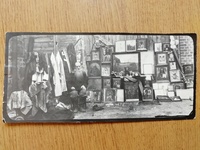 In 1945, the police raided an underground monastery of True Orthodox Christians (TOC). It was located in a vault under a private house in the town of Chuguev, near Kharkov, Ukraine. As a result, nine believers (most of them nuns and monks) were arrested with hieromonk Seraphim (Shevtsov) amongst them. All religious artefacts belonging to the community were confiscated and most of them were later destroyed. The photographs presented in this entry were taken during the raid and were later attached to a NKGB criminal file as incriminating evidence. The images portray confiscated church property at the same time inscribing an arrestee, father Seraphim, into the “crime scene”. The first photograph shows father Seraphim surrounded by church utensils, antiminses and icons found by the police in the underground church. In the second photograph, he sits with confiscated valuables and a clock. The last image shows the right side of the underground church, with a part of the altar and Seraphim’s bed. Hieromonk Seraphim (1875 – 1955) was a long-term leader of underground churches and monasteries of the True Orthodox Christians in the Kharkov region, northeast Ukraine. For several decades, Seraphim was the focus of close attention from the Soviet secret services, as he was seemingly the only catacomb priest in the region. A special secret operation called “Christoduls”, which continued after Seraphim’s death, targeted his clandestine communities of believers. As a young boy, aged 15, Daniil Shevtsov was tonsured a monk (adopting the name Seraphim) in Sviatohirsk monastery, a major Orthodox Christian monastery in eastern Ukraine. He continued his religious career as a deacon of the metropolitan Antony (Khrapovitsky), who later fled with the White Army, and together with other bishops in exile he founded an independent church structure called Russian Orthodox Church Outside Russia. Seraphim was among thousands of other monks who were left homeless when their monasteries were closed down by the Bolsheviks. Soon after his monastery was turned into the Renovated (Obnovlencheskaya) church (a movement within the Russian Orthodox Church, sponsored by the Bolsheviks and loyal to Soviet power) Seraphim went underground and joined the catacomb True Orthodox movement. He received his first 5-year sentence in 1934, and was deported to the North of Russia from where he escaped and illegally returned to Ukraine in 1937. Until the date of his arrest on 11th July 1945, he hid in different underground monasteries and churches near the city of Kharkov. Living literary underground, he led catacomb True Orthodox communities (numbering altogether around 2000 believers) in northeast Ukraine and southern parts of Russia. During the WWII, when Ukraine was occupied by the German army and many religious communities were granted relative freedom, Seraphim started to preach openly. For this, of course, he was later accused of collaboration with the Nazis. After his arrest in 1945, Seraphim was sentenced to 7 years in labour camps. He was released in 1952 and went into hiding again, continuing his “illegal” activities. In the following years, the secret police were busy searching for him, trying to recruit informers from his circle and raiding newly revealed underground churches and home communities. They did not know that Seraphim had died and was secretly buried in one of the underground monasteries in 1955 . According to the recollections of Seraphim’s followers, the secret police eventually discovered Seraphim’s grave and exhumed his body in order to prevent a growing pilgrimage movement. The body was unspoiled and the coffin emitted a fragrance of such strength that the policemen complained that a whole bottle of perfume had been poured inside. The Ukrainian secret police targeted the catacomb True Orthodox Church (TOC) throughout the entire Soviet period. The same year Seraphim was arrested, the secret police launched a centralized all-Ukrainian operation called “Hermitage" (Skit), to uncover the growing underground networks of True Orthodox communities. In 1947, the secret police reported the results of the two-year operation: 367 TOC members arrested; 4 underground monasteries, 10 underground churches and 25 “illegal” praying houses disclosed (SBU archive, f. 3, spr. 300, p. 113-114). The images come from the State Archive Branch of the Security Services of Ukraine, fond 6, sprava 75976, SBU Archive (Kiev, Ukraine). The two-volume file contains interrogation protocols, formal notes on the police search and confiscation with a detailed list of confiscated religious items and valuables, a closing indictment and the final sentence as well as other photographs of the underground monastery. For related entries see:
-
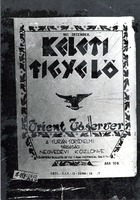 These images have been selected from the photo-documentation of materials sent by post to Mihály Virasztó, a former religious specialist of the Church of the Turan Believers of One God. The first photo shows the cover page of the Keleti Figyelő [Orient Observer], the short-lived journal of the Turáni Történelmi Társaság [Turan Historical Society] founded by immigrant Hungarians in Melbourne, Australia. The second photo shows a certificate of honorary membership of Mihály Virasztó for supporting the study of Hungarian history, issued by the same society in 1962. The images come from a documentary file on Virasztó. The case of the Orient Observer is illustrative of the performative power of certain objects and of the responsive mechanisms of the secret police. By the time of the journal’s arrival in February 1962, Mihály Virasztó had been under surveillance for years, after being classified as dangerous due to his openly anti-communist stance, involvement in 1956, relations with right-wing emigrants, and his past as the priest and activist of the Turan Believers of One God. The arrival of the issues and the certificate was reported by an informant working on Virasztó in July 1962, only four months after the local county division of the secret police had claimed in a report that the Church of the Turan Believers of One God was practically non-existent in the region. Along with Virasztó’s correspondence with other Hungarian right wing emigrants and his involvement in a case of anonymous anti-collectivization letters, the package set the machinery of the secret police in motion. The local branch of the secret police made excessive efforts to get hold of the issues: they asked for photocopies from the Budapest headquarters, while also drawing up a plan to get Virasztó’s own copies. The police also mobilized its network of informants to find out if Virasztó was disseminating the issues, and instructed them to collect more information on the Turan Believers of One God as well. In September 1962, the Budapest headquater sent the copies of the certificate and selected pages of the journal, with a short note that according to their examinations, the articles focused on "the origins and development of various languages”. To decide whether the journal’s content was "hostile”, the local secret police attained Virasztó’s copies in March 1963 through a local informant, who managed to borrow them from him for a couple of days. The Orient Observer was also featured in Virasztó’s two penal files from 1964 and 1966. From these and from other informant reports we know that he had given the issues to several people, the director of the local museum being among them. We also learn from these files that during a house search at his home in 1964 the secret police was looking for the issues but could not find them. The Observer came to the forefront again in 1966, at the time of Virasztó’s last penal case, with the secret police planning a complex operation for its confiscation. This time their aim was to produce evidence that Virasztó was circulating materials hostile to the regime. The Orient Observer was founded in 1960 and had only two volumes and four numbers during its existence. Printed on a small offset printing machine and having hand-drawn illustrations, it claimed to be scientific and focused mainly on the origins of the Hungarian people. Using linguistic and historical argumentation that would not stand up to modern academic scrutiny, the journal argued for the relatedness of Hungarians to various past and present Asiatic peoples. Although the articles were not openly political, the issues contained some negative references to communism and the Soviet Union here and there. One of these, a sentence on the fatal consequences of Soviet dominance for the future of the Hungarian nation, was picked out by the secret police as proof of Virasztó possessing and circulating anti-communist contents. Mihály Virasztó had a long police record in both regimes before and after 1945. As a priest (táltos) and missionary of the Church of the Turan Believers of One God he was repeatedly condemned to prison at the end of the 1930’s for "agitation against religious denominations”. He remained on the radar of authorities in the communist regime for his anti-communist political views and activity, his relationships with right-wing figures abroad, and also for his past and supposedly present involvement with the Church of Turan Believers of One God. He had several clashes with the authorities: he was imprisoned for two month in 1952 for slander, detained for possessions of arms in 1957, a charge that was later dropped, his mental health was investigated and he was sent to a mental hospital in 1964 and 1967. After his last release in the summer of 1968, he was placed under the guardianship of his wife. His file was closed in 1972. These images come from file ÁBTL 3.1.5 O-14980/18. The file also includes confiscated personal letters and photographs, two poems written by Virasztó, lists of confiscated items, medical reports, interrogation minutes, and informant reports. For further entries on Virasztó and the Church of Turan Believers of One God see:
-
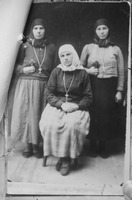 These confiscated photographs come from a 1938 Military Court file from Romanian Bessarabia (today’s Republic of Moldova). On the 25th August 1938, a house search was conducted of the home of Vladimir Draguțan in the village of Recea, county Lăpușna. Amongst the items “used for Inochentist propaganda” discovered at Vlademir’s home were a number of religious booklets, devotional images of Alexandru Culeac, the founder of the movement, and Inochentie of Balta, a number of small crosses and several photographs of the community. The first image shows three women one of whom is named in the case file as Maria Sârbu, who was arrested at the time of the house search; the second image shows two men, one of whom may be Vladimir Draguțan; the third is a group image of what appear to be elders of the community, and the final image is of three of the Culeac brothers, the leaders of networks inspired by Inochentism that emerged in the 1920s following the death of Inochentie of Balta. Vladimir, his father Vasile and Maria Sârbu, were found guilty of Inochentist propaganda on the basis of the evidence gathered during the house search. The two men were both sentenced to six months imprisonment, Maria received a sentence of three months. In the case file, Maria Sîrbu confesses that she had “left her home village ten years previously and had been wandering as a vagabond with Inochentist sectants” ever since. During this period, women in particular are frequently reported as living as travelling preachers or propagandists for the movement, something that the Romanian Gendarmerie and Secret Police struggled to put a stop to. In the safe houses dotted across the Moldovan countryside established by the group, they also devised means to generate income for the community. Vladimir Drăguțan, in whose home Maria Sîrbu was arrested, was found to be making “small crosses from silver, with all the kit necessary for making crosses”; the gendarmes confiscated “three silver coins and five small crosses” and in his statement Vladimir admits to manufacturing them since 1931. The gendarme captain interprets the manufacture of crosses as a means to “cheat believers and sectants and with the sale of the crosses attract them from the Orthodox religion to the Inochentist sect.” In the photographs presented here we can see that all members of the community wore silver crosses very prominently outside their clothing on long chains. From the fairly large corpus of photographs of Archangelists preserved in Military Court and Gendarme files, it is evident that this was a characteristic and distinctive practice of the group. In the absence of Archangelist written testimonies from this period, the materials found in the Military Court files present us with an important record of Archangelist material cultural practices from this time. We can look upon Maria Sîrbu represented in the way she chose to be seen alongside her sisters in faith. In the first image, one of the women is seated – we cannot be sure but this one appears to be Maria as she is the place of honour – while the other two women standing behind her hold wooden crosses in their right hands, the symbol of a martyr in Orthodox iconography and a direct infringement of Orthodox canonical norms regarding visual representations of people who are not saints. Inochentie of Balta, the founder of Inochentism, also frequently appears in photographs in this pose and since his time it has served as visual marker of Inochentist identity. These photographs come from the National Archive of the Republic of Moldova – Military Tribunal of the 3rd Army Corps ANRM-TMC3A 738-1-6846. In addition to the photographs shown here the file contains a further three devotional photographs of Alexandru Culeac and Inochentie of Balta, two pencil sketches and two booklets, one entitled A Vision that appeared in the Year 1920 [O vedenie ce s’a arătat în anul 1920]. 1924. Iaşi: Institutul de Arta Grafice “Versuri şi Proză” and the other, The Lord has Spoken [Dumnezeu a vorbit]. Undated. București: Tipografia “Lupta” N. Stoilă. For related entries see:
-
 The images show a Brethren publication entitled Viață și Lumină volume three, issue nine from September 1930. According to the text on the cover, the publication appeared once a month and was edited by Florea Moisescu with administrative facilities in Bucharest under the direction of Gheorghe Teodorescu. Scripture references from the Gospel of John are included under the title, from which the latter is derived. The subscription cost was 60 lei per year in Romania and one dollar in America. This issue, along with two others, were included in the file composed by the General Police Division on the Norwegian Society Norske Israelmision. The society was a missionary organization aimed at converting Jews to Christianity that received authorization from the Ministry of Religious Denominations through order nr. 15486/1565/930. Their representative in Romania was Isaac Feinstein, a Romanian citizen of Jewish ethnicity, born in Dorohoi, whose memoranda to the government requesting freedom for the society to function in the cities of Reni and Iași is included in the file. Another letter from Feinstein to the Ministry of Interior included in the file protests the application of decision nr. 4781 from 1937 to their activity. The aforementioned decision was passed to limit the activity of religious minorities or sects, which Feinstein argued his organization was not. The Brethren publications are not mentioned anywhere else in the file. They were likely gathered by police informers during one of Feinstein’s Norske Israelmision meetings. The Brethren religious minority was considered a sect with foreign allegiance and strictly monitored during the 1930s and outlawed by the Ion Antonescu government in 1940. The placement of the publications with the police correspondence and memoranda concerning the Norwegian society implicates both groups in what could be considered activity threatening state security. Feinstein’s Jewish ethnicity is continually brought up in reports included in the file revealing the police’s intention (as also expressed in other files) of finding a link between the Jewish threat and the sectarian threat. The publication comes from file ANIC, DGP inv. 2349, 51/1930. The file includes two other Brethren publications, police reports, correspondence between the Ministry of Interior-General Police Division, the Bucharest Regional Inspectorate, and the Galați Municipal Police, as well as letters sent by Isaac Feinstein to the Ministry of Interior. For related entries see:
-
 The images show an inventory and confiscated photographs included in a case file forwarded to the Romanian 3rd Army Military Court on 2nd December 1938. The first image shows the inventory of items found in the house, which was located in Fălciu county. The officer lists the following Inochentist "propaganda" materials: "1. A brochure entitled 'The Deeds of the Archangel Michael', 2. a small icon of saint Paraschiva, 3. a cross sculpted from wood, 4. three photographs of Culeac dressed in white with a cross on his chest, 5. a photograph of Culeac dressed in vestments." The second image shows one of the photographs of "Culeac" dressed in white described in the inventory. The third image is the photograph of "Culeac dressed in vestments". The fourth image shows the first page of the brochure 'The Deeds of the Archangel Michael'. The diligent way in which the items were listed and collated by the Romanian Gendarmerie in this case reflects the importance that the Romanian authorities placed on the prevention of the spread of Inochentist "religious propaganda materials" and their important use as evidence in anti-sect trials in this period. On the 21st April 1937, the Ministry of Religions and Arts had issued Ministerial Decision no. 4.781 “Regarding banned sects and religious associations” in which it was stated explicitly that the administrative and police agencies were to stop every form of “propaganda of religious prosleytism, whether this is done verbally, in the form of writing, through brochures and journals etc. by colporteurs, or members of the illegal sect.” The police were also to confiscate all religious materials and send them together with the completed documents to the Ministry of Internal Affairs (Deciziunea 4.781 1937, 3-4). This policy ensured that many Inochentist brochures, photo-icons and photographs were preserved in the case files and penal files of individuals arrested at this time. In the case featured here, the items did not result in a successful prosecution as the accused stated that the materials belonged to his daughter-in-law and that he had no knowledge of their contents or meaning. These images come from the National Archive of the Republic of Moldova – Military Tribunal of the 3rd Army Corps ANRM-TMC3A 738-1-6849. For related entries see