Items
-
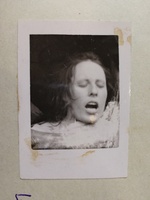 These arrest photographs come from a 1952 secret police penal file on a group of 23 believers who were arrested in the Kiev region of Ukraine. The file contains two versions of their arrest photographs taken by the MGB officers. As the photos were being taken, the believers intentionally closed their eyes, turned their heads away, or sang while the officers tried to restrain them. Their gloved hands are clearly visible in the images. Police officers later tried to correct these “tainted” photographs by removing the evidence of their violent intervention from the prints, which one can see in the spruced-up copies with the hands of the policemen roughly shaded out. The handless photos were used in the formal documentation of the case, while the smaller-size, original photos with the hands were appended to the back of the arrest questionnaires. The MGB official closing indictment charged the group with conducting anti-Soviet activity and propaganda as members of the “ecclesiastical-monarchist organization ‘the True Orthodox Church.’” However, no one knew much about them. Their co-villagers described them as Stundists or Baptists and knew nothing more than the fact that, even though they displayed Orthodox icons, crosses and church books in their homes, they never went to Orthodox Church and did not recognize Orthodox priests. The members of the group lived isolated lives; they rarely talked to their neighbours, avoided representatives of the Soviet authorities and never discussed their faith except to repeat the phrase: “God knows” (Bog znaet). All we know about them now is that they were poor peasants who gathered for prayer in secret in their homes, sometimes travelling between villages to pray together. They refused to enroll in local collective farms or to work at other state enterprises, never paid taxes or registered for other Soviet documents, and never used money (“the mark of the dragon”) or sent their kids to public school. The pre-trial review of the believers was brief: a mere three days of interrogations and then an additional night of twenty-two orchestrated confrontations between the arrestees and witnesses (conducted from 9pm until 4am). During the review, the believers refused to answer questions, responding to everything by saying simply “God knows” or “I will only answer to the Judgment of God.” During the whole process they never stopped singing and praying. They continued when the police came for them, as their arrest photographs were being taken, during the interrogations that preceded their trial and even during the court hearing. The case lasted 9 days between the arrests and the court hearing with the final decision of 25 years in labour camps handed down to most of the defendants. For more about the case see: Tatiana Vagramenko, Gabriela Nicolescu, The Hand at Work or How the KGB File Leaks in the Exhibition. In Martor Journal (forthcoming, 2021). For related items see:
-
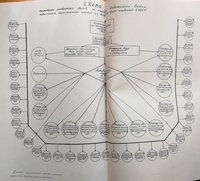 This network scheme of the Jehovah’s Witness organization comes from a four-volume top-secret file titled LKB, Legendirovannoe Kraevoe Biuro (Regional Bureau Covert Operation). It was produced by the Ukrainian secret police in 1953 and shows Jehovah’s Witness districts and circuits located in the Soviet Union with the organization’s country committee (called by that time the Regional Bureau) as the governing body of Soviet Jehovah’s Witnesses. The scheme shows the connections of Soviet-based groups of believers with the Jehovah’s Witness organization abroad: the East-European Bureau in Poland, the Romanian branch, the European centre in Switzerland and the Jehovah’s Witness headquarters in the USA on top of the network scheme. The secret operation (Regional Bureau Covert Operation) was launched by the Ukrainian MGB office in 1951, the same year the state organized a large-scale deportation of Witnesses from the western borderlands. It was suspended in 1954, soon after Stalin’s death. The operation aimed at infiltrating the Jehovah’s Witness underground organization in Ukraine (and later the entire Soviet Union) and to organize a Witness country committee as a covert operation. The plan was designed such that the Soviet security service became the head of the Jehovah’s Witnesses organization, and the headquarters of the official Watch Tower Bible and Tract Society (hereafter the Watch Tower Society), located in Brooklyn, became a channel in their counter-intelligence operations against the US. The scheme comes from the SBU Archives, fond 2, sprava 2432. The file also contains correspondence between the MGB office in Kiev and regional offices in western Ukraine, agent reports, surveillance reports, information on the structure of the Jehovah’s Witness organization in Ukraine, intercepted letters and samizdat publications. More about the secret operation and agent infiltration of Jehovah’s Witnesses in Soviet Ukraine see: Tatiana Vagramenko, KGB “Evangelism”: Agents and Jehovah’s Witnesses in Soviet Ukraine. Kritika: Explorations in Russian and Eurasian History, (forthcoming 2021) For related entries see:
-
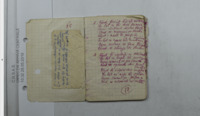 These images show a handwritten songbook that was confiscated from a Tudorist believer during a luggage inspection in 1975 whilst he was doing his military service. The first image shows the inside cover of the songbook, containing a short verse that reads: “And then, the whole eternity will be your prize, Because you were patient and kept yourself pure, For Him, and many hardships you have endured, But you kept yourself white and pure.” We also catch a glimpse of the first verses of a religious song. The following two images show other religious songs that he had handwritten. Because the songs are numbered we learn that there are 49 songs that he had collected and handwritten. The second image shows a song written by Nicolae Moldoveanu, entitled “Remain in Me” (Rămâneți în Mine). The third image represents the continuation of the short verse written on the inside cover. We learn, thus, that the song is called “Beloved Lily” (Crin iubit) and is a song written by Traian Dorz. Both Nicolae Moldoveanu and Traian Dorz were well-known religious figures and members of the Lord’s Army (Oastea Domnului) that suffered imprisonment and persecution during communism. The songs and hymns that they wrote are still valued and highly regarded by various religious communities, including the Tudorists and Neo-protestant communities. The size of the songbook is quite small, suggesting that its owner was trying to keep it secret or hidden. From a report that was composed following the event, as well as from a letter that the Tudorist believer had written, we learn that the songbook was found in one of his pieces of luggage during an inspection. It was confiscated along with a notebook, of which only the covers were attached to his file, as well as other religious books. The Tudorist believer was labelled as a “religious fanatic” and was accused of smuggling religious materials into the army. The fact that all these materials were attached to his file suggests that he was closely monitored by his peers during his military service. This songbook can be found in the file CNSAS, I 0456045. It also contains some personal letters, as well as reports and declarations of the people who were giving information about the Tudorist believer. For related entries see:
-
 These images show a church songbook that was carefully handwritten by nun Olimpiada Petreanu sometime in 1940. The first image depicts the cover of the songbook. It conveys important information such as the owner of the songbook, the fact that it was a church songbook, “cântări bisericești”, and, in faded letters, the year when the songbook was written. The second and the third images show a small part of the content of the songbook, namely the so-called “canon of the soul”, which was dedicated to the Virgin Mary, and the Akatist of Jesus Christ. These are both important hymns and hymnal elements of the Orthodox tradition. The last image shows a short poem, or proverb, that states: “man is like a flower that is here and gone tomorrow, he now laughs and parties, tomorrow he lays in his grave.” It also shows the date, March 12 1940, and the signature of nun Olimpiada. These images illustrate the effort and care that was put into writing the songbook, which is colourful and carefully organized. Moreover, at a time when most women were illiterate, nun Olimpiada Petreanu was able to handwrite, draw and put together such a wonderful songbook that, fortunately, survived until today. Born in Răucești, Neamț county, Olimpiada Petreanu, whose lay name was Safta, is one of the nuns that was imprisoned at Vărzărești Monastery, in 1937. Vărzărești was one of the main places where Old Calendarist nuns were brought and, according to some Old Calendarist literature, they were forced to accept the New Calendar there. She wrote her first postcard from Vărzărești in May 1937, asking her parents to send her some food, her watch, some clothes and money. From the onset, we learn that she used to live at Old Agapia Monastery as she compares the location of Vărzărești Monastery with its location, and that she had partially lost sight in her right eye, an issue that is constantly mentioned in her correspondence with her family and acquaintances. According to the declaration of her father, she joined the monastery more than ten years prior to 1937, and after the Neamț Old Calendarist rebellion she allegedly lost the support of her family who chose to follow the new calendar. Based on the concerned tone of the postcards that she received from them, as well as the fact that they continued to send her packages and whatever she needed in order to make her detention easier to endure, it is difficult to believe that such was the case. The time of her release is uncertain and what we know about the rest of her life is based on the information gathered during ethnographic research. After her release, she was allegedly sent to Oniceni, Buzău county, where she founded a skete for nuns at Drăgușeni with the help of Glicherie Tănase, an important Old Calendarist bishop. She became the mother Superior of the skete and spent the rest of her life there. She died in January 2002 and left behind this songbook. These images were provided to the Hidden Galleries research team by the nuns of Mănăstirea „Buna Vestire”, Valea Roșie. For related entries see:
-
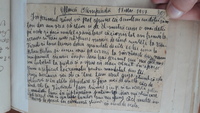 These images show the front and reverse of a postcard that was sent to nun Olimpiada Petreanu by her brother whilst she was incarcerated at Vărzărești Monastery. The postcard is of particular interest as it mentions the difficulties that the families of imprisoned Old Calendarist nuns encountered in their efforts to contact them. The first image shows the front of the postcard and contains references to one of the most important issues that the nuns and their families experienced. One of the constant complaints of the nuns, as well as of their families, was that the postcards, letters and packages often went missing or were delivered late. Olimpiada Petreanu’s brother expresses his concern about the fact that their communication was made difficult by unknown causes: “we sent you many letters but you have not responded since you arrived at Vărzărești [...] we asked at the post office but they said that there was nothing for us, so we made a complaint [...] I don’t know the reason for this, maybe because of the lack of money, but many letters are not sent, they stop them.” Similar concerns are expressed by other nuns’ family members in their letters and this continuous state of confusion seems to have been intentionally maintained by the authorities entrusted with the incarcerated nuns supervision. By controlling every package and letter the nuns and their families received, the authorities hoped to destroy the nuns’ will to resist the religious calendar reform and with it undermine the entire Old Calendarist movement. Moreover, we learn from similar correspondence that the lack of communication triggered a fear of abandonment, of having been forgotten and a struggle to come to terms with a difficult situation. The second image shows the back of the postcard. It contains important information about nun Olimpiada, namely that she had a problem with one of her eyes, as her brother asks her if her eye had healed; from other postcards we learn that she had partially lost sight in her right eye. On the upper edge of the back of the postcard her brother wrote a note asking her about a certain nun Anica and if she had received her packages. This note demonstrates that such events were not isolated and that other Old Calendarist nuns and their families suffered due to the fact that communication was rendered difficult. Written in 1937, this postcard is important proof of the waves of arrests that followed the so-called "rebellions" in Besserabia, in 1936. Many Old Calendarist nuns were sent to detention where they suffered numerous hardships, hunger and cold. Vărzărești Monastery was one of the main places where Old Calendarist nuns were brought and, according to some Old Calendarist literature, they were forced to accept the New Calendar there. The intimate and private lives of the nuns in detention revealed by these postcards contrasts sharply with the way they were portrayed in the press of the time as dangerous and rebels. These images can be found in the file ANIC, Insp. Gen. al Jand., D 23/1937. Apart from this postcard, this file contains many more letters and postcards sent or received by Old Calendarist nuns that were detained at various Orthodox Monasteries. For related entries see:
-
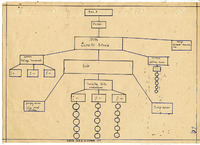 This network scheme is from a file on a Hungarian Catholic underground movement. Hand drawn and sketchy, it is a less sophisticated version of its more elaborate and detailed – and sometimes almost artistically executed – Soviet and Romanian counterparts. The purpose of network schemes was to map the connections of groups or individuals; in this case it shows the people István Divald, a young Piarist monk recruited to the Catholic underground movement lead by György Bulányi. Amongst the recruits we find a canon, three parish priests and a catechism teacher from three settlements in north-western Hungary, Győr, Sopron and Csorna. According to the scheme, two of the recruits headed three subgroups, while one of them lead only one. Since the scheme comes without any notations, it is unclear what the little circles below some of the groups stand for, but most probably they indicate the number of members in each group. The scheme also shows that Divald communicated with the Budapest centre of the movement via “couriers” who, according to various reports in the file were mostly university students. We don’t know the exact date of the network scheme but it should have been drawn sometime in 1951 or early 1952. István Divald joined the underground Catholic movement in 1949 or – according to some sources – 1950. After his monastery was closed in 1950 he worked as a chaplain in Kóny, a village near the county capital Győr, and this is where he started to organise the underground cells shown in the network scheme. According to reports in the file Divald regularly visited and lead the cells he helped organise, and was especially successful in engaging young people: he frequented pubs, played cards and bowls and organised the local volleyball team. Authorities deemed the whole movement extremely dangerous and alleged that it “did not only try to ideologically influence its members but prepared them for terrorist activity and diversive action.” Divald was dispelled from the diocese in 1951 and from 1952 – the year the movement’s leaders were arrested – had various non-ecclesiastical jobs. His relationship with the secret police took a turn sometime in 1954 when he was officially roped in as agent “Dusek”. From then on he regularly reported on the resurgent cells of various Catholic underground movements such as Catholic women’s groups and scouts groups with which he was also actively involved as an occasional lecturer. In the summer of 1956, before the planned arrest of the second generation of underground Catholic group leaders, Divald emigrated with the help of the secret police first to Austria and in 1957 to the USA. Between 1962 and 1965 he reprised his role as an active agent under the cover name “Broger”. The network scheme is included in file ÁBTL 3.1.5 O-11959, which also contains summary reports, confessions under interrogation, reports on shadowing and informer’s reports.
-
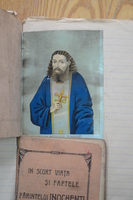 This postcard icon portrays Feodosie Levițchi (Romanian spelling) or Teodosie Levitsky (in Russian) (1791-1845), of Balta (today’s Odessa Oblast, Ukraine). It was confiscated from a Bessarabian peasant in 1938 who had been charged with Inochentist propaganda and sentenced to 45 days imprisonment. Feodosie was an important figure for the Inochentist movement as Inochentie of Balta (1875-1917) was instrumental in sponsoring the cult of his deceased predecessor and distributed mass produced icons (like the one seen here) and miracle stories across Ukraine and Bessarabia to encourage pilgrims to visit for the tomb and then later the monastery of Feodosie Levițchi founded to house his relics. Levițchi was eventually canonised by the Russian Orthodox Church in 2009, over 100 years after the the campaign for his canonisation was first launched. Levițchi was born in the village of Korytna in Podolia, today’s Ukraine. He became a priest in 1815 and was ordained in the Church of Saint Nicholas in Balta. Levițchi soon became known for the power of his improvised preaching and, following the death of his wife in 1818, he dedicated himself to delivering increasingly apocalyptic sermons. He lived as a hermit and spent long hours in prayer, eventually writing a study which he sent to Tsar Alexander I via Alexander Nikolayevich Golytsin, the Tsar’s conservative Education minister. The Tsar enjoyed the work so much that on the 3rd May 1823 Levițchi was invited to Saint Petersburg. Levițchi seems to have had a powerful effect on Golytsin and he became a regular visitor to the priest who was soon presented to the Tsar who was reported to have been “very happy and grateful for his work in the name of God” and gave him permission to continue to spread his teachings. In the summer, he left Saint Petersburg but continued to write to the Tsar. Levițchi’s fame grew but his association with Golytsin, who was accused by powerful enemies of being a Freemason was to be his downfall. Levițchi asked for permission to return to Podolia but his request was denied and he was instead exiled to a monastery on an island on lake Ladoga where he was kept under close supervision. When he was eventually released in 1827 following the death of Alexander and enthronement of Nicholas I, he returned to Balta. There he returned to his old position in the Church of Saint Nicholas. He built a modest hostel there to offer shelter to the poor, orphans and the sick. He died on 9th March 1845. In 1909, under unusual circumstances, Inochentie of Balta, took charge of removing Levițchi’s relics from his family plot to the sanctuary of the new monastery in Balta. From this point forward, the cult of Levițchi grew exponentially under the direction of Inochentie of Balta. For related entries see:
-
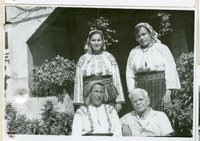 These photograph come from a surveillance file opened in 1974 on Sescu Petru, a local amateur historian and folklore collector from the Catholic village of Săbăoani (Szabófalva in Hungarian) who was suspected of "nationalist-chauvenist" activity. Sescu Petru belonged to the local Hungarian minority referred to as Csángós in Hungarian. In August 1974, Sescu Petru was visited in his home village by Laios Pușkaș (Puskás Lajos in Hungarian), a retired history and Latin teacher from Cluj (who we can see seated in the first image). According to the secret police, while they were visiting different people in the village and the neighbouring village of Pildești (Kelgyest) on a borrowed horse and cart and "taking photographs and making recordings on a tape recorder", they were intercepted by the local police who confiscated their equipment and ordered Puskás Lajos to leave Săbăoani immediately. The cassette and film were later returned after the recordings and photographs had been deleted. According to the police report, all of those who had been photographed by Puskás Lajos were identified and later called in to the police station for interrogation. The secret police noted in this case that "nationalist Hungarian" activity, including "the collection and use of distorted ethnographic and folkloric data from the region populated by Csángós with which they demonstrate their Hungarian origin" was increasing and that the "the Moldavian Csángó problem", the "denationalisation and Romanianization" of Moldavian Hungarians, was "being raised frequently by Hungarian citizens of Romania and by foreign interested parties with international organs." In the light of the secret police interpretation of these images, seemingly harmless photographs of local village life and people wearing folk costumes are implicated in an international conspiracy to undermine the image of the Romanian state abroad. For related entries see:
-
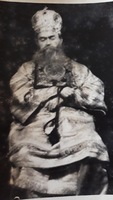 The two photographs are related to the death of the Old Calendarist Romanian Orthodox Bishop Evloghie Oța and come as a result of extensive ethnographic fieldwork amongst Old Calendarist on-line communities and monasteries in Bucharest and Sibiu. The first picture represents Bishop Evloghie Oța before he was interred by his monastic brothers inside the underground church in Televiziunii street, 13 in February of 1979. From several descriptions given by informants of the Secret Police and in interviews with surviving witnesses, Bishop Evloghie Oța was interred sitting on the Bishop’s throne, dressed in episcopal vestments and holding the Holy Scripture and prayer beads. This picture, which is not found in Oța’s secret police file, fits perfectly the written description in the documents and the interviews with witnesses of the funeral. I first come across the picture in a Facebook group called Imagini de Arhivă ale Bisericii Ortodoxe de Stil Vechi (Archival images of the Old Calendarist Orthodox Church) where it was posted by Sebastian Hriscu who tagged the picture with a description "Pictured found in my grandmother’s archive". Further discussions revealed that the picture circulated amongst Old Calendarist communities throughout the country after the bishop’s death. I later acquired two other scanned copies of the same image from the monks at the Monastery of the Dormition of the Mother of God, Bucharest (Mănăstirea Adormirea Maicii Domnului a Bisericii Ortodoxe Române de Stil Vechi) where bishop Evloghie Oța was initially buried. In 1983, the Secret Police, in an attempt to destroy the monastic community in Televiziunii street, arrested the monks. The body of the Bishop was exhumed and taken away. The church and the monastic complex have been tore-down, and the believers and monks were forbidden to return to the site. According to interviews with members of the church, the area was levelled and the land was used for agriculture until 1989. The whereabouts of the body of the bishop remain unknown. The second picture represents a string of religious beads displayed in the Hidden Galleries project exhibition (Imagini din galerii secrete: religia clandestină în arhivele poliției secrete/ Rejtett galériák: Az üldözött vallásosság képei a titkosszolgálati levéltárakban) at the Art Museum in Cluj Napoca, Romania. The beads (metanii) belong to Bishop Flavian Bârgăoanu who, in an interview from April 2019 spoke about Bishop Oța beads that had been buried with him but were lost when the bishop was exhumed and his body and everything he was buried with were taken away by the Secret Police. He explained that a few months after the revolution when he and several monastic brothers returned to Televiziunii street he received a visit from a man that had helped with exhumation of bishop Oța's body. He brought with him the beads and told Bishop Flavian that they had been on the body of the bishop and that he had taken them away but so many bad things happened to him afterwards that he is now returning them to the monastery. Bishop Flavian loaned the religious beads to be exhibited in Cluj for the duration of the exhibition. Description of the burial of bishop Evloghie Oța and the details of his interment can be found in the CNSAS file I0161965 vol 1
-
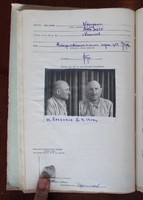 The mugshot is one of the main visual materials produced by the secret police during their investigations. Together with fingerprints and personal information, mugshots connect the police image of the alleged enemy to an actual person, whom they show stripped of personal dignity and agency, often head-shaven, dejected, pensive and nervous. Mugshots are contained in almost all secret police criminal investigation case files and were produced according to a very precise set of rules which makes them very similar from one case to another. Although at a first glance they seem less interesting than other types of visual material, their use in fieldwork can bring unexpected results. During a fieldwork trip to the village of Odaia in Moldova in the summer of 2018, we offered local believers the possibility of viewing the mugshots from the criminal case file of Dumitru Busilcov, Gheorghe Mârza, and Ermolae Croitor, the spiritual fathers of the local community. They had been arrested in 1953 accused of organising a sectarian commune of followers of Ioan Zlotea (a monk and spiritual father who attracted a large following in Bessarabia in the interwar period) and Inochentie of Balta (the founder of the religious movement commonly referred to as Inochentism), and of collaboration with German and Romanian authorities during the war and were condemned to 25 years of labour camp. The interviewed believers were surprised and slightly shocked by the photos of their spiritual leaders whose archival images differed from the way their detention in the prison camp have been imagined by the community. The mugshot photographs elicited many stories about the detention of their leaders and about the miracles they had worked in the prisons. For these believers, the mugshot made the connection between the religious leaders they knew at home in the community and their fabricated identity created by the police. Showing such images to descendent communities entails certain risks that need to be carefully balanced. The mugshots, when viewed outside of their archival context, came to possess a new agency with the potential to be both traumatic and liberatory for the community. However, the continued enclosure of Communist-era anti-sect case files in the archives and their separation from and lack of accessibility for the targeted communities also has the potential to cause future harm to minority religious groups. The disclosure of archival images represents an important means through which numerous propaganda myths about allegedly harmful sects can be deconstructed. Without the inclusion of the voices of members persecuted groups, the analysis and re-interpretion of the textual and visual materials stored in the police archives will always remain incomplete. For related entries see:
-
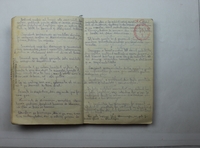 The three images show the personal notebook of Constantin Voicescu (1924-1997) that was confiscated by the Securitate after his second release from prison (1954. It contains 33 aphorisms and 17 religious poems that circulated within the Communist prisons especially among the legionary group labeled by the Communist authorities as "the mystics". The notebook contains four pages of short sentences (aphorisms) written in black crayon about religious experiences, how to achieve personal redemption through self-sacrifice or the imminent victory of Christianity over the armies of Satan (Communism). Most probably, these sentences belonged to the group of legionary prisoners (“the mystics”) who abjured their legionary convictions in favour of an intense commitment to religious life. Under the impact of prison life, these legionaries renounced their political activism in favour of incessant prayer to expiate the sins of the Nation and to convert people to non-violence. Attributed to Ion Ianolide, one of the members of the circle of legionary mystics, most of the sentences are very similar to those voiced by other mystics such legionary commander Traian Trifan (1899-1990), the leader of the group, and Valeriu Gafencu (1921-1952), one of his closest disciples, who Voicescu encountered during their stay in the prison-sanatorium at Târgu-Ocna. The second section comprises of 17 poems written in blue ink belonging to Valeriu Gafencu (Dor, Mi-s ochii triști, Rămas bun, Imnul învierii, În Noaptea Sfântă, Colind, Dar, Chemare, Cântec de leagăn, Frate bun, etc.) and Nichifor Crainic (Laudă, Potirul, Unde sunt cei ce nu mai sunt). In the case of Valeriu Gafencu’s poems, with a few exceptions (Chemare, Cântec de leagăn), all are structured explicitly as Christmas carols or with a chorus that lead us to think that most of these poems circulated in the prisons as songs. The transmission through music of these poems and, therefore, of the legionary religious message to absolve the sins of the Nation through self-sacrifice and passive acceptance of any sufferings, had both a mnemonic and missionary component. Mnemonic, to preserve the legionary message among the inmates and missionaries because one of the key points of the mystics’ program was that of spreading the gospel of legionary non-violence and the primacy of self-sacrifice for Fatherland through prayer and a quasi-monastic life. The images selected were part of a single surveillance file of several members of the group of legionary mystics questioned by Securitate officers in 1958-1959. Variants of these poems can be found in Orthodox and Greek Catholic communities today leading to the conclusion that after 1989 they became widespread inside Orthodox underground communities, and thus a useful method of passing information on the community through musical rather than textual means. The three images come from file CNSAS Penal fond P0000327, vol. 5. The penal file also contains surveillance photographs, intercepted correspondence, notes from informants, religious texts and samizdat.
-
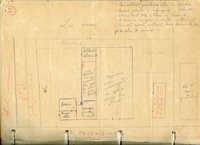 The two images are part of an individual file opened by the secret police on Bishop Evloghie Oța of the Old Calendarist Orthodox Church following his release from prison in 1964 in the general Amnesty Decree. The images show house layouts that were drawn by the police during their surveillance operation. Two handwritten documents precede the two drawings of the house layouts. They are from two successive years and originate from the street/ local policemen (sectorist) that supervised the area where Bishop Evloghie Oța established his community and built his church in Televiziunii street. The first document from December 1964 represents the first meeting of the local policeman with the new neighbors that he describes as “people dressed in monastic uniforms” and the second following soon after was a more detailed account by a lieutenant who entered the house to ask for the house documents and encountered four persons, Bishop Evloghie among them, in a “prayer session, in possession of religious books, religious vestments and icons representing church figures”. One can safely assume that first house layout drawing was created to this lieutenant. The document, in which he asked for further instructions, was sent to his superiors and ended up with the Secret Police to later be used during the first destruction of the Old Calendarist Orthodox Church in Televiziunii street. The house layout drawing is thorough. It has an explanatory legend and uses different colors to distinguish between important and less important areas. At number 4 in the legend we find the church room that is adjacent to the bishop’s room. The plan also shows that a policeman lived in a house across the street from the underground house church. Based on this initial layout a slightly different one was made. The second house layout acknowledges Bishop Oța’s ownership of the house. This layout also presents the way, using blue arrows, in which the house can be entered. This layout was used in the later secret police operation when the church was destroyed and the bishop arrested. The images come from file CNSAS fond Informativ, I 161963, Vol. 1. The Informative file includes several other evidence photographs, notes from informants, intercepted letters, secret police reports on the everyday activity of Evloghie Oța and the Old Calendarist Orthodox Church community in Bucharest.
-
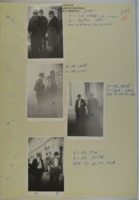 These three pages of photo collages represent three instances in which Greek Catholic Bishop Ioan Dragomir was captured by secret police surveillance shortly after his release from prison in 1966. They all come from Dragomir’s individual file that extends to ten volumes. The first two collages are of photographs taken in stake out operations by Securitate officers from Maramureș county at the request of the central offices of the secret police. The officers had been instructed to map the network of persons Bishop Dragomir had contact with in his daily activities. These images consist of two types of photographs. The first collage is comprised of photographs where the camera (in the hands of the officer) is mobile and follows Bishop Dragomir after leaving his house. This page of images offers a visual story for the textual report submitted by the officer. One can discover by looking at the photographs frame by frame when the bishop leaves the house, who he meets, who he walks and talks with and the places he visits (the Roman Catholic parish house, the Roman Catholic Church, the market, the shop, the restaurant and the train station). The Bishop was in most cases aware of the surveillance and thus he takes all types of precautions to hide his activity from the secret police officers. When the officer was close enough, dialogue was added to the visual material. The persons that the bishop met were one by one tracked down and also placed under surveillance. They are initially known by aliases in the file and gradually, as the officers learn more about the individuals, the file includes more thorough descriptions of their age, workplace and behaviour. The second type of collage is focused on the intimate daily activities of Bishop Dragomir. His family is tracked in their meetings with the “subject” and his visits to family members are recorded. The pictures in this collage present the bishop with his niece Maria Pop. The third collage, part of volume seven of the individual file captures bishop Dragomir’s funeral. The officers photographed the participants, counted them and then placed them under surveillance also. Bishop Dragomir was the oldest of the underground bishops and his funeral was an event for the Greek Catholic Church and thus the secret police followed it closely and recorded even minute details about the attendance and the funeral ceremony. The three photo collages are part of CNSAS file I3560 volumes 2 and 7. Pages of photograph-collages can be found all throughout the 10 volume file along with reports of surveillance, biographies of the persons that belonged to Bishop Dragomir’s network and descriptions of meeting places.
-
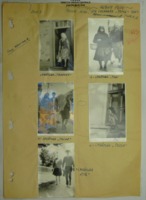 This two-page collage of photographs represent Greek Catholic believers coming to underground services and meetings with Alexandru Todea the underground Greek Catholic bishop in Reghin, Mureș county in the mid 1960s. The images come from the informative file on Bishop Alexandru Todea that was opened upon his release from prison in 1964 as part of the general Amnesty Decree. The photo collage was sent by the Securitate officers from Mureș region to the central office in Bucharest with the description of the individuals represented in the pictures. The pictures were the result of a longer period of surveillance of the visitors to the house where Todea was residing. They were classified and selected from a larger pool of people, categorised as people who often visited and people who visited him seldomly. The surveillance operation also identified the meeting places, either permanent or provisional (two houses and a place of work). The two-page collage and the documents that explain it help us to understand the work of the Securitate in surveilling underground religious communities. For example, the photographed individuals are identified with aliases. In the description, they are identified with names, the names of parents, place and date of birth, current domicile and how many years the person attended school and sometimes also their employment history appears as well. The focus in the description is also on gender and age. Men were considered more important in the underground religious communities as they owned the houses where meetings and religious services took place. However, one can see from the collage that women made up the overwhelming majority of the visitors. The secret police also track the young men and women that participate since they represented the future of the community and their resilience. The majority of the people of the network were peasants or lived in the countryside according not only to the description but also to the way they are dressed; most women wore headscarves and aprons, the men white trousers and shirt with a dark sleeveless overcoat and a traditional hat. Also, one can see in the pictures that the women carry large shoulder bags and baskets that are traditionally used to take goods to sell at the town market. These images also shows the interest that the secret police had in the way the underground hierarchy of the Greek Catholic Church made their living since they were not employed. They assumed, correctly at least for the early years after their prison release, that peasants brought food to support their clergy. The two-page photo collage is part of CNSAS file I3470, volume 2. The collage is attached at the end of the volume along with the description of the photographs, the short bios of the persons and the description of the meeting places.
-
 Being surveilled and under constant risk of arrest, many clandestine religious communities developed their own coded language to communicate with each other and with their religious centres. This enabled them to avoid the disclosure of sensitive information in case of arrest and confiscation. Jehovah’s Witnesses were among the groups who developed their own coded system of communication, which they used in their missionary materials and finance reports and tallies. The secret police, in turn, made great efforts to intercept clandestine communication channels and to decipher coded messages. The missionary tallies you can see here were confiscated by the Soviet KGB from a group arrested Jehovah’s Witnesses in Western Ukraine. They report about the so-called “field service” of Witness Western circuits in Ukraine during 1953-1954. The encrypted reports contain information about the number of believers in local groups, the amount of religious literature produced and distributed and hours spent evangelizing, as well as information about prayer meetings and Bible study groups, christenings and other religious events. The confiscated reports were discovered by the police in an underground bunker and were later attached to a case file and were used as an incriminating evidence of organized proselytism by Jehovah’s Witnesses, an illegal sect in the Soviet Union. The images come from the State Archive Branch of the Security Services of Ukraine, fond 5, spr. 42795, vol. 14. The 27-volume case file against seven Witnesses from Ukraine contain hundreds of interrogation records, arrest questionnaires, photographs, confiscated religious materials and personal items. For related entries on:
-
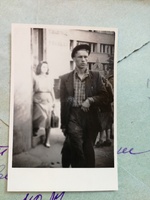 These photographs come from a KGB surveillance file on Jehovah’s Witnesses in Ukraine, 1955-1956. The photographs, which were taken with a hidden camera, capture the meeting of a KGB agent with a group of Witnesses in the town of Morshyn, western Ukraine. The agent was a Witness minister recruited by the KGB as an informer. He was appointed by the secret police to meet with members of the Jehovah’s Witness regional committee in Ukraine in order to gain their confidence and to intercept the communication channels of Ukrainian Jehovah’s Witnesses with their headquarters abroad. During one of the meetings, the agent intercepted and copied the country missionary reports sent from Ukraine to the Polish Jehovah’s Witness office and later submitted it to the KGB. The handwritten copies are attached to the file. A month later, two of the Witnesses from the meeting were arrested. After the annexation of western Ukraine in 1939, and particularly with the beginning for the Cold war, the Soviet state launched a full-scale attack against the Jehovah’s Witnesses living in the western borderlands of the country. In the period between 1947 and 1953 alone, the state arrested about 2,000 Witnesses in western Ukraine, confiscated hundreds of thousands of journals and leaflets and destroyed several underground printing presses. Alleged emissaries of the American intelligence services, Ukrainian Jehovah’s Witnesses faced two mass deportations in 1949 and 1950. The repression nearly wiped out the organizational structure of the Jehovah’s Witnesses and fractured their coherent network of close-knit communities in Ukraine. As part of the plan to repress them, the KGB carried out several secret operations that aimed to infiltrate the Jehovah’s Witness leadership with KGB agents and informers. There were about 200 agents and informers working in the Witness underground in western Ukraine in the mid-1950s. Several KGB informers became important figures within the Jehovah’s Witness organization, entered the country committee, travelled abroad and established communication with higher level Witness centres in Poland and Switzerland. Many Witness couriers who smuggled information from the Soviet Union abroad were under the control of the KGB. This is how the secret police obtained detailed and up to date information about the religious underground. The subsequent history of the Jehovah’s Witnesses in the Soviet Union, however, demonstrates that neither KGB agent infiltration nor mass deportation prevented the survival or indeed the steady growth of the organization. The images come from the State Archive Branch of the Security Services of Ukraine, fond 2, op.1, spr. 2677. Along with 6 photographs, the file contains numerous reports on surveillance and informer recruitment, reports on the arrest of Witness leaders, agent reports, character assessments of informers, copies of interrogation reports, fragments of intercepted letters and tallies of Jehovah’s Witness membership. For related entries see:
-
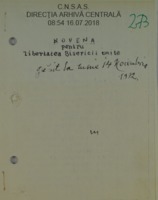 In the early 1970s, during a raid and house search on Fr. Aurel Leluțiu, the officers found amongst other documents a typed prayer entitled "Novena for the freedom of the Greek Catholic Church". The prayer, however, is not included in Fr Leluțiu’s file. The four images presented here are selections from the same ten-page Novena preserved in Bishop Ioan Dragomir’s secret police individual file. The prayer was considered problematic by the Securitate with mentions of it being made in several other files. This Novena, a nine-day prayer exercise, is directed to the Virgin Mary to intermediate with Jesus on behalf of the Romanian Greek Catholics for the recognition and freedom of their church. It asks the Divinity to “not be late in breaking the chains of the Bishops, Priests and believers that remain faithful to the church.” Like several other memoranda and leaflets produced by the Greek Catholic underground in the late 1960s and 1970s, this prayer can be considered political in that it focused on tangible results in easing the life of the community under the political regime of the time. The prayer asked Virgin Mary to “Soften the hardened hearts of the state leaders […] so they would not fight the [church’s] activity and its resurrection from the underground where persecution has pushed us.” Several tropes that characterize the life of the underground Greek Catholic Church can be noted in this prayer: church of the catacombs, the silent church, chains (breaking the/being in), erasing the memory of the church from the history of the nation. These themes run throughout the underground samizdat literature produced by the Greek Catholic intellectual and clerical elite. The prayer was typed and it circulated extensively in Greek Catholic environments with mention of this prayer ranging from Bucharest to Brașov and Cluj-Napoca. The four pages selected here from a ten-page manuscript, are part of CNSAS file I0003560, volume 3. Mentions about the manuscript are also found in CNSAS file I163305 volume 1. The manuscript is found at the back of the file alongside other samizdat materials.
-
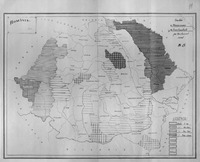 This map, which was created by the Romanian interwar secret police, the Siguranța, shows the distribution of two banned religious groups, Nazarenes and Inochentists. The map is undated but appears together with other materials from 1938. From the second half of 1938, the new Royal Dictatorship headed by King Carol pursued harsher policies towards religious sects and the Siguranța made a concerted effort to gather accurate data on sects in order to be able to plan operations and determine whether its actions were producing results. The data for maps such as this one was collected by local gendarme posts, which functioned as the eye and ears of the regime in the countryside. Local gendarme commanders regularly reported data upwards including the names and addresses of preachers, the locations of places of worship, numbers of adherents of the various banned groups in local settlements and numbers of reverts to Orthodoxy (this data was supplied to them by local Orthodox priests who issued certificates as proof of membership of the Orthodox Church). Based on this data, the secret police created maps, charts and tables showing the nationwide statistics and distribution of illegal sects. This map comes from a Documentary file CNSAS, D015288, on Inochentism 1934-1943. This file also contains a number of press cuttings from the 1930s on Inochentism plus tables of statistics on produced by the Gendarmerie. For related entries see:
-
 The first image is a photograph of Ignat Neculai and his family from Moșna, Falciu county. He is photographed with his wife, and four children, one of whom is in regional dress. Ignat’s name is written on the edge of the photo. The other image is a photograph of some soldiers, Sergeant Gheorghe Sorin, Captain Costache Jugnaru, and Costache Pițu, from Battalion I, Regiment 25, Company 4, stationed in Moșna. Their names are also written in pen along the edge of the photograph. The third image is a photographic negative of a group of officers from Iași taken at Christmas. On the back of each item there is a handwritten description. The photos were used in a court case brought against Stefan Neculai. Neculai was twenty-eight years old, married with two children, and originally from Cuza Voda, Ialomița County but resident in Vaslui City. He made a living as a photographer but he had failed to obtain the required authorisation to possess a camera. The fact that he took photos of soldiers also made him suspicious. The three photos mentioned were taken between December 1939 and February 1940. Neculai was apprehended at the Seventh-Day Adventist prayer house in Moșna village on 10 February 1940 and taken to court. Based on the documents in the case file it is unclear what the outcome of the case was. Neculai’s police testimony and that of witnesses are included in the file. Among them is the statement of a Jewish regimental tailor Sami Segal, at whose shop Neculai had lodged for six days. The odds were not in Neculai’s favor. As an Adventist he was considered a sectarian with foreign ties and therefore potentially dangerous to state security. His affiliation with the Jewish tailor during a time of rabid antisemitism also made his activity suspicious to the authorities. Seventh-Day Adventists were outlawed during the war and Neculai’s case is evidence of increased concern regarding religious minorities. Reports on other suspicious sectarian soldiers are also included in the folder. The photographs come from ANIC, DGP inv. 2349, 40/1930. The file includes police reports, correspondence between local gendarme commanders and the General Police Division in Bucharest. Personal files on soldiers with a sectarian background enrolled in the army between 1928 and 1940 are also available in the folder.
-
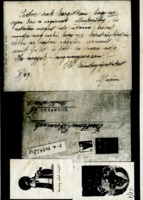 The image comes from a documentary file on the former leaders of KLOSZ (National Confederation of Catholic Girls), a Hungarian Catholic youth organisation, which was by that time, like other civil organisations, dissolved by law. It shows an intercepted letter, an envelope and two religious images. The message on the card is rather enigmatic: "I’m writing hastily, my dear Margit, asking Gizi not to write to our brother-in-law – on the contrary, if she happens to come here, she should tell him not to make any inquiries in this matter for now, – and he should also return what he had noted down – I will explain if I visit you – Hugs, [illegible name]." According to a note made by the secret police in the file, the letter was posted on 27 May 1953. The header in the envelope originally displaying KLOSZ, but is has been taped over. Other than this, there is no information about the identity of the corresponding parties or the meaning and importance of the letter. However the context and the other confiscated letters contained in the file suggest that it is an example of how clandestine religious communities communicated and organised their activities. Aware of being surveilled by the secret police, these groups were cautious in their actions and had various strategies to safely transmit information: they relied on oral communication whenever possible and used coded language or ambiguous wording if writing was unavoidable. In this case for example we may assume that the term "brother-in-law” stood for a cleric participating in the movement. When caught by the secret police, these messages were used as evidence of the illegal activities of these groups. KLOSZ was founded in 1923 to provide extra curicular education for girls and young women to help them become modern and active Catholic women. It lost its legal recognition in 1946 when nearly all civil organisations were dissolved by law but continued its original work underground with its leading figures and some of its members participating actively in underground Catholic movements. The image is included in file ÁBTL 3.1.5 O–10202 titled "Catholic girls." Apart from the letter the file contains other items of confiscated or intercepted correspondence and interrogations of various leaders of the underground Catholic youth movement (including György Bulányi), operative plans, studies of targets and potential collaborators, summary reports and recommendations for arrests. For related entries see:
-
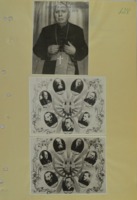 These images are of postcards that circulated in the 1970s of the Greek Catholic bishops that refused the forced unification of their church with the Romanian Orthodox Church. The bishops were all arrested, imprisoned and either died in prison or in forced domicile. The two images show the Greek Catholic Bishops Ioan Suciu (1953), Valeriu Traian Frențiu (1952), Vasile Aftenie (1950), Ioan Bălan (1959), Alexandru Rusu (1963), Tit Liviu Chinezu (1955), and Cardinal Iuliu Hossu (1970). Their photos were then collaged together and artistically framed around an image of the Blaj Greek Catholic Cathedral. Because Cardinal Iuliu Hossu appears in the medallion with the date of his death, we can safely date the postcards in the 1970s. The first image also has a photo of Bishop Ioan Dragomir dressed in his cassock with cincture and with an episcopal cross. These visual clues also serves to narrow the date in which the postcards were produced to before 1985 when bishop Ioan Dragomir died since the file in which these images are found does not give any explanations of the postcard or the picture. We can only assume that both bishop Dragomir’s staged photo and the postcard of the martyr bishops were similarly used as a means to inform the community, through these visual messages, that the Greek Catholic bishops had died for their faith in the communist prisons and yet the Church continues to live on in the underground. The second image of the same postcard of the martyr bishops comes from the Informative File of Greek Catholic Bishop Ioan Ploscaru. The document contains the postcard, a picture of all the Greek Catholic bishops taken before 1948 and the envelope in which these pictures were presumably sent. The document represents the secret police practice of making photographic evidence of problematic correspondence. After it was copied, the letter was probably posted on to the addressee. In this case, the letter was sent to Florea Dosoftei at Curtea de Argeș. What made this letter suspicious was probably the fact that it was correspondence between the Greek Catholic bishop Ioan Ploscariu and Fr Dosoftei Florea, a monk in the Orthodox Church. They were both imprisoned during the communist regime. The images selected were part of two different surveillance files of two underground Greek Catholic bishops. Variants of these postcards can be found in Greek Catholic communities today leading to the conclusion that they were widespread in the period and fairly accessible inside the underground community, and thus a useful method of passing information on the community through visual rather than textual means. These postcards are photographed and attached to two different multiple volumes informative files that space out from 1964 to the late 1980s. The files are preserved in the archive as CNSAS I3560 vol 7 and I262256 vol 4. They also contain surveillance images, intercepted correspondence, notes from informants, religious texts and samizdat.
-
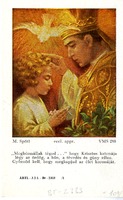 This is a picture of a confirmation holy card by artist Maria Spötl (1898-1953). The holy card depicts a confirmation with a bishop giving a blessing to a praying young boy. On the lower part of the holy card we find the following text: “Megbérmállak téged …….hogy Krisztus katonája légy az ördög, a bűn, a tévedés és gúny ellen. Győznöd kell, hogy megkapjad az élet koronáját.” “I confirm you ………..to be the soldier of Christ against the devil, sin, deception and scorn. You have to be victorious to receive the crown of life.” The "VMS" abbreviation below the picture stands for Verlag Maria Spötl (Maria Spötl Publishing). This holy card was confiscated from a Hungarian Verbite (Society of the Divine Word) missionary priest while trying to smuggle 10 000 holy cards along with 300 memorial cards and 10 rosaries from Austria into Hungary in 1962. The memorial cards and the rosaries were found during the customs check at the border but were allowed to be brought into the country as it was not a large quantity. He offered to give the holy cards to the Bishop of the Diocese of Győr, however, the bishop refused them due to their illegal origins. Having tapped the bishopric palace, the secret police learnt of the smuggled holy cards and used this illegal act to blackmail and incriminate the Verbite monk. During an interrogation in 1962, the monk was asked to cooperate with the secret police under the cover name 'Hobbs' and send intelligence on the Verbite order and on his mission field in the Philippines. At his missionary post Hobbs worked in the improvement of the social well-being of the 14000 indigenous people living on two islands 300 kilometers away from Manila. He stayed in contact with the authorities and sent a few reports back but was not in active operation. Only when he visited Hungary to see his family, which he didn't do every year, did he have to report to his officer. In 1974 Hobbs was 'de-activated' as an informer without letting him know as he might have been required to serve the Hungarian secret police upon his return to the country. After 1984, the file describes a series of attempts to reactivate him as an informer. Eventually the officer overseeing Hobbs decided that despite his willingness to cooperate, he had no potential to provide useful intelligence so there was no need to keep up the connection with him. The Hobbs case illustrates two things, how something as everyday as a confirmation card was for a period of time were difficult to source and required sensitive navigation on the part of the Catholic Church, and secondly, that this seemingly insignificant act could lead to a protracted attention from the secret police. The holy card comes from file ÁBTL 3.2.1. Bt-2333. Along with the holy card, the file also contains the transcript of a tapped conversation with the Győr bishopric palace, Hobbs’ interrogation reports and transcripts of Hobbs’ letters written to his contact officer.
-
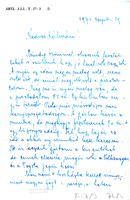 In this image we see cryptographic letters written by agent ‘Géza Szebeni’. This was not his real name but his secret service pseudonym. The first image is of the visible “cover letter” which masks the cryptographic letter shown here in the second image, while the third image is the decoded transcript of the cryptographic letter. The letters were created using a cryptographic technique that allows the writer to hide the important message underneath a decoy message containing inane and useless information. In this case, the cover letter resembles friendly correspondence such as family issues and weather. The cryptographic letter, which is hidden behind the cover letter and which had to be developed using a special technique, contained the intelligence information. The agent, ‘Géza Szebeni’ sent his letters to the Hungarian secret service using different Hungarian-American names and addresses. Agent ‘Géza Szebeni’ was recruited in 1961 and between 1961 and 1969 in five working dossiers he reported on the inner life of the Baptist community in Hungary. In 1969 he took up a position as the pastor of the Hungarian Baptist community in Detroit, USA. Szebeni was expected to work as an operative for a period of 4-6 years to “conduct research and maybe recruit people in addition to collect, organize and analyze materials connected to the American small churches.” From 1969 he reported on a monthly basis through “first class cryptography.” From the dossiers we learn that Szebeni was trained in intelligence methods, including the use of cryptographic letters for communication and in eavesdropping techniques and its prevention. The officers of the Hungarian secret police kept reminding ‘Szebeni’ to fold the paper first before writing to ensure that he did not write on the folded part as it was not possible to develop text written on the fold. Often his coded messages were incomprehensible. An instruction document entitled “The basics of invisible cryptography” (A láthatatlan tikosírás alapjai) was produced for agents and can be found in the archives at ÁBTL. In 1969-70, ‘Szebeni’ was met at a previously agreed location every six months, however, from 1971 reports from ‘Szebeni’ become scarcer. He explains to the complaining officers that he felt he was under surveillance and therefore did not send regular reports in order to protect himself. In 1972, the secret police broke off contacts with ‘Szebeni’ as his existential and social situation took an unfavorable turn and his reports had no operative value for the Hungarian secret service. Finally, in 1976 he was expelled from the secret police network. When visiting Hungary in 1979, he returned his cryptographic toolkit, a black notebook. He died in 1981 in the USA. The cryptographic letters come from files ÁBTL 3.2.2 T-27/2-3. In the files we find many letters with the original cover letter, the developed cryptographic letter containing the intelligence and the transcript of the reported message.
-
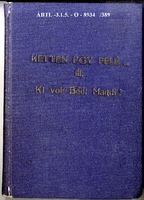 The first image depicts the cover of the samizdat book entitled Ketten egy felé… III. Ki volt Bódi Magdi (Two towards one… III. Who was Magdi Bódi?). The second image is the inside cover of the book with the text: Ketten egy felé… Szent Goretti Mária és Bódi Magdi utja. 1956, Karácsonyán. – Kézirant gyanánt.- (Two towards one… The life of St. Maria Goretti and Magdi Bódi. 1956, Christmas. -As manuscipt). The third image is a photograph of Magdi Bódi from the book with the caption below the image reading “Fűzfő angyala”, “The Angel of Fűzfő.” The last image is of page 204 of the confiscated book and depicts the tomb of Magdi Bódi in the village of Litér and the caption reads: A litéri sír… Magdi! – Élsz Krisztusban!...(The tomb in Litér… Magdi! You live in Christ!). The typewritten book is an account of Mária Magdolna Bódi (1921-1945), a working-class girl from Balatonfűzfő. Her life story is paralleled with that of the martyr St. Maria Goretti. Magdi Bódi was a young Catholic girl who had made a vow of chastity to Christ. She was active in organizing faith life in Balatonfűzfő having initiated the local group of the Hungarian Catholic Working Women’s Movement. According to the book, Magdi Bódi’s parish priest instructed her to always keep a knife or scissors with her in order to be able to defend herself against the violence of the Soviet soldiers. In 1945 a Soviet soldier shot her as she was trying to protect herself from sexual assault. The typewritten book contains original photograph illustrations of Magdi, some with her family and one of her tombstone with a crucifix. In the dossier, the tomb of Magdi Bódi is discussed as a place of gathering of reactionary priests and sisters. The samizdat book was written by a Catholic abbot, Dr. Miklós Galambos, in 1955. He had heard of Magdi Bódi’s martyrdom while imprisoned in Veszprém. The book is the third part of a series. The first two parts of the book series tell of the life of St. Maria Goretti. The content of the book is discussed in the dossier as anti-Soviet content in the guise of religion. The book was confiscated from Dr. István Kiss, professor of theology and vice-director of the Theological College of Eger. Dr. Kiss was the target of the operative dossier in which the book is located as he was a representative in the Hungarian National Assembly for the Independent Smallholders’ Party and had strong connections with the high clergy and the democratic opposition leaders between 1945-48. Authorities judged him to be reactionary and he was under surveillance from 1951 onwards. His name occurs in several other secret police dossiers as he was openly anti-communist and is accused of educating the seminary students of the Theological College in this mentality. Dr. Kiss was interrogated in 1958 and on several other occassions for spreading the illegal samizdat entitled “The Angel of Fűzfő.” His ownership of the book was used as evidence against him. After 1989 there has been a growing cult of Magdi Bódi, especially in her home town where she was buried. Her beatification process was initiated by the Hungarian Catholic Church in 2017. The images and the book are found in ÁBTL 3.1.5. O-8934 along with intercepted letters to Dr. Kiss, an operative plan to disclose the details of the circulation of the illegal book and interrogation reports.
-
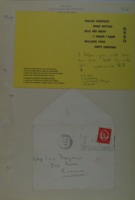 The four images show Amnesty International postcards sent to Dej prison to the Greek Catholic Bishop Ioan Dragomir in 1964. They are selected from a total of 15 winter holiday postcards sent from various places in United Kingdom and Australia to Dej prison. Most of them have standardized typed messages on the Amnesty International cards. The first picture shows the inside of a card and back of an envelope. The card is a standard pre-written Amnesty International card to which the sender added: “I hope you will soon be free. God be with you.” The sender was the secretary of the University College in Cardiff. Most of the cards come with only the pre-written standardized messages and are signed and addressed. This is among the few that include some lines from the sender. The second and third images show the front of two cards. The forth image shows the inside of a card that sparked the special interest of the secret police. The senders’ message reads: “Dear bishop Dragomir, greetings. May the future bring greater light, Yours Faithfully Fred Dykstiva”. However, it was not the hand-written message the Securitate officers were concerned about but the pre-written Amnesty International message at the bottom of the card. “This card is being sent to men and women in various countries held in prison for their beliefs, to show that those who are free to speak and worship as they wish remember those who are not.” The 15 cards arrived at Dej prison in November 1964 several months after Bishop Ioan Dragomir had been released from prison after an amnesty decree that released most of the political prisoners of the regime. However, what triggered the Securitate involvement was the fact that Bishop Dragomir had never been a prisoner of the Dej prison (this was a prison that catered for prisoners arrested and charged for spying for a Western country). Bishop Dragomir was supposed to have been sent to Dej prison since his imprisonment had originally been on charges of espionage for Vatican. However, his past as a member of the Peasant Party ensured instead that he was sent to Galați prison and later to Brăila where he spent the last days of his imprisonment until July 1964. While most of the political prisoners in Dej prison received Amnesty International postcards it was the Ioan Dragomir batch that raised the suspicions of the secret police. The officers raised questions about how the senders had found out that this was the correct address for political prisoners. This mistake in address seemed to indicate that international institutions were privy to the thinking behind the types of prisoners being sent to the various prisons. Moreover, the officers were interested in whether the correspondence between the bishop and these senders continued after his release from prison. Unlike his correspondence after his release that was copied and read by the secret police, these postcards never reached bishop Dragomir. Bishop Dragomir was one of the clandestine Greek Catholic hierarchy that was created by Nuncio Patrick O’Hara following the imprisonment of the bishops of the Greek Catholic Church in 1948 for refusing to sign and acknowledge the forced unification with the Orthodox Church. He was imprisoned for 20 years in 1952 for activities against the social order. He was released in 1964 and returned to his home where he spiritually administered the clandestine communities of Greek Catholics as their bishop. The four images are part of the informative file on Ioan Dragomir CNSAS I3560 volume 2. The informative file has 10 volumes and includes several other evidence photographs, notes from informants, intercepted correspondence, secret police reports on the everyday activity of Ioan Dragomir and the Greek Catholic underground community. For related entries see:
-
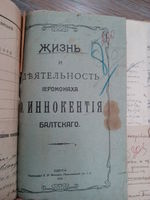 The image depicts the cover page of a booklet published in 1918 in Odessa by the followers of Inochentie of Balta. It was confiscated by the Soviet secret police in 1921 from the Inochentist community of the village of Lipetskoe (Balta county, Odessa Governorate). The village of Lipetskoe was a spiritual center of Inochentism, where the followers of Inochentie of Balta built an underground monastery and established an utopian communal society called Gradina Raiului, the Garden of Paradise. The booklet contains 19 pages which describe the life of Inochentie of Balta, the founder of the Inochentist religious movement, which emerged at the beginning of the 20th century. From the perspective of the secret police, the collection of this kind of literature was important because it allowed the officers to construct a clearer understanding of this new religious movement and to formulate more efficient strategies to repress it. The booklet narrates a unique version of the life and deeds of Inochentie of Balta, different from the accounts found from other textual and oral sources. The secret police archives contain textual materials produced at different stages of the history of religious groups, many of which cannot be found in other repositories or in personal collections. The booklet is attached to the file number 27146 that is preserved in the Archive of SBU Office in Odeska Oblast of Ukraine. The file contains 11 photographs and icons, one booklet and a number of flyers produced by Inochentists and a propaganda flyer of the White Movement with the image of Alexander Kolchak. For related entries see:
-
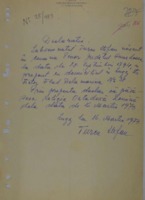 The four images are of letters from members of the Romanian Orthodox Church community expressing their desire to leave the church. The almost identical, handwritten, signed and dated (spring 1973) letters were sent to the Romanian Orthodox parish in Lugoj. The second and third letters were written by the same person on behalf of different family members. The authors inform the Orthodox Church in Lugoj that they are leaving the Orthodox Church. The final letter, which was written in the name of an entire family, states that if by mistake they were registered as children with the Orthodox Church they respectfully ask to be removed from the church records and with this act they declare themselves Roman Catholic believers. According to the explanations given to the Ministry for Religious Denominations by the Orthodox Archbishop of Banat, within whose jurisdiction Lugoj was situated, the authors of the letters were former Greek Catholic believers that joined the Orthodox Church in 1948. The Archbishops communication goes on to identify the authors as older and helpless members of the former Greek Catholic Church, one of which was a bedridden former Greek Catholic priest. These letters, which were required according to the Law for the General State of the Religious Denominations, chapter 5, articles 38 and 39 that outlines the official process of leaving one denomination and joining another, were considered part of a larger campaign by the underground Greek Catholic Church aimed at the legalisation of the church by the communist regime. The letters demonstrate that the Greek Catholic community was still active in the 1970s and that its members were openly leaving the Orthodox Church in protest at the 1948 forced unification. Moreover, especially the forth letter shows that after the forceful unification between the Orthodox and the Greek Catholic Church the believers of the latter were, in some cases, registered as Orthodox without their knowledge or agreement. The letters ended up at the secret police via the Ministry for Religious Denominations where they were received together with the Orthodox Archbishop’s letter requesting the ministry’s help in discovering who instigated this action and solutions for the problems it raised. The matter was investigated by the secret police and deemed not dangerous. The officers leading the investigation reported that the authors of the letters were old and the sole reason they had drafted them was so they could prepare for their death. The Roman Catholic Church could not or would not officiate at the funerals of nominally registered Orthodox believers and thus the authors of the letters had to officially leave the Orthodox Church even if, at least in some cases, they had never officially joined it. The letters are part of a larger file on the Catholic problem in Romania CNSAS D69 vol 9. The documentary file regarding this matter contains a letter between the Orthodox Archbishop and the Ministry for Religious Denominations, communication between the Ministry and the secret police, the originals and several copies of the letters and a document with the results of the secret police investigation.
-
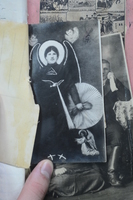 The three images presented here all show variants of the same photo-icon of Alexandru Culeac portrayed as the Archangel Michael. In the first image he appears alone; in the second image, his photograph appears next to that of Inochentie of Balta, and the third image is a reproduction of the photo-icon that appears inside the front cover of a booklet containing Alexandru Culeac's visions entitled "A vision that appeared in 1920". The presence of multiple examples of this photo-icon in the same file reflects the importance of this devotional image to the Archangelist community. Archangelism formed as a branch of Inochentism under the leadership of the Culeac brothers, the most prominent of whom was Alexandru Culeac (b. 1891). He was considered to be the Archangel Michael returned to earth to battle Satan at the End of Days. The Culeac brothers published and distributed their visionary experiences of divine election and the Final Judgement in the form of brochures and continued the tradition started by followers of Inochentie of Balta of using powerful visual materials to communicate their message, commissioning icons and producing photographs to reinforce their special claims. Alexandru Culeac quickly grasped the power of the image to establish his status as mediator between earthly and heavenly realities and in the image shown here we see how techniques of montage and over-painting have been used to create a striking iconization of Alexandru Culeac. In 1924, the photo-icon was printed on the inside cover page of his booklet of prophetic visions entitled "A vision that appeared in 1920" (image three). In the photo-icon, Alexandru Culeac is pictured with a flaming sword, a shield and a dove at his heart, a sign of his dual identity as both the Holy Spirit and Archangel Michael. Later, during the Soviet period, media reports and propaganda publications continued to draw attention to the significance of the production and distribution of religious images for the success of the Archangelist sect, whilst also ridiculing the crudity of their production. In Alexandru Culeac’s confession which was published in 1959 under the title "Repentance of a Sinner", he explains how important the icon that “looked just like me” was for his career, for the Archangelist movement and for the promotion of his divine status: "I decided then to make an icon with my image. I commissioned it from a painter who painted the Day of Judgement and the Ascension of the Archangel Michael, as well as my ascension to heaven. The icon was a success. And the Archangel Michael looked just like me. I declared this icon holy. And it started here. People threw themselves down on their knees in front of the icon. They kissed it and prayed to it to heal them from illness. I don’t know if the icon cured anyone but in exchange we received a handsome income. They brought us cereals, money, carpets and cattle." Intended to portray Alexandru Culeac as a religious charlatan who fooled his followers into making offerings to him, this extract from his confession (which may well have been extracted under duress) nevertheless offers us an insight into the power of the image in the Moldovan vernacular worldview. These photographs come from the National Archive of the Republic of Moldova – Military Tribunal of the 3rd Army Corps ANRM-TMC3A 738-1-6846. In addition to the materials shown here the file contains several photographs of members of the Archangelist community, two pencil sketches and another booklets entitled "The Lord has Spoken [Dumnezeu a vorbit]. Undated. București: Tipografia “Lupta” N. Stoilă. For related entries see:
-
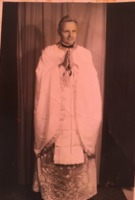 The four images illustrate the religious life of a Greek Catholic community in 1970s Transylvania as recorded by the community in photographs and how it is described by the Securitate on the basis of their surveillance and investigation of the community. These materials represent a rare instance where it has been possible to relate secret police descriptions to photographic materials that can still be found in the community. The first three images come from the private collection of Mihai and Ana Rus and form part of a group of photos related to their regular attendance at religious services in Bishop Todea’s house in Reghin where the bishop had also held their wedding and administered the Baptism and the Confirmation of their children. The Rus family could not pinpoint the exact date when they received the photos nor when they were taken. The fourth image is the first page of a Securitate document dated 23rd January 1971 that describes the situation of the clandestine Greek Catholic community in Reghin, Mureș county, a town near to the Rus family's home village, and the planned measures to be taken against the Greek Catholic community in the area. The first picture from the Rus family collection is a staged photograph of Greek Catholic Bishop Alexandru Todea in the period after his return from prison (1964) when he lived in the town of Reghin in Mureș county. The picture shows Todea in bishop's vestments in a staged, still photograph. His hands are clasped in prayer and is smiling softly towards the camera. The picture was probably taken at his request and served as reminder for the underground community that he ministered spiritually that he was alive and performing his pastoral duties. Moreover, it showed that his church, which had been dismembered by the communist regime in 1948, was still functioning. Descriptions of similar photographic devotional materials appear in Todea’s Securitate Informative file. Secret police agents and informers talk about a distribution network of pictures of Alexandru Todea within the Greek Catholic community. The documents also mention that a monetary value was placed on the photos of 3 lei. However this information was not verified in the interviews the Securitate carried out. The second picture was taken during The Great Entrance stage of the liturgy that was conducted in Alexandru Todea’s house. The picture shows an unidentified Roman Catholic priest dressed in Roman Catholic liturgical vestments holding the chalice (and therefore heading the procession) and a Greek Catholic priest (probably Fr. Augustin Giurgiu) holding the disk (ceremonial plate) with the unconsecrated Holy Body of Christ (the Prosphora). The picture shows that in this particular Byzantine service, the Roman Catholic priest holding the chalice leads the liturgy. The picture also shows a well-attended service with several kneeling women and men. The third picture was taken during a religious service in Bishop Todea’s house in Reghin. It is a snapshot of a detail of the back of the priest dressed in vestments during the Gospel reading. There is a clear image of three church goers, one kneeling holding a candle, probably the acolyte or alter server (or făt in Romanian). The fourth image is the first page of the Securitate's description of the religious life we see depicted in the Rus family's personal collection. At the bottom of the page the document states that Bishop Alexandru Todea (secret police code name Toma Aurel) performed religious services all over the town as well as in his house. Wedding ceremonies also took place in his house. The photographic images come from the private photo collection of Mihai and Ana Rus from Băița village, Mureș county, and were shown to the author during ethnographic fieldwork in August, 2018. The family also described religious life and practices of the community during the period when the photographs were taken. The family photo collection contains several photographs that are described in the secret police files on Bishop Alexandru Todea. The image of the Securitate document is part of the file CNSAS I3470. The Informative file on Bishop Alexandru Todea contains several descriptions of the altar in his house, the religious services performed there and surveillance pictures of people visiting the bishop. For related entries see:
-
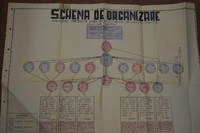 This network scheme comes from a documentary file on Jehovah’s Witnesses in the former administrative region of Cluj. Titled as “Organisation Scheme of the organisation “Jehovah’s Witnesses” in Cluj Region, it shows the structure of the group with names, ranks and connections of each of the functionaries (indicated by circles). The blue box at the top stands for the national leaders, while the rectangular boxes at the bottom represent the six territorial units in the region with the number of their subunits and members. The scheme also informs the viewer of the progress the authorities had made in their measures against the group: arrested “elements” are indicated with red, while those still free are coloured with blue. The scheme is an attachment to an interim report written in 1955 and visualises the results of an ongoing "informative–operative" operation conducted by the Securitate’s Cluj regional directorate. The operation started in 1953, two years after the leadership of Jehovah’s Witnesses in Cluj region (35 people) were arrested and convicted. The aim of the operation was to identify the new leaders and functionaries of the reorganised regional units, to map their connections within and beyond the regional structure, and to gather information about their activities and whereabouts. To further this goal, the Securitate employed several informants to work on the group and relied on information gathered during interrogations of members arrested during the operation (in 1951 or after 1953). As the scheme aims to show, Jehovah’s Witnesses as an organisation had a hierarchical structure. The basic units were the local congregation, each having its leader called servant (this emic term was used for all leaders, and as the scheme shows, it was also adopted by the Securitate). On a territorial basis congregations formed circuits (there were 6 of them in the Cluj region with altogether 146 congregations) with circuit servants responsible for coordinating the work of congregations, supplying them with religious materials and acting as mediators between them and the regional servant. The regional servant in turn was responsible for coordinating the work of circuit leaders: he collected reports, money or other types of donations, distributed teaching materials and mediated between the circuits and the national leaders. His work was helped by evangelisers called pioneers who took an active part in proselytising and organising new congregations; they were mainly young, unmarried and devoted men already living illegally for having refused military service. Communication between the levels was carried out with the help of couriers who transported messages, reports, reading materials and donations. Interaction within the group was highly secretive: most servants and pioneers used cover names even with other group members, all reports were coded and couriers met with the leaders in crowded public places and used prearranged signs to get in touch with one another. Authorities found the highly organised structure of the group and the discretion with which they carried out their interactions suspicious and considered this evidence of the group’s conspiratorial nature. Before 1990, apart from two short periods between 1933–1937 and 1945–1949, Jehovah’s Witnesses did not enjoy a legal status in Romania. They suffered intense persecution at the hands of inter-war democratic governments and the wartime and post-war totalitarian regimes. The main reasons given by the authorities for their harassment were their proselytising activity, the lack of transparency in their organisation, their refusal to perform military service or to participate in elections and other civic duties, their ties to their American headquarters, and their heralding of the end of the regime and the onset of a theocratic kingdom. Throughout the communist period, Jehovah’s Witnesses were closely surveilled by the Securitate with many being imprisoned or sent to labour camps. In spite of the repressive environment, however, their number grew from 15000 in 1949 to 35000 in 1990. These images come from file CNSAS D 014428. Beside the network scheme it contains a 17-page report and several crime scene or evidence photographs of various hidden materials (a typewriter, a loudspeaker fake IDs, religious brochures, coded reports). For further readings on Jehovah’s Witnesses and the Romanian state see: Pintilescu, Corneliu – Fătu-Tutoveanu, Andrada, 2011, Jehova’s Witnesses in Post-communist Romania: the Relationship Between the Religious Minority and the State (1989-2010). Journal for the Study of Religions and Ideologies, vol. 10, issue 30 (Winter): 102–126. For related entries see: