-
Title
-
Postcard from Vladimireşti Convent, Romania
-
Description
-
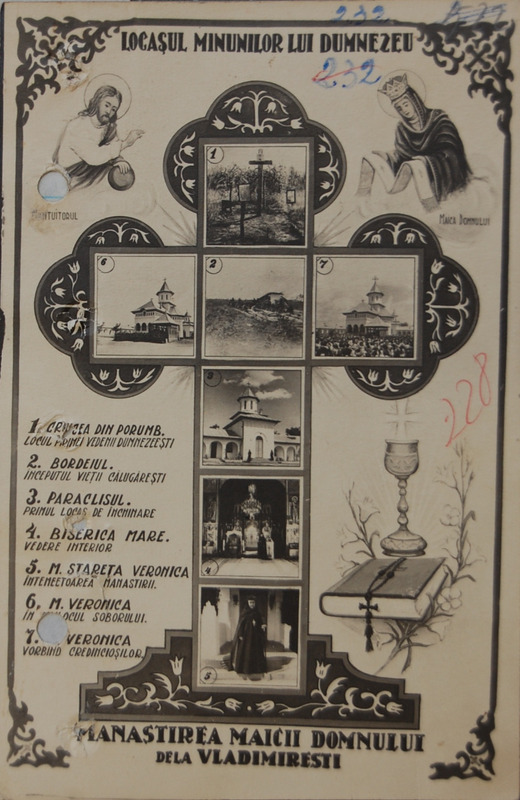
This photo-montage, printed on a piece of light cardboard the size of a postcard, was produced in 1952 as a souvenir for visitors and pilgrims to the Vladimireşti Convent of the Mother of God. The six photographs were commissioned and arranged by Father Iovan, an important monk living at the convent, and were taken by a photographer known only as “I.R.”, who served ten years in prison for his part in producing them (Hanganu 2004). By 1952 the convent had become a focal point for pilgrims in western Moldavia, with people travelling long distances to hear the charismatic preaching of Father Iovan and to take part in collective confession, as well as to witness the prophecies and healings of the convent’s founder and mother superior (stareţă), Mother Veronica. Iovan and Veronica actively cultivated the convent’s popularity, and produced the photo-montage as part of a religious marketing strategy. Blessed by the Saviour and the Mother of God, and sitting alongside a Bible and a chalice, the photos are arranged in a Latin cross bottony common in Eastern Orthodoxy. Three of the photos feature Mother Veronica; in front of the convent, surrounded by priests, and speaking to a crowd of pilgrims. Another shows the interior of the church, but the first three tell the miraculous story of the convent’s beginnings.
In October 1937, when she was still only seventeen years old, Mother Veronica – then known as Vasilica Barbu – had a vision. She said, “I saw a young man of unusual beauty, dressed as a shepherd (mocan). He said to me, ‘Vasilica, go to the priests and the mayor in your village and tell the villagers to erect a cross with the image of the Savior, Jesus Christ, on it, for the forgiveness of sins’" (Barbu 1940). The young man later introduced himself as St. Symeon the Stylite, and appeared to her again a week later together with Jesus himself, when she was working in the corn fields with her sister. The photograph at the top of the montage shows the cross that she erected on in the field where she first met Jesus, evoking both her rural roots and reminding pilgrims that Vasilica had obeyed God’s commands. Vasilica continued having visions, and travelled around the area recruiting other pious young women and raising the money necessary to start a convent. Despite receiving no financial support from the Church, the women pooled their dowries and donations and began building in September 1939. Meanwhile, they lived in a dugout house, where they worshipped, farmed, and faced a number of dangers as a group of young women living in an isolated part of the countryside. The second photo, featuring their first house, stands in sharp contrast to the third, which is of the completed oratory – a testament both to their dedication and to God’s blessing of their work. Taken in order, the images tell a story of continuous growth emerging out of obedience to God’s initiative in revealing himself to a teenage girl.
Beyond its function as a souvenir for visitors, the photo-montage also served as evidence against Mother Veronica and Father Iovan when the Securitate arrested them and closed the monastery in 1956. Secret police reports accused them of harbouring fugitive fascists and of spreading anti-Communist propaganda. Several important theologians helped the Communists’ cause by writing denunciations of Mother Veronica as a visionary and condemning Father Iovan’s practice of collective confession as heretical. Although in itself the photo-montage appears quite harmless, in the context of the Securitate’s investigation it ‘proved’ that Mother Veronica was encouraging a personality cult around herself as a seer and a visionary, and spreading ‘unhealthy’ mystical currents to a credulous and easily misled community. A number of the convent’s leading figures spent years in prison following the forced closure of the convent, and alongside many others, Mother Veronica was terrorized into becoming an informant for the secret police.
ReferencesȘ
Gabriel Hanganu, “«Photo-Cross»: The Political and Devotional Lives of a Romanian Orthodox Photograph,” in Photographs, Objects, Histories: On the Materiality of Images, eds. Elizabeth Edwards and Janice Hart (London: Routledge, 2004), 156–74.
Vasilica Barbu, Minunile din comuna Tudor Vladimirescu, Jud. Tecuci, 2nd Edition (Galaţi: Tipografia “Cultura Poporului”, 1940), 24.
-
Subject
-
Religion and State--Europe
-
Religion -- History -- 20th century
-
Creator
-
Roland Clark
-
Publisher
-
This project has received funding from the European Research Council (ERC) under the European Union’s Horizon 2020 research and innovation programme No. 677355
-
Date
-
1952
-
Format
-
image/jpeg
-
Language
-
RO
-
Type
-
Image
-
Identifier
-
Consiliul Național pentru Studierea Arhivelor Securității (CNSAS), I.60128, vol. 1.
-
Coverage
-
20th century
-
Romania