
Underground spaces
Item set
- Title
- Underground spaces
- Description
-
The term “religious underground”, so often used by both the secret police and dissident religious groups during communism, had both metaphorical and literal meanings. Clandestine and illegal religious groups sometimes opted to conduct their services and meetings or to hide their members and possessions in underground spaces. This was not a phenomenon solely of the communist era however; in the history of Christianity many groups, especially monastic communities have chosen to worship and live in subterranean spaces. In Orthodox Christianity there are many examples of sacred underground complexes, which could serve as a model for the creation of new underground spaces when circumstances required it. Many different groups used underground spaces during the course of the twentieth century and examples can be found in Ukraine, Romania, Moldova and Hungary amongst both Orthodox dissent movements and so-called sects of Protestant or Evangelical origin, such as Adventists or Jehovah's Witnesses.
Underground places of worship were often dug specifically for the purpose although existing cellars and caves were also sometimes used. These underground spaces varied in size, complexity and artistry, from small “priest-hole” type hiding places to vast underground complexes. They were dug in both rural and urban settings but were more easily realised and concealed in the countryside.
Religious gatherings conducted in subterranean spaces might demand certain changes such as the modification of the spatial and material aspects of ritual or the reduction in the number of those present a certain gatherings.
Typically, the images we find in the secret police archives were taken as crime scene photographs and as such they were concerned with showing means of concealment of entrances to underground spaces, the route of entry and actual hidden space. In some cases, the secret police also captured in photographs and film the enforced re-enactment of ritual in these spaces.
- Creator
- James A. Kapaló
- Publisher
- This project has received funding from the European Research Council (ERC) under the European Union’s Horizon 2020 research and innovation programme No . 677355
- Bibliographic Citation
- James A. Kapaló "Underground spaces"
- http://hiddengalleries.eu/digitalarchive/s/en/item-set/273
- Date Created
- 2019
Items
-
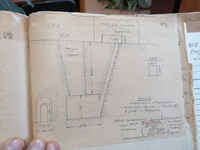 The image contains the sketch of the underground shelter built by Archangelist leaders, Alexandru and Grigore Culiac, and by their followers in Vadul-Leca village, Moldova. The sketch was produced by the Soviet state security service in 1945 after a police raid of the Archangelist community on the 3rd of February. The sketch contains technical details regarding the dimensions of the underground space and about the hiding techniques used by Archangelists to protect their leaders. The shelter was built four meters deep under an orchard, and its entrance was hidden by a shed. The underground space was 1.75 meters high, 2.5 meters long and had two airways. From the 1920s the Archangelists developed the technique of building hidden underground spaces being forced to hide their religious life firstly from the Romanian authorities who persecuted them through interwar decades and latter, after the region was occupied by the USSR in 1944, from Soviet regime whose secret police and propaganda apparatus launched systematic campaigns aimed at eliminating this religious movement. The sketch is enclosed in file R-3401-2-4934 from the National Archive of the Republic of Moldova. For related entries see:
 -
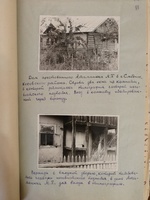 These images were included in a 14-volume criminal file against seven Jehovah’s Witnesses (JW) leaders from western Ukraine (former Drohobych and Stanislav region), 1955-1956. The photographs were produced during a police raid of an underground bunker printing press operated by the Witnesses in a rural location. The photographs were used as incriminating evidence of their clandestine illegal activities. The first image shows a rural private house in Smodne village under which the bunker was constructed. The place was also used as a safe house where several members of the JW organisation were hiding to avoid arrest. The top photograph from the second image shows a bunker air-way masked with sheaves. The third image shows the evidence found as a result of the police search: confiscated printing equipment (rotator, wax stencil, paper, typeface, and ink), samizdat religious materials, as well as an entrance box from the bunker. The bottom photograph on the third image pictures an arrested believer (and the owner of the house) sitting with the confiscated items. The bunker printing press was discovered by the police in 1955 as a result of a major secret operation against the JW leadership in Ukraine. Among the arrested persons was Bogdan Terletsky, the leader of the Jehovah’s Witnesses in the Soviet Union from 1953-1955, who had been on a secret police wanted list since 1950. Under intense pressure and after numerous interrogations, Terletsky’s spirit was broken and he agreed to cooperate with the secret police. Later, during the 1960s, he would give evidence in trials against other Jehovah’s Witnesses. The Soviet authorities considered the Witnesses an anti-Soviet organisation and denied it legal recognition. The Soviet secret police conducted mass arrests of the Witnesses, carried out two major deportations of the Witnesses and their families from the western Ukrainian borderland and Moldova (in 1949 and 1951), and ran numerous secret operations to disclose their complex underground networks. Despite state repression, the Witnesses in the Soviet Union proved remarkably resilience, with the number of members steadily growing throughout the entire Soviet period (see Baran 2014). The repression they endured made the Jehovah’s Witnesses in the Soviet Union an insular organisation, with internal hierarchy and leadership, a coded reporting system and finances, smuggling operations, and clandestine communication channels. They also ran a complex underground network of printing presses that were of particular targets to the secret police. The images come from the State Archive Branch of the Security Services of Ukraine in Kyiv. The file reference is: fond 5, sprava 42795, tom 13. The file consists of fourteen volumes and contains interrogation records of arrestees and witnesses, reports of the police raid, decisions of a commission of experts regarding the anti-Soviet message of confiscated religious literature, etc. The whole volume (No. 14) consists of confiscated Jehovah’s Witnesses material: coded financial and missionary reports, internal instructions, a list of names of arrested Witnesses with addresses of detention places, personal correspondence and photographs. For further readings see: Baran, Emily. 2014. Dissent on the Margins: How Soviet Jehovah's Witnesses Defied Communism and Lived to Preach About It. Oxford University Press. Berezhko, K.A. 2012. Istoriia Svidkiv Egovy v Ukraini: u 5 tomakh. Feodosiia: Art-Life. Ivanenko, S.I. 2002. Svideteli Iegovy – traditsionnaia dlia Rossii religioznaia organizatsiia. Moscow: Art-Busines-Center. For related entries see:
 -
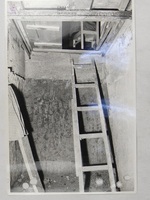 The 4 images are taken from a secret police personal file and were used as evidence of an Old Calendarist underground monastery in Bucharest. The community was led by the Old Calendarist bishop Evloghie Oța. According to the communist state legal framework, the Old Calendarist Orthodox Church was an illegal entity. These pictures documented a sweep operation of the secret police that ended in the destruction of the underground church and the arrest of the bishop. We cannot date the pictures precisely because the community kept rebuilding the underground chapel and the secret police destroyed it each time from 1965 until 1983. The community dated from 1964 when their bishop was released from prison and was held together under his charismatic leadership. During the 26 years of the community existence under communism their number increased gradually. They had several brothers in the monastery and a parish that consisted of regular church goers and people that came from time to time from various places across Romania. The bishop visited and maintained a correspondence with the geographically distant members of his flock. This form of parish is typical for an Old Calendarist community in the communist period but not typical for a regular Romanian Orthodox Church parish. For this reason the numbers of believers cannot be accurately assessed. The file contains several other pictures (14 in total) and two maps of the house and the underground chapel. The pictures follow standard crime scene photographic principles, illustrating the exterior, means of entry to the underground chapel as well as the main incriminating evidence and close up details of particular elements that elucidate the crime. They also show the methods by which the building was transformed from a house into an illegal underground chapel including photos linking the bishop and parishioners to the site. The pictures selected here, illustrate common tropes of illegal religious activity: the route of entry via a ladder to the underground chapel; the ritual space; and the means by which the community financed itself. The third picture reveals the altar table and icons surrounding it together with religious service books, candles and items of from episcopal paraphernalia. Note particularly the crosier and the mitre, both elements that indicate the rank of the officiant that is not present in the picture. The forth picture in this entry shows the money next to several diptychs (several lists of names for whom religious service has to be held are observable in the picture). A stole and a censer can also be seen in this picture, religious objects and garments effectively linking the money to the religious service provided. Although the secret police implied that the community was hiding underground the Old Calendarist subterranean religious spaces and/ or underground chapels were not necessarily used for hiding in. There is an Orthodox Christian monastic tradition of locating sites of worship in cave and subterranean spaces. For related entries see:
 -
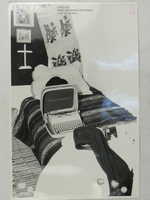 The two photographs are part of an evidence file of an underground Old Calendarist community. They are successive images of a typewriter and the typewriter with its owner taken by the Securitate for an evidence file constructed against the underground group. The first photograph has the typewriter placed near a Kalimavkion (monastic head gear in the Orthodox Church) which visually links the object with the owner. They are placed in the dormitory on the bed and what appears to be some literature is visible next to the typewriter. The second picture presents the owner of the typewriter with the open typewriter. The room is more visible in this image and on the bed several leaflets and books are spread to reinforce the link between the person, the typewriter and the use to which it was put. The person, identified in the file as Evloghie Oța was dressed in a cassock and has a bandage on his left hand which may indicate he may have been subject to physical violence at an earlier stage. It was common practice for the secret police to bring suspects back to the (crime) scene in order to produce stage photographs as incriminating evidence. In interviews with Old Calendarist Orthodox monks that knew bishop Evloghie it appears that his hand was broken at the time and this was not an outcome of his imprisonment. Evloghie Oța is described in the secret police file as a Stilist Bishop. The typewriter along with other equipment used to disseminate information and proselytize (i.e. tape recorder, magnetophone, video recorder, video player) was among the clearest evidence to demonstrate illegal creation, production and reproduction of materials. These types of images are recurrent in evidence files. The Romanian legislation during the communist period incorporated rules for typewriter ownership. Every typewriter was registered with the state administration and a page with the typewriter’s letters and signs was kept in a police file so the user could easily be identified. The images come from file CNSAS fond Informativ, I 161963, Vol. 1. The Informative file includes several other evidence photographs, notes from informants, intercepted letters, secret police reports on the everyday activity of Evloghie Oța and the Old Calendarist community in Bucharest. For related entries see: