
Communication in the underground
Item set
- Title
- Communication in the underground
- Description
-
A key to the survival of underground religious groups was the ability to be able to communicate with one another without being discovered by the authorities. To this end, they developed various communication strategies. Some, like the heavily persecuted Jehovah’s Witnesses, communicated in coded reports, operated a complex system of trusted couriers to deliver messages and religious materials and used cover names for their leaders. It was common practice amongst clandestine religious groups to rely heavily on orally transmitted messages and to use coded language, ambiguous wording and omissions in both oral and written communication. Also, part of the communication strategy of some groups was to limit the amount of information known to each individual member, thus protecting the wider network.
The secret police made considerable efforts to map communication networks within the religious underground and to intercept transmitted messages as they were often of key importance in unravelling and controlling clandestine religious activities. Examples of these kinds of communication methods and techniques are abundant in secret police files. They are usually presented as evidence of the hostile and conspiratorial nature of religious communities, both because of the content of their messages and the secretive nature of their communication practices.
- Creator
- Agnes Hesz
- Publisher
-
This project has received funding from the European Research Council (ERC) under the European Union’s Horizon 2020 research and innovation programme No . 677355
- Bibliographic Citation
-
Agnes Hesz, "Communication in the underground"
http://hiddengalleries.eu/digitalarchive/s/en/item-set/354 - Date Created
- 2019
Items
-
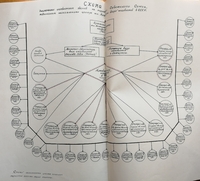 This network scheme of the Jehovah’s Witness organization comes from a four-volume top-secret file titled LKB, Legendirovannoe Kraevoe Biuro (Regional Bureau Covert Operation). It was produced by the Ukrainian secret police in 1953 and shows Jehovah’s Witness districts and circuits located in the Soviet Union with the organization’s country committee (called by that time the Regional Bureau) as the governing body of Soviet Jehovah’s Witnesses. The scheme shows the connections of Soviet-based groups of believers with the Jehovah’s Witness organization abroad: the East-European Bureau in Poland, the Romanian branch, the European centre in Switzerland and the Jehovah’s Witness headquarters in the USA on top of the network scheme. The secret operation (Regional Bureau Covert Operation) was launched by the Ukrainian MGB office in 1951, the same year the state organized a large-scale deportation of Witnesses from the western borderlands. It was suspended in 1954, soon after Stalin’s death. The operation aimed at infiltrating the Jehovah’s Witness underground organization in Ukraine (and later the entire Soviet Union) and to organize a Witness country committee as a covert operation. The plan was designed such that the Soviet security service became the head of the Jehovah’s Witnesses organization, and the headquarters of the official Watch Tower Bible and Tract Society (hereafter the Watch Tower Society), located in Brooklyn, became a channel in their counter-intelligence operations against the US. The scheme comes from the SBU Archives, fond 2, sprava 2432. The file also contains correspondence between the MGB office in Kiev and regional offices in western Ukraine, agent reports, surveillance reports, information on the structure of the Jehovah’s Witness organization in Ukraine, intercepted letters and samizdat publications. More about the secret operation and agent infiltration of Jehovah’s Witnesses in Soviet Ukraine see: Tatiana Vagramenko, KGB “Evangelism”: Agents and Jehovah’s Witnesses in Soviet Ukraine. Kritika: Explorations in Russian and Eurasian History, (forthcoming 2021) For related entries see:
 -
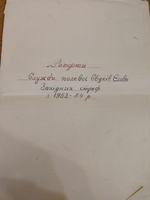 Being surveilled and under constant risk of arrest, many clandestine religious communities developed their own coded language to communicate with each other and with their religious centres. This enabled them to avoid the disclosure of sensitive information in case of arrest and confiscation. Jehovah’s Witnesses were among the groups who developed their own coded system of communication, which they used in their missionary materials and finance reports and tallies. The secret police, in turn, made great efforts to intercept clandestine communication channels and to decipher coded messages. The missionary tallies you can see here were confiscated by the Soviet KGB from a group arrested Jehovah’s Witnesses in Western Ukraine. They report about the so-called “field service” of Witness Western circuits in Ukraine during 1953-1954. The encrypted reports contain information about the number of believers in local groups, the amount of religious literature produced and distributed and hours spent evangelizing, as well as information about prayer meetings and Bible study groups, christenings and other religious events. The confiscated reports were discovered by the police in an underground bunker and were later attached to a case file and were used as an incriminating evidence of organized proselytism by Jehovah’s Witnesses, an illegal sect in the Soviet Union. The images come from the State Archive Branch of the Security Services of Ukraine, fond 5, spr. 42795, vol. 14. The 27-volume case file against seven Witnesses from Ukraine contain hundreds of interrogation records, arrest questionnaires, photographs, confiscated religious materials and personal items. For related entries on:
 -
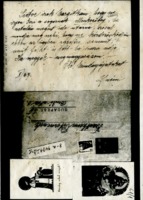 The image comes from a documentary file on the former leaders of KLOSZ (National Confederation of Catholic Girls), a Hungarian Catholic youth organisation, which was by that time, like other civil organisations, dissolved by law. It shows an intercepted letter, an envelope and two religious images. The message on the card is rather enigmatic: "I’m writing hastily, my dear Margit, asking Gizi not to write to our brother-in-law – on the contrary, if she happens to come here, she should tell him not to make any inquiries in this matter for now, – and he should also return what he had noted down – I will explain if I visit you – Hugs, [illegible name]." According to a note made by the secret police in the file, the letter was posted on 27 May 1953. The header in the envelope originally displaying KLOSZ, but is has been taped over. Other than this, there is no information about the identity of the corresponding parties or the meaning and importance of the letter. However the context and the other confiscated letters contained in the file suggest that it is an example of how clandestine religious communities communicated and organised their activities. Aware of being surveilled by the secret police, these groups were cautious in their actions and had various strategies to safely transmit information: they relied on oral communication whenever possible and used coded language or ambiguous wording if writing was unavoidable. In this case for example we may assume that the term "brother-in-law” stood for a cleric participating in the movement. When caught by the secret police, these messages were used as evidence of the illegal activities of these groups. KLOSZ was founded in 1923 to provide extra curicular education for girls and young women to help them become modern and active Catholic women. It lost its legal recognition in 1946 when nearly all civil organisations were dissolved by law but continued its original work underground with its leading figures and some of its members participating actively in underground Catholic movements. The image is included in file ÁBTL 3.1.5 O–10202 titled "Catholic girls." Apart from the letter the file contains other items of confiscated or intercepted correspondence and interrogations of various leaders of the underground Catholic youth movement (including György Bulányi), operative plans, studies of targets and potential collaborators, summary reports and recommendations for arrests. For related entries see:
 -
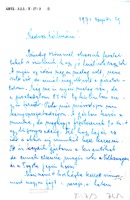 In this image we see cryptographic letters written by agent ‘Géza Szebeni’. This was not his real name but his secret service pseudonym. The first image is of the visible “cover letter” which masks the cryptographic letter shown here in the second image, while the third image is the decoded transcript of the cryptographic letter. The letters were created using a cryptographic technique that allows the writer to hide the important message underneath a decoy message containing inane and useless information. In this case, the cover letter resembles friendly correspondence such as family issues and weather. The cryptographic letter, which is hidden behind the cover letter and which had to be developed using a special technique, contained the intelligence information. The agent, ‘Géza Szebeni’ sent his letters to the Hungarian secret service using different Hungarian-American names and addresses. Agent ‘Géza Szebeni’ was recruited in 1961 and between 1961 and 1969 in five working dossiers he reported on the inner life of the Baptist community in Hungary. In 1969 he took up a position as the pastor of the Hungarian Baptist community in Detroit, USA. Szebeni was expected to work as an operative for a period of 4-6 years to “conduct research and maybe recruit people in addition to collect, organize and analyze materials connected to the American small churches.” From 1969 he reported on a monthly basis through “first class cryptography.” From the dossiers we learn that Szebeni was trained in intelligence methods, including the use of cryptographic letters for communication and in eavesdropping techniques and its prevention. The officers of the Hungarian secret police kept reminding ‘Szebeni’ to fold the paper first before writing to ensure that he did not write on the folded part as it was not possible to develop text written on the fold. Often his coded messages were incomprehensible. An instruction document entitled “The basics of invisible cryptography” (A láthatatlan tikosírás alapjai) was produced for agents and can be found in the archives at ÁBTL. In 1969-70, ‘Szebeni’ was met at a previously agreed location every six months, however, from 1971 reports from ‘Szebeni’ become scarcer. He explains to the complaining officers that he felt he was under surveillance and therefore did not send regular reports in order to protect himself. In 1972, the secret police broke off contacts with ‘Szebeni’ as his existential and social situation took an unfavorable turn and his reports had no operative value for the Hungarian secret service. Finally, in 1976 he was expelled from the secret police network. When visiting Hungary in 1979, he returned his cryptographic toolkit, a black notebook. He died in 1981 in the USA. The cryptographic letters come from files ÁBTL 3.2.2 T-27/2-3. In the files we find many letters with the original cover letter, the developed cryptographic letter containing the intelligence and the transcript of the reported message.
 -
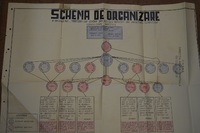 This network scheme comes from a documentary file on Jehovah’s Witnesses in the former administrative region of Cluj. Titled as “Organisation Scheme of the organisation “Jehovah’s Witnesses” in Cluj Region, it shows the structure of the group with names, ranks and connections of each of the functionaries (indicated by circles). The blue box at the top stands for the national leaders, while the rectangular boxes at the bottom represent the six territorial units in the region with the number of their subunits and members. The scheme also informs the viewer of the progress the authorities had made in their measures against the group: arrested “elements” are indicated with red, while those still free are coloured with blue. The scheme is an attachment to an interim report written in 1955 and visualises the results of an ongoing "informative–operative" operation conducted by the Securitate’s Cluj regional directorate. The operation started in 1953, two years after the leadership of Jehovah’s Witnesses in Cluj region (35 people) were arrested and convicted. The aim of the operation was to identify the new leaders and functionaries of the reorganised regional units, to map their connections within and beyond the regional structure, and to gather information about their activities and whereabouts. To further this goal, the Securitate employed several informants to work on the group and relied on information gathered during interrogations of members arrested during the operation (in 1951 or after 1953). As the scheme aims to show, Jehovah’s Witnesses as an organisation had a hierarchical structure. The basic units were the local congregation, each having its leader called servant (this emic term was used for all leaders, and as the scheme shows, it was also adopted by the Securitate). On a territorial basis congregations formed circuits (there were 6 of them in the Cluj region with altogether 146 congregations) with circuit servants responsible for coordinating the work of congregations, supplying them with religious materials and acting as mediators between them and the regional servant. The regional servant in turn was responsible for coordinating the work of circuit leaders: he collected reports, money or other types of donations, distributed teaching materials and mediated between the circuits and the national leaders. His work was helped by evangelisers called pioneers who took an active part in proselytising and organising new congregations; they were mainly young, unmarried and devoted men already living illegally for having refused military service. Communication between the levels was carried out with the help of couriers who transported messages, reports, reading materials and donations. Interaction within the group was highly secretive: most servants and pioneers used cover names even with other group members, all reports were coded and couriers met with the leaders in crowded public places and used prearranged signs to get in touch with one another. Authorities found the highly organised structure of the group and the discretion with which they carried out their interactions suspicious and considered this evidence of the group’s conspiratorial nature. Before 1990, apart from two short periods between 1933–1937 and 1945–1949, Jehovah’s Witnesses did not enjoy a legal status in Romania. They suffered intense persecution at the hands of inter-war democratic governments and the wartime and post-war totalitarian regimes. The main reasons given by the authorities for their harassment were their proselytising activity, the lack of transparency in their organisation, their refusal to perform military service or to participate in elections and other civic duties, their ties to their American headquarters, and their heralding of the end of the regime and the onset of a theocratic kingdom. Throughout the communist period, Jehovah’s Witnesses were closely surveilled by the Securitate with many being imprisoned or sent to labour camps. In spite of the repressive environment, however, their number grew from 15000 in 1949 to 35000 in 1990. These images come from file CNSAS D 014428. Beside the network scheme it contains a 17-page report and several crime scene or evidence photographs of various hidden materials (a typewriter, a loudspeaker fake IDs, religious brochures, coded reports). For further readings on Jehovah’s Witnesses and the Romanian state see: Pintilescu, Corneliu – Fătu-Tutoveanu, Andrada, 2011, Jehova’s Witnesses in Post-communist Romania: the Relationship Between the Religious Minority and the State (1989-2010). Journal for the Study of Religions and Ideologies, vol. 10, issue 30 (Winter): 102–126. For related entries see:
 -
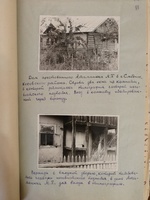 These images were included in a 14-volume criminal file against seven Jehovah’s Witnesses (JW) leaders from western Ukraine (former Drohobych and Stanislav region), 1955-1956. The photographs were produced during a police raid of an underground bunker printing press operated by the Witnesses in a rural location. The photographs were used as incriminating evidence of their clandestine illegal activities. The first image shows a rural private house in Smodne village under which the bunker was constructed. The place was also used as a safe house where several members of the JW organisation were hiding to avoid arrest. The top photograph from the second image shows a bunker air-way masked with sheaves. The third image shows the evidence found as a result of the police search: confiscated printing equipment (rotator, wax stencil, paper, typeface, and ink), samizdat religious materials, as well as an entrance box from the bunker. The bottom photograph on the third image pictures an arrested believer (and the owner of the house) sitting with the confiscated items. The bunker printing press was discovered by the police in 1955 as a result of a major secret operation against the JW leadership in Ukraine. Among the arrested persons was Bogdan Terletsky, the leader of the Jehovah’s Witnesses in the Soviet Union from 1953-1955, who had been on a secret police wanted list since 1950. Under intense pressure and after numerous interrogations, Terletsky’s spirit was broken and he agreed to cooperate with the secret police. Later, during the 1960s, he would give evidence in trials against other Jehovah’s Witnesses. The Soviet authorities considered the Witnesses an anti-Soviet organisation and denied it legal recognition. The Soviet secret police conducted mass arrests of the Witnesses, carried out two major deportations of the Witnesses and their families from the western Ukrainian borderland and Moldova (in 1949 and 1951), and ran numerous secret operations to disclose their complex underground networks. Despite state repression, the Witnesses in the Soviet Union proved remarkably resilience, with the number of members steadily growing throughout the entire Soviet period (see Baran 2014). The repression they endured made the Jehovah’s Witnesses in the Soviet Union an insular organisation, with internal hierarchy and leadership, a coded reporting system and finances, smuggling operations, and clandestine communication channels. They also ran a complex underground network of printing presses that were of particular targets to the secret police. The images come from the State Archive Branch of the Security Services of Ukraine in Kyiv. The file reference is: fond 5, sprava 42795, tom 13. The file consists of fourteen volumes and contains interrogation records of arrestees and witnesses, reports of the police raid, decisions of a commission of experts regarding the anti-Soviet message of confiscated religious literature, etc. The whole volume (No. 14) consists of confiscated Jehovah’s Witnesses material: coded financial and missionary reports, internal instructions, a list of names of arrested Witnesses with addresses of detention places, personal correspondence and photographs. For further readings see: Baran, Emily. 2014. Dissent on the Margins: How Soviet Jehovah's Witnesses Defied Communism and Lived to Preach About It. Oxford University Press. Berezhko, K.A. 2012. Istoriia Svidkiv Egovy v Ukraini: u 5 tomakh. Feodosiia: Art-Life. Ivanenko, S.I. 2002. Svideteli Iegovy – traditsionnaia dlia Rossii religioznaia organizatsiia. Moscow: Art-Busines-Center. For related entries see:
 -
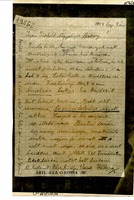 The image shows the photocopy of a handwritten letter from Budapest, September 1954, recommending a cathecism teacher who gave clandestine classes to children. Written on a piece of checkered paper the letter provides precise information about when and where to contact this person. It also contains instructions on how to get to the location of the meeting, a private flat. The visit of the person addressed in the letter, a doctor’s wife who was looking for a religious teacher for her daughters, was already expected by the catechism teacher, who had been notified of her intentioned visit. Near the end of the short and rather straightforward text the writer, a widow, notes: „This has to be kept in secret, obviously”. The envelope belonging to the letter with the names and addresses of sender and adressee was also copied and attached to the file. Although there is no additional information in the file about the identities of the corresponding partners, the letter gives some clues about their relationship and social background. The writer uses a form of address "My honourable Lady” typical of the old regime and notes at the very end of the letter that "the clothes are ready”. This allows us to assume that she may have been a seamstress or a laundress and the addressee was one of her clients. It is also apparent from the letter that the sender knew the cathecism teacher and wrote of him with utmost repsect, describing him as an extraordinary person and a superb speaker whose sermons were attended by "thousands”. The letter was written four years after the Hungarian government made the previously compulsory cathecism classes optional in schools. Although getting religious education remained technically possible, parents were strongly discouraged against enrolling their children in these classes. As a 1955 informant report from another file reveals, even cathecism teachers in schools were confidentially instructed to try to reduce the number of students in their classes. For those wanting to learn about religion, private cathecism classes held by one of the several clandestine religious organisations and movements were the only option. The authority deemed these classes illegal and pursued their teachers: priests, former monks and nuns, or lay activists. Getting involved in these classes in any way was risky and as this letter illustrates, finding a teacher or accepting a student was a matter of trust in which people relied on their personal relations. The letter comes from a documentary file on underground Roman Catholic religious groups that were connected to a movement lead by György Bulányi, a piarist monk. Though the letter only mentions the surname of the cathecism teacher, "Barlai”, he is most probably identical with Ödön Szabolcs Barlay, a former cistertian monk and teacher, who is featured in many other ÁBTL files. He was imprisoned in 1958 and 1961 for organizing illegal religious youth groups and giving illegal cathecism classes. Interestingly however, he was not in touch with those groups that were the targets of this particular file, and apart from the letter his name is not mentioned in it. The letter is included in file ÁBTL 3.1.5 O-11959/4. Apart from this letter the file contains copies of personal letters and postcards, confessions under interrogation, reports on illegal gatherings, transcripts of tapped phone calls and recorded gatherings and detailed reports on shadowings. For further readings see: Bögre Zsuzsanna – Szabó Csaba 2010 Törésvonalak. Apácasorsok a kommunizmusban. Budapest, Metem–Historia Ecclesiastica Hungarica Alapítvány–Szent István Társulat. Mezey András 2014 Az első hazai bázisközösségek: a Bulányi-jelenség és a Katolikus Egyház az 50-es évek elején In Barna Gábor – Povedák Kinga (ed.): Lelkiségek, lelkiségi mozgalmak Magyarországon és Kelet-Közép Európában.
 -
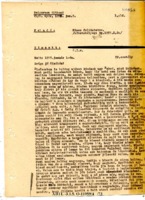 This word-for-word transcript of a typewritten personal letter tells about a secret home christening held in Budapest in December 1954. Amongst other deeply personal matters, the author, the child’s grandmother, briefly reports about the baptism. From this we learn that the child was baptised by a Piarist monk in the presence of the extended family, altogether 22 people. For the occasion the child’s grandfather erected a makeshift altar. As the letter-writer notes, he "made a beautiful altar. He made it so exceptionally nice that everybody was weeping with emotion. My entire home looked like a stage. Everything was shining bright.” Although in theory the Hungarian state granted freedom of religion even in the harshest years of the communist regime, the years of Mátyás Rákosi's rule (1947-1956), many people chose to refrain from openly practicing their faith in fear of various kinds of retribution. The secret baptism is a good example of how people tried to reconcile their religious needs with their desire to avoid conflict with the authorities by withdrawing their religious activities into the domestic sphere. It also nicely illustrates how people creatively turned their everyday environment into a sacred ritual space, even temporarily. And finally, this home-held ritual is also an illustrative example of silent resistance against the regime: as the letter goes on we learn that in his baptismal sermon the Piarist monk made derogatory metaphorical references to communism, much to the approval of the author. As her request at the end of the letter, „please burn this letter after reading” shows, however, she was very much aware of the risk her family was taking in conducting the baptism and in writing this letter. This transcript comes from a file on "illegal" organizations that were connected to a movement lead by a Piarist monk, György Bulányi. The goal of his movement was to keep Christianity alive through small secret local cells where members – mostly young people – could have access to religious education and spiritual guidance. The Bulányi movement started in 1945, and gained momentum after 1948, when the nationalization of church-owned schools excluded historical churches from educational activities and drastically decreased their access to young people. While most of its leaders came from the Piarist order, one of the four monastic orders that were allowed to keep some of their schools and were granted legal status after the dissolution of religious orders in 1950, many of the movement's activists were former members of other banned monastic groups. The secret police considered the movement an "illegal clerical-fascist organization" which, under the disguise of religion, was working to undermine democracy and the building of socialism. For this reason, the secret service had been gathering information about the movement since its early days. As a result, Bulányi and other leading figures were arrested and condemned in 1952. The movement, however, did not cease to exist and the ÁVH, the Hungarian secret service at the time, continued to surveil its activities extensively for at least another decade. The letter comes from a documentary file containing diverse materials, and focusing on groups mainly lead by lay female activists and former nuns. It includes no additional information concerning the letter; apart from their names we don’t know who the correspondents were, what their social background was or what kind of relationship they had with each other. Neither is there any direct information about their involvement in the movement or about the way the secret police got hold of the letter. However, the context of the file allows us to assume that the addressee was a member of a religious cell, officially deemed illegal. The letter is placed in the file among other letters, which indicate that it may have been used as evidence of the clandestine religious activity of Piarist monks. The letter is included in file ÁBTL 3.1.5 O-11959/4. Apart from this letter the file contains copies of personal letters and postcards, confessions under interrogation, reports on illegal gatherings, transcripts of tapped phonecalls and recorded gatherings, and detailed reports on shadowings. For further readings see: Bögre Zsuzsanna – Szabó Csaba 2010 Törésvonalak. Apácasorsok a kommunizmusban. Budapest, Metem–Historia Ecclesiastica Hungarica Alapítvány–Szent István Társulat. Mezey András 2014 Az első hazai bázisközösségek: a Bulányi-jelenség és a Katolikus Egyház az 50-es évek elején In Barna Gábor – Povedák Kinga (ed.): Lelkiségek, lelkiségi mozgalmak Magyarországon és Kelet-Közép Európában. For related entries see: