
Secret monasticism
Item set
- Title
- Secret monasticism
- Description
-
Monastic orders experienced various forms of repression in Eastern Europe during the 20th century: all monasteries on the territory of Soviet Union were forcibly closed after 1928 and the majority of monastic orders were dissolved by law in most satellite states. In Romania this took place in 1948–1949 and in Hungary in 1950. Upon the dissolution of these communities, many of their members were arrested or detained in designated monasteries and then forced to make their way in the secular world. Whilst a part of them chose to give up their vows, many former monks and nuns continued their monastic life in clandestine communities, some of which were literally underground, or tried to keep up their monastic practices secretly while seemingly integrated into secular life. In Hungary, they also actively participated in organising underground religious life and attracting young people to religion.
As the authorities regarded monastic communities as a possible threat to the regime, they made considerable efforts to closely monitor the activities of former monks and nuns. The secret police kept track of former members of religious orders, identified their clandestine communities and mapped their networks in order to be able to make interventions when it was deemed necessary.
- Creator
- Agnes Hesz
- Publisher
-
This project has received funding from the European Research Council (ERC) under the European Union’s Horizon 2020 research and innovation programme No . 677355
- Bibliographic Citation
-
Agnes Hesz, "Secret monasticism"
http://hiddengalleries.eu/digitalarchive/s/en/item-set/353 - Date Created
- 2019
Items
-
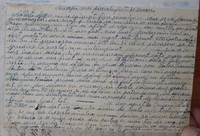 These images show a postcard sent by an Old Calendarist nun to her family in which she describes how she was arrested and sent to an Orthodox Monastery. The postcard was confiscated and attached to a file that contains many such postcards. They all date from approximately same period of time between 1936 and 1937. The first image represents the face of the postcard and includes important details about the fate of the nun. She describes to her family how she was arrested, where she was taken and what the conditions at the Monastery were like. Arrested by the Gendarmes on her way to the post office, the nun was taken from Oniceni (Neamț county) to Ciolanu Monastery (Buzău county), where all her things were confiscated. There were 70 nuns there altogether who were put into four rooms. She had to share a room with 20 other nuns. The second image shows the reverse of the postcard. It offers important information about the regime that the nuns lived under at the Monastery. She asks her parents to write back to her, but carefully, as their letters are first read by someone else implying that she may suffer consequences if the letter contained anything compromising. The image shows how the nun filled the entire postcard writing in order to convey as much information as possible. On the right edge of the back of the postcard she wrote a cramped note asking her family who was still alive in the village. This may have been due to her wish to pray for anyone that was deceased, or it might be a direct hint at the policy of violent repression and arrests that the Old Calendarist church was subjected to on the part of the Gendarmes. Written in 1937, a short time after a series of so-called Stilist "rebellions" in Besserabia, this postcard is proof of the waves of arrests that followed these events, which sometimes included nuns and Old Calendarist women. When caught by the Gendarmes in the woods, or during Silist agitations, women were arrested and most of the time fined or sent to detention in Orthodox Monasteries. Vărzărești Monastery was one of the main places where Old Calendarist nuns were brought and according to some Old Calendarist literature, they were forced to accept the New Calendar there. The intimate and private lives of the nuns in detention revealed by these postcards contrasts sharply with the way they were portrayed in the press of the time as dangerous and rebels. These images can be found in the file ANIC, Insp. Gen. al Jand., D 25/1937. Apart from this postcard, it contains many more letters and postcards sent or received by Old Calendarist nuns that were detained at various Orthodox Monasteries. For related entries see:
 -
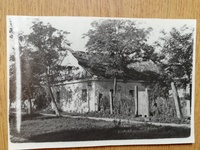 These photographs were taken during a raid on an underground monastery by the Soviet secret police, the NKGB in 1945. The images provide visual representations of a vernacular subterranean architecture developed by True Orthodox Christian communities in Soviet-era Ukraine. The monastery was located in the underground vault dug out under a private house (see the first image) in the small town of Chuguev, near Kharkov, northeast Ukraine. The twenty two photographs enclosed in the secret police file give a detailed description of the underground construction. Images 2 and 3 depicts two entries to the hidden religious space. The main entry (image 3) was concealed within the wall of a vault by a wooden structure. Inside, the monastery had several bedrooms, a storage space with a stove and a mill, and an archway gallery (image 4) leading to an underground church. The last photograph shows the altar of the church. Apparently, this was not the only underground monastery in the region. As other secret police files on the True Orthodox Church reported, there was a network of underground churches and monasteries constructed in caves and underneath rural houses in the region. In the short period between 1945 and 1947, the Soviet security services discovered 14 similar monasteries and churches. In later years, at least until the 1960s, the police reported more underground True Orthodox communities and their hidden dwellings and places of worship. When the police raided the underground monastery in 1945, there were some 20 people (mostly monks and nuns) gathered for a religious service; nine of them were arrested and brought to trial. Among the arrested was hieromonk Seraphim (Shevtsov), the leading figure in the religious underground of the True Orthodox Church in that area. Records of his interrogations give a detailed account of how underground churches and monasteries were constructed and how the religious life of communities of dissenters was organised. Seraphim claimed that there were about 2000 believers under his leadership, from different parts of eastern Ukraine and southern Russia. The underground church could fit up to 300 people at a time, with a core group of 10-15 monastics who permanently lived there under the spiritual guidance of father Seraphim. Even in the religious underground, there was a constant mobility. As more people came, the subterranean structure was expanded and modified. When a place was discovered or became unsafe, believers built new underground churches, moving from village to village. In the interrogation report, Seraphim explains about an incident that happened in the underground monastery in 1941. The subterranean structure partly collapsed when a group of believers gathered for prayer. The tragedy took the life of four people who were then secretly buried in the same underground church where they died. Monks and nuns belonging to the community were also buried inside the underground church. Not all the monastics of the True Orthodox communities lived underground, many of them practiced secret monasticism. As Seraphim reported, he personally tonsured some fifty people into secret monasticism. For reasons of safety, new monks and nuns did not receive new monastic names (as is the tradition in Orthodox Christianity). Continuing to live in the secular world, they followed the monastic code (prayers, celibacy, asceticism, non-possession of material goods and monastic obedience). They kept their monastic vows in secret even to their immediate circle of family and friends and never spoke about their monastic life with anyone (for more on secret monasticism see Wynot 2002). The police continued to arrest Seraphim’s followers after his detention. In 1948, the MGB reported the arrest of a group of wondering monastics left uprooted after Seraphim’s imprisonment and the closure of the underground monastery. Seraphim returned to his community after his release in 1952 and continued to build more underground churches. He was secretly buried in one of them in 1955. The images come from the State Archive Branch of the Security Services of Ukraine, fond 6, sprava 75976, SBU Archive (Kiev, Ukraine). The two-volume file contains interrogations protocols, formal notes on the police search and confiscation, with the detailed list of confiscated religious items and valuables from the underground monastery, closing indictment and the final sentence. Several confiscated (unidentified) personal photographs are also attached to the file. For related entries see:
 -
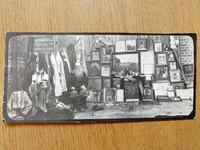 In 1945, the police raided an underground monastery of True Orthodox Christians (TOC). It was located in a vault under a private house in the town of Chuguev, near Kharkov, Ukraine. As a result, nine believers (most of them nuns and monks) were arrested with hieromonk Seraphim (Shevtsov) amongst them. All religious artefacts belonging to the community were confiscated and most of them were later destroyed. The photographs presented in this entry were taken during the raid and were later attached to a NKGB criminal file as incriminating evidence. The images portray confiscated church property at the same time inscribing an arrestee, father Seraphim, into the “crime scene”. The first photograph shows father Seraphim surrounded by church utensils, antiminses and icons found by the police in the underground church. In the second photograph, he sits with confiscated valuables and a clock. The last image shows the right side of the underground church, with a part of the altar and Seraphim’s bed. Hieromonk Seraphim (1875 – 1955) was a long-term leader of underground churches and monasteries of the True Orthodox Christians in the Kharkov region, northeast Ukraine. For several decades, Seraphim was the focus of close attention from the Soviet secret services, as he was seemingly the only catacomb priest in the region. A special secret operation called “Christoduls”, which continued after Seraphim’s death, targeted his clandestine communities of believers. As a young boy, aged 15, Daniil Shevtsov was tonsured a monk (adopting the name Seraphim) in Sviatohirsk monastery, a major Orthodox Christian monastery in eastern Ukraine. He continued his religious career as a deacon of the metropolitan Antony (Khrapovitsky), who later fled with the White Army, and together with other bishops in exile he founded an independent church structure called Russian Orthodox Church Outside Russia. Seraphim was among thousands of other monks who were left homeless when their monasteries were closed down by the Bolsheviks. Soon after his monastery was turned into the Renovated (Obnovlencheskaya) church (a movement within the Russian Orthodox Church, sponsored by the Bolsheviks and loyal to Soviet power) Seraphim went underground and joined the catacomb True Orthodox movement. He received his first 5-year sentence in 1934, and was deported to the North of Russia from where he escaped and illegally returned to Ukraine in 1937. Until the date of his arrest on 11th July 1945, he hid in different underground monasteries and churches near the city of Kharkov. Living literary underground, he led catacomb True Orthodox communities (numbering altogether around 2000 believers) in northeast Ukraine and southern parts of Russia. During the WWII, when Ukraine was occupied by the German army and many religious communities were granted relative freedom, Seraphim started to preach openly. For this, of course, he was later accused of collaboration with the Nazis. After his arrest in 1945, Seraphim was sentenced to 7 years in labour camps. He was released in 1952 and went into hiding again, continuing his “illegal” activities. In the following years, the secret police were busy searching for him, trying to recruit informers from his circle and raiding newly revealed underground churches and home communities. They did not know that Seraphim had died and was secretly buried in one of the underground monasteries in 1955 . According to the recollections of Seraphim’s followers, the secret police eventually discovered Seraphim’s grave and exhumed his body in order to prevent a growing pilgrimage movement. The body was unspoiled and the coffin emitted a fragrance of such strength that the policemen complained that a whole bottle of perfume had been poured inside. The Ukrainian secret police targeted the catacomb True Orthodox Church (TOC) throughout the entire Soviet period. The same year Seraphim was arrested, the secret police launched a centralized all-Ukrainian operation called “Hermitage" (Skit), to uncover the growing underground networks of True Orthodox communities. In 1947, the secret police reported the results of the two-year operation: 367 TOC members arrested; 4 underground monasteries, 10 underground churches and 25 “illegal” praying houses disclosed (SBU archive, f. 3, spr. 300, p. 113-114). The images come from the State Archive Branch of the Security Services of Ukraine, fond 6, sprava 75976, SBU Archive (Kiev, Ukraine). The two-volume file contains interrogation protocols, formal notes on the police search and confiscation with a detailed list of confiscated religious items and valuables, a closing indictment and the final sentence as well as other photographs of the underground monastery. For related entries see:
 -
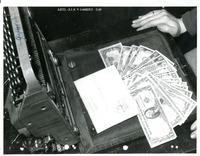 This picture depicts a Continental typewriter confiscated during a house search of a Hungarian Cistercian monk, Dr. Ferenc Piusz Halász (1909-1994) in 1961. The typewriter was photographed along with illegally held US dollars. Three photo images were taken by the secret agents in order to show how the US dollars were hidden in an envelope inside the typewriter. On the reverse of the photograph we find the following text: "Elismerem, hogy a fotokópia hátoldalán látható dollár az én tulajdonomat képezte, illetve azonos azzal a négyszázkilencvenhét dollárral, melyet a fotokópia hátoldalán látható írógépben rejtegettem. Budapest, 1961. június 12., Dr. Halász Ferenc" "I acknowledge that the dollars on the other side of this photographic image are my property and are identical with the 497 dollars that I hid in my typewriter which is found on the photo as well. Budapest, 12th June, 1961. Dr. Ferenc Halász." These pictures served as one of the main pieces of evidence against Dr. Ferenc Piusz Halász when he was given a 6 year prison sentence in 1961. This constituted the main evidence against Dr. Ferenc Piusz Halász, one of the main defendants of a show trial against the underground Cistercians. The images here follow the classic model how evidence was found. The sequence of shots demonstrate a classic photographic methodology of how secret police produced incriminating evidence. In this case we can assume that the dollars were planted by the secret police agents. Similar to show trials - where the authorities have already determined the guilt of the defendant(s) –house search scenario was usually constructed in a way that the forbidden western foreign money – in this case US dollars – was hidden and then found by the officers on the spot. The possession of foreign currency was considered a criminal offence according to the state and served as unambiguous evidence against the incriminated person. Typewriters of persons under surveillance or persecution had a significant role in the eye of the secret police as the uncontrolled typewriters provided means for the production and circulation of uncensored documents, messages or spiritual writings. For this reason, typewriter can also been seen as the symbol of free speech. By producing a sample from the typewriter, it is possible to identify the typewriter later and get an insight into the distribution network of religious samizdat and the volume of produced materials. Dr. Ferenc Piusz Halász was a member of the Cistercian order dissolved in 1950. He was one of the main defendant of the show trial against the underground Cistercian order after the dissolution of most Catholic religious orders in 1950. From 1946 he was the Prior of the austere, ascetic Borsodpuszta Cistercian community. He was active in producing religious writings. After the dissolution of the order, Dr. Ferenc Piusz Halász was a parish priest in Csatka from 1951-1961. The persecution against him began in 1961. According to the charges of the show trial he was one of the ideological leaders of priests and monks organizing the overthrow of the political system. During his allegedly subversive, anti-state efforts he copied and re-produced the sermon-collection “Preach the Gospel!” which served as an evidence for the trial. Dr. Ferenc Piusz Halász was convicted for 6 years of prison but was freed in 1963 as part of the collective political amnesty but convicted again in 1965 with a similar sentence. The photo image is found in ÁBTL 3.1.9. V-146835/3 For related entries see: