
Photo albums
Item set
- Title
- Photo albums
- Description
- The secret police developed several methods for representing and curating visual materials stemming from surveilled groups or persons. Photo albums represent one of these, although they were relatively rarely used compared to other means of archiving and ordering photographic materials. Some of the albums we find in the secret police archival collections were compiled by secret police officers and included both images confiscated from the target person/group and images created by the secret police (surveillance or crime scene photos, images of confiscated items). These compilations were more than just a handsome, practical way of ordering visual materials: they formed a carefully structured narrative to incriminate religious groups as dangerous and hostile to the regime. As well as photo albums created by the secret services, secret police archives also contain albums that were confiscated from persons and families. Containing family portraits or shots of family events, these albums were valuable for the authorities because they provided information on family relations and friendship networks, the life histories and the social background of their owners. The police could then use this invaluable information in its operational work.
- Creator
- Agnes Hesz
- Publisher
- This project has received funding from the European Research Council (ERC) under the European Union’s Horizon 2020 research and innovation programme No . 677355
- Bibliographic Citation
-
Agnes Hesz, "Photo albums"
http://hiddengalleries.eu/digitalarchive/s/en/item-set/351 - Date Created
- 2019
Items
-
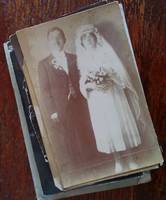 These photographs are part of a family album found on a woman who tried to cross the border between USSR and Romania that was confiscated by the Soviet secret police in 1940. They depict different moments from the life of the family, such as a wedding and a day spent at the seaside in Odessa. The album contains images of members of the family at different ages and of some of the family’s friends. For over a hundred years both banks of Dniester river were part of the Russian Empire until 1918 when Bessarabia united with Romania and the river became frontier between Romania and the Soviet Union. The new border and the hostilities between the Soviet Union and Romania brought numerous changes to the region but did not put an end to the personal ties between the people on the two banks of the river. In the winter of 1940, a woman of Bessarabian origin living in Odessa tried to join her family that lived on the Romanian side of the frontier by crossing the frozen river Dniester. The border was frequently transgressed from both sides by people seeking a better life or escaping repression. The number of illegal crossings from the Soviet side in Romania increased during the famines and during the collectivisation of agriculture. Some of the inhabitants of the villages located close to the river also crossed to visit their relatives across the border or were practiced smuggling. Those wanting to flee from the country were helped by the people living in the border area who knew the best places to cross Dniester. Many were arrested or even killed when trying to cross. The women whose family album was confiscated by the Soviet secret police tried to illegally cross the border with the help of a guide from Nezavertailovca, a village near Tiraspol. They were both arrested and sentenced to five and three years imprisonment respectively. Family albums were of interest to secret police as the the Communist Party’s project of social engineering required extraordinary powers of the state over the citizen, including in his/her family life. The Soviet state was therefore very attentive to kinship relations, which from the regime’s perspective could in certain conditions undermine ones devotion to the state and the party. From the secret police perspective, the arrest of a citizen could lead to the development of anti-soviet sentiments amongst the members of his family or friends, who could then also become involved in different kinds of conspiracies. Collecting family pictures, as well as registering data regarding family networks of those who had been convicted was part of the secret police’s attempt to identify those parts of the society from where anti-Soviet elements were more likely to come. The album shown here was found on a person who had relatives abroad as some of the persons depicted in the photographs lived in Romania. The album therefore could be used to prove the existence of cross-border networks that were perceived as dangerous and from the perspective of the secret police and may also have been used to identify other would be transgressors. Likewise, the family photographs could provide secret police with data regarding the past of the arrested persons. For example, the economic state of the family is reflected in the material items displayed on the photographs, (clothing, housing, the quality of the photographs and the workshops were they were produced). The photography revealed the social status of those depicted on it. Likewise, the photographs allowed the officers to identify places visited by the convicted persons, and to read on their reverse notes about personal impressions, fillings, and attitudes. The abovementioned photographs are part of the file number 595, found R-3401, inventory 1, preserved at the National Archive of the Republic of Moldova. The file contains approximately 20 family photographs belonging to the woman who tried to cross the frontier, her birth certificate and an autorisation to travel to Romania issued in 1937 by Romanian Royal Diplomatic Legation in Odessa. For related entries see:
 -
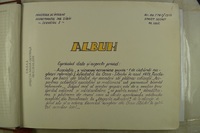 These images come from a photo album compiled by the Securitate on the Hungarian Calvinist Church Choir in the town of Ocna Sibiului (Vízakna), Transylvania. The first image shows the title page of the album with a short introduction to the choir and its supposed activity. In the second image, we can see photos which were most probably taken by the secret police displaying the decorated walls of the choir’s meeting place. The third image includes shots taken in the usual fashion of crime scene photographs of items confiscated from the choir during a secret police raid. The fourth image shows close-ups of confiscated musical scores with Hungarian themes, the national anthem of Hungary amongst them. In 1973, the choir was accused of nurturing nationalist-irredentist ideals behind the façade of their church choir and of being hostile to the socialist Romanian state. The album, which itself is a documentary file containing photos of confiscated documents and images owned by the group or taken by the secret police, was carefully designed to support this claim. It starts with a five and a half page report on the history and activity of the choir stating that the choir’s real aim was to maintain the national identity of the local Hungarian minority and to instil Hungarianess in the next generation. The reporting officer made efforts to portray the choir as a conspiratory group not independent of other equally dubious Hungarian organisations. He claimed that it had negative influence on the discipline of the local community. The album then continues with group photographs of choir members, exterior and interior photos of the group’s meeting room focusing on its Hungarian patriotic decoration, crime scene photos of confiscated materials, selected operative documentation of the choir (minutes of meetings, financial reports, membership lists etc.), its correspondence with past members or other organisations, musical scores and finally, several pages taken from confiscated notebooks written by the choir's former secretary, an elderly man who was an amateur local historian and an avid preserver of memories of the local Hungarian past. The photos are often amended with explanatory captions that give translations of the documents or point to the nationalistic nature of the choir; for example, under the 1971 group photo the officer writes: “the colour of the (previously Hungarian national) flag is now black, the symbol of mourning, and the Hungarian tricolour is carried secretly in the hearts of the members.” From the report we know that after the raid some leading members were interrogated by the secret police and were kept under surveillance afterwards. The choir was allowed to continue with its church related duties but local party leaders were ordered to “pay more attention to the proper education of local Hungarians.” Ethnographic fieldwork revealed that the Securitate’s attack on the choir is still part of the community’s memory and oral history. As several members recalled, the operation on the choir had been drawn up by an ethnic Hungarian officer who befriended the choir’s former secretary. Playing on his Hungarian roots he claimed to be interested in Hungarian historical matters and cajoled the old man to loan his historical writings to him. A couple of days later the Securitate launched a raid on the choir’s meeting place and confiscated most of its documentation and its official stamp. These items, as well as the notebooks taken from the ex-secretary were never returned. Loss of these materials meant the loss of a large part of the choir’s past. Fieldwork with surviving members of the choir has revealed that the community had made efforts to compensate for this loss: some of the notebooks had been rewritten or recreated since. Accusing religious groups with ethnic minority backgrounds of being nationalist or irredentist was common in socialist Romania. As this case shows it was not always religion or religious practice that the authorities were after but the supposed political affiliations of these groups. The Ocna Sibiului Calvinist Church Choir was founded in 1889. From 1907 it officially operated as an association with a president, secretary, accountant and had its own banner and stamp. Its main task was to sing at the funerals of congregation members and at church services, but was also central to community life for local Hungarians. The choir still functions today. The images come from file CNSAS D 015847. For related entries see:
 -
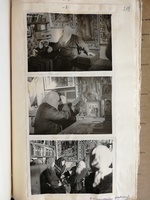 The photographs come from a 1959 KGB criminal case against three members of an Ioannite community in Cherkasy region, Ukraine. The images were designed as a photo album pasted into the secret police file. They portray father Mitrofan, the priest of the community in his house, which had been turned into a clandestine chapel. The first photo collage shows father Mitrofan dressed in Orthodox vestments against a background of icons, performing a religious service and talking to women, seemingly his followers. The second photo collage records the ritual washing of feet, also performed in father Mitrofan’s home. These photographs differ from typical secret police arrest or surveillance images. They intend to depict religious community life in an apparently natural context. At the same time the good quality of the photos, taken with a bright artificial light, indicate that these representation of rituals were staged. The last three images show the results of a police search of the clandestine chapel. The photos of cash confiscated during the police search and a table nicely served with food and drinks were used as incriminating evidence of the priest’s profiting from illegal economic activities. An image of a coffin and shelves with religious literature were intended to demonstrate the esoteric and fanatically sectarian nature of a repressed community. The last image constitutes a valuable source for the study of folk icons and handmade religious images circulated in the Soviet-era religious underground. It depicts confiscated and later destroyed icons used by the community. Apart from the portrait of father Mitrofan himself, there is an image of father John (Ioann) of Kronstadt, a famous Russian priest venerated by the community as a saint (hence the name of believers, the Ioannites). There is also a picture of Ambrose of Optina, placed together with the portrait of father John of Kronstadt in the same frame. Hieroschemamonk Ambrose was one of the most famous starets in Optina Monastery. He is pictured here on his deathbed. The choice of that image appears to be meaningful, as death and the afterlife were particularly sensitive issues for the community. The believers even built a clandestine Christian cemetery called “New Jerusalem”, photographs of which are also present in the secret police file as incriminating evidence. Ioannitism was a popular apocalyptic and chiliastic movement that emerged from the Russian Orthodox tradition at the beginning of the 20th century. The Ioannites were mainly peasant believers from the Russian and Ukrainian countryside, who venerated father John of Kronstadt (1829-1909), an archpriest from a town near St. Petersburg, one of the most popular religious personalities in late imperial Russia. A charismatic preacher, he was known as a blessed healer and wonder-worker, “the first modern Russian religious celebrity, with his image in souvenir scarves, mugs, placards, and postcard” (Kizenko 2000:2). During his lifetime, the pilgrimage to Kronstadt became a mass phenomenon, as thousands of believers all over Russia travelled to Kronstadt to see the “prophet.” Ioannitism, however, never constituted a unified religious movement, neither theologically, nor organisationally. It was rather constituted of dispersed peasant communities and individual wondering book-sellers, prophets and prophetess united by the common apocalyptic vision of the world, and centred around the figure of father John. Some believers remained within the Russian Orthodox Church, venerating father John as a blessed worshiper; others worshiped father John as the prophet Elijah or the embodiment of the Trinity, or Jesus Christ himself, thus, cutting themselves off from the official Church structures. In the early Soviet period, the Ioannites were persecuted as harmful ecclesiastic-monarchist sectarians. Driven underground, Ioannite communities built clandestine chapels and continued to live as underground monastic communities scattered from Western Siberia to Ukraine. Repression and shared underground experience drew the Ioannites together with catacomb True Orthodox communities. In the later years, this was even further facilitated by the Soviet secret services that made no distinction between the Ioannites and the True Orthodox Christians. Thus, the arrested believers in this criminal case were charged as the members of the True Orthodox Church. Father Mitrofan was known among believers as a miraculous healer. The village of Osytniazhka, where he lived, attracted numerous pilgrims who sought his blessing and spiritual help. The trial of father Mitrofan and his followers in 1959 was widely publicised. Apart from the official trial, a show-like civil trial was also held, which was recorded and later turned into a propaganda film titled “The End of a Spider.” The verbatim record of the civil trial is attached to the secret police file. Some photos found in the secret police file also appear in the film, which proves that the film was made under the direct supervision of the secret services. The photographs in this entry come from the State Archive Branch of the Security Services of Ukraine in Kyiv. The file reference is: fond 6, sprava 75174. The file consists of three volumes. Along with the photographs presented in this entry there are other images of the community and their religious artefacts. The file contains also numerous interrogation records of arrestees and witnesses. Three original Ioannite handwritten manuscripts of “The Dream of Father John of Kronstadt” are also attached to the file. Other confiscated religious writings, such as “The Explanation of the Apocalypse”, the brochure “Life story of starets father Mitrofan”, and Mitrofan’s homilies were destroyed as they are absent in the file. Their images, however, appear in the above mentioned propaganda film. For further readings see: Kizenko, Nadieszda. A Prodigal Saint: Father John of Kronstadt and the Russian People. Pennsylvania State University Press, 2003 Tepliakov, A.G. Ioannity Zapadnoi Sibiri v dokumentakh VChK-OGPU-NKVD (1920-1940 gody). Vestnik Tverskogo gosudarstvennogo universiteta. Seria: Istoria, 2010, vol. 30(4):128-136 Shugaeva, L. Ioannity: Techiia khiliastychno-eskhitalohychnoho spriamuvannia pravoslavnoho pokhodzhennia. Ukrainske relihieznavstvo. 2006, vol. 39:145-153 For related entries see:
 -
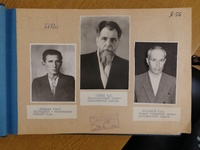 These photographs come from a KGB internal publication which is in the form of a photo album. It features arrested Ukrainian Greek Catholics, Josyf Slipyi, Ilia Blavatsky and Vasyl Kavatsiv and was published in Krasnoyarsk in 1958. The photographs of the arrested persons open the photo album (Image 1). The image of the metropolitan Josyf Slipyi, the head the Ukrainian Greek Catholic Church, is placed in the centre. Vasyl Kavatsiv (left), an underground priest and a secret monk, is defined under his photo as a nationalist, closely linked to Blavatsky. Ilia Blavatsky (right) was a Greek Catholic priest and one of the most trusted of Slipyi’s companions. The second image shows Slipyi’s desktop with manuscripts and newspaper cuttings confiscated during the police search. The third image shows Slipyi’s manuscript of the 5th volume of “The History of the Church in Ukraine” which was used as incriminating evidence against him. It was found by the police in the house of one of Slipyi’s friends. The fourth image shows religious items found by the police in Blavatsky’s house. The final image shows a barrack where Ilia Blavatsky, together with his parents and sisters, lived in exile. The house was located in a special settlement for exiled people in Krasnoyarsk (Eastern Siberia). Before it was moved to the secret police archive, the photo album had been kept in the internal “Chekist library” and seemingly served as an educational manual. It contains photographs of the police search with copies of confiscated manuscripts, correspondence and ritual items, as well as photographs of houses in the Siberian special settlements where religious leaders lived in exile after their release from prison. Apparently the photo album was based on the materials from a penal case against Josyf Slipyi, as most of the photographs place the police search of Slipyi’s residence in the home for disabled people in the Krasnoyarsk region in 1958. The police search was followed by his arrest and second imprisonment in 1959. He spent in total 18 years in labour camps. During the 1940-1950s, the organization of the Ukrainian Greek Catholic Church was virtually wiped out in the Soviet Union. The church was suppressed as it was accused of being closely related to the Ukrainian Insurgent Army (UPA) and the Organization of Ukrainian Nationalists (OUN), illegal in the Soviet Union. In 1945-1946, the Soviet authorities initiated a forced reunification of the Ukrainian Greek Catholic Church with the Russian Orthodox Church, Moscow Patriarchate. Stalin signed the directive on the liquidation of the church and the secret police were placed in charge of the operation. As a means of intimidation, all Ukrainian Greek Catholic bishops, the metropolitan and over 800 priests were arrested during the liquidation campaign. Those clergy and faithful believers that refused to a forced conversion to Orthodoxy were driven underground, forming the largest catacomb church in the Soviet Union. By the time of its liquidation, the Ukrainian Greek Catholic Church had 4 dioceses, one metropolitan, 7 bishops, over 2,400 priests, 1600 monastics, and nearly 4 million believers with only 30% of clergy having accepted the reunification with the Russian Orthodox Church. Believers and clergy were persecuted throughout the entire Soviet period. Thousands of them, including metropolitan Josyf Slipyi, were sent to GULAG or deported. The church received legal recognition only in 1989 during Perestroika. The images come from the State Archive Branch of the Security Services of Ukraine in Kiev. The file reference is: fond 13, sprava 584. For related entries see: