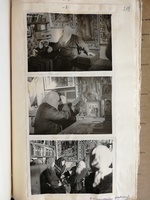
The photographs come from a 1959 KGB criminal case against three members of an Ioannite community in Cherkasy region, Ukraine. The images were designed as a photo album pasted into the secret police file. They portray father Mitrofan, the priest of the community in his house, which had been turned into a clandestine chapel. The first photo collage shows father Mitrofan dressed in Orthodox vestments against a background of icons, performing a religious service and talking to women, seemingly his followers. The second photo collage records the ritual washing of feet, also performed in father Mitrofan’s home. These photographs differ from typical secret police arrest or surveillance images. They intend to depict religious community life in an apparently natural context. At the same time the good quality of the photos, taken with a bright artificial light, indicate that these representation of rituals were staged.
The last three images show the results of a police search of the clandestine chapel. The photos of cash confiscated during the police search and a table nicely served with food and drinks were used as incriminating evidence of the priest’s profiting from illegal economic activities. An image of a coffin and shelves with religious literature were intended to demonstrate the esoteric and fanatically sectarian nature of a repressed community. The last image constitutes a valuable source for the study of folk icons and handmade religious images circulated in the Soviet-era religious underground. It depicts confiscated and later destroyed icons used by the community. Apart from the portrait of father Mitrofan himself, there is an image of father John (Ioann) of Kronstadt, a famous Russian priest venerated by the community as a saint (hence the name of believers, the Ioannites). There is also a picture of Ambrose of Optina, placed together with the portrait of father John of Kronstadt in the same frame. Hieroschemamonk Ambrose was one of the most famous starets in Optina Monastery. He is pictured here on his deathbed. The choice of that image appears to be meaningful, as death and the afterlife were particularly sensitive issues for the community. The believers even built a clandestine Christian cemetery called “New Jerusalem”, photographs of which are also present in the secret police file as incriminating evidence.
Ioannitism was a popular apocalyptic and chiliastic movement that emerged from the Russian Orthodox tradition at the beginning of the 20th century. The Ioannites were mainly peasant believers from the Russian and Ukrainian countryside, who venerated father John of Kronstadt (1829-1909), an archpriest from a town near St. Petersburg, one of the most popular religious personalities in late imperial Russia. A charismatic preacher, he was known as a blessed healer and wonder-worker, “the first modern Russian religious celebrity, with his image in souvenir scarves, mugs, placards, and postcard” (Kizenko 2000:2). During his lifetime, the pilgrimage to Kronstadt became a mass phenomenon, as thousands of believers all over Russia travelled to Kronstadt to see the “prophet.” Ioannitism, however, never constituted a unified religious movement, neither theologically, nor organisationally. It was rather constituted of dispersed peasant communities and individual wondering book-sellers, prophets and prophetess united by the common apocalyptic vision of the world, and centred around the figure of father John. Some believers remained within the Russian Orthodox Church, venerating father John as a blessed worshiper; others worshiped father John as the prophet Elijah or the embodiment of the Trinity, or Jesus Christ himself, thus, cutting themselves off from the official Church structures.
In the early Soviet period, the Ioannites were persecuted as harmful ecclesiastic-monarchist sectarians. Driven underground, Ioannite communities built clandestine chapels and continued to live as underground monastic communities scattered from Western Siberia to Ukraine. Repression and shared underground experience drew the Ioannites together with catacomb True Orthodox communities. In the later years, this was even further facilitated by the Soviet secret services that made no distinction between the Ioannites and the True Orthodox Christians. Thus, the arrested believers in this criminal case were charged as the members of the True Orthodox Church.
Father Mitrofan was known among believers as a miraculous healer. The village of Osytniazhka, where he lived, attracted numerous pilgrims who sought his blessing and spiritual help. The trial of father Mitrofan and his followers in 1959 was widely publicised. Apart from the official trial, a show-like civil trial was also held, which was recorded and later turned into a propaganda film titled “The End of a Spider.” The verbatim record of the civil trial is attached to the secret police file. Some photos found in the secret police file also appear in the film, which proves that the film was made under the direct supervision of the secret services.
The photographs in this entry come from the State Archive Branch of the Security Services of Ukraine in Kyiv. The file reference is: fond 6, sprava 75174. The file consists of three volumes. Along with the photographs presented in this entry there are other images of the community and their religious artefacts. The file contains also numerous interrogation records of arrestees and witnesses. Three original Ioannite handwritten manuscripts of “The Dream of Father John of Kronstadt” are also attached to the file. Other confiscated religious writings, such as “The Explanation of the Apocalypse”, the brochure “Life story of starets father Mitrofan”, and Mitrofan’s homilies were destroyed as they are absent in the file. Their images, however, appear in the above mentioned propaganda film.
For further readings see:
Kizenko, Nadieszda. A Prodigal Saint: Father John of Kronstadt and the Russian People. Pennsylvania State University Press, 2003
Tepliakov, A.G. Ioannity Zapadnoi Sibiri v dokumentakh VChK-OGPU-NKVD (1920-1940 gody). Vestnik Tverskogo gosudarstvennogo universiteta. Seria: Istoria, 2010, vol. 30(4):128-136
Shugaeva, L. Ioannity: Techiia khiliastychno-eskhitalohychnoho spriamuvannia pravoslavnoho pokhodzhennia. Ukrainske relihieznavstvo. 2006, vol. 39:145-153
For related entries see:

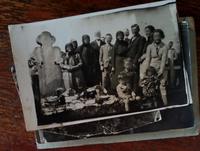 The photograph shows a family from Bessarabia in a cemetery of Chilia Nouă celebrating Paștele Blajinilor (in Romanian) or Radonitsa (in Russian), the day when the Orthodox Christian families commemorate their deceased relatives. Almsgiving has a central place in the commemoration of the dead in Orthodox Christian tradition. It is believed that by offering to each other bread, cookies, fruits, tableware items and drinks, the believers redeem the sins of their deceased relatives, and satiate the dead’s thirst and hunger. This is why the grave in the image is covered with various items that were due to be offered as gifts. Celebrated one week after the Orthodox Easter, Paștele Blajinilor or Radonitsa is a day when the entire family are gathered in the cemetery. This family used this occasion to take a picture, a copy of which was later sent to a relative who could not attend the commemoration and who was arrested by the Soviet secret police in 1940. The photograph was confiscated from a woman arrested when trying to flee from USSR to Bessarabia (at that time part of Romania). The photograph was important for the secret police investigation because it depicted cross-border family networks. The photograph have been attached to the investigation file 595 that is preserved in the archival found R-3401, inventory 1, at the National Archive of the Republic of Moldova. The file contains another 21 family photographs, a birth certificate and a visa issued in 1937 by the Romanian Royal Diplomatic Legacy in Odessa. For related entries see:
 The photographs come from a 1959 KGB criminal case against three members of an Ioannite community in Cherkasy region, Ukraine. The images were designed as a photo album pasted into the secret police file. They portray father Mitrofan, the priest of the community in his house, which had been turned into a clandestine chapel. The first photo collage shows father Mitrofan dressed in Orthodox vestments against a background of icons, performing a religious service and talking to women, seemingly his followers. The second photo collage records the ritual washing of feet, also performed in father Mitrofan’s home. These photographs differ from typical secret police arrest or surveillance images. They intend to depict religious community life in an apparently natural context. At the same time the good quality of the photos, taken with a bright artificial light, indicate that these representation of rituals were staged. The last three images show the results of a police search of the clandestine chapel. The photos of cash confiscated during the police search and a table nicely served with food and drinks were used as incriminating evidence of the priest’s profiting from illegal economic activities. An image of a coffin and shelves with religious literature were intended to demonstrate the esoteric and fanatically sectarian nature of a repressed community. The last image constitutes a valuable source for the study of folk icons and handmade religious images circulated in the Soviet-era religious underground. It depicts confiscated and later destroyed icons used by the community. Apart from the portrait of father Mitrofan himself, there is an image of father John (Ioann) of Kronstadt, a famous Russian priest venerated by the community as a saint (hence the name of believers, the Ioannites). There is also a picture of Ambrose of Optina, placed together with the portrait of father John of Kronstadt in the same frame. Hieroschemamonk Ambrose was one of the most famous starets in Optina Monastery. He is pictured here on his deathbed. The choice of that image appears to be meaningful, as death and the afterlife were particularly sensitive issues for the community. The believers even built a clandestine Christian cemetery called “New Jerusalem”, photographs of which are also present in the secret police file as incriminating evidence. Ioannitism was a popular apocalyptic and chiliastic movement that emerged from the Russian Orthodox tradition at the beginning of the 20th century. The Ioannites were mainly peasant believers from the Russian and Ukrainian countryside, who venerated father John of Kronstadt (1829-1909), an archpriest from a town near St. Petersburg, one of the most popular religious personalities in late imperial Russia. A charismatic preacher, he was known as a blessed healer and wonder-worker, “the first modern Russian religious celebrity, with his image in souvenir scarves, mugs, placards, and postcard” (Kizenko 2000:2). During his lifetime, the pilgrimage to Kronstadt became a mass phenomenon, as thousands of believers all over Russia travelled to Kronstadt to see the “prophet.” Ioannitism, however, never constituted a unified religious movement, neither theologically, nor organisationally. It was rather constituted of dispersed peasant communities and individual wondering book-sellers, prophets and prophetess united by the common apocalyptic vision of the world, and centred around the figure of father John. Some believers remained within the Russian Orthodox Church, venerating father John as a blessed worshiper; others worshiped father John as the prophet Elijah or the embodiment of the Trinity, or Jesus Christ himself, thus, cutting themselves off from the official Church structures. In the early Soviet period, the Ioannites were persecuted as harmful ecclesiastic-monarchist sectarians. Driven underground, Ioannite communities built clandestine chapels and continued to live as underground monastic communities scattered from Western Siberia to Ukraine. Repression and shared underground experience drew the Ioannites together with catacomb True Orthodox communities. In the later years, this was even further facilitated by the Soviet secret services that made no distinction between the Ioannites and the True Orthodox Christians. Thus, the arrested believers in this criminal case were charged as the members of the True Orthodox Church. Father Mitrofan was known among believers as a miraculous healer. The village of Osytniazhka, where he lived, attracted numerous pilgrims who sought his blessing and spiritual help. The trial of father Mitrofan and his followers in 1959 was widely publicised. Apart from the official trial, a show-like civil trial was also held, which was recorded and later turned into a propaganda film titled “The End of a Spider.” The verbatim record of the civil trial is attached to the secret police file. Some photos found in the secret police file also appear in the film, which proves that the film was made under the direct supervision of the secret services. The photographs in this entry come from the State Archive Branch of the Security Services of Ukraine in Kyiv. The file reference is: fond 6, sprava 75174. The file consists of three volumes. Along with the photographs presented in this entry there are other images of the community and their religious artefacts. The file contains also numerous interrogation records of arrestees and witnesses. Three original Ioannite handwritten manuscripts of “The Dream of Father John of Kronstadt” are also attached to the file. Other confiscated religious writings, such as “The Explanation of the Apocalypse”, the brochure “Life story of starets father Mitrofan”, and Mitrofan’s homilies were destroyed as they are absent in the file. Their images, however, appear in the above mentioned propaganda film. For further readings see: Kizenko, Nadieszda. A Prodigal Saint: Father John of Kronstadt and the Russian People. Pennsylvania State University Press, 2003 Tepliakov, A.G. Ioannity Zapadnoi Sibiri v dokumentakh VChK-OGPU-NKVD (1920-1940 gody). Vestnik Tverskogo gosudarstvennogo universiteta. Seria: Istoria, 2010, vol. 30(4):128-136 Shugaeva, L. Ioannity: Techiia khiliastychno-eskhitalohychnoho spriamuvannia pravoslavnoho pokhodzhennia. Ukrainske relihieznavstvo. 2006, vol. 39:145-153 For related entries see: