
Religious booklets and pamphlets
Item set
- Title
- Religious booklets and pamphlets
- Description
- Publications feature heavily among the religious materials found in secret police archives or itemized on lists of confiscated materials. Most religious communities in the twentieth century promoted their ideas through the publication of religious periodicals, pamphlets and booklets which could be cheaply produced and easily distributed. Many of these items were published cheaply in shorts runs by local presses. During periods of totalitarian rule, state authorities tried to regulate or ban the production of such materials. The secret police intercepted materials sent in the post, confiscated them in house searches or uncovered them at the border when individuals attempted to smuggle them. Due to their generally small size, however, booklets and leaflets could be easily concealed. They were generally distributed through underground religious networks, both nationally and internationally, or in some cases they were distributed and sold by colporteurs (salesmen of religious literature) on markets, on trains or at pilgrimages. Many of the religious booklets and pamphlets we find in the secret police archives, which had little value for mainstream libraries and archives, are extremely rare and can be found nowhere else in state collections. Some of these materials have immense value for religious communities that were divested of their sacred materials by the state.
- Creator
- James A. Kapaló
- Publisher
- This project has received funding from the European Research Council (ERC) under the European Union’s Horizon 2020 research and innovation programme No. 677355
- Date Created
- 2019
Items
-
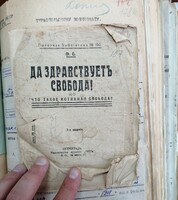 The image depicts the cover page of a booklet published in 1917 in Saint Petersburg. The booklet is entitled “Long live freedom! But what is the true freedom?” and was published at the printing house named “The seventeenth year”. The year 1917 was a turning point in Russian history, marked by a democratic revolution followed by the Bolshevik cue d'etat in October the same year. The Revolution eliminated the restrictive confessional policies imposed by the old Tsarist regime, and in 1917 the Baptists and other minority religious groups were granted unprecedented freedom to practice their religion. The Revolution was welcomed by Baptist communities, and the question of what is real freedom and how to use it had become central to their religious life. The Evangelical literature of the time compared the Revolution to a spiritual resurrection and the booklet shown here explores the idea of freedom from a religious perspective. The booklet “Long live freedom! But what is the true freedom?” was confiscated by the secret police from a group of believers in Soviet Moldavia in 1937, in a period in which Baptists were perceived by the Soviet state as a threat. The booklet was enclosed in the criminal investigation case file and served as evidence of illegal religious activity of nine arrested Baptists. The main accusation against the arrested believers was that they were Romanian spies. Four of them were sentenced to the death penalty, and five to 10 years of imprisonment. The booklet is enclosed in the file R-3401-1-3308 from the National Archive of the Republic of Moldova. The file does not contain any other confiscated materials. For related entries see:
 -
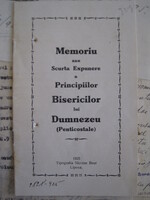 This booklet, which was published in 1925, appears in a Ministry of Religions and Arts file dated the same year. This booklet was the second official declaration of Pentecostal faith submitted to the Romanian authorities as part of their requests for official recognition. The first appeal by a Pentecostal believer came in 1924 but this was rejected by the Ministry of Religions in Decision no. 5734 of the 29th January 1925. The Ministry declared that the ‘Declaration of True Foundation’ (Declararea [sic] fundamentului adevărat) did not offer sufficient guarantees to meet the conditions of article 22 of the Constitution. A new declaration in the form of this booklet entitled 'Short statement on the principles of the Churches of God (Pentecostals)’ was attached to the second request for official recognition. This was also rejected with Decision no. 24536 of 1928 in which it was reaffirmed that Pentecostal communities remained on the banned list. This booklet appears in ANIC – fond. Ministerul Cultelor și Artelor 172/1925 amongst diverse documents relating to a range of so-called sects and especially the problem of their presence within the military. Also included is in this file is a similar declaration of faith simply entitled Declaration (Memoriu) submitted to the Ministry of Religions and Arts in January 1925 by representatives of The Brethren (known as Creștin după Evanghelie, Christians of the Gospels in Romanian) from the city of Ploiești as part of an appeal for recognition of their community. For further reading see: Ciprian Bălăban, Istoria Bisericii Penticostale din România (1922-1989) - instituție și harisme. Oradea: Editura Scriptum, 2016. For related entries see:
 -
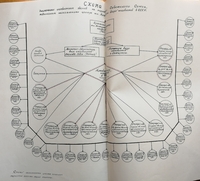 This network scheme of the Jehovah’s Witness organization comes from a four-volume top-secret file titled LKB, Legendirovannoe Kraevoe Biuro (Regional Bureau Covert Operation). It was produced by the Ukrainian secret police in 1953 and shows Jehovah’s Witness districts and circuits located in the Soviet Union with the organization’s country committee (called by that time the Regional Bureau) as the governing body of Soviet Jehovah’s Witnesses. The scheme shows the connections of Soviet-based groups of believers with the Jehovah’s Witness organization abroad: the East-European Bureau in Poland, the Romanian branch, the European centre in Switzerland and the Jehovah’s Witness headquarters in the USA on top of the network scheme. The secret operation (Regional Bureau Covert Operation) was launched by the Ukrainian MGB office in 1951, the same year the state organized a large-scale deportation of Witnesses from the western borderlands. It was suspended in 1954, soon after Stalin’s death. The operation aimed at infiltrating the Jehovah’s Witness underground organization in Ukraine (and later the entire Soviet Union) and to organize a Witness country committee as a covert operation. The plan was designed such that the Soviet security service became the head of the Jehovah’s Witnesses organization, and the headquarters of the official Watch Tower Bible and Tract Society (hereafter the Watch Tower Society), located in Brooklyn, became a channel in their counter-intelligence operations against the US. The scheme comes from the SBU Archives, fond 2, sprava 2432. The file also contains correspondence between the MGB office in Kiev and regional offices in western Ukraine, agent reports, surveillance reports, information on the structure of the Jehovah’s Witness organization in Ukraine, intercepted letters and samizdat publications. More about the secret operation and agent infiltration of Jehovah’s Witnesses in Soviet Ukraine see: Tatiana Vagramenko, KGB “Evangelism”: Agents and Jehovah’s Witnesses in Soviet Ukraine. Kritika: Explorations in Russian and Eurasian History, (forthcoming 2021) For related entries see:
 -
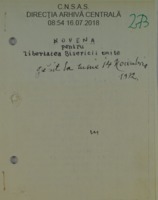 In the early 1970s, during a raid and house search on Fr. Aurel Leluțiu, the officers found amongst other documents a typed prayer entitled "Novena for the freedom of the Greek Catholic Church". The prayer, however, is not included in Fr Leluțiu’s file. The four images presented here are selections from the same ten-page Novena preserved in Bishop Ioan Dragomir’s secret police individual file. The prayer was considered problematic by the Securitate with mentions of it being made in several other files. This Novena, a nine-day prayer exercise, is directed to the Virgin Mary to intermediate with Jesus on behalf of the Romanian Greek Catholics for the recognition and freedom of their church. It asks the Divinity to “not be late in breaking the chains of the Bishops, Priests and believers that remain faithful to the church.” Like several other memoranda and leaflets produced by the Greek Catholic underground in the late 1960s and 1970s, this prayer can be considered political in that it focused on tangible results in easing the life of the community under the political regime of the time. The prayer asked Virgin Mary to “Soften the hardened hearts of the state leaders […] so they would not fight the [church’s] activity and its resurrection from the underground where persecution has pushed us.” Several tropes that characterize the life of the underground Greek Catholic Church can be noted in this prayer: church of the catacombs, the silent church, chains (breaking the/being in), erasing the memory of the church from the history of the nation. These themes run throughout the underground samizdat literature produced by the Greek Catholic intellectual and clerical elite. The prayer was typed and it circulated extensively in Greek Catholic environments with mention of this prayer ranging from Bucharest to Brașov and Cluj-Napoca. The four pages selected here from a ten-page manuscript, are part of CNSAS file I0003560, volume 3. Mentions about the manuscript are also found in CNSAS file I163305 volume 1. The manuscript is found at the back of the file alongside other samizdat materials.
 -
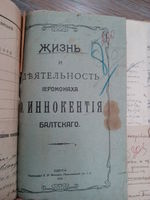 The image depicts the cover page of a booklet published in 1918 in Odessa by the followers of Inochentie of Balta. It was confiscated by the Soviet secret police in 1921 from the Inochentist community of the village of Lipetskoe (Balta county, Odessa Governorate). The village of Lipetskoe was a spiritual center of Inochentism, where the followers of Inochentie of Balta built an underground monastery and established an utopian communal society called Gradina Raiului, the Garden of Paradise. The booklet contains 19 pages which describe the life of Inochentie of Balta, the founder of the Inochentist religious movement, which emerged at the beginning of the 20th century. From the perspective of the secret police, the collection of this kind of literature was important because it allowed the officers to construct a clearer understanding of this new religious movement and to formulate more efficient strategies to repress it. The booklet narrates a unique version of the life and deeds of Inochentie of Balta, different from the accounts found from other textual and oral sources. The secret police archives contain textual materials produced at different stages of the history of religious groups, many of which cannot be found in other repositories or in personal collections. The booklet is attached to the file number 27146 that is preserved in the Archive of SBU Office in Odeska Oblast of Ukraine. The file contains 11 photographs and icons, one booklet and a number of flyers produced by Inochentists and a propaganda flyer of the White Movement with the image of Alexander Kolchak. For related entries see:
 -
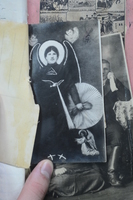 The three images presented here all show variants of the same photo-icon of Alexandru Culeac portrayed as the Archangel Michael. In the first image he appears alone; in the second image, his photograph appears next to that of Inochentie of Balta, and the third image is a reproduction of the photo-icon that appears inside the front cover of a booklet containing Alexandru Culeac's visions entitled "A vision that appeared in 1920". The presence of multiple examples of this photo-icon in the same file reflects the importance of this devotional image to the Archangelist community. Archangelism formed as a branch of Inochentism under the leadership of the Culeac brothers, the most prominent of whom was Alexandru Culeac (b. 1891). He was considered to be the Archangel Michael returned to earth to battle Satan at the End of Days. The Culeac brothers published and distributed their visionary experiences of divine election and the Final Judgement in the form of brochures and continued the tradition started by followers of Inochentie of Balta of using powerful visual materials to communicate their message, commissioning icons and producing photographs to reinforce their special claims. Alexandru Culeac quickly grasped the power of the image to establish his status as mediator between earthly and heavenly realities and in the image shown here we see how techniques of montage and over-painting have been used to create a striking iconization of Alexandru Culeac. In 1924, the photo-icon was printed on the inside cover page of his booklet of prophetic visions entitled "A vision that appeared in 1920" (image three). In the photo-icon, Alexandru Culeac is pictured with a flaming sword, a shield and a dove at his heart, a sign of his dual identity as both the Holy Spirit and Archangel Michael. Later, during the Soviet period, media reports and propaganda publications continued to draw attention to the significance of the production and distribution of religious images for the success of the Archangelist sect, whilst also ridiculing the crudity of their production. In Alexandru Culeac’s confession which was published in 1959 under the title "Repentance of a Sinner", he explains how important the icon that “looked just like me” was for his career, for the Archangelist movement and for the promotion of his divine status: "I decided then to make an icon with my image. I commissioned it from a painter who painted the Day of Judgement and the Ascension of the Archangel Michael, as well as my ascension to heaven. The icon was a success. And the Archangel Michael looked just like me. I declared this icon holy. And it started here. People threw themselves down on their knees in front of the icon. They kissed it and prayed to it to heal them from illness. I don’t know if the icon cured anyone but in exchange we received a handsome income. They brought us cereals, money, carpets and cattle." Intended to portray Alexandru Culeac as a religious charlatan who fooled his followers into making offerings to him, this extract from his confession (which may well have been extracted under duress) nevertheless offers us an insight into the power of the image in the Moldovan vernacular worldview. These photographs come from the National Archive of the Republic of Moldova – Military Tribunal of the 3rd Army Corps ANRM-TMC3A 738-1-6846. In addition to the materials shown here the file contains several photographs of members of the Archangelist community, two pencil sketches and another booklets entitled "The Lord has Spoken [Dumnezeu a vorbit]. Undated. București: Tipografia “Lupta” N. Stoilă. For related entries see:
 -
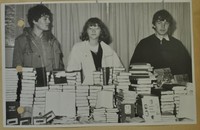 These photos were taken in 1985 and show the search by Customs Officers of a car belonging to three tourists who were trying to cross the border into Romania. This was a normal procedure and any attempt to smuggle religious materials into the country was considered dangerous and an attack against the regime. The first image depicts the three tourists together with all the religious material that they were presumably hiding in their car. Among the books we can see a few Bibles, brochures, calendars, some cassettes and songbooks. These materials were confiscated along with the list of names of the people that they were supposed to be delivered to. The second image shows the officers as they were uncovering the religious materials that were hidden in the car. These type of images are recurrent in evidence files and they are used to prove the guilt of the persons trying to smuggle religious or other forbidden materials in the country. Similar to the second image, the third and the forth photos depict the officers pulling religious books out from their hiding places. The photos were taken at the precise moment (or were staged to appear as such) in an attempt to emphasize the dramatic character of the situation and to further incriminate the smugglers. The books were hidden in various hard-to-reach places inside the car such as the engine area, as can be seen in the forth image. According to the report present in the file, the three people tried to enter Romania in September 1985 but there is no mentions of where they came from. However, based on the registration plate of their car, as depicted in some of the photos, it is safe to assume that they were West German tourists from Karlsruhe, presumably Christians belonging to a protestant or Evangelical church, that were trying to smuggle religious materials inside the country. The tourists were fined and denied access to the country. The photos can be found in the file CNSAS, D 00003, vol. 1. Apart from these four photos, there are seven other photos referring to this particular case, 18 photos concerning two similar cases, as well as other police reports and instructive materials for the officers on how to act in these type of situations. For related entries see:
 -
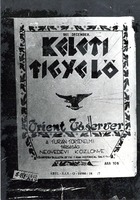 These images have been selected from the photo-documentation of materials sent by post to Mihály Virasztó, a former religious specialist of the Church of the Turan Believers of One God. The first photo shows the cover page of the Keleti Figyelő [Orient Observer], the short-lived journal of the Turáni Történelmi Társaság [Turan Historical Society] founded by immigrant Hungarians in Melbourne, Australia. The second photo shows a certificate of honorary membership of Mihály Virasztó for supporting the study of Hungarian history, issued by the same society in 1962. The images come from a documentary file on Virasztó. The case of the Orient Observer is illustrative of the performative power of certain objects and of the responsive mechanisms of the secret police. By the time of the journal’s arrival in February 1962, Mihály Virasztó had been under surveillance for years, after being classified as dangerous due to his openly anti-communist stance, involvement in 1956, relations with right-wing emigrants, and his past as the priest and activist of the Turan Believers of One God. The arrival of the issues and the certificate was reported by an informant working on Virasztó in July 1962, only four months after the local county division of the secret police had claimed in a report that the Church of the Turan Believers of One God was practically non-existent in the region. Along with Virasztó’s correspondence with other Hungarian right wing emigrants and his involvement in a case of anonymous anti-collectivization letters, the package set the machinery of the secret police in motion. The local branch of the secret police made excessive efforts to get hold of the issues: they asked for photocopies from the Budapest headquarters, while also drawing up a plan to get Virasztó’s own copies. The police also mobilized its network of informants to find out if Virasztó was disseminating the issues, and instructed them to collect more information on the Turan Believers of One God as well. In September 1962, the Budapest headquater sent the copies of the certificate and selected pages of the journal, with a short note that according to their examinations, the articles focused on "the origins and development of various languages”. To decide whether the journal’s content was "hostile”, the local secret police attained Virasztó’s copies in March 1963 through a local informant, who managed to borrow them from him for a couple of days. The Orient Observer was also featured in Virasztó’s two penal files from 1964 and 1966. From these and from other informant reports we know that he had given the issues to several people, the director of the local museum being among them. We also learn from these files that during a house search at his home in 1964 the secret police was looking for the issues but could not find them. The Observer came to the forefront again in 1966, at the time of Virasztó’s last penal case, with the secret police planning a complex operation for its confiscation. This time their aim was to produce evidence that Virasztó was circulating materials hostile to the regime. The Orient Observer was founded in 1960 and had only two volumes and four numbers during its existence. Printed on a small offset printing machine and having hand-drawn illustrations, it claimed to be scientific and focused mainly on the origins of the Hungarian people. Using linguistic and historical argumentation that would not stand up to modern academic scrutiny, the journal argued for the relatedness of Hungarians to various past and present Asiatic peoples. Although the articles were not openly political, the issues contained some negative references to communism and the Soviet Union here and there. One of these, a sentence on the fatal consequences of Soviet dominance for the future of the Hungarian nation, was picked out by the secret police as proof of Virasztó possessing and circulating anti-communist contents. Mihály Virasztó had a long police record in both regimes before and after 1945. As a priest (táltos) and missionary of the Church of the Turan Believers of One God he was repeatedly condemned to prison at the end of the 1930’s for "agitation against religious denominations”. He remained on the radar of authorities in the communist regime for his anti-communist political views and activity, his relationships with right-wing figures abroad, and also for his past and supposedly present involvement with the Church of Turan Believers of One God. He had several clashes with the authorities: he was imprisoned for two month in 1952 for slander, detained for possessions of arms in 1957, a charge that was later dropped, his mental health was investigated and he was sent to a mental hospital in 1964 and 1967. After his last release in the summer of 1968, he was placed under the guardianship of his wife. His file was closed in 1972. These images come from file ÁBTL 3.1.5 O-14980/18. The file also includes confiscated personal letters and photographs, two poems written by Virasztó, lists of confiscated items, medical reports, interrogation minutes, and informant reports. For further entries on Virasztó and the Church of Turan Believers of One God see:
 -
 The images show a Brethren publication entitled Viață și Lumină volume three, issue nine from September 1930. According to the text on the cover, the publication appeared once a month and was edited by Florea Moisescu with administrative facilities in Bucharest under the direction of Gheorghe Teodorescu. Scripture references from the Gospel of John are included under the title, from which the latter is derived. The subscription cost was 60 lei per year in Romania and one dollar in America. This issue, along with two others, were included in the file composed by the General Police Division on the Norwegian Society Norske Israelmision. The society was a missionary organization aimed at converting Jews to Christianity that received authorization from the Ministry of Religious Denominations through order nr. 15486/1565/930. Their representative in Romania was Isaac Feinstein, a Romanian citizen of Jewish ethnicity, born in Dorohoi, whose memoranda to the government requesting freedom for the society to function in the cities of Reni and Iași is included in the file. Another letter from Feinstein to the Ministry of Interior included in the file protests the application of decision nr. 4781 from 1937 to their activity. The aforementioned decision was passed to limit the activity of religious minorities or sects, which Feinstein argued his organization was not. The Brethren publications are not mentioned anywhere else in the file. They were likely gathered by police informers during one of Feinstein’s Norske Israelmision meetings. The Brethren religious minority was considered a sect with foreign allegiance and strictly monitored during the 1930s and outlawed by the Ion Antonescu government in 1940. The placement of the publications with the police correspondence and memoranda concerning the Norwegian society implicates both groups in what could be considered activity threatening state security. Feinstein’s Jewish ethnicity is continually brought up in reports included in the file revealing the police’s intention (as also expressed in other files) of finding a link between the Jewish threat and the sectarian threat. The publication comes from file ANIC, DGP inv. 2349, 51/1930. The file includes two other Brethren publications, police reports, correspondence between the Ministry of Interior-General Police Division, the Bucharest Regional Inspectorate, and the Galați Municipal Police, as well as letters sent by Isaac Feinstein to the Ministry of Interior. For related entries see:
 -
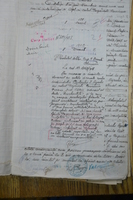 The images show an inventory and confiscated photographs included in a case file forwarded to the Romanian 3rd Army Military Court on 2nd December 1938. The first image shows the inventory of items found in the house, which was located in Fălciu county. The officer lists the following Inochentist "propaganda" materials: "1. A brochure entitled 'The Deeds of the Archangel Michael', 2. a small icon of saint Paraschiva, 3. a cross sculpted from wood, 4. three photographs of Culeac dressed in white with a cross on his chest, 5. a photograph of Culeac dressed in vestments." The second image shows one of the photographs of "Culeac" dressed in white described in the inventory. The third image is the photograph of "Culeac dressed in vestments". The fourth image shows the first page of the brochure 'The Deeds of the Archangel Michael'. The diligent way in which the items were listed and collated by the Romanian Gendarmerie in this case reflects the importance that the Romanian authorities placed on the prevention of the spread of Inochentist "religious propaganda materials" and their important use as evidence in anti-sect trials in this period. On the 21st April 1937, the Ministry of Religions and Arts had issued Ministerial Decision no. 4.781 “Regarding banned sects and religious associations” in which it was stated explicitly that the administrative and police agencies were to stop every form of “propaganda of religious prosleytism, whether this is done verbally, in the form of writing, through brochures and journals etc. by colporteurs, or members of the illegal sect.” The police were also to confiscate all religious materials and send them together with the completed documents to the Ministry of Internal Affairs (Deciziunea 4.781 1937, 3-4). This policy ensured that many Inochentist brochures, photo-icons and photographs were preserved in the case files and penal files of individuals arrested at this time. In the case featured here, the items did not result in a successful prosecution as the accused stated that the materials belonged to his daughter-in-law and that he had no knowledge of their contents or meaning. These images come from the National Archive of the Republic of Moldova – Military Tribunal of the 3rd Army Corps ANRM-TMC3A 738-1-6849. For related entries see
 -
 This songbook is located in a police file from 1938 and it appears to have been confiscated from two Tudorist believers, both of whom were women, who were distributing brochures, calendars and other religious literature to various people on the street. The images uploaded are the front cover and the contents page of a 30 pages long book. The first image depicts the cover of the book which has the name “Tudor Popescu”, the founder of the religious group and its title, Christian Songs (Cântări creștinești). The number “47” refers to the total number of songs that are contained in the songbook. The printing press and its location are mentioned at the bottom of the page. The second image depicts the content of the book, i.e. the list of the songs which are included in the book, in alphabetical order. These songs were collected, translated and some of them composed by Dumitru Cornilescu in circa 1921. He was a former Orthodox priest, biblical scholar and translator and religious reformer. He was a close friend of Tudor Popescu. This was the first songbook produced by the Tudorist community and remained the standard song collection for some years until. According to the biography of Dumitru Cornilescu, these songs were first learnt by heart by the members of the community and only later was he able to collect them together and to publish the songbook. The Tudorists appeared in the 1920s’ and formed as a religious group around the figure of Tudor/Teodor Popescu, a former Orthodox priest. The initial name of the community was the Scriptural Christians but they were soon known as the Tudorists, after the name of their founder. For a very long time the group was outlawed, but in 1939, in order to gain officail ecognition, they were compelled to unify with the Brethren (this was the common term used for creștini după evanghelie/ Evangelical Christians) as it was believed that they shared doctrinal similarities. However, they continued to have a distinct identity inside this larger group and are nowadays known as a second branch of the Brethren. The Tudorists rejected icons and important aspects of Orthodox tradition and for this reason they were seen as a threat for both the Orthodox Church and the state. As part of the Hidden Galleries research project, this songbook was later shown to a member of the community who explained its value to the community as this songbook is extremely rare. This songbook can be found in the file CNSAS, I 259046. The file is one of the informative files on Tudor Popescu compiled by the Securitate from Siguranța files. It contains more brochures that were confiscated by the police, some personal letters of Tudor Popescu, as well as declarations and arrest warrants of Tudorist members that were caught by the police distributing religious literature. For further references see: Alexandru Măianu, ”Viața și lucrarea lui Dumitru Cornilescu”, București, 1995. For related entries see: