
Jehovah’s Witnesses
Item set
- Title
- Jehovah’s Witnesses
- Description
-
Jehovah’s Witnesses (JW) is a millenarian Christian denomination that emerged in the United States at the end of the 19th century. It first arrived in Eastern Europe during the interwar period and began to spread to all the countries that went on to form the Socialist bloc. The state authorities of the Soviet Union, Romania, Poland, Czechoslovakia, Hungary and Romania considered the Witnesses a hostile organisation and denied it legal recognition. The main reasons given for the repression of the Witnesses were their American roots and close ties to their Brooklyn headquarters, their rejection of civic duties, including military service (based on their teachings of non-violence), their apocalyptic beliefs and door-to-door proselytism. Whilst under communist dictatorships, the Witnesses were accused of being spies for American imperialism, whereas under the far-right regimes that preceded them in several countries, they were considered to pose a threat as assumed communists. They became one of the largest categories of political prisoners in the socialist bloc.
Being outlawed, JW were kept under close surveillance and were subjected to intense harassment: home raids, confiscation of Bibles and religious literature, mass arrests and show trials with subsequent long-term imprisonment and detention in labour camps. In Hungary, after the JWs were banned in the interwar period, hundreds of believers were arrested and taken to labour camps or concentration camps (including Auschwitz, Dachau and Buchenwald). In Romanian-controlled territories, the Witnesses faced restrictions and suffered mass arrests and police raids of homes almost immediately after the first groups started to spread there in the 1920s. By 1945, about 1,200 Witnesses had lost their lives in Germany under the Nazi regime.
The Soviet authorities initiated two major deportations of the Witnesses and their families from the western Ukrainian borderland, Moldova, Belarus, Latvia, Lithuania and Estonia (in 1949 and 1951). The state exiled over 10,000 Witnesses and their families (including children and elderly) to Siberian and Transbaikal “special settlements”. This was the largest mass exile of a religious community in the Soviet Union (Baran 2014: 59-69).
JWs in the Soviet Union and the Communist bloc ran one of the most active and complex underground networks with internal hierarchy and leadership, a coded reporting system and finances, network of printing presses, smuggling operations and clandestine communication channels. Despite mass repression, the Witnesses in Central and Eastern Europe proved remarkably resilience with the number of members steadily growing.
In this collection, you will find images of JW religious literature and coded reports confiscated by secret police and used as incriminating evidence, surveillance photographs and crime scene photographs as well as various other internal top-secret documentation produced by the secret police in their work against JW underground networks.
For further readings see:
Baran, Emily. 2014. Dissent on the Margins: How Soviet Jehovah's Witnesses Defied Communism and Lived to Preach About It. Oxford University Press.
Berezhko, K.A. 2012. Istoriia Svidkiv Egovy v Ukraini: u 5 tomakh. Feodosiia: Art-Life.
Ivanenko, S.I. 2002. Svideteli Iegovy – traditsionnaia dlia Rossii religioznaia organizatsiia. Moscow: Art-Busines-Center.
Knox, Z. (2018). Jehovah’s Witnesses and the Secular World: From the 1870s to the Present. London, Palgrave Macmillan.
Besier, G., Stokłosa, K. eds., (2016). Jehovah’s Witnesses in Europe: Past and Present. volume 1, Newcastle upon Tyne, Cambridge Scholars Publishing. - Creator
- Tatiana Vagramenko
- Publisher
- This project has received funding from the European Research Council (ERC) under the European Union’s Horizon 2020 research and innovation programme No . 677355
- Bibliographic Citation
- http://hiddengalleries.eu/digitalarchive/s/en/item-set/294
- Date Created
- 2018
Items
-
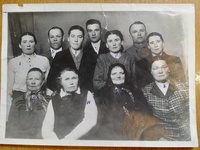 This photograph was enclosed in a KGB surveillance file from 1952-1955 on Jehovah’s Witnesses in the Rivno region, western Ukraine. The image pictures a group of Jehovah’s Witnesses from the Rivno region. It was enclosed in an envelope along with 6 other confiscated or intercepted photographs. Each depicted person was marked with a number and on the reverse side a secret police officer wrote their names, date of birth, information on their origin and place of residence, as well as their role within the Jehovah’s Witness organization, such as: “ordinary member of the underground,” “active Jehovist,” preacher, group elder, or “courier of the Jehovist underground”. Nearly all of them were marked as objects of surveillance as part of the agent operation “Zavet”. Another envelope enclosed copies of intercepted Jehovah’s Witness literature: several booklets and 12 issues of the Watchtower journal. As evidenced from one of the documents, it was an informer under a codename Poliakov (a Jehovah’s Witness recruited by the KGB) who passed the literature to the secret police. From his report we learn that he met a Witness courier named Varvara Senkevich (marked 5 in the photograph) and several other believers in Rivno. Senkevich gave this literature to a believer not knowing that he was a KGB informer. She asked him to distribute the Watchtower journals among brothers and sisters. The agent meeting with Senkevich and her co-believers in Rivno was part of a secret operation “Zavet”, the aim of which was to recruit Witnesses as agents and informers in order to intercept detailed information on the organization’s leadership in western Ukraine, disclose underground printing presses in the region and believers’ communication channels with exiled or imprisoned Jehovah’s Witnesses, as well with those living in other regions or abroad. Senkevich herself was also a potential target for recruitment by the KGB because her role as a Jehovah’s Witness courier could reveal sensitive information on clandestine communication channels within the organization. In the 1950s, the Ukrainian secret police launched several secret operations that targeted Jehovah’s Witness leadership and aimed to disclose Witness clandestine groups and their system of communication. The agent network was believed to be the main weapon in the fight against the religious dissent. There were about 200 agents and informers working in the Witness underground in the mid-1950s in western Ukraine. Most of them were recruited from within the Witness organization, many had tragic experiences with their close families imprisoned or exiled. Some of them had been and would be (after their service with the security police) arrested and tried. All of them were recruited by straightforward blackmail. However, as some historical accounts reveal, Witnesses were aware of agent infiltration and KGB surveillance and knew names of many agents and informers. They were also aware of some secret operations carried out against them. While being shadowed by the secret police, they shadowed KGB officers too. Counter-infiltration was another pattern of their everyday resistance. Some believers intentionally entered the informers’ network or were chosen to become collaborators by their own congregations. Appointed agents delivered partial or less sensitive information in exchange for getting to know KGB plans and operations. Other believers wrote fake denunciations to mislead the secret police. The photograph comes from the SBU archives, fond 2, sprava 2592. The file contains materials on several agent operations amongst Jehovah’s Witnesses in the Rivno region, information on agent recruitment, compromising evidence that could be used as blackmail during recruitment, surveillance reports, and correspondence between KGB branches. For related entries see:
 -
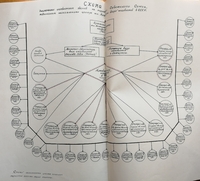 This network scheme of the Jehovah’s Witness organization comes from a four-volume top-secret file titled LKB, Legendirovannoe Kraevoe Biuro (Regional Bureau Covert Operation). It was produced by the Ukrainian secret police in 1953 and shows Jehovah’s Witness districts and circuits located in the Soviet Union with the organization’s country committee (called by that time the Regional Bureau) as the governing body of Soviet Jehovah’s Witnesses. The scheme shows the connections of Soviet-based groups of believers with the Jehovah’s Witness organization abroad: the East-European Bureau in Poland, the Romanian branch, the European centre in Switzerland and the Jehovah’s Witness headquarters in the USA on top of the network scheme. The secret operation (Regional Bureau Covert Operation) was launched by the Ukrainian MGB office in 1951, the same year the state organized a large-scale deportation of Witnesses from the western borderlands. It was suspended in 1954, soon after Stalin’s death. The operation aimed at infiltrating the Jehovah’s Witness underground organization in Ukraine (and later the entire Soviet Union) and to organize a Witness country committee as a covert operation. The plan was designed such that the Soviet security service became the head of the Jehovah’s Witnesses organization, and the headquarters of the official Watch Tower Bible and Tract Society (hereafter the Watch Tower Society), located in Brooklyn, became a channel in their counter-intelligence operations against the US. The scheme comes from the SBU Archives, fond 2, sprava 2432. The file also contains correspondence between the MGB office in Kiev and regional offices in western Ukraine, agent reports, surveillance reports, information on the structure of the Jehovah’s Witness organization in Ukraine, intercepted letters and samizdat publications. More about the secret operation and agent infiltration of Jehovah’s Witnesses in Soviet Ukraine see: Tatiana Vagramenko, KGB “Evangelism”: Agents and Jehovah’s Witnesses in Soviet Ukraine. Kritika: Explorations in Russian and Eurasian History, (forthcoming 2021) For related entries see:
 -
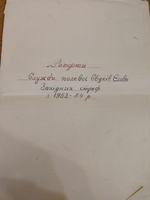 Being surveilled and under constant risk of arrest, many clandestine religious communities developed their own coded language to communicate with each other and with their religious centres. This enabled them to avoid the disclosure of sensitive information in case of arrest and confiscation. Jehovah’s Witnesses were among the groups who developed their own coded system of communication, which they used in their missionary materials and finance reports and tallies. The secret police, in turn, made great efforts to intercept clandestine communication channels and to decipher coded messages. The missionary tallies you can see here were confiscated by the Soviet KGB from a group arrested Jehovah’s Witnesses in Western Ukraine. They report about the so-called “field service” of Witness Western circuits in Ukraine during 1953-1954. The encrypted reports contain information about the number of believers in local groups, the amount of religious literature produced and distributed and hours spent evangelizing, as well as information about prayer meetings and Bible study groups, christenings and other religious events. The confiscated reports were discovered by the police in an underground bunker and were later attached to a case file and were used as an incriminating evidence of organized proselytism by Jehovah’s Witnesses, an illegal sect in the Soviet Union. The images come from the State Archive Branch of the Security Services of Ukraine, fond 5, spr. 42795, vol. 14. The 27-volume case file against seven Witnesses from Ukraine contain hundreds of interrogation records, arrest questionnaires, photographs, confiscated religious materials and personal items. For related entries on:
 -
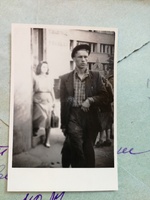 These photographs come from a KGB surveillance file on Jehovah’s Witnesses in Ukraine, 1955-1956. The photographs, which were taken with a hidden camera, capture the meeting of a KGB agent with a group of Witnesses in the town of Morshyn, western Ukraine. The agent was a Witness minister recruited by the KGB as an informer. He was appointed by the secret police to meet with members of the Jehovah’s Witness regional committee in Ukraine in order to gain their confidence and to intercept the communication channels of Ukrainian Jehovah’s Witnesses with their headquarters abroad. During one of the meetings, the agent intercepted and copied the country missionary reports sent from Ukraine to the Polish Jehovah’s Witness office and later submitted it to the KGB. The handwritten copies are attached to the file. A month later, two of the Witnesses from the meeting were arrested. After the annexation of western Ukraine in 1939, and particularly with the beginning for the Cold war, the Soviet state launched a full-scale attack against the Jehovah’s Witnesses living in the western borderlands of the country. In the period between 1947 and 1953 alone, the state arrested about 2,000 Witnesses in western Ukraine, confiscated hundreds of thousands of journals and leaflets and destroyed several underground printing presses. Alleged emissaries of the American intelligence services, Ukrainian Jehovah’s Witnesses faced two mass deportations in 1949 and 1950. The repression nearly wiped out the organizational structure of the Jehovah’s Witnesses and fractured their coherent network of close-knit communities in Ukraine. As part of the plan to repress them, the KGB carried out several secret operations that aimed to infiltrate the Jehovah’s Witness leadership with KGB agents and informers. There were about 200 agents and informers working in the Witness underground in western Ukraine in the mid-1950s. Several KGB informers became important figures within the Jehovah’s Witness organization, entered the country committee, travelled abroad and established communication with higher level Witness centres in Poland and Switzerland. Many Witness couriers who smuggled information from the Soviet Union abroad were under the control of the KGB. This is how the secret police obtained detailed and up to date information about the religious underground. The subsequent history of the Jehovah’s Witnesses in the Soviet Union, however, demonstrates that neither KGB agent infiltration nor mass deportation prevented the survival or indeed the steady growth of the organization. The images come from the State Archive Branch of the Security Services of Ukraine, fond 2, op.1, spr. 2677. Along with 6 photographs, the file contains numerous reports on surveillance and informer recruitment, reports on the arrest of Witness leaders, agent reports, character assessments of informers, copies of interrogation reports, fragments of intercepted letters and tallies of Jehovah’s Witness membership. For related entries see:
 -
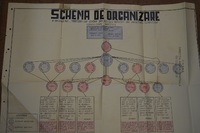 This network scheme comes from a documentary file on Jehovah’s Witnesses in the former administrative region of Cluj. Titled as “Organisation Scheme of the organisation “Jehovah’s Witnesses” in Cluj Region, it shows the structure of the group with names, ranks and connections of each of the functionaries (indicated by circles). The blue box at the top stands for the national leaders, while the rectangular boxes at the bottom represent the six territorial units in the region with the number of their subunits and members. The scheme also informs the viewer of the progress the authorities had made in their measures against the group: arrested “elements” are indicated with red, while those still free are coloured with blue. The scheme is an attachment to an interim report written in 1955 and visualises the results of an ongoing "informative–operative" operation conducted by the Securitate’s Cluj regional directorate. The operation started in 1953, two years after the leadership of Jehovah’s Witnesses in Cluj region (35 people) were arrested and convicted. The aim of the operation was to identify the new leaders and functionaries of the reorganised regional units, to map their connections within and beyond the regional structure, and to gather information about their activities and whereabouts. To further this goal, the Securitate employed several informants to work on the group and relied on information gathered during interrogations of members arrested during the operation (in 1951 or after 1953). As the scheme aims to show, Jehovah’s Witnesses as an organisation had a hierarchical structure. The basic units were the local congregation, each having its leader called servant (this emic term was used for all leaders, and as the scheme shows, it was also adopted by the Securitate). On a territorial basis congregations formed circuits (there were 6 of them in the Cluj region with altogether 146 congregations) with circuit servants responsible for coordinating the work of congregations, supplying them with religious materials and acting as mediators between them and the regional servant. The regional servant in turn was responsible for coordinating the work of circuit leaders: he collected reports, money or other types of donations, distributed teaching materials and mediated between the circuits and the national leaders. His work was helped by evangelisers called pioneers who took an active part in proselytising and organising new congregations; they were mainly young, unmarried and devoted men already living illegally for having refused military service. Communication between the levels was carried out with the help of couriers who transported messages, reports, reading materials and donations. Interaction within the group was highly secretive: most servants and pioneers used cover names even with other group members, all reports were coded and couriers met with the leaders in crowded public places and used prearranged signs to get in touch with one another. Authorities found the highly organised structure of the group and the discretion with which they carried out their interactions suspicious and considered this evidence of the group’s conspiratorial nature. Before 1990, apart from two short periods between 1933–1937 and 1945–1949, Jehovah’s Witnesses did not enjoy a legal status in Romania. They suffered intense persecution at the hands of inter-war democratic governments and the wartime and post-war totalitarian regimes. The main reasons given by the authorities for their harassment were their proselytising activity, the lack of transparency in their organisation, their refusal to perform military service or to participate in elections and other civic duties, their ties to their American headquarters, and their heralding of the end of the regime and the onset of a theocratic kingdom. Throughout the communist period, Jehovah’s Witnesses were closely surveilled by the Securitate with many being imprisoned or sent to labour camps. In spite of the repressive environment, however, their number grew from 15000 in 1949 to 35000 in 1990. These images come from file CNSAS D 014428. Beside the network scheme it contains a 17-page report and several crime scene or evidence photographs of various hidden materials (a typewriter, a loudspeaker fake IDs, religious brochures, coded reports). For further readings on Jehovah’s Witnesses and the Romanian state see: Pintilescu, Corneliu – Fătu-Tutoveanu, Andrada, 2011, Jehova’s Witnesses in Post-communist Romania: the Relationship Between the Religious Minority and the State (1989-2010). Journal for the Study of Religions and Ideologies, vol. 10, issue 30 (Winter): 102–126. For related entries see:
 -
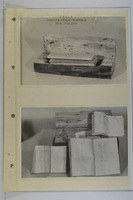 These crime scene photographs were selected from a documentary file on Jehovah’s Witnesses in the former administrative unit called Cluj region. The pictures were taken during various house searches conducted by the secret police in the homes of Jehovah’s Witnesses or people related to them. The photos in the first image show a "normal sized piece of firewood" with its inside carved out and the reports of the Huedin circuit (territorial unit within the Jehovah's Witnesses organisation) from 1951–1954 that were hidden inside it. It was found in the home of the already arrested Huedin circuit servant (leader of the circuit responsible for coordinating congregation work within his unit). The first photo on the second image shows a loudspeaker and accessories. The loudspeaker was found in the well of the arrested assistant of the Huedin circuit servant, while other parts of the equipment were hidden piece by piece underneath the pigsty. According to the report, the loudspeaker was used during meetings. In the second photo in this image we can see a coded report from the same circuit hidden amongst unused tiles. The third image is a statement about refusing military service. It was written by one of the pioneers (evangelisers actively taking part in the life of the congregations) who was also arrested by the time of the report. According to the secret police, the statement was distributed as a sample amongst young male members. The top picture on the fourth image portrays the arrested leader of the Abrud circuit seated beside a glass jar containing coded reports. The picture intends to capture the moment when the jar was dug up from its concealment, near the roots of a tree. The photo below offers a close-up of the material contained in the jar. The photos follow the common standards of crime scene photography of Eastern European secret services. These photos were often “re-enactments”, a common method to illustrate the crime and incriminate its perpetrator; the fourth image is an excellent example of this. All pictures were supplemented by detailed captions providing basic information about the items shown and the place they were found. The report included in the file emphasised that Jehovah’s Witnesses were exceptionally resourceful when it came to concealing “forbidden” materials, so much so that the services needed tips from their informers to find them. The photos in this file were used to support accusations (participating in a conspiratory and hostile organisation, producing and disseminating forbidden publications, encouraging young men to refuse military service, holding clandestine meetings etc.) against arrested members and helped authorities to convict them. Up to 1990, apart from two short periods between 1933–1937 and 1945–1949, Jehovah’s Witnesses did not enjoy legal recognition in Romania. They suffered intense persecution at the hands of interwar democratic governments as well as the wartime and post-war totalitarian regimes. The main reasons given for their repression were their proselytising activity, the lack of transparency in their organisation, their refusal to perform military service or participate in elections and other civic duties, their ties to their American headquarters, and their heralding of the end of regime and the onset of a theocratic kingdom. Throughout communism, Jehovah’s Witnesses were closely surveilled by the Securitate with many being imprisoned or sent to labour camps. In spite of the repressive environment, however, their number grew from 15000 in 1949 to 35000 in 1990. These images come from file CNSAS D 014428. Beside these images it contains several other crime scene or evidence photographs of various hidden materials (a typewriter, fake IDs, religious brochures, coded reports), a 17-page report and the network scheme of the groups active in the region. For further readings on Jehovah’s Witnesses and the Romanian state see: Pintilescu, Corneliu – Fătu-Tutoveanu, Andrada, 2011, Jehova’s Witnesses in Post-communist Romania: the Relationship Between the Religious Minority and the State (1989-2010). Journal for the Study of Religions and Ideologies, vol. 10, issue 30 (Winter): 102–126. For related entries see:
 -
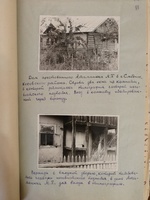 These images were included in a 14-volume criminal file against seven Jehovah’s Witnesses (JW) leaders from western Ukraine (former Drohobych and Stanislav region), 1955-1956. The photographs were produced during a police raid of an underground bunker printing press operated by the Witnesses in a rural location. The photographs were used as incriminating evidence of their clandestine illegal activities. The first image shows a rural private house in Smodne village under which the bunker was constructed. The place was also used as a safe house where several members of the JW organisation were hiding to avoid arrest. The top photograph from the second image shows a bunker air-way masked with sheaves. The third image shows the evidence found as a result of the police search: confiscated printing equipment (rotator, wax stencil, paper, typeface, and ink), samizdat religious materials, as well as an entrance box from the bunker. The bottom photograph on the third image pictures an arrested believer (and the owner of the house) sitting with the confiscated items. The bunker printing press was discovered by the police in 1955 as a result of a major secret operation against the JW leadership in Ukraine. Among the arrested persons was Bogdan Terletsky, the leader of the Jehovah’s Witnesses in the Soviet Union from 1953-1955, who had been on a secret police wanted list since 1950. Under intense pressure and after numerous interrogations, Terletsky’s spirit was broken and he agreed to cooperate with the secret police. Later, during the 1960s, he would give evidence in trials against other Jehovah’s Witnesses. The Soviet authorities considered the Witnesses an anti-Soviet organisation and denied it legal recognition. The Soviet secret police conducted mass arrests of the Witnesses, carried out two major deportations of the Witnesses and their families from the western Ukrainian borderland and Moldova (in 1949 and 1951), and ran numerous secret operations to disclose their complex underground networks. Despite state repression, the Witnesses in the Soviet Union proved remarkably resilience, with the number of members steadily growing throughout the entire Soviet period (see Baran 2014). The repression they endured made the Jehovah’s Witnesses in the Soviet Union an insular organisation, with internal hierarchy and leadership, a coded reporting system and finances, smuggling operations, and clandestine communication channels. They also ran a complex underground network of printing presses that were of particular targets to the secret police. The images come from the State Archive Branch of the Security Services of Ukraine in Kyiv. The file reference is: fond 5, sprava 42795, tom 13. The file consists of fourteen volumes and contains interrogation records of arrestees and witnesses, reports of the police raid, decisions of a commission of experts regarding the anti-Soviet message of confiscated religious literature, etc. The whole volume (No. 14) consists of confiscated Jehovah’s Witnesses material: coded financial and missionary reports, internal instructions, a list of names of arrested Witnesses with addresses of detention places, personal correspondence and photographs. For further readings see: Baran, Emily. 2014. Dissent on the Margins: How Soviet Jehovah's Witnesses Defied Communism and Lived to Preach About It. Oxford University Press. Berezhko, K.A. 2012. Istoriia Svidkiv Egovy v Ukraini: u 5 tomakh. Feodosiia: Art-Life. Ivanenko, S.I. 2002. Svideteli Iegovy – traditsionnaia dlia Rossii religioznaia organizatsiia. Moscow: Art-Busines-Center. For related entries see: