
Women and Orthodox Dissent
Item set
- Title
- Women and Orthodox Dissent
- Description
-
Women often played an important and visible role within Orthodox Christian dissent movements. Even though they were often portrayed as vulnerable and the main victims of religious leaders, some archival sources present them as key leaders, proselytisers (or propagandists in the language of the secret police), providers of religious items, such as icons and prayer books, as well as staunch defenders of their belief system. In some communities it was not unusual for women to take on the role of a priest, especially when male leaders were absent, and preside over religious services for the community. In challenging the gender norms of contemporary society (many groups also encouraged sexual abstinence and the rejection of marriage), women were often accused in Orthodox Church journals such as Luminatorul and Misionarul, the state authorities and the press of being sexually promiscuous and of being the concubines of male charismatic leaders.
Many women suffered detention, imprisonment and deportation as well as sickness and extreme hardships under both rightwing and leftwing dictatorships.
For further readings see:
“Drumul rectilin al bisericii românești” in Biserica și Școala, No.15, 11 April, 1937, p.128.
“Descoperiri în legătură cu activitatea stiliștilor din Piatra Neamț” in Credința, 7 October, 1936.
Pr. D. Croitoru, “Pericolul stilismului și inochentismului din Basarabia” in Misionarul, No. 1-2, January- February 1936, p. 120.
Grigore Spiru, “Rasputinul Moldovei”, 1936- anti-Stilist propaganda brochure printed with the approval of the Iași Metropolitan Church.
- Creator
- Iuliana Cindrea
- Publisher
- This project has received funding from the European Research Council (ERC) under the European Union’s Horizon 2020 research and innovation programme No . 677355
- Bibliographic Citation
- Iuliana Cindrea, "Women and Orthodox Dissent"
- http://hiddengalleries.eu/digitalarchive/s/en/item-set/282
- Date Created
- 2019
Items
-
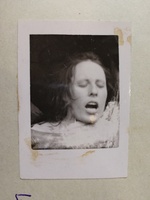 These arrest photographs come from a 1952 secret police penal file on a group of 23 believers who were arrested in the Kiev region of Ukraine. The file contains two versions of their arrest photographs taken by the MGB officers. As the photos were being taken, the believers intentionally closed their eyes, turned their heads away, or sang while the officers tried to restrain them. Their gloved hands are clearly visible in the images. Police officers later tried to correct these “tainted” photographs by removing the evidence of their violent intervention from the prints, which one can see in the spruced-up copies with the hands of the policemen roughly shaded out. The handless photos were used in the formal documentation of the case, while the smaller-size, original photos with the hands were appended to the back of the arrest questionnaires. The MGB official closing indictment charged the group with conducting anti-Soviet activity and propaganda as members of the “ecclesiastical-monarchist organization ‘the True Orthodox Church.’” However, no one knew much about them. Their co-villagers described them as Stundists or Baptists and knew nothing more than the fact that, even though they displayed Orthodox icons, crosses and church books in their homes, they never went to Orthodox Church and did not recognize Orthodox priests. The members of the group lived isolated lives; they rarely talked to their neighbours, avoided representatives of the Soviet authorities and never discussed their faith except to repeat the phrase: “God knows” (Bog znaet). All we know about them now is that they were poor peasants who gathered for prayer in secret in their homes, sometimes travelling between villages to pray together. They refused to enroll in local collective farms or to work at other state enterprises, never paid taxes or registered for other Soviet documents, and never used money (“the mark of the dragon”) or sent their kids to public school. The pre-trial review of the believers was brief: a mere three days of interrogations and then an additional night of twenty-two orchestrated confrontations between the arrestees and witnesses (conducted from 9pm until 4am). During the review, the believers refused to answer questions, responding to everything by saying simply “God knows” or “I will only answer to the Judgment of God.” During the whole process they never stopped singing and praying. They continued when the police came for them, as their arrest photographs were being taken, during the interrogations that preceded their trial and even during the court hearing. The case lasted 9 days between the arrests and the court hearing with the final decision of 25 years in labour camps handed down to most of the defendants. For more about the case see: Tatiana Vagramenko, Gabriela Nicolescu, The Hand at Work or How the KGB File Leaks in the Exhibition. In Martor Journal (forthcoming, 2021). For related items see:
 -
 These images show a church songbook that was carefully handwritten by nun Olimpiada Petreanu sometime in 1940. The first image depicts the cover of the songbook. It conveys important information such as the owner of the songbook, the fact that it was a church songbook, “cântări bisericești”, and, in faded letters, the year when the songbook was written. The second and the third images show a small part of the content of the songbook, namely the so-called “canon of the soul”, which was dedicated to the Virgin Mary, and the Akatist of Jesus Christ. These are both important hymns and hymnal elements of the Orthodox tradition. The last image shows a short poem, or proverb, that states: “man is like a flower that is here and gone tomorrow, he now laughs and parties, tomorrow he lays in his grave.” It also shows the date, March 12 1940, and the signature of nun Olimpiada. These images illustrate the effort and care that was put into writing the songbook, which is colourful and carefully organized. Moreover, at a time when most women were illiterate, nun Olimpiada Petreanu was able to handwrite, draw and put together such a wonderful songbook that, fortunately, survived until today. Born in Răucești, Neamț county, Olimpiada Petreanu, whose lay name was Safta, is one of the nuns that was imprisoned at Vărzărești Monastery, in 1937. Vărzărești was one of the main places where Old Calendarist nuns were brought and, according to some Old Calendarist literature, they were forced to accept the New Calendar there. She wrote her first postcard from Vărzărești in May 1937, asking her parents to send her some food, her watch, some clothes and money. From the onset, we learn that she used to live at Old Agapia Monastery as she compares the location of Vărzărești Monastery with its location, and that she had partially lost sight in her right eye, an issue that is constantly mentioned in her correspondence with her family and acquaintances. According to the declaration of her father, she joined the monastery more than ten years prior to 1937, and after the Neamț Old Calendarist rebellion she allegedly lost the support of her family who chose to follow the new calendar. Based on the concerned tone of the postcards that she received from them, as well as the fact that they continued to send her packages and whatever she needed in order to make her detention easier to endure, it is difficult to believe that such was the case. The time of her release is uncertain and what we know about the rest of her life is based on the information gathered during ethnographic research. After her release, she was allegedly sent to Oniceni, Buzău county, where she founded a skete for nuns at Drăgușeni with the help of Glicherie Tănase, an important Old Calendarist bishop. She became the mother Superior of the skete and spent the rest of her life there. She died in January 2002 and left behind this songbook. These images were provided to the Hidden Galleries research team by the nuns of Mănăstirea „Buna Vestire”, Valea Roșie. For related entries see:
 -
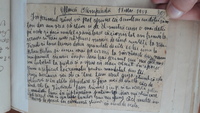 These images show the front and reverse of a postcard that was sent to nun Olimpiada Petreanu by her brother whilst she was incarcerated at Vărzărești Monastery. The postcard is of particular interest as it mentions the difficulties that the families of imprisoned Old Calendarist nuns encountered in their efforts to contact them. The first image shows the front of the postcard and contains references to one of the most important issues that the nuns and their families experienced. One of the constant complaints of the nuns, as well as of their families, was that the postcards, letters and packages often went missing or were delivered late. Olimpiada Petreanu’s brother expresses his concern about the fact that their communication was made difficult by unknown causes: “we sent you many letters but you have not responded since you arrived at Vărzărești [...] we asked at the post office but they said that there was nothing for us, so we made a complaint [...] I don’t know the reason for this, maybe because of the lack of money, but many letters are not sent, they stop them.” Similar concerns are expressed by other nuns’ family members in their letters and this continuous state of confusion seems to have been intentionally maintained by the authorities entrusted with the incarcerated nuns supervision. By controlling every package and letter the nuns and their families received, the authorities hoped to destroy the nuns’ will to resist the religious calendar reform and with it undermine the entire Old Calendarist movement. Moreover, we learn from similar correspondence that the lack of communication triggered a fear of abandonment, of having been forgotten and a struggle to come to terms with a difficult situation. The second image shows the back of the postcard. It contains important information about nun Olimpiada, namely that she had a problem with one of her eyes, as her brother asks her if her eye had healed; from other postcards we learn that she had partially lost sight in her right eye. On the upper edge of the back of the postcard her brother wrote a note asking her about a certain nun Anica and if she had received her packages. This note demonstrates that such events were not isolated and that other Old Calendarist nuns and their families suffered due to the fact that communication was rendered difficult. Written in 1937, this postcard is important proof of the waves of arrests that followed the so-called "rebellions" in Besserabia, in 1936. Many Old Calendarist nuns were sent to detention where they suffered numerous hardships, hunger and cold. Vărzărești Monastery was one of the main places where Old Calendarist nuns were brought and, according to some Old Calendarist literature, they were forced to accept the New Calendar there. The intimate and private lives of the nuns in detention revealed by these postcards contrasts sharply with the way they were portrayed in the press of the time as dangerous and rebels. These images can be found in the file ANIC, Insp. Gen. al Jand., D 23/1937. Apart from this postcard, this file contains many more letters and postcards sent or received by Old Calendarist nuns that were detained at various Orthodox Monasteries. For related entries see:
 -
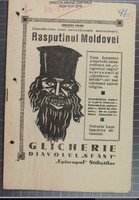 These four images are part of a brochure written in or around 1936 by Grigore Spiru, a well known Romanian journalist of the interwar period. The brochure, whose main characters are Glicherie Tănase and his alleged mistress, Maria Gârleanu, was meant to combat Old Calendarist ideas and to portray the Stilists (referring to "old style"), as Old Calendarists were referred to, in a negative manner. The first picture depicts the cover of the brochure, entitled “The Rasputin of Moldova. Glicherie, the holy devil and the Stilist bishop”, as well as a caricature of Glicherie. The comparison with the famous Rasputin was not coincidental and it mainly referred to Glicherie’s power of attracting large crowds of peasants, many of whom were women. The text also calls him “the black monk” and it makes references to the activities that were supposedly happening in various Old Calendarist churches, such as orgies, fake miracles and the use of real blood during the Eucharist. The second picture can be found on the inside of the brochure and it depicts a caricature of Glicherie, as well as the title “The childhood and…monasticism of Glicherie”. The caricature itself, as well as the term bishop written between quotation marks, are meant to mock Glicherie’s status amongst the Old Calendarists. The text goes on to describe Glicherie’s childhood in a very different manner from the way that it is recorded by the Old Calendarist church, portraying him as a charlatan from a very young age and motivated in his choice of the monastic path by financial reasons. The third picture can also be found on the inside of the brochure and it depicts a caricature of Maria Gârleanu. She was often described as the mistress of Glicherie Tănase, as well as his accomplice, especially in Glicherie’s attempts to stage various miracles in order to impress the peasants. In the brochure, Spiru depicts Maria Gârleanu as an adventurous woman, fascinated by various monastic figures, especially by Rasputin, whom Glicherie is said to have resembled. The forth picture depicts a caricature of Glicherie holding a bottle of alcohol, pointing to the Old Calendarists’ alleged immoral behaviour. Spiru goes on to describe how the Old Calendarist priests received gifts from naïve believers whilst spending their time drinking alcohol and luring young women. The brochure, which appeared in 1936, was meant to combat the Old Calendarist ideas and was part of a narrative that was encouraged and propagated by the Orthodox Church. These images, along with the brochure, can be found in the file CNSAS, D 013408, vol. 1. Apart from this brochure, it contains police reports, lists of names and newspaper articles that refer to the so-called Stilist rebellions from 1935- 1936. For further readings see: ”Isprăvile lui Glicherie episcopul stiliștilor” in Universul, No. 257, September 17, 1936. For related entries see:
 -
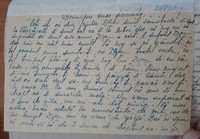 These images show a postcard sent by an Old Calendarist nun to her family whilst in detention. It is a particularly sensitive letter as it conveys the struggles of the nun who appears to have been rejected by her parents for reasons that are not clear from the information we have. The first image shows the face of the postcard and it contains references to the sufferings that the nun had endured for the last two years. From the message that she wrote to her parents, she seems to accuse them of having forgotten about her during these hardships and she reminds them that she is still their daughter and shares the same rights as her other sisters. The reason for her being treated like this by her parents are not described in the postcard but she makes a statement that might hint at it: “ I always cry and pray to God that He won’t abandon you, that you will get to know the good and the bad.” The statement could imply that her parents were religious and disagreed with her decision of becoming a nun or that they might have accepted the New Calendar, thus putting them at odds with her adherence to the Old Calendar. The second image shows the back of the postcard. It contains information that makes it clear that the postcard was sent from Vărzărești Monastery, one of the Orthodox monasteries where Old Calendarist nuns were detained and, according to some Old Calendarist literature, forced to accept the New Calendar. The nun asks her family to come and visit her, she wishes them happy holidays and asks for forgiveness. This postcard offers us a glimpse of the emotions and personal challenges faced by nuns and women who rejected the Orthodox Church calendar reform. This is contrasted by the very different image of Old Calendarist women that was portrayed in the press and Orthodox Church publications of the time. The author of this postcard chose to suffer because of her religious convictions. Although the archives do not preserve a reply to her postcard and we are not aware of her fate, she seems convinced that there is reason to her suffering for her faith. This is a recurrent theme in the letters and postcards written by Old Calendarist women in detention. These images can be found in the file ANIC, Insp. Gen. al Jand., D 25/1937. Apart from this postcard, it contains many more letters and postcards sent or received by Old Calendarist nuns that were detained at various Orthodox Monasteries in Romania. For related entries see:
 -
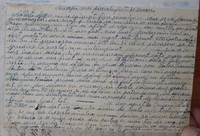 These images show a postcard sent by an Old Calendarist nun to her family in which she describes how she was arrested and sent to an Orthodox Monastery. The postcard was confiscated and attached to a file that contains many such postcards. They all date from approximately same period of time between 1936 and 1937. The first image represents the face of the postcard and includes important details about the fate of the nun. She describes to her family how she was arrested, where she was taken and what the conditions at the Monastery were like. Arrested by the Gendarmes on her way to the post office, the nun was taken from Oniceni (Neamț county) to Ciolanu Monastery (Buzău county), where all her things were confiscated. There were 70 nuns there altogether who were put into four rooms. She had to share a room with 20 other nuns. The second image shows the reverse of the postcard. It offers important information about the regime that the nuns lived under at the Monastery. She asks her parents to write back to her, but carefully, as their letters are first read by someone else implying that she may suffer consequences if the letter contained anything compromising. The image shows how the nun filled the entire postcard writing in order to convey as much information as possible. On the right edge of the back of the postcard she wrote a cramped note asking her family who was still alive in the village. This may have been due to her wish to pray for anyone that was deceased, or it might be a direct hint at the policy of violent repression and arrests that the Old Calendarist church was subjected to on the part of the Gendarmes. Written in 1937, a short time after a series of so-called Stilist "rebellions" in Besserabia, this postcard is proof of the waves of arrests that followed these events, which sometimes included nuns and Old Calendarist women. When caught by the Gendarmes in the woods, or during Silist agitations, women were arrested and most of the time fined or sent to detention in Orthodox Monasteries. Vărzărești Monastery was one of the main places where Old Calendarist nuns were brought and according to some Old Calendarist literature, they were forced to accept the New Calendar there. The intimate and private lives of the nuns in detention revealed by these postcards contrasts sharply with the way they were portrayed in the press of the time as dangerous and rebels. These images can be found in the file ANIC, Insp. Gen. al Jand., D 25/1937. Apart from this postcard, it contains many more letters and postcards sent or received by Old Calendarist nuns that were detained at various Orthodox Monasteries. For related entries see:
 -
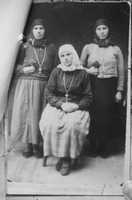 These confiscated photographs come from a 1938 Military Court file from Romanian Bessarabia (today’s Republic of Moldova). On the 25th August 1938, a house search was conducted of the home of Vladimir Draguțan in the village of Recea, county Lăpușna. Amongst the items “used for Inochentist propaganda” discovered at Vlademir’s home were a number of religious booklets, devotional images of Alexandru Culeac, the founder of the movement, and Inochentie of Balta, a number of small crosses and several photographs of the community. The first image shows three women one of whom is named in the case file as Maria Sârbu, who was arrested at the time of the house search; the second image shows two men, one of whom may be Vladimir Draguțan; the third is a group image of what appear to be elders of the community, and the final image is of three of the Culeac brothers, the leaders of networks inspired by Inochentism that emerged in the 1920s following the death of Inochentie of Balta. Vladimir, his father Vasile and Maria Sârbu, were found guilty of Inochentist propaganda on the basis of the evidence gathered during the house search. The two men were both sentenced to six months imprisonment, Maria received a sentence of three months. In the case file, Maria Sîrbu confesses that she had “left her home village ten years previously and had been wandering as a vagabond with Inochentist sectants” ever since. During this period, women in particular are frequently reported as living as travelling preachers or propagandists for the movement, something that the Romanian Gendarmerie and Secret Police struggled to put a stop to. In the safe houses dotted across the Moldovan countryside established by the group, they also devised means to generate income for the community. Vladimir Drăguțan, in whose home Maria Sîrbu was arrested, was found to be making “small crosses from silver, with all the kit necessary for making crosses”; the gendarmes confiscated “three silver coins and five small crosses” and in his statement Vladimir admits to manufacturing them since 1931. The gendarme captain interprets the manufacture of crosses as a means to “cheat believers and sectants and with the sale of the crosses attract them from the Orthodox religion to the Inochentist sect.” In the photographs presented here we can see that all members of the community wore silver crosses very prominently outside their clothing on long chains. From the fairly large corpus of photographs of Archangelists preserved in Military Court and Gendarme files, it is evident that this was a characteristic and distinctive practice of the group. In the absence of Archangelist written testimonies from this period, the materials found in the Military Court files present us with an important record of Archangelist material cultural practices from this time. We can look upon Maria Sîrbu represented in the way she chose to be seen alongside her sisters in faith. In the first image, one of the women is seated – we cannot be sure but this one appears to be Maria as she is the place of honour – while the other two women standing behind her hold wooden crosses in their right hands, the symbol of a martyr in Orthodox iconography and a direct infringement of Orthodox canonical norms regarding visual representations of people who are not saints. Inochentie of Balta, the founder of Inochentism, also frequently appears in photographs in this pose and since his time it has served as visual marker of Inochentist identity. These photographs come from the National Archive of the Republic of Moldova – Military Tribunal of the 3rd Army Corps ANRM-TMC3A 738-1-6846. In addition to the photographs shown here the file contains a further three devotional photographs of Alexandru Culeac and Inochentie of Balta, two pencil sketches and two booklets, one entitled A Vision that appeared in the Year 1920 [O vedenie ce s’a arătat în anul 1920]. 1924. Iaşi: Institutul de Arta Grafice “Versuri şi Proză” and the other, The Lord has Spoken [Dumnezeu a vorbit]. Undated. București: Tipografia “Lupta” N. Stoilă. For related entries see:
 -
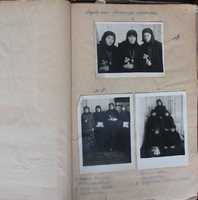 This page from an MGB investigation file from 1947 from Soviet Moldavia shows three images of women preachers from the Archangelist movement, a branch of Inochentism. The first image portrays the women holding crosses in their right hand, facing the camera and cut off at waist height. The composition and symbolism of this image reproduce the visual language of icons. Images of this kind could offend the sensibilities of Orthodox believers. The two lower images carry the same imagery but in a less obvious way. The women are dressed conservatively in dark clothes that are inspired by monastic dress, a common practice among all branches of Inochentism. The role of these photographs, which were found on the persons of the arrested individuals, were used by the secret police to both prove membership of the illegal religious group and to identify further members of the community. In the first image the central figure is identified by name as one of the significant women preachers of the group. In the lower two pictures, in a similar fashion, the secret police highlight certain individuals identified by name. Interrogation stenographs from other cases reveal that these types of images were produced by group members as mementos of group meetings. We do not know the circumstances in which the photographs were taken, but from the setting and the quality we can suppose that the photographer was invited to the community. This type of photographic practice was common and it appears to be important for the Archangelists of this period. The leader of the movement, Alexandru Culeac, produced numerous photographs of himself in large numbers to distribute to his followers. The Archangelist movement grew out of the earlier Inochentist movement in 1920s Bessarabia (present day Republic of Moldova) under Romanian rule and is one of a branches of the movement. It represents a form of local vernacular Orthodoxy drawing heavily on the conservative monastic tradition. When the territory of Bessarabia was (re)occupied by Soviet forces in 1944, Archangelists once again became a target due to their maintenance of values opposed to Soviet policies applied in the countryside. Accusations included resistance to mobilization to army, mass mobilization to work on Sundays, vote in elections, join the Communist Youth Organizations. In the context of collectivization of agriculture and the recent famine in Moldova, Archangelists shared a culture of apocalyptic rumor with many other religious groups in rural Russia and Ukraine. Beside the above-mentioned photographs, the quoted file (ASIS, 019520, vol.2) contains two Archangelist-Inochentist icons, a photograph of an Archangelist hagiographic icon and one brochure. For related entries see:
 -
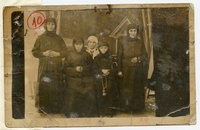 This photograph was confiscated in 1941 by the Siguranța, the Romanian secret police prior to Communism. It depicts four Old Calendarist nuns, also referred to as Stilists. A short handwritten text on the reverse states that it was taken on September 1st, 1939. The nuns are dressed in standard monastic clothes, their heads are covered and their black tunics entirely cover their bodies. In their hands, they hold “metaniere”, Eastern Orthodox prayer ropes. The “metaniera” is an important part of monastic dress and is used during prayer to aid concentration. The composition of the photograph and the screen with painted architectural features tells us that it was taken in a photo studio. Because the dress of Old Calendarist nuns was not distinguishable from those of Orthodox nuns from legally recognised monasteries, the women were able to travel freely without drawing undue attention of the authorities. The photograph was confiscated by the police from two nuns, Steliana Geancu and Anica Măzărel. They were discovered hiding in a hut, in the Pralea Woods, Bacău county. It was added to their penal file but it is unclear to which one of them it originally belonged. A short text on the reverse of the photograph suggests that it was used as a personal memento: “Aminitire, această fotografie este amia, Singlitichia, scoasă la 1 septembrie 1939. Aici este Ma. Chirichoia și Ma. Melania și Sara Iliana și M Singliticia Păcătoasa,” translated as “Memory, This photo is mine, Singlitichia, developed on September 1st 1939. Here are M. Chirichoia, M. Melania and Sara Iliana and M. Singlitichia the Sinner.” Both Steliana Geancu and Anica Măzărel were arrested and tried for Stilist propaganda in 1941. Old Calendarists emerged in 1924 after the introduction of the new calendar by the Orthodox Church. They were a group of Orthodox believers who rejected the newly adopted Gregorian calendar and went on to organize their religious life according to the “old style”, hence the name Stilists. They were condemned by both the Orthodox Church and state authorities which collaborated in identifying and prosecuting them. Often on the basis of local information provided by the Orthodox Church, the state deployed its security agencies, the police, the Gendarmerie and the Siguranța, to prevent Old Calendarist gatherings, arrest their leaders and disrupt the life of the community. In a number of cases, the intervention by the security services resulted in violence and casualties. State security archival sources report that the “Stilist phenomenon” had faded by 1940 and indeed, leading up to 1936, the most important leaders of the group had been arrested. However, the community continued to exist underground. Some began meeting in attics, cellars, or other secluded places, while others fled in the woods, where they hid in caves and huts. In this period the term “vagabond priests and nuns” was used to refer to those Old Calendarist members who wandered from community to community to avoid arrest. The photo image is found in the file CNSAS, P 096704. Together with the photo included in this entry, the police also confiscated Steliana Geancu’s and Anica Măzărel’s personal letters, icons and other objects. Of these, the letters, a handwritten prayer and a list of personal sins are included in the penal file. For further readings see: ”Primejdia stilismului în Basarabia și Moldova” in Universul, No. 52, February 22, 1936. For related entries see: