
Prisoner's letters
Item set
- Title
- Prisoner's letters
- Description
- The letters and postcards that were written to and from detention or prison were often intercepted by the secret police or prison authorities. Such letters represent valuable sources as they enable us to both reconstruct the conditions in the prisons and labour camps as lived by members of various religious groups and also to gain an insight into the intimate details of the personal lives of individuals. Letters sent by detainees and prisoners offer us a very different picture of their authors than the one portrayed of them in police reports, court documents or in the press or police reports. They sometimes reveal the deepest emotions, struggles and thoughts of prisoners. Secret police archival documents contain letters written by both men and women. The letters written by women are particularly valuable as their reflections on how they each understood their calling and reasons for their detention are rarely captured elsewhere.
- Creator
- Iuliana Cindrea
- Publisher
- This project has received funding from the European Research Council (ERC) under the European Union’s Horizon 2020 research and innovation programme No . 677355
- Bibliographic Citation
- Iuliana Cindrea, "Prisoner's letters"
- http://hiddengalleries.eu/digitalarchive/s/en/item-set/281
- Date Created
- 2019
Items
-
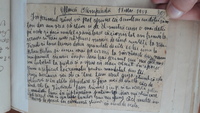 These images show the front and reverse of a postcard that was sent to nun Olimpiada Petreanu by her brother whilst she was incarcerated at Vărzărești Monastery. The postcard is of particular interest as it mentions the difficulties that the families of imprisoned Old Calendarist nuns encountered in their efforts to contact them. The first image shows the front of the postcard and contains references to one of the most important issues that the nuns and their families experienced. One of the constant complaints of the nuns, as well as of their families, was that the postcards, letters and packages often went missing or were delivered late. Olimpiada Petreanu’s brother expresses his concern about the fact that their communication was made difficult by unknown causes: “we sent you many letters but you have not responded since you arrived at Vărzărești [...] we asked at the post office but they said that there was nothing for us, so we made a complaint [...] I don’t know the reason for this, maybe because of the lack of money, but many letters are not sent, they stop them.” Similar concerns are expressed by other nuns’ family members in their letters and this continuous state of confusion seems to have been intentionally maintained by the authorities entrusted with the incarcerated nuns supervision. By controlling every package and letter the nuns and their families received, the authorities hoped to destroy the nuns’ will to resist the religious calendar reform and with it undermine the entire Old Calendarist movement. Moreover, we learn from similar correspondence that the lack of communication triggered a fear of abandonment, of having been forgotten and a struggle to come to terms with a difficult situation. The second image shows the back of the postcard. It contains important information about nun Olimpiada, namely that she had a problem with one of her eyes, as her brother asks her if her eye had healed; from other postcards we learn that she had partially lost sight in her right eye. On the upper edge of the back of the postcard her brother wrote a note asking her about a certain nun Anica and if she had received her packages. This note demonstrates that such events were not isolated and that other Old Calendarist nuns and their families suffered due to the fact that communication was rendered difficult. Written in 1937, this postcard is important proof of the waves of arrests that followed the so-called "rebellions" in Besserabia, in 1936. Many Old Calendarist nuns were sent to detention where they suffered numerous hardships, hunger and cold. Vărzărești Monastery was one of the main places where Old Calendarist nuns were brought and, according to some Old Calendarist literature, they were forced to accept the New Calendar there. The intimate and private lives of the nuns in detention revealed by these postcards contrasts sharply with the way they were portrayed in the press of the time as dangerous and rebels. These images can be found in the file ANIC, Insp. Gen. al Jand., D 23/1937. Apart from this postcard, this file contains many more letters and postcards sent or received by Old Calendarist nuns that were detained at various Orthodox Monasteries. For related entries see:
 -
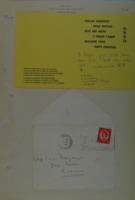 The four images show Amnesty International postcards sent to Dej prison to the Greek Catholic Bishop Ioan Dragomir in 1964. They are selected from a total of 15 winter holiday postcards sent from various places in United Kingdom and Australia to Dej prison. Most of them have standardized typed messages on the Amnesty International cards. The first picture shows the inside of a card and back of an envelope. The card is a standard pre-written Amnesty International card to which the sender added: “I hope you will soon be free. God be with you.” The sender was the secretary of the University College in Cardiff. Most of the cards come with only the pre-written standardized messages and are signed and addressed. This is among the few that include some lines from the sender. The second and third images show the front of two cards. The forth image shows the inside of a card that sparked the special interest of the secret police. The senders’ message reads: “Dear bishop Dragomir, greetings. May the future bring greater light, Yours Faithfully Fred Dykstiva”. However, it was not the hand-written message the Securitate officers were concerned about but the pre-written Amnesty International message at the bottom of the card. “This card is being sent to men and women in various countries held in prison for their beliefs, to show that those who are free to speak and worship as they wish remember those who are not.” The 15 cards arrived at Dej prison in November 1964 several months after Bishop Ioan Dragomir had been released from prison after an amnesty decree that released most of the political prisoners of the regime. However, what triggered the Securitate involvement was the fact that Bishop Dragomir had never been a prisoner of the Dej prison (this was a prison that catered for prisoners arrested and charged for spying for a Western country). Bishop Dragomir was supposed to have been sent to Dej prison since his imprisonment had originally been on charges of espionage for Vatican. However, his past as a member of the Peasant Party ensured instead that he was sent to Galați prison and later to Brăila where he spent the last days of his imprisonment until July 1964. While most of the political prisoners in Dej prison received Amnesty International postcards it was the Ioan Dragomir batch that raised the suspicions of the secret police. The officers raised questions about how the senders had found out that this was the correct address for political prisoners. This mistake in address seemed to indicate that international institutions were privy to the thinking behind the types of prisoners being sent to the various prisons. Moreover, the officers were interested in whether the correspondence between the bishop and these senders continued after his release from prison. Unlike his correspondence after his release that was copied and read by the secret police, these postcards never reached bishop Dragomir. Bishop Dragomir was one of the clandestine Greek Catholic hierarchy that was created by Nuncio Patrick O’Hara following the imprisonment of the bishops of the Greek Catholic Church in 1948 for refusing to sign and acknowledge the forced unification with the Orthodox Church. He was imprisoned for 20 years in 1952 for activities against the social order. He was released in 1964 and returned to his home where he spiritually administered the clandestine communities of Greek Catholics as their bishop. The four images are part of the informative file on Ioan Dragomir CNSAS I3560 volume 2. The informative file has 10 volumes and includes several other evidence photographs, notes from informants, intercepted correspondence, secret police reports on the everyday activity of Ioan Dragomir and the Greek Catholic underground community. For related entries see:
 -
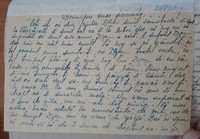 These images show a postcard sent by an Old Calendarist nun to her family whilst in detention. It is a particularly sensitive letter as it conveys the struggles of the nun who appears to have been rejected by her parents for reasons that are not clear from the information we have. The first image shows the face of the postcard and it contains references to the sufferings that the nun had endured for the last two years. From the message that she wrote to her parents, she seems to accuse them of having forgotten about her during these hardships and she reminds them that she is still their daughter and shares the same rights as her other sisters. The reason for her being treated like this by her parents are not described in the postcard but she makes a statement that might hint at it: “ I always cry and pray to God that He won’t abandon you, that you will get to know the good and the bad.” The statement could imply that her parents were religious and disagreed with her decision of becoming a nun or that they might have accepted the New Calendar, thus putting them at odds with her adherence to the Old Calendar. The second image shows the back of the postcard. It contains information that makes it clear that the postcard was sent from Vărzărești Monastery, one of the Orthodox monasteries where Old Calendarist nuns were detained and, according to some Old Calendarist literature, forced to accept the New Calendar. The nun asks her family to come and visit her, she wishes them happy holidays and asks for forgiveness. This postcard offers us a glimpse of the emotions and personal challenges faced by nuns and women who rejected the Orthodox Church calendar reform. This is contrasted by the very different image of Old Calendarist women that was portrayed in the press and Orthodox Church publications of the time. The author of this postcard chose to suffer because of her religious convictions. Although the archives do not preserve a reply to her postcard and we are not aware of her fate, she seems convinced that there is reason to her suffering for her faith. This is a recurrent theme in the letters and postcards written by Old Calendarist women in detention. These images can be found in the file ANIC, Insp. Gen. al Jand., D 25/1937. Apart from this postcard, it contains many more letters and postcards sent or received by Old Calendarist nuns that were detained at various Orthodox Monasteries in Romania. For related entries see:
 -
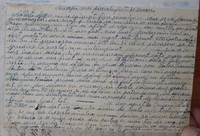 These images show a postcard sent by an Old Calendarist nun to her family in which she describes how she was arrested and sent to an Orthodox Monastery. The postcard was confiscated and attached to a file that contains many such postcards. They all date from approximately same period of time between 1936 and 1937. The first image represents the face of the postcard and includes important details about the fate of the nun. She describes to her family how she was arrested, where she was taken and what the conditions at the Monastery were like. Arrested by the Gendarmes on her way to the post office, the nun was taken from Oniceni (Neamț county) to Ciolanu Monastery (Buzău county), where all her things were confiscated. There were 70 nuns there altogether who were put into four rooms. She had to share a room with 20 other nuns. The second image shows the reverse of the postcard. It offers important information about the regime that the nuns lived under at the Monastery. She asks her parents to write back to her, but carefully, as their letters are first read by someone else implying that she may suffer consequences if the letter contained anything compromising. The image shows how the nun filled the entire postcard writing in order to convey as much information as possible. On the right edge of the back of the postcard she wrote a cramped note asking her family who was still alive in the village. This may have been due to her wish to pray for anyone that was deceased, or it might be a direct hint at the policy of violent repression and arrests that the Old Calendarist church was subjected to on the part of the Gendarmes. Written in 1937, a short time after a series of so-called Stilist "rebellions" in Besserabia, this postcard is proof of the waves of arrests that followed these events, which sometimes included nuns and Old Calendarist women. When caught by the Gendarmes in the woods, or during Silist agitations, women were arrested and most of the time fined or sent to detention in Orthodox Monasteries. Vărzărești Monastery was one of the main places where Old Calendarist nuns were brought and according to some Old Calendarist literature, they were forced to accept the New Calendar there. The intimate and private lives of the nuns in detention revealed by these postcards contrasts sharply with the way they were portrayed in the press of the time as dangerous and rebels. These images can be found in the file ANIC, Insp. Gen. al Jand., D 25/1937. Apart from this postcard, it contains many more letters and postcards sent or received by Old Calendarist nuns that were detained at various Orthodox Monasteries. For related entries see: