
Funerals and dead bodies
Item set
- Title
- Funerals and dead bodies
- Description
- The topic of funerals and dead bodies is complex and wide-ranging. From their political symbolism and importance for religious memorialisation, to ideas such as what constitutes a proper burial, how particular corpses could be targeted and instrumentalist by the secret police and the importance of death rituals and beliefs, the subject touches on many intertwined themes. Even though photographs of family members or religious leaders taken after their death may seem unsettling, their intention could be to make a political statement or to indicate a change in the hierarchy of the religious community. As with any symbol, the dead body becomes effective in moments of system transformations, when the history that created the symbol is modified, drawing attention to the place of tradition in a specific society. Images of the dead bodies of children also constituted a propaganda tool used by the secret police against various religious minorities, such as Inochentists, in an effort to portray them and their rituals as dangerous and immoral.
- Creator
- Iuliana Cindrea
- Publisher
- This project has received funding from the European Research Council (ERC) under the European Union’s Horizon 2020 research and innovation programme No . 677355
- Bibliographic Citation
- Iuliana Cindrea, "Funerals and dead bodies"
- http://hiddengalleries.eu/digitalarchive/s/en/item-set/280
- Date Created
- 2019
Items
-
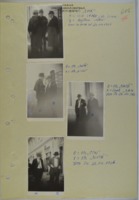 These three pages of photo collages represent three instances in which Greek Catholic Bishop Ioan Dragomir was captured by secret police surveillance shortly after his release from prison in 1966. They all come from Dragomir’s individual file that extends to ten volumes. The first two collages are of photographs taken in stake out operations by Securitate officers from Maramureș county at the request of the central offices of the secret police. The officers had been instructed to map the network of persons Bishop Dragomir had contact with in his daily activities. These images consist of two types of photographs. The first collage is comprised of photographs where the camera (in the hands of the officer) is mobile and follows Bishop Dragomir after leaving his house. This page of images offers a visual story for the textual report submitted by the officer. One can discover by looking at the photographs frame by frame when the bishop leaves the house, who he meets, who he walks and talks with and the places he visits (the Roman Catholic parish house, the Roman Catholic Church, the market, the shop, the restaurant and the train station). The Bishop was in most cases aware of the surveillance and thus he takes all types of precautions to hide his activity from the secret police officers. When the officer was close enough, dialogue was added to the visual material. The persons that the bishop met were one by one tracked down and also placed under surveillance. They are initially known by aliases in the file and gradually, as the officers learn more about the individuals, the file includes more thorough descriptions of their age, workplace and behaviour. The second type of collage is focused on the intimate daily activities of Bishop Dragomir. His family is tracked in their meetings with the “subject” and his visits to family members are recorded. The pictures in this collage present the bishop with his niece Maria Pop. The third collage, part of volume seven of the individual file captures bishop Dragomir’s funeral. The officers photographed the participants, counted them and then placed them under surveillance also. Bishop Dragomir was the oldest of the underground bishops and his funeral was an event for the Greek Catholic Church and thus the secret police followed it closely and recorded even minute details about the attendance and the funeral ceremony. The three photo collages are part of CNSAS file I3560 volumes 2 and 7. Pages of photograph-collages can be found all throughout the 10 volume file along with reports of surveillance, biographies of the persons that belonged to Bishop Dragomir’s network and descriptions of meeting places.
 -
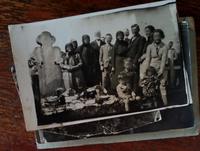 The photograph shows a family from Bessarabia in a cemetery of Chilia Nouă celebrating Paștele Blajinilor (in Romanian) or Radonitsa (in Russian), the day when the Orthodox Christian families commemorate their deceased relatives. Almsgiving has a central place in the commemoration of the dead in Orthodox Christian tradition. It is believed that by offering to each other bread, cookies, fruits, tableware items and drinks, the believers redeem the sins of their deceased relatives, and satiate the dead’s thirst and hunger. This is why the grave in the image is covered with various items that were due to be offered as gifts. Celebrated one week after the Orthodox Easter, Paștele Blajinilor or Radonitsa is a day when the entire family are gathered in the cemetery. This family used this occasion to take a picture, a copy of which was later sent to a relative who could not attend the commemoration and who was arrested by the Soviet secret police in 1940. The photograph was confiscated from a woman arrested when trying to flee from USSR to Bessarabia (at that time part of Romania). The photograph was important for the secret police investigation because it depicted cross-border family networks. The photograph have been attached to the investigation file 595 that is preserved in the archival found R-3401, inventory 1, at the National Archive of the Republic of Moldova. The file contains another 21 family photographs, a birth certificate and a visa issued in 1937 by the Romanian Royal Diplomatic Legacy in Odessa. For related entries see:
 -
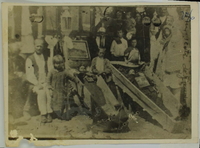 This photograph was taken in 1934 or 1935 in the village of Toporăști in the county of Vaslui. It depicts the funeral of two victims of the Romanian Gendarmerie following an attack on their church in an attempt to arrest the community's priest. The first image shows a few Old Calendarist believers surrounding the coffins of two people, a man and a woman. They seem to have two icons placed on their chests and we can see that three of the children present in the photo have their hands on the coffins, implying that this is their parents' funeral. There is a short note on the right edge of the photo that states: “Shot by the Gendarmes”, suggesting that they were killed during a direct confrontation with the Gendarmes. The second image shows the back of the photo which has a short text describing the event in the photo. The text states as follows: “From the massacre in Toporăști- Vaslui. Mother and father shot by the Gendarmes of the former regime for this belief,” referring to the Old Calendarist belief. It is unclear to whom the photo belonged or how it ended up in the file. The events that happened in Toporăști in 1934 are similar to the events in the village of Cucova, and mark the beginning of a series of confrontations between the Old Calendarists and the Gendarmes. Described as massacres, these attacks were meant to dissipate the Old Calendarist communities in the region. Even though it is not very clear what caused the incident in Toporăști, it seems that the Gendarmes surrounded the church in an attempt to arrest the Old Calendarist priest present there. Based on some archival documents and other sources, 12 Old Calendarists and 4 Gendarmes were wounded and 3 Old Calendarists were killed during the confrontation. In 1936, two years after this event, police reports state that the Stilist movement was no longer active in the region. This image can be found in the file CNSAS, I 1075010, vol. 4. Apart from this photo, the file also contains police reports, lists of names, two more photos and other confiscated items from an Old Calendarist believer. For related entries see: