
Tudorists
Item set
- Title
- Tudorists
- Description
- The Tudorists are a religious group that appeared in the early 1920s in Romania and formed around the figure of Tudor (Teodor) Popescu (1887- 1963), a former Orthodox priest. The initial name of the community was the Scriptural Christians, but they soon became known as the Tudorists, after the founder of the movement. The group was outlawed for much of the interwar period but in 1939 the Tudorists was forced to merge with the legally recognized Evangelical Christians, as the state considered that they shared doctrinal similarities. The Tudorists continued to have a distinct identity inside this larger group and are nowadays known as a second branch of the Evangelical Christians. The Tudorists rejected icons and many aspects of Orthodox tradition and for this reason they were seen as a threat to both the Romanian Orthodox Church and the Romanian state, which in the interwar and wartime periods sought to build a unitary nation state through the promotion of the Orthodox faith and its association with the ethnic Romanian majority. Dumitru Cornilescu, an important member of the Tudorist community and one of Tudor Popescu's closest friends, translated the Bible into the modern Romanian language, between 1920 and 1924. This translation of the Bible is still largely used by various Neo-protestant communities in Romania.
- Creator
- Iuliana Cindrea
- Publisher
- This project has received funding from the European Research Council (ERC) under the European Union’s Horizon 2020 research and innovation programme No . 677355
- Bibliographic Citation
- Iuliana Cindrea, "Tudorists"
- http://hiddengalleries.eu/digitalarchive/s/en/item-set/279
- Date Created
- 2019
Items
-
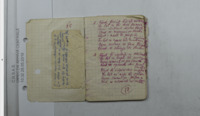 These images show a handwritten songbook that was confiscated from a Tudorist believer during a luggage inspection in 1975 whilst he was doing his military service. The first image shows the inside cover of the songbook, containing a short verse that reads: “And then, the whole eternity will be your prize, Because you were patient and kept yourself pure, For Him, and many hardships you have endured, But you kept yourself white and pure.” We also catch a glimpse of the first verses of a religious song. The following two images show other religious songs that he had handwritten. Because the songs are numbered we learn that there are 49 songs that he had collected and handwritten. The second image shows a song written by Nicolae Moldoveanu, entitled “Remain in Me” (Rămâneți în Mine). The third image represents the continuation of the short verse written on the inside cover. We learn, thus, that the song is called “Beloved Lily” (Crin iubit) and is a song written by Traian Dorz. Both Nicolae Moldoveanu and Traian Dorz were well-known religious figures and members of the Lord’s Army (Oastea Domnului) that suffered imprisonment and persecution during communism. The songs and hymns that they wrote are still valued and highly regarded by various religious communities, including the Tudorists and Neo-protestant communities. The size of the songbook is quite small, suggesting that its owner was trying to keep it secret or hidden. From a report that was composed following the event, as well as from a letter that the Tudorist believer had written, we learn that the songbook was found in one of his pieces of luggage during an inspection. It was confiscated along with a notebook, of which only the covers were attached to his file, as well as other religious books. The Tudorist believer was labelled as a “religious fanatic” and was accused of smuggling religious materials into the army. The fact that all these materials were attached to his file suggests that he was closely monitored by his peers during his military service. This songbook can be found in the file CNSAS, I 0456045. It also contains some personal letters, as well as reports and declarations of the people who were giving information about the Tudorist believer. For related entries see:
 -
 This songbook is located in a police file from 1938 and it appears to have been confiscated from two Tudorist believers, both of whom were women, who were distributing brochures, calendars and other religious literature to various people on the street. The images uploaded are the front cover and the contents page of a 30 pages long book. The first image depicts the cover of the book which has the name “Tudor Popescu”, the founder of the religious group and its title, Christian Songs (Cântări creștinești). The number “47” refers to the total number of songs that are contained in the songbook. The printing press and its location are mentioned at the bottom of the page. The second image depicts the content of the book, i.e. the list of the songs which are included in the book, in alphabetical order. These songs were collected, translated and some of them composed by Dumitru Cornilescu in circa 1921. He was a former Orthodox priest, biblical scholar and translator and religious reformer. He was a close friend of Tudor Popescu. This was the first songbook produced by the Tudorist community and remained the standard song collection for some years until. According to the biography of Dumitru Cornilescu, these songs were first learnt by heart by the members of the community and only later was he able to collect them together and to publish the songbook. The Tudorists appeared in the 1920s’ and formed as a religious group around the figure of Tudor/Teodor Popescu, a former Orthodox priest. The initial name of the community was the Scriptural Christians but they were soon known as the Tudorists, after the name of their founder. For a very long time the group was outlawed, but in 1939, in order to gain officail ecognition, they were compelled to unify with the Brethren (this was the common term used for creștini după evanghelie/ Evangelical Christians) as it was believed that they shared doctrinal similarities. However, they continued to have a distinct identity inside this larger group and are nowadays known as a second branch of the Brethren. The Tudorists rejected icons and important aspects of Orthodox tradition and for this reason they were seen as a threat for both the Orthodox Church and the state. As part of the Hidden Galleries research project, this songbook was later shown to a member of the community who explained its value to the community as this songbook is extremely rare. This songbook can be found in the file CNSAS, I 259046. The file is one of the informative files on Tudor Popescu compiled by the Securitate from Siguranța files. It contains more brochures that were confiscated by the police, some personal letters of Tudor Popescu, as well as declarations and arrest warrants of Tudorist members that were caught by the police distributing religious literature. For further references see: Alexandru Măianu, ”Viața și lucrarea lui Dumitru Cornilescu”, București, 1995. For related entries see: