
Images of religious leaders
Item set
- Title
- Images of religious leaders
- Description
-
The rapid development of photographic technology in the 20th century resulted in new forms of visual expression in religious field. It made the production and reproduction iconographic images more accessible to communities, both large and small, urban and rural, and offered them more creative possibilities. Groups were able to experiment and innovate utilizing new techniques of photographic production which in turn gave birth to new forms of devotional image.
In Central and Eastern Europe, authoritarian regimes (sometimes in cooperation with majority or mainstream churches and denominations) attempted to regulate and control the production of non-sanctioned religious images of leaders who were not recognised by authorised religious institutions. In this context, the image of a religious leader could become a mark of creative resistance by religious groups.
Some groups developed icon-style photographic images of leaders persecuted by the regime reflecting their would-be saintly identity.
Such photographs, that could be mass produced and easily hidden became widespread in some contexts, especially amongst Orthodox dissenting movements.
The widespread use of images of religious leaders meant that they were often found on arrested believers. Such images were useful to the secret police as they could prove membership of illegal or banned groups and allegiance to unauthorised, underground leaders. Police officers could also try to identify the social networks through which the photographs were produced and spread. As a result, secret police investigation and case files contain numerous images of religious leaders found on arrested individuals that were used as evidence during the trials. - Creator
- Dumitru Lisnic
- Publisher
- Hidden Galleries (ERC project no. 677355)
Items
-
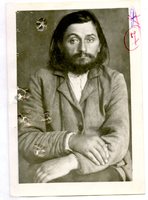
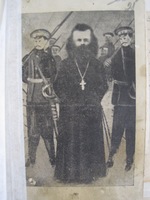
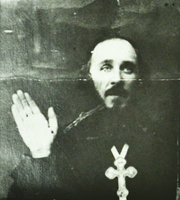 These photographs are of the Catholic monk N. F. Gumenski, who was arrested by the Soviet secret police in 1935. The first image was cropped from a photo icon and in this photograph Gumenski wears a large pectoral cross on his chest and holds his right palm open. The second image is a photo which depicts Gumenski in a white clerical habit with a prayer rope in his left hand and with his right hand holding a cross. These photographs were attached to a Soviet secret police report from 9 November 1935. The report is signed by Nikolai Sharov, the chief of NKVD department of Kiev oblast, and informs the head of Soviet Ukraine’s secret police, Balitsky, about the arrest of a number of religious leaders. The Catholic monk N. F. Guminski was among the arrested and the leader of the religious movement presented in the report as Apocalypsists (Apokalipsisty in Russian). According to the police report, the Apocalypsists preached the impending collapse of the Soviet regime, which they imagined as “the kingdom of the Apocalyptic Beast”. Sharov attached the two photographs to his report in order to prove to his superior the distinctiveness of this religious movement and the special status of Gumenski. The police report to which the photo icons are attached is enclosed in the file 16-1-0032 from State Archive Branch of the Security Services of Ukraine. The file does not contain other images or confiscated texts. For related entries see:
 -
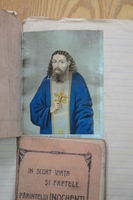 This postcard icon portrays Feodosie Levițchi (Romanian spelling) or Teodosie Levitsky (in Russian) (1791-1845), of Balta (today’s Odessa Oblast, Ukraine). It was confiscated from a Bessarabian peasant in 1938 who had been charged with Inochentist propaganda and sentenced to 45 days imprisonment. Feodosie was an important figure for the Inochentist movement as Inochentie of Balta (1875-1917) was instrumental in sponsoring the cult of his deceased predecessor and distributed mass produced icons (like the one seen here) and miracle stories across Ukraine and Bessarabia to encourage pilgrims to visit for the tomb and then later the monastery of Feodosie Levițchi founded to house his relics. Levițchi was eventually canonised by the Russian Orthodox Church in 2009, over 100 years after the the campaign for his canonisation was first launched. Levițchi was born in the village of Korytna in Podolia, today’s Ukraine. He became a priest in 1815 and was ordained in the Church of Saint Nicholas in Balta. Levițchi soon became known for the power of his improvised preaching and, following the death of his wife in 1818, he dedicated himself to delivering increasingly apocalyptic sermons. He lived as a hermit and spent long hours in prayer, eventually writing a study which he sent to Tsar Alexander I via Alexander Nikolayevich Golytsin, the Tsar’s conservative Education minister. The Tsar enjoyed the work so much that on the 3rd May 1823 Levițchi was invited to Saint Petersburg. Levițchi seems to have had a powerful effect on Golytsin and he became a regular visitor to the priest who was soon presented to the Tsar who was reported to have been “very happy and grateful for his work in the name of God” and gave him permission to continue to spread his teachings. In the summer, he left Saint Petersburg but continued to write to the Tsar. Levițchi’s fame grew but his association with Golytsin, who was accused by powerful enemies of being a Freemason was to be his downfall. Levițchi asked for permission to return to Podolia but his request was denied and he was instead exiled to a monastery on an island on lake Ladoga where he was kept under close supervision. When he was eventually released in 1827 following the death of Alexander and enthronement of Nicholas I, he returned to Balta. There he returned to his old position in the Church of Saint Nicholas. He built a modest hostel there to offer shelter to the poor, orphans and the sick. He died on 9th March 1845. In 1909, under unusual circumstances, Inochentie of Balta, took charge of removing Levițchi’s relics from his family plot to the sanctuary of the new monastery in Balta. From this point forward, the cult of Levițchi grew exponentially under the direction of Inochentie of Balta. For related entries see:
 -
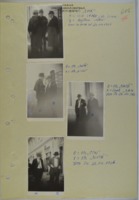 These three pages of photo collages represent three instances in which Greek Catholic Bishop Ioan Dragomir was captured by secret police surveillance shortly after his release from prison in 1966. They all come from Dragomir’s individual file that extends to ten volumes. The first two collages are of photographs taken in stake out operations by Securitate officers from Maramureș county at the request of the central offices of the secret police. The officers had been instructed to map the network of persons Bishop Dragomir had contact with in his daily activities. These images consist of two types of photographs. The first collage is comprised of photographs where the camera (in the hands of the officer) is mobile and follows Bishop Dragomir after leaving his house. This page of images offers a visual story for the textual report submitted by the officer. One can discover by looking at the photographs frame by frame when the bishop leaves the house, who he meets, who he walks and talks with and the places he visits (the Roman Catholic parish house, the Roman Catholic Church, the market, the shop, the restaurant and the train station). The Bishop was in most cases aware of the surveillance and thus he takes all types of precautions to hide his activity from the secret police officers. When the officer was close enough, dialogue was added to the visual material. The persons that the bishop met were one by one tracked down and also placed under surveillance. They are initially known by aliases in the file and gradually, as the officers learn more about the individuals, the file includes more thorough descriptions of their age, workplace and behaviour. The second type of collage is focused on the intimate daily activities of Bishop Dragomir. His family is tracked in their meetings with the “subject” and his visits to family members are recorded. The pictures in this collage present the bishop with his niece Maria Pop. The third collage, part of volume seven of the individual file captures bishop Dragomir’s funeral. The officers photographed the participants, counted them and then placed them under surveillance also. Bishop Dragomir was the oldest of the underground bishops and his funeral was an event for the Greek Catholic Church and thus the secret police followed it closely and recorded even minute details about the attendance and the funeral ceremony. The three photo collages are part of CNSAS file I3560 volumes 2 and 7. Pages of photograph-collages can be found all throughout the 10 volume file along with reports of surveillance, biographies of the persons that belonged to Bishop Dragomir’s network and descriptions of meeting places.
 -
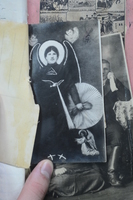 The three images presented here all show variants of the same photo-icon of Alexandru Culeac portrayed as the Archangel Michael. In the first image he appears alone; in the second image, his photograph appears next to that of Inochentie of Balta, and the third image is a reproduction of the photo-icon that appears inside the front cover of a booklet containing Alexandru Culeac's visions entitled "A vision that appeared in 1920". The presence of multiple examples of this photo-icon in the same file reflects the importance of this devotional image to the Archangelist community. Archangelism formed as a branch of Inochentism under the leadership of the Culeac brothers, the most prominent of whom was Alexandru Culeac (b. 1891). He was considered to be the Archangel Michael returned to earth to battle Satan at the End of Days. The Culeac brothers published and distributed their visionary experiences of divine election and the Final Judgement in the form of brochures and continued the tradition started by followers of Inochentie of Balta of using powerful visual materials to communicate their message, commissioning icons and producing photographs to reinforce their special claims. Alexandru Culeac quickly grasped the power of the image to establish his status as mediator between earthly and heavenly realities and in the image shown here we see how techniques of montage and over-painting have been used to create a striking iconization of Alexandru Culeac. In 1924, the photo-icon was printed on the inside cover page of his booklet of prophetic visions entitled "A vision that appeared in 1920" (image three). In the photo-icon, Alexandru Culeac is pictured with a flaming sword, a shield and a dove at his heart, a sign of his dual identity as both the Holy Spirit and Archangel Michael. Later, during the Soviet period, media reports and propaganda publications continued to draw attention to the significance of the production and distribution of religious images for the success of the Archangelist sect, whilst also ridiculing the crudity of their production. In Alexandru Culeac’s confession which was published in 1959 under the title "Repentance of a Sinner", he explains how important the icon that “looked just like me” was for his career, for the Archangelist movement and for the promotion of his divine status: "I decided then to make an icon with my image. I commissioned it from a painter who painted the Day of Judgement and the Ascension of the Archangel Michael, as well as my ascension to heaven. The icon was a success. And the Archangel Michael looked just like me. I declared this icon holy. And it started here. People threw themselves down on their knees in front of the icon. They kissed it and prayed to it to heal them from illness. I don’t know if the icon cured anyone but in exchange we received a handsome income. They brought us cereals, money, carpets and cattle." Intended to portray Alexandru Culeac as a religious charlatan who fooled his followers into making offerings to him, this extract from his confession (which may well have been extracted under duress) nevertheless offers us an insight into the power of the image in the Moldovan vernacular worldview. These photographs come from the National Archive of the Republic of Moldova – Military Tribunal of the 3rd Army Corps ANRM-TMC3A 738-1-6846. In addition to the materials shown here the file contains several photographs of members of the Archangelist community, two pencil sketches and another booklets entitled "The Lord has Spoken [Dumnezeu a vorbit]. Undated. București: Tipografia “Lupta” N. Stoilă. For related entries see:
 -
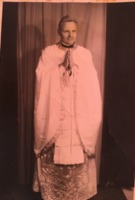 The four images illustrate the religious life of a Greek Catholic community in 1970s Transylvania as recorded by the community in photographs and how it is described by the Securitate on the basis of their surveillance and investigation of the community. These materials represent a rare instance where it has been possible to relate secret police descriptions to photographic materials that can still be found in the community. The first three images come from the private collection of Mihai and Ana Rus and form part of a group of photos related to their regular attendance at religious services in Bishop Todea’s house in Reghin where the bishop had also held their wedding and administered the Baptism and the Confirmation of their children. The Rus family could not pinpoint the exact date when they received the photos nor when they were taken. The fourth image is the first page of a Securitate document dated 23rd January 1971 that describes the situation of the clandestine Greek Catholic community in Reghin, Mureș county, a town near to the Rus family's home village, and the planned measures to be taken against the Greek Catholic community in the area. The first picture from the Rus family collection is a staged photograph of Greek Catholic Bishop Alexandru Todea in the period after his return from prison (1964) when he lived in the town of Reghin in Mureș county. The picture shows Todea in bishop's vestments in a staged, still photograph. His hands are clasped in prayer and is smiling softly towards the camera. The picture was probably taken at his request and served as reminder for the underground community that he ministered spiritually that he was alive and performing his pastoral duties. Moreover, it showed that his church, which had been dismembered by the communist regime in 1948, was still functioning. Descriptions of similar photographic devotional materials appear in Todea’s Securitate Informative file. Secret police agents and informers talk about a distribution network of pictures of Alexandru Todea within the Greek Catholic community. The documents also mention that a monetary value was placed on the photos of 3 lei. However this information was not verified in the interviews the Securitate carried out. The second picture was taken during The Great Entrance stage of the liturgy that was conducted in Alexandru Todea’s house. The picture shows an unidentified Roman Catholic priest dressed in Roman Catholic liturgical vestments holding the chalice (and therefore heading the procession) and a Greek Catholic priest (probably Fr. Augustin Giurgiu) holding the disk (ceremonial plate) with the unconsecrated Holy Body of Christ (the Prosphora). The picture shows that in this particular Byzantine service, the Roman Catholic priest holding the chalice leads the liturgy. The picture also shows a well-attended service with several kneeling women and men. The third picture was taken during a religious service in Bishop Todea’s house in Reghin. It is a snapshot of a detail of the back of the priest dressed in vestments during the Gospel reading. There is a clear image of three church goers, one kneeling holding a candle, probably the acolyte or alter server (or făt in Romanian). The fourth image is the first page of the Securitate's description of the religious life we see depicted in the Rus family's personal collection. At the bottom of the page the document states that Bishop Alexandru Todea (secret police code name Toma Aurel) performed religious services all over the town as well as in his house. Wedding ceremonies also took place in his house. The photographic images come from the private photo collection of Mihai and Ana Rus from Băița village, Mureș county, and were shown to the author during ethnographic fieldwork in August, 2018. The family also described religious life and practices of the community during the period when the photographs were taken. The family photo collection contains several photographs that are described in the secret police files on Bishop Alexandru Todea. The image of the Securitate document is part of the file CNSAS I3470. The Informative file on Bishop Alexandru Todea contains several descriptions of the altar in his house, the religious services performed there and surveillance pictures of people visiting the bishop. For related entries see:
 -
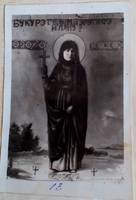 These photographs were confiscated by the secret police of the Moldavian SSR from a community of Archangelists in 1952. Archangelism inherited the iconographic tradition of Eastern Christianity and developed them creatively using modern techniques of photograph, photocopying, collage and multiplication. The first image was produced using the technique of photo collage. The creator of the image has utilised a copy of an Orthodox icon showing a female saint replacing the face of the saint with a photograph of the face of Elena Culiac, venerated by Archangelists as the embodiment of Virgin Mary or the Mother of God as she is more commonly referred to in Orthodox Christianity. She was the wife of Alexandru Culiac, one of the founders of Archangelism who was considered to be the embodiment of the Archangel Michael by the believers. Above the image of Elena Culiac, there is a writing similar to that used on classic orthodox icons that praises her as a saint and as an empress. The other two photographs show two groups of Archangelist women preachers. They are dressed monastic-style robes, holding icons and crosses in a stance similar to those seen in iconographic representations of saints. Archangelism emerged in Bessarabia from mainstream Eastern Orthodox Christianity but one of its distinctive features was the central role that women came to play. Unlike mainstream Christianity where only men can become priests, in Archangelism women hold leadership positions and officiate some religious services. The women had different roles and levels of status inside the community and these hierarchical differences are depicted in their visual representations. Elena Culiac was worshiped as the embodiment of Virgin Mary and she is represented according to sacred iconographic traditions. The first image creates a connection between these older representations of the Virgin Mary and Elena Culiac, encouraging the believer to worship her through this image. The clothes and stance of the women in the second and third photographs, who are shown standing or sitting in distinctive poses, underline their status as preachers. These icon-like images, however, do not gives them the same aura of sanctity associated with Elena Culiac. The small icons held in their hands may be intended to underline this difference. It is unlikely that these photographs fulfilled the same purpose as the photo-icon of Elena Culeac. The women depicted on the second and the third photographs were rather messengers of the embodied saints of the movement. There role was to deliver the word and the icons of the embodied saints to believers. It is no coincidence that three of five icons held by the preachers represent Virgin Mary. The Virgin Mary is the most venerated female saint in Christianity and for Archangelist women the association with her person was the highest mark of respect and status. Not all women in the second and in the third photographs share the same status. According to police records and as the images suggest, one of them held more authority. The women represented seating on the second photograph and sitting on the left side in the third picture held a leadership role in the community. Her status is marked by a special headscarf on the second picture, and by a handkerchief placed on her left lap on the second image. Both the headscarf and the handkerchief are decorated with crosses. On both photographs she is seated on the chair in a central position. These confiscated photographs were used by the police as evidence of the women's involvement in an illegal sect and as a means of identification of other members of the group. Through these photographs the police tried to reconstruct the network of Archangelists in the south of the Moldovan SSR. These photographs are attached to a secret police investigation case file created in 1952. Today the file is preserved under number 3716 at the National Archive of the Republic of Moldova, fond R-3401, inventory 1. It contains a total number of 14 photographs that include one mugshot, one picture showing confiscated religious items produced by the police and 12 confiscated photographs. For related entries see:
 -
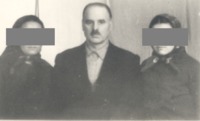 This confiscated photograph was included in a personal file of an Inochentist leader alongside several others collated by the Romanian Securitate. The image shows the male leader flanked by two women from the community. Such group and community photographs feature heavily amongst the corpus of confiscated images in the secret police archives in Romania as for the secret police they were a convenient means of tracing networks and personal relationships of the religious underground. The case file does not state when the images were confiscated but from an Informer Report that appears elsewhere in the personal file we learn that in February 1965 the members of a “sisterhood” of Inochentist women were being investigated by the Securitate because of their links to the leader in the photograph, a “Saint” referred to by his flock as the prophet “Elisha” with the initials C.A. The informer, “Dan Gheorghe” (not his real name), who had either infiltrated the group or been recruited from within it, after a conversation with the “sisters” reported the following: “She [one of the leaders of the group] told me that the militia man [who lived next door to her] got hold of a photograph of her with C. A. and M. and that if she is asked by the militia if she knows C. A., that she won’t say no because the militia have the photograph, but if she is asked about other “brothers” in the group she will say nothing even if they cut her into pieces. I asked her how the photograph reached the militia and she told me that she was photographed together with those I mentioned above, then she sent the photograph to C. A. through the post and in this way the militia had made a copy of the photograph” (CNSAS I 237454, vol. 3, 57.). This short extract from the Informers Report tells us a lot about the biography of this particular photograph revealing how the image was produced by members of the community, how it was shared, how it was intercepted by the secret police and finally how it was transformed into incriminating evidence that could be used to identify members of the underground community. This example serves to illustrate the text/image relationship as the Informers Report engages the photograph as evidence of the meeting with C.A. The image, however, is in stark contrast to the text that describes it; the text incriminates and implicates the image in a conspiratorial narrative, whereas the intention of the producers of the image was to commemorate a significant act of devotion to the group’s spiritual leader, which they preserved despite the risk that the photograph posed to the community. Three copies of a photograph, together with a number of others, appear compiled on a single page of the secret police file and are described as “photographs of the elements [meaning the individuals under surveillance] from the operation of group no. 70.” For related entries see:
 -
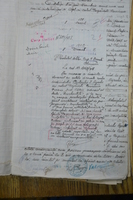 The images show an inventory and confiscated photographs included in a case file forwarded to the Romanian 3rd Army Military Court on 2nd December 1938. The first image shows the inventory of items found in the house, which was located in Fălciu county. The officer lists the following Inochentist "propaganda" materials: "1. A brochure entitled 'The Deeds of the Archangel Michael', 2. a small icon of saint Paraschiva, 3. a cross sculpted from wood, 4. three photographs of Culeac dressed in white with a cross on his chest, 5. a photograph of Culeac dressed in vestments." The second image shows one of the photographs of "Culeac" dressed in white described in the inventory. The third image is the photograph of "Culeac dressed in vestments". The fourth image shows the first page of the brochure 'The Deeds of the Archangel Michael'. The diligent way in which the items were listed and collated by the Romanian Gendarmerie in this case reflects the importance that the Romanian authorities placed on the prevention of the spread of Inochentist "religious propaganda materials" and their important use as evidence in anti-sect trials in this period. On the 21st April 1937, the Ministry of Religions and Arts had issued Ministerial Decision no. 4.781 “Regarding banned sects and religious associations” in which it was stated explicitly that the administrative and police agencies were to stop every form of “propaganda of religious prosleytism, whether this is done verbally, in the form of writing, through brochures and journals etc. by colporteurs, or members of the illegal sect.” The police were also to confiscate all religious materials and send them together with the completed documents to the Ministry of Internal Affairs (Deciziunea 4.781 1937, 3-4). This policy ensured that many Inochentist brochures, photo-icons and photographs were preserved in the case files and penal files of individuals arrested at this time. In the case featured here, the items did not result in a successful prosecution as the accused stated that the materials belonged to his daughter-in-law and that he had no knowledge of their contents or meaning. These images come from the National Archive of the Republic of Moldova – Military Tribunal of the 3rd Army Corps ANRM-TMC3A 738-1-6849. For related entries see
 -
 These mugshots were confiscated in 1952 by the Securitate from Onofrei V. Onofrei, an Old Calendarist monk, who was also the secretary of the Old Calendarist community. The mugshots of Glicherie Tănase, one of the most important Old Calendarist leaders, were taken in 1936, when he was arrested after the first confrontations between the Old Calendarists and the state authorities in Neamț county. He was arrested again, in 1952, and numerous attempts were made by members of the group to set him free. According to the penal file of Onofrei V. Onofrei, described as one of the youngest members of the group and also as a mystical member, he obtained these mugshots from a militiaman, who was working in Neamț county, and managed to make copies of them at a photostudio in the same county. Even though this is a police photograph, it was distributed as a devotional material. Onofrei made 45 copies of the mugshots in an attempt to encourage the community to remember their imprisoned spiritual leader . He went on to distribute 25 of these images to the monks of Slătioara Monastery, the largest Old Calendarist monastery, and to other Old Calendarist members. In this file the police report that they managed to confiscate four copies, two of which were included in this file. However, other copies of the same image can be found in his second penal file, P 0068482. Onofrei's actions were considered dangerous by the state and seen as an attempt to agitate the Old Calendarists against the regime. He was arrested and measures were taken in order for the rest of the copies to be confiscated from all the individuals he had managed to distribute them to. These images can be found in the file CNSAS, P 0022247, which is one of the penal files of Onofrei V. Onofrei. Copies of the same photos can be found in his second penal file, P 0068482. Apart from these two images, the file contains other pieces of evidence against Onofrei V. Onofrei, mostly in the form of declarations taken from people that were approached by him and even from the photographer that helped him replicate the mugshots. For related entries see:
 -
 The images show postcards and mass produced photographs confiscated from a group of arrested Inochentists in February 1942 in the village of Cuibușor, in Romanian-occupied Transnistria. Image 1 and 2 show the front and reverse of a postcard. On the front, the monk Inochentie (1875-1917) is shown in a scene from his vernacular hagiography in which he is under arrest, surrounded by Tsarist soldiers after his attempted to escape from exile on Solovetsky island. The reverse of the postcard, comprises short quotes and adaptations from the New Testament. Here text and image were configured in a relationship designed to establish a parallel between Inochentie’s suffering and the passion of Jesus Christ. The text opens with an abridged and slightly altered version of Jesus’ discourse on the Good Shepherd from John 10: 14-16. In the section of the text that follows, this is taken one stage further with the torments suffered by Inochentie being equated to Christ’s passion. “Behold, the good shepherd whose life was given and is not given back. By his spiritual brothers, chased, cursed, shot [with a gun], insulted, given poison to drink, with hands tied behind his back, put in prison because he revealed the truth, not heeding what the Apostle says: Whoever hates his brother is a murderer, and the murderer will not enter the Kingdom of God (1 John 3: 15).” Image 3 is a photograph-icon of Inochentie that shows him with angels wings and a dove at his heart, a symbol which indicates his association in Inochentist belief with the third person of the Trinity, the Holy Spirit. This type of mass produced photo-postcard image were widely used by Inochentists to spread their message. These were carried from village to village across the Moldovan countryside, easily concealed about their person. There are reports of them being sold on markets from suitcases. Hidden under officially sanctioned religious icons and booklets, they were sold to knowing customers ‘on-request’ for the price of 10 lei. The Holy Synod took very seriously the danger posed by these subversive and heretical images and texts being produced by religious dissenters, not only Inochentists but also Old Calendarists, and passed a ruling in 1936, to be enforced by the Ministry of Internal Affairs through the Gendarmerie, requiring all religious icons, crosses and religious publications to be approved by the Church. Arrests were frequently made on the basis of possession of illegal icons and Inochentists were, by the 1940s, routinely sent to the military courts where they received anything between a small fine to 6 months in a labour camp. The file from which these items come reports the arrest of a group of 41 Inochentists, 9 men and 32 women, in an illegal “prayer house” in the village of Cuibușor. The village was located adjacent to the underground Inochentist complex of Gradina Raiului (the Garden of Paradise) that had been destroyed by the Bolsheviks in 1919/20. The area had recently been occupied by Romania following the Axis invasion of the Soviet Union in June 1941. In the 1942, there were a series of arrests of Inochentists from Bessarabia (which had become part of Greater Romania following the First World War) as they began to gather around their sacred centres of Balta and Gradina Raiului. It was illegal for Bessarabians to travel to the occupied territories without travel papers. The Romanian authorities noted that the rumour of deportation of sectants from Romania to Transnistrian concentration camps alongside Jews and Roma (Gypsies) seemed to have inspired some Inochentists to relocate to the place of origin of their movement. Both the postcard and the groups relocation to their sacred centre are expressions of the apocalyptic expectations of the group that intensified with the start of World War Two. These images come from the National Central Historical Archives of Romania [Archiva Naționale Istorice Centrale – fond. Inspectoratul General al Jandarmeriei (Romania) [Central National Historical Archive – General Inspectorate of the Gendarmerie], dosar. 120/1942, pp. 22-26. Alongside the two items reproduced here, there is a third postcard-icon and a brief description of other religious materials found at the hidden prayer house. For related entries see: