
Confiscated group photographs
Item set
- Title
- Confiscated group photographs
- Description
- Group and community photographs feature heavily amongst the corpus of confiscated images in the secret police archives. Such images were often taken at pilgrimages, religious festivals and special gatherings and were a means for the community to materialise communal memory and present their values and beliefs in distinctive visual form. For the secret police they were an invaluable source of information and a convenient means of tracing networks and personal relationships in the religious underground. Arrested members of groups could be forced to name individuals with to whom they had been photographed. These archives, therefore, represent an important resource for understanding how religious groups chose to represent themselves and how the totalitarian system used images of religious groups in order to identify, trace and incriminate their members. Consequently, photographs of religious groups in the secret police archives have a dual character as both religious justification and incrimination.
- Creator
- James A. Kapaló
- Publisher
- Hidden Galleries (ERC project no. 677355)
- Bibliographic Citation
- James A. Kapaló, "Confiscated group photographs"
- http://hiddengalleries.eu/digitalarchive/s/en/item-set/268
- Date Created
- 2019
Items
-
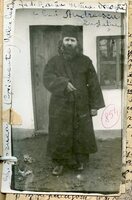 These two photographs were confiscated in 1936 by the police from an Old Calendarist monk, Gheorghe Ștefan Dorneanu, also known as father Grichentie. The first photograph shows Dorneanu dressed in monastic clothes in front of what seems to be a small house or a skete. The left and upper edges of the photograph contain a handwritten text that states: „Gh. Dorneanu (Grichentie) Valea lui Ion jud. Bacău mâna dreaptă a lui Andreescu Eustațiu,” which can be translated as „Gh. Dorneanu (Grichentie) Valea lui Ion, Bacău County, the right hand of Andreescu Eustațiu.” The second photo depicts a group of Old Calendarist believers, and we can see a small hand-drawn cross that was meant to identify Corneanu. Both the small cross and the text were most probably written by the agent that confiscated the photographs from Corneanu’s house when it was searched. In addition to these photos, the agent also confiscated letters that the monk exchanged with numerous other Old Calendarist monks that were being looked for by the police or who have already been imprisoned. One of the monks that frequently wrote to Dorneanu was Eustațiu Andreescu himself. The latter had been arrested in 1936 and sent to Iezeru Monastery from where he wrote letters to Dorneanu in order to encourage him to continue with the construction of the Old Calendarist church in Zănești, Neamț County, and to ask him for help, food, and clothes. In one of the letters, Andreescu disclosed to Dorneanu the place where he had hidden some money, that was also confiscated by the police. Gheorghe Corneanu was accused of conducting illegal church services, as well as spreading false information against the new calendar. He was arrested in 1936 and sent to Cheia Monastery, Prahova County. The Holy Synod of the Romanian Orthodox Church officially decided in October 1936 that the fate of the Old Calendarist nuns and monks was to be sent to detention at isolated sketes, where they were forced to accept the new calendar. One of the monasteries where Old Calendarist nuns were sent in order to correct their behaviour and, presumably, accept the new calendar, was Vărzărești Monastery, while the monks were sent to Cheia or Iezeru Monastery. Based on archival information such monasteries also existed in other places in the country, however, details related to those cases are either insufficient or unavailable to scholars, for the time being. These photgraphs can be found in the file CNSAS, D 015261. Apart from these photos, the file also contains police reports, lists of names, letters, and statements. For related entries see:
 -
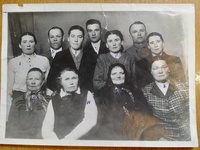 This photograph was enclosed in a KGB surveillance file from 1952-1955 on Jehovah’s Witnesses in the Rivno region, western Ukraine. The image pictures a group of Jehovah’s Witnesses from the Rivno region. It was enclosed in an envelope along with 6 other confiscated or intercepted photographs. Each depicted person was marked with a number and on the reverse side a secret police officer wrote their names, date of birth, information on their origin and place of residence, as well as their role within the Jehovah’s Witness organization, such as: “ordinary member of the underground,” “active Jehovist,” preacher, group elder, or “courier of the Jehovist underground”. Nearly all of them were marked as objects of surveillance as part of the agent operation “Zavet”. Another envelope enclosed copies of intercepted Jehovah’s Witness literature: several booklets and 12 issues of the Watchtower journal. As evidenced from one of the documents, it was an informer under a codename Poliakov (a Jehovah’s Witness recruited by the KGB) who passed the literature to the secret police. From his report we learn that he met a Witness courier named Varvara Senkevich (marked 5 in the photograph) and several other believers in Rivno. Senkevich gave this literature to a believer not knowing that he was a KGB informer. She asked him to distribute the Watchtower journals among brothers and sisters. The agent meeting with Senkevich and her co-believers in Rivno was part of a secret operation “Zavet”, the aim of which was to recruit Witnesses as agents and informers in order to intercept detailed information on the organization’s leadership in western Ukraine, disclose underground printing presses in the region and believers’ communication channels with exiled or imprisoned Jehovah’s Witnesses, as well with those living in other regions or abroad. Senkevich herself was also a potential target for recruitment by the KGB because her role as a Jehovah’s Witness courier could reveal sensitive information on clandestine communication channels within the organization. In the 1950s, the Ukrainian secret police launched several secret operations that targeted Jehovah’s Witness leadership and aimed to disclose Witness clandestine groups and their system of communication. The agent network was believed to be the main weapon in the fight against the religious dissent. There were about 200 agents and informers working in the Witness underground in the mid-1950s in western Ukraine. Most of them were recruited from within the Witness organization, many had tragic experiences with their close families imprisoned or exiled. Some of them had been and would be (after their service with the security police) arrested and tried. All of them were recruited by straightforward blackmail. However, as some historical accounts reveal, Witnesses were aware of agent infiltration and KGB surveillance and knew names of many agents and informers. They were also aware of some secret operations carried out against them. While being shadowed by the secret police, they shadowed KGB officers too. Counter-infiltration was another pattern of their everyday resistance. Some believers intentionally entered the informers’ network or were chosen to become collaborators by their own congregations. Appointed agents delivered partial or less sensitive information in exchange for getting to know KGB plans and operations. Other believers wrote fake denunciations to mislead the secret police. The photograph comes from the SBU archives, fond 2, sprava 2592. The file contains materials on several agent operations amongst Jehovah’s Witnesses in the Rivno region, information on agent recruitment, compromising evidence that could be used as blackmail during recruitment, surveillance reports, and correspondence between KGB branches. For related entries see:
 -
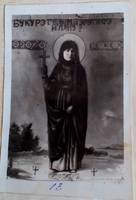 These photographs were confiscated by the secret police of the Moldavian SSR from a community of Archangelists in 1952. Archangelism inherited the iconographic tradition of Eastern Christianity and developed them creatively using modern techniques of photograph, photocopying, collage and multiplication. The first image was produced using the technique of photo collage. The creator of the image has utilised a copy of an Orthodox icon showing a female saint replacing the face of the saint with a photograph of the face of Elena Culiac, venerated by Archangelists as the embodiment of Virgin Mary or the Mother of God as she is more commonly referred to in Orthodox Christianity. She was the wife of Alexandru Culiac, one of the founders of Archangelism who was considered to be the embodiment of the Archangel Michael by the believers. Above the image of Elena Culiac, there is a writing similar to that used on classic orthodox icons that praises her as a saint and as an empress. The other two photographs show two groups of Archangelist women preachers. They are dressed monastic-style robes, holding icons and crosses in a stance similar to those seen in iconographic representations of saints. Archangelism emerged in Bessarabia from mainstream Eastern Orthodox Christianity but one of its distinctive features was the central role that women came to play. Unlike mainstream Christianity where only men can become priests, in Archangelism women hold leadership positions and officiate some religious services. The women had different roles and levels of status inside the community and these hierarchical differences are depicted in their visual representations. Elena Culiac was worshiped as the embodiment of Virgin Mary and she is represented according to sacred iconographic traditions. The first image creates a connection between these older representations of the Virgin Mary and Elena Culiac, encouraging the believer to worship her through this image. The clothes and stance of the women in the second and third photographs, who are shown standing or sitting in distinctive poses, underline their status as preachers. These icon-like images, however, do not gives them the same aura of sanctity associated with Elena Culiac. The small icons held in their hands may be intended to underline this difference. It is unlikely that these photographs fulfilled the same purpose as the photo-icon of Elena Culeac. The women depicted on the second and the third photographs were rather messengers of the embodied saints of the movement. There role was to deliver the word and the icons of the embodied saints to believers. It is no coincidence that three of five icons held by the preachers represent Virgin Mary. The Virgin Mary is the most venerated female saint in Christianity and for Archangelist women the association with her person was the highest mark of respect and status. Not all women in the second and in the third photographs share the same status. According to police records and as the images suggest, one of them held more authority. The women represented seating on the second photograph and sitting on the left side in the third picture held a leadership role in the community. Her status is marked by a special headscarf on the second picture, and by a handkerchief placed on her left lap on the second image. Both the headscarf and the handkerchief are decorated with crosses. On both photographs she is seated on the chair in a central position. These confiscated photographs were used by the police as evidence of the women's involvement in an illegal sect and as a means of identification of other members of the group. Through these photographs the police tried to reconstruct the network of Archangelists in the south of the Moldovan SSR. These photographs are attached to a secret police investigation case file created in 1952. Today the file is preserved under number 3716 at the National Archive of the Republic of Moldova, fond R-3401, inventory 1. It contains a total number of 14 photographs that include one mugshot, one picture showing confiscated religious items produced by the police and 12 confiscated photographs. For related entries see:
 -
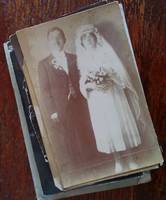 These photographs are part of a family album found on a woman who tried to cross the border between USSR and Romania that was confiscated by the Soviet secret police in 1940. They depict different moments from the life of the family, such as a wedding and a day spent at the seaside in Odessa. The album contains images of members of the family at different ages and of some of the family’s friends. For over a hundred years both banks of Dniester river were part of the Russian Empire until 1918 when Bessarabia united with Romania and the river became frontier between Romania and the Soviet Union. The new border and the hostilities between the Soviet Union and Romania brought numerous changes to the region but did not put an end to the personal ties between the people on the two banks of the river. In the winter of 1940, a woman of Bessarabian origin living in Odessa tried to join her family that lived on the Romanian side of the frontier by crossing the frozen river Dniester. The border was frequently transgressed from both sides by people seeking a better life or escaping repression. The number of illegal crossings from the Soviet side in Romania increased during the famines and during the collectivisation of agriculture. Some of the inhabitants of the villages located close to the river also crossed to visit their relatives across the border or were practiced smuggling. Those wanting to flee from the country were helped by the people living in the border area who knew the best places to cross Dniester. Many were arrested or even killed when trying to cross. The women whose family album was confiscated by the Soviet secret police tried to illegally cross the border with the help of a guide from Nezavertailovca, a village near Tiraspol. They were both arrested and sentenced to five and three years imprisonment respectively. Family albums were of interest to secret police as the the Communist Party’s project of social engineering required extraordinary powers of the state over the citizen, including in his/her family life. The Soviet state was therefore very attentive to kinship relations, which from the regime’s perspective could in certain conditions undermine ones devotion to the state and the party. From the secret police perspective, the arrest of a citizen could lead to the development of anti-soviet sentiments amongst the members of his family or friends, who could then also become involved in different kinds of conspiracies. Collecting family pictures, as well as registering data regarding family networks of those who had been convicted was part of the secret police’s attempt to identify those parts of the society from where anti-Soviet elements were more likely to come. The album shown here was found on a person who had relatives abroad as some of the persons depicted in the photographs lived in Romania. The album therefore could be used to prove the existence of cross-border networks that were perceived as dangerous and from the perspective of the secret police and may also have been used to identify other would be transgressors. Likewise, the family photographs could provide secret police with data regarding the past of the arrested persons. For example, the economic state of the family is reflected in the material items displayed on the photographs, (clothing, housing, the quality of the photographs and the workshops were they were produced). The photography revealed the social status of those depicted on it. Likewise, the photographs allowed the officers to identify places visited by the convicted persons, and to read on their reverse notes about personal impressions, fillings, and attitudes. The abovementioned photographs are part of the file number 595, found R-3401, inventory 1, preserved at the National Archive of the Republic of Moldova. The file contains approximately 20 family photographs belonging to the woman who tried to cross the frontier, her birth certificate and an autorisation to travel to Romania issued in 1937 by Romanian Royal Diplomatic Legation in Odessa. For related entries see:
 -
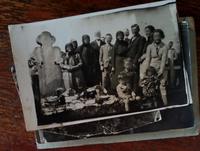 The photograph shows a family from Bessarabia in a cemetery of Chilia Nouă celebrating Paștele Blajinilor (in Romanian) or Radonitsa (in Russian), the day when the Orthodox Christian families commemorate their deceased relatives. Almsgiving has a central place in the commemoration of the dead in Orthodox Christian tradition. It is believed that by offering to each other bread, cookies, fruits, tableware items and drinks, the believers redeem the sins of their deceased relatives, and satiate the dead’s thirst and hunger. This is why the grave in the image is covered with various items that were due to be offered as gifts. Celebrated one week after the Orthodox Easter, Paștele Blajinilor or Radonitsa is a day when the entire family are gathered in the cemetery. This family used this occasion to take a picture, a copy of which was later sent to a relative who could not attend the commemoration and who was arrested by the Soviet secret police in 1940. The photograph was confiscated from a woman arrested when trying to flee from USSR to Bessarabia (at that time part of Romania). The photograph was important for the secret police investigation because it depicted cross-border family networks. The photograph have been attached to the investigation file 595 that is preserved in the archival found R-3401, inventory 1, at the National Archive of the Republic of Moldova. The file contains another 21 family photographs, a birth certificate and a visa issued in 1937 by the Romanian Royal Diplomatic Legacy in Odessa. For related entries see:
 -
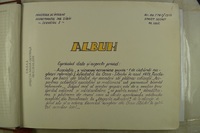 These images come from a photo album compiled by the Securitate on the Hungarian Calvinist Church Choir in the town of Ocna Sibiului (Vízakna), Transylvania. The first image shows the title page of the album with a short introduction to the choir and its supposed activity. In the second image, we can see photos which were most probably taken by the secret police displaying the decorated walls of the choir’s meeting place. The third image includes shots taken in the usual fashion of crime scene photographs of items confiscated from the choir during a secret police raid. The fourth image shows close-ups of confiscated musical scores with Hungarian themes, the national anthem of Hungary amongst them. In 1973, the choir was accused of nurturing nationalist-irredentist ideals behind the façade of their church choir and of being hostile to the socialist Romanian state. The album, which itself is a documentary file containing photos of confiscated documents and images owned by the group or taken by the secret police, was carefully designed to support this claim. It starts with a five and a half page report on the history and activity of the choir stating that the choir’s real aim was to maintain the national identity of the local Hungarian minority and to instil Hungarianess in the next generation. The reporting officer made efforts to portray the choir as a conspiratory group not independent of other equally dubious Hungarian organisations. He claimed that it had negative influence on the discipline of the local community. The album then continues with group photographs of choir members, exterior and interior photos of the group’s meeting room focusing on its Hungarian patriotic decoration, crime scene photos of confiscated materials, selected operative documentation of the choir (minutes of meetings, financial reports, membership lists etc.), its correspondence with past members or other organisations, musical scores and finally, several pages taken from confiscated notebooks written by the choir's former secretary, an elderly man who was an amateur local historian and an avid preserver of memories of the local Hungarian past. The photos are often amended with explanatory captions that give translations of the documents or point to the nationalistic nature of the choir; for example, under the 1971 group photo the officer writes: “the colour of the (previously Hungarian national) flag is now black, the symbol of mourning, and the Hungarian tricolour is carried secretly in the hearts of the members.” From the report we know that after the raid some leading members were interrogated by the secret police and were kept under surveillance afterwards. The choir was allowed to continue with its church related duties but local party leaders were ordered to “pay more attention to the proper education of local Hungarians.” Ethnographic fieldwork revealed that the Securitate’s attack on the choir is still part of the community’s memory and oral history. As several members recalled, the operation on the choir had been drawn up by an ethnic Hungarian officer who befriended the choir’s former secretary. Playing on his Hungarian roots he claimed to be interested in Hungarian historical matters and cajoled the old man to loan his historical writings to him. A couple of days later the Securitate launched a raid on the choir’s meeting place and confiscated most of its documentation and its official stamp. These items, as well as the notebooks taken from the ex-secretary were never returned. Loss of these materials meant the loss of a large part of the choir’s past. Fieldwork with surviving members of the choir has revealed that the community had made efforts to compensate for this loss: some of the notebooks had been rewritten or recreated since. Accusing religious groups with ethnic minority backgrounds of being nationalist or irredentist was common in socialist Romania. As this case shows it was not always religion or religious practice that the authorities were after but the supposed political affiliations of these groups. The Ocna Sibiului Calvinist Church Choir was founded in 1889. From 1907 it officially operated as an association with a president, secretary, accountant and had its own banner and stamp. Its main task was to sing at the funerals of congregation members and at church services, but was also central to community life for local Hungarians. The choir still functions today. The images come from file CNSAS D 015847. For related entries see:
 -
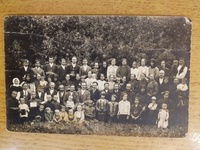 This photograph was confiscated in 1948 by the Soviet secret police from a Romanian peasant repressed as a follower of the Reformed Adventist Church in Chernivtsi oblast (former Northern Bukovina), Ukraine. The photograph was included in his criminal file. It pictures a community of Romanian Adventists who are festively dressed with most of them holding Bibles as a symbol of their faith. Apart from this photograph the police also confiscated a notebook with religious songs handwritten in Romanian language. According to the file, Vasilii Litvan was a poor, illiterate Romanian peasant who lived in the small village of Pripruttia all his life. He was born at the time when Northern Bukovina was part of Romania and he was baptised by a Romanian Adventist missionary in 1924. In 1931, following the teachings of missionaries from Transylvania, he joined the Reformed Adventist movement. Before the annexation of Northern Bukovina by the Soviet Union and during WWII, when Romania temporarily regained Northern Bukovina, Litvan was twice sentenced for his beliefs by the Romanian courts. His third sentence in 1948, was received from a Soviet court. This time he was sentenced to 10 years in a labour camp. As evidenced from the file, the secret police also created a separate criminal case against 17 other of Litvan’s fellow-believers from his village, including his wife. The Reformed Adventist movement, which had split from the Church of the Seventh-Day Adventists, was banned in the Soviet Union. Its followers rigorously followed the sixth commandment “Thou shalt not kill” and therefore refused military service, obligatory in the Soviet Union. They also had specific dietary restrictions and were vegetarians. Most of the repressed Reformed Adventists in the Soviet period were charged for their refusal to serve in the Red Army and for so-called anti-Soviet activity and propaganda. This photograph comes from the Archive of the Security Services of Ukraine in Chernivtsi oblast, spr. 5821-П. Apart from this image, the file contains Vasilii Litvan's arrest form with his mugshot arrest photograph, interrogation reports, the indictment, a confiscated notebook and a document relating to his rehabilitation issued in 1992. For further readings see: Kuromiya, Hiroaki. Conscience on Trial. The Fate of Fourteen Pacifists in Stalin’s Ukraine, 1952-1953. University of Toronto Press, 2012. Lohne, Alf. Adventists in Russia. Washington, DC: Review and Herald Pub. Association, 1987. Parasei A.F. and N.A. Zhukaliuk. Bednaya, brosaemaia bureiu… Istoricheskie ocherki k 110-letnemu iubileiu Tserkvi adventistov sed’mogo dnia v Ukraine. Kiev: “Dzherelo zhittia”, 1997. Sapiets Marite. True Witness: The Story of Seventh-day Adventists in the Soviet Union. Cambridge: Keston Institute, 1990. For related entries see:
 -
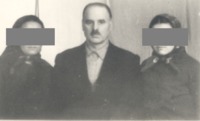 This confiscated photograph was included in a personal file of an Inochentist leader alongside several others collated by the Romanian Securitate. The image shows the male leader flanked by two women from the community. Such group and community photographs feature heavily amongst the corpus of confiscated images in the secret police archives in Romania as for the secret police they were a convenient means of tracing networks and personal relationships of the religious underground. The case file does not state when the images were confiscated but from an Informer Report that appears elsewhere in the personal file we learn that in February 1965 the members of a “sisterhood” of Inochentist women were being investigated by the Securitate because of their links to the leader in the photograph, a “Saint” referred to by his flock as the prophet “Elisha” with the initials C.A. The informer, “Dan Gheorghe” (not his real name), who had either infiltrated the group or been recruited from within it, after a conversation with the “sisters” reported the following: “She [one of the leaders of the group] told me that the militia man [who lived next door to her] got hold of a photograph of her with C. A. and M. and that if she is asked by the militia if she knows C. A., that she won’t say no because the militia have the photograph, but if she is asked about other “brothers” in the group she will say nothing even if they cut her into pieces. I asked her how the photograph reached the militia and she told me that she was photographed together with those I mentioned above, then she sent the photograph to C. A. through the post and in this way the militia had made a copy of the photograph” (CNSAS I 237454, vol. 3, 57.). This short extract from the Informers Report tells us a lot about the biography of this particular photograph revealing how the image was produced by members of the community, how it was shared, how it was intercepted by the secret police and finally how it was transformed into incriminating evidence that could be used to identify members of the underground community. This example serves to illustrate the text/image relationship as the Informers Report engages the photograph as evidence of the meeting with C.A. The image, however, is in stark contrast to the text that describes it; the text incriminates and implicates the image in a conspiratorial narrative, whereas the intention of the producers of the image was to commemorate a significant act of devotion to the group’s spiritual leader, which they preserved despite the risk that the photograph posed to the community. Three copies of a photograph, together with a number of others, appear compiled on a single page of the secret police file and are described as “photographs of the elements [meaning the individuals under surveillance] from the operation of group no. 70.” For related entries see:
 -
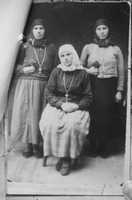 These confiscated photographs come from a 1938 Military Court file from Romanian Bessarabia (today’s Republic of Moldova). On the 25th August 1938, a house search was conducted of the home of Vladimir Draguțan in the village of Recea, county Lăpușna. Amongst the items “used for Inochentist propaganda” discovered at Vlademir’s home were a number of religious booklets, devotional images of Alexandru Culeac, the founder of the movement, and Inochentie of Balta, a number of small crosses and several photographs of the community. The first image shows three women one of whom is named in the case file as Maria Sârbu, who was arrested at the time of the house search; the second image shows two men, one of whom may be Vladimir Draguțan; the third is a group image of what appear to be elders of the community, and the final image is of three of the Culeac brothers, the leaders of networks inspired by Inochentism that emerged in the 1920s following the death of Inochentie of Balta. Vladimir, his father Vasile and Maria Sârbu, were found guilty of Inochentist propaganda on the basis of the evidence gathered during the house search. The two men were both sentenced to six months imprisonment, Maria received a sentence of three months. In the case file, Maria Sîrbu confesses that she had “left her home village ten years previously and had been wandering as a vagabond with Inochentist sectants” ever since. During this period, women in particular are frequently reported as living as travelling preachers or propagandists for the movement, something that the Romanian Gendarmerie and Secret Police struggled to put a stop to. In the safe houses dotted across the Moldovan countryside established by the group, they also devised means to generate income for the community. Vladimir Drăguțan, in whose home Maria Sîrbu was arrested, was found to be making “small crosses from silver, with all the kit necessary for making crosses”; the gendarmes confiscated “three silver coins and five small crosses” and in his statement Vladimir admits to manufacturing them since 1931. The gendarme captain interprets the manufacture of crosses as a means to “cheat believers and sectants and with the sale of the crosses attract them from the Orthodox religion to the Inochentist sect.” In the photographs presented here we can see that all members of the community wore silver crosses very prominently outside their clothing on long chains. From the fairly large corpus of photographs of Archangelists preserved in Military Court and Gendarme files, it is evident that this was a characteristic and distinctive practice of the group. In the absence of Archangelist written testimonies from this period, the materials found in the Military Court files present us with an important record of Archangelist material cultural practices from this time. We can look upon Maria Sîrbu represented in the way she chose to be seen alongside her sisters in faith. In the first image, one of the women is seated – we cannot be sure but this one appears to be Maria as she is the place of honour – while the other two women standing behind her hold wooden crosses in their right hands, the symbol of a martyr in Orthodox iconography and a direct infringement of Orthodox canonical norms regarding visual representations of people who are not saints. Inochentie of Balta, the founder of Inochentism, also frequently appears in photographs in this pose and since his time it has served as visual marker of Inochentist identity. These photographs come from the National Archive of the Republic of Moldova – Military Tribunal of the 3rd Army Corps ANRM-TMC3A 738-1-6846. In addition to the photographs shown here the file contains a further three devotional photographs of Alexandru Culeac and Inochentie of Balta, two pencil sketches and two booklets, one entitled A Vision that appeared in the Year 1920 [O vedenie ce s’a arătat în anul 1920]. 1924. Iaşi: Institutul de Arta Grafice “Versuri şi Proză” and the other, The Lord has Spoken [Dumnezeu a vorbit]. Undated. București: Tipografia “Lupta” N. Stoilă. For related entries see:
 -
 This photograph, reproduced as a postcard, was confiscated by the police in 1936, from Pavel Caras, a former monk, who was wandering the villages in Bessarabia distributing these post cards to people. The photo was taken during the 1930s in Albineț, Bessarabia(today Republic of Moldova), which was one of the most important centres of Old Calendarist activity during the period. It depicts the Old Calendarists from Albineț standing in front of their church which appears to be under construction. The photo contains a small description in the lower right hand corner which states: ”In memory of the Church in Albineț, followers of the old calendar”, without mentioning the specific date or year when the photo was taken. Even though little information is given about its context, there are small details that reveal important aspects about the community and about the event captured in the photo. We can see that one man holds a bucket in his hand, which may contain holy water, that could indicate that the community was celebrating the consecration of their church. Considering the opposition that the Old Calendarists were facing during the 1930s, the priest in the photo might have been a local one, or he might have traveled to Albineț from a nearby village. It was common practice at this time for priests to move from one village to another. These activities were followed closely by the secret police. The composition of the photograph suggests that the members of this Old Calendarist church cooperated with the photographer, as all of them face the camera, while some of them are even smiling, preparing to capture this important event in the life of their small community. Even though this photograph seems to depict a peaceful and relatively small community of Old Calendarist believers, the reality is that Albineț was considered one of the most dangerous places in Bessarabia during the 1930s. The Old Calendarists in the area were deemed rebellious and dangerous, defenders of Nicolae Climovici and Ieremia Pletosu, two of the most important priests, looked for by the Gendarmerie. According to the archival documents, the photo was used by the Old Calendarist church in Albineț as a propaganda tool, in an attempt to draw attention to itself, for which reason they chose Pavel Caras as their main colporteur. These images can be found in the ANIC, Inspectoratul General al Jandarmeriei, D 25/ 1935. Apart from these images, the file also contains declarations, newspaper articles and Gendarmerie reports about the problems caused by the Old Calendarists in Bessarabia. For related entries see:
 -
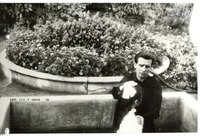 These images were confiscated from an underground Pentecostal community in Budapest-Pesterzsébet in 1972. The first image depicts a baptism where pastor József Németh is baptising a young girl. The second image is a group-picture of pastor József Németh and another five congregants in white who had just been baptised. They are standing with presumably other congregants and family members. The third image depicts pastor József Németh preaching to his congregation in their hidden house church. Prior to confiscation, the photos belonged to pastor József Németh. The photos were taken by a member of the community named in the file. 12 images were confiscated altogether along with several other religious materials by the secret police during a house raid on September 26th, 1972 during a regular Tuesday service. The images were used as incriminating evidence against the leading figures of the community including pastor József Németh himself. József Németh had separated from the officially recognised Evangelical Christian Church (Evangéliumi Keresztény Egyház), which was the recognised Pentecostal organisation, in 1968 after being accused of a series of "misdemeanors" by the Church. Following this, the secret police initiated an investigation on the grounds that the religious group held no official permit to operate. In 1972 the secret police decided to take action and according to the investigation file the following objectives were set out: a) end the illegal religious activity, b) collect evidence for the illegal activity and c) assess the valuables of the illegal community. The main accusation against József Németh and his congregation was the misuse of the right to freedom of association. The secret police used an anonymous note written by a citizen as a pretext (a common practice of the Hungarian secret police) in order to justify a raid on the community. After the house search József Németh and other leading figures in the community were interrogated on several later occasions. Pastor József Németh received a suspended sentence of 3 months. As part of the Hidden Galleries research project, these photos were later shown to the community. From them we know that the hidden house chapel was no longer used following the house raid and due to ongoing surveillance the community dissolved. József Németh only succeeded in planting a new community ten years later in 1982. The new community began to gather again in the same hidden house chapel. However, by this time pastor József Németh had become a member of the officially registered Free Christian Church (Magyarországi Szabadkeresztyén Gyülekezet). We also learned that the girl in the picture is the daughter of the pastor, who was 12 years old at that time, and that the baptism took place in the garden of the hidden house church in a specially constructed font. The confiscated images serve as evidences proving the secret religious activities of the religious group. The photographs come from file ÁBTL 3.1.9. V-160122. Along with the confiscated images the file contains interrogation reports, the trial sentence, 27 crime scene photographs and other confiscated documents including a diary and the community’s cash book. For related entries see:
 -
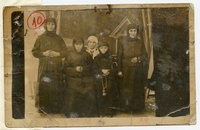 This photograph was confiscated in 1941 by the Siguranța, the Romanian secret police prior to Communism. It depicts four Old Calendarist nuns, also referred to as Stilists. A short handwritten text on the reverse states that it was taken on September 1st, 1939. The nuns are dressed in standard monastic clothes, their heads are covered and their black tunics entirely cover their bodies. In their hands, they hold “metaniere”, Eastern Orthodox prayer ropes. The “metaniera” is an important part of monastic dress and is used during prayer to aid concentration. The composition of the photograph and the screen with painted architectural features tells us that it was taken in a photo studio. Because the dress of Old Calendarist nuns was not distinguishable from those of Orthodox nuns from legally recognised monasteries, the women were able to travel freely without drawing undue attention of the authorities. The photograph was confiscated by the police from two nuns, Steliana Geancu and Anica Măzărel. They were discovered hiding in a hut, in the Pralea Woods, Bacău county. It was added to their penal file but it is unclear to which one of them it originally belonged. A short text on the reverse of the photograph suggests that it was used as a personal memento: “Aminitire, această fotografie este amia, Singlitichia, scoasă la 1 septembrie 1939. Aici este Ma. Chirichoia și Ma. Melania și Sara Iliana și M Singliticia Păcătoasa,” translated as “Memory, This photo is mine, Singlitichia, developed on September 1st 1939. Here are M. Chirichoia, M. Melania and Sara Iliana and M. Singlitichia the Sinner.” Both Steliana Geancu and Anica Măzărel were arrested and tried for Stilist propaganda in 1941. Old Calendarists emerged in 1924 after the introduction of the new calendar by the Orthodox Church. They were a group of Orthodox believers who rejected the newly adopted Gregorian calendar and went on to organize their religious life according to the “old style”, hence the name Stilists. They were condemned by both the Orthodox Church and state authorities which collaborated in identifying and prosecuting them. Often on the basis of local information provided by the Orthodox Church, the state deployed its security agencies, the police, the Gendarmerie and the Siguranța, to prevent Old Calendarist gatherings, arrest their leaders and disrupt the life of the community. In a number of cases, the intervention by the security services resulted in violence and casualties. State security archival sources report that the “Stilist phenomenon” had faded by 1940 and indeed, leading up to 1936, the most important leaders of the group had been arrested. However, the community continued to exist underground. Some began meeting in attics, cellars, or other secluded places, while others fled in the woods, where they hid in caves and huts. In this period the term “vagabond priests and nuns” was used to refer to those Old Calendarist members who wandered from community to community to avoid arrest. The photo image is found in the file CNSAS, P 096704. Together with the photo included in this entry, the police also confiscated Steliana Geancu’s and Anica Măzărel’s personal letters, icons and other objects. Of these, the letters, a handwritten prayer and a list of personal sins are included in the penal file. For further readings see: ”Primejdia stilismului în Basarabia și Moldova” in Universul, No. 52, February 22, 1936. For related entries see: