
Church of the Turan Believers of One God
Item set
- Title
- Church of the Turan Believers of One God
- Description
- The Church of the Turan Believers of One God was a radically nationalist, racist, anti-Christian and anti-western movement founded in the 1930’s. Its theoreticians wanted to return to a form of “true Hungarian religion” which built on the ancient, pre-Christian veneration of natural laws, but also fitted with the rationalistic thinking of contemporary society. They believed in the cultural and moral supremacy of the Turanian people and their resurgence to world leadership. For Hungarians to occupy a leading role among Turanian nations, they believed it necessary to “revert” people from Christianity to their “original” religion. Although the number of followers is estimated to be rather low (some hundred people), the interwar authorities categorised them as a sect and made efforts to control them due to their very vocal opposition to mainstream Christianity and the ruling regime.
- Creator
- Agnes Hesz
- Publisher
- Hidden Galleries (ERC project no. 677355)
Items
-
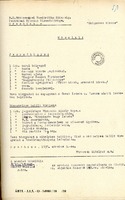 The image shows a typewritten copy of a list of confiscated items that were taken from the home and workshop of Mihály Virasztó during a house search on 5 March 1957. He was a former member and táltos (ritual specialist) of the Church of the Turan Believers of One God. The list contains several items that are directly linked to the group: a “turan stamp”, a “turul” stamp (turul is a mythological bird used as a national symbol in modern Hungary), a book of ceremony, a book written by the groups founder, Zoltán Bencsi, and various copies of “Turanist journals”, possibly referring to the radical Turáni Roham (Turan Attack) published between 1934 and 1939. Beside these, the secret police also expropriated a book on Hungarian history, a Hungarian travel atlas, a hand-drawn map, legal documents, photos, a poem, and two dossiers, one containing newspapers and the other private letters. The list comes from Virasztó’s surveillance file, which was opened in 1968 but contained various documents and informant reports from before this time. From these we learn that Virasztó was arrested on 12 March 1957, seven days after the house search, for the illegal possession of a firearm. It is interesting to note, however, that no weapons were mentioned in the list of confiscated items above, which suggests that another house search may have been conducted at the time of the arrest. The authorities’ action in 1957 was a result of his supposed activity in the 1956 Hungarian Revolution and his former involvement with the Church of the Turan Believers of One God. According to a summary report written before the house search on 26 February 1957, Virasztó had reorganised the Turan Believers after 1945, and had been hosting their meetings in his home and corresponding with other similar organisations. As the report claims his group was active in 1956, spreading rumours before the October events, and producing and disseminating anti-communist leaflets during the revolution. They also called for strikes. The report also briefly introduces the Church of Turan Believers characterising it as nationalist, chauvinist and racist. It even gives a short description of their initiation rites: “new members were anointed with jam. This procedure was formerly effected with blood; the Catholic Church has condemned this ritual as different from the usual ceremony of Christian baptism and launched a counter attack on the “Turanian” organisations.” Following the incident Virasztó was interned for 15 months, although the authorities could not prove his ownership of the weapon found. Mihály Virasztó had a long police record in both regimes before and after 1945. As a priest (táltos) and missionary of the Church of the Turan Believers of One God he was repeatedly condemned to prison at the end of the 1930’s for „agitation against religious denominations”. He remained on the radar of authorities in the communist regime for his anti-communist political views and activity, his relationships with right-wing figures abroad, and also for his past and supposedly present involvement with the Church of Turan Believers of One God. He had several clashes with the authorities: apart from his 1957 case, he was imprisoned for two months in 1952 for slander, and his mental health was investigated and he was sent to a mental hospital in 1964 and 1967. After his last release in the summer of 1968, he was placed under the guardianship of his wife. His file was closed in 1972. This image comes from the file ÁBTL 3.1.5 O-14980/18, which also includes confiscated personal letters and photographs, issues of Keleti Figyelő (The Orient Observer), two poems written by Virasztó, medical reports, interrogation minutes, and informant reports. For more on Virasztó and the Turan Believers of One God see: Ablonczy Balázs 2016 Keletre Magyar! A magyar turanizmus története. Budapest, Jaffa Kiadó. Fazekas Csaba 1996 Kisegyházak és szektakérdés a Horthy-korszakban. Budapest, TEDISZ–SzPA. Szécsényi Mihály 2013 Virrasztó Koppány és társai. A Turáni Egyistenhívők és a hatalom az 1930-as évek második felében. In Lukács Anikó (szerk.): Rendi társadalom – polgári társadalom 25. Budapest, Hajnal István Kör, 349–362. For related entries see:
 -
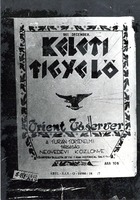 These images have been selected from the photo-documentation of materials sent by post to Mihály Virasztó, a former religious specialist of the Church of the Turan Believers of One God. The first photo shows the cover page of the Keleti Figyelő [Orient Observer], the short-lived journal of the Turáni Történelmi Társaság [Turan Historical Society] founded by immigrant Hungarians in Melbourne, Australia. The second photo shows a certificate of honorary membership of Mihály Virasztó for supporting the study of Hungarian history, issued by the same society in 1962. The images come from a documentary file on Virasztó. The case of the Orient Observer is illustrative of the performative power of certain objects and of the responsive mechanisms of the secret police. By the time of the journal’s arrival in February 1962, Mihály Virasztó had been under surveillance for years, after being classified as dangerous due to his openly anti-communist stance, involvement in 1956, relations with right-wing emigrants, and his past as the priest and activist of the Turan Believers of One God. The arrival of the issues and the certificate was reported by an informant working on Virasztó in July 1962, only four months after the local county division of the secret police had claimed in a report that the Church of the Turan Believers of One God was practically non-existent in the region. Along with Virasztó’s correspondence with other Hungarian right wing emigrants and his involvement in a case of anonymous anti-collectivization letters, the package set the machinery of the secret police in motion. The local branch of the secret police made excessive efforts to get hold of the issues: they asked for photocopies from the Budapest headquarters, while also drawing up a plan to get Virasztó’s own copies. The police also mobilized its network of informants to find out if Virasztó was disseminating the issues, and instructed them to collect more information on the Turan Believers of One God as well. In September 1962, the Budapest headquater sent the copies of the certificate and selected pages of the journal, with a short note that according to their examinations, the articles focused on "the origins and development of various languages”. To decide whether the journal’s content was "hostile”, the local secret police attained Virasztó’s copies in March 1963 through a local informant, who managed to borrow them from him for a couple of days. The Orient Observer was also featured in Virasztó’s two penal files from 1964 and 1966. From these and from other informant reports we know that he had given the issues to several people, the director of the local museum being among them. We also learn from these files that during a house search at his home in 1964 the secret police was looking for the issues but could not find them. The Observer came to the forefront again in 1966, at the time of Virasztó’s last penal case, with the secret police planning a complex operation for its confiscation. This time their aim was to produce evidence that Virasztó was circulating materials hostile to the regime. The Orient Observer was founded in 1960 and had only two volumes and four numbers during its existence. Printed on a small offset printing machine and having hand-drawn illustrations, it claimed to be scientific and focused mainly on the origins of the Hungarian people. Using linguistic and historical argumentation that would not stand up to modern academic scrutiny, the journal argued for the relatedness of Hungarians to various past and present Asiatic peoples. Although the articles were not openly political, the issues contained some negative references to communism and the Soviet Union here and there. One of these, a sentence on the fatal consequences of Soviet dominance for the future of the Hungarian nation, was picked out by the secret police as proof of Virasztó possessing and circulating anti-communist contents. Mihály Virasztó had a long police record in both regimes before and after 1945. As a priest (táltos) and missionary of the Church of the Turan Believers of One God he was repeatedly condemned to prison at the end of the 1930’s for "agitation against religious denominations”. He remained on the radar of authorities in the communist regime for his anti-communist political views and activity, his relationships with right-wing figures abroad, and also for his past and supposedly present involvement with the Church of Turan Believers of One God. He had several clashes with the authorities: he was imprisoned for two month in 1952 for slander, detained for possessions of arms in 1957, a charge that was later dropped, his mental health was investigated and he was sent to a mental hospital in 1964 and 1967. After his last release in the summer of 1968, he was placed under the guardianship of his wife. His file was closed in 1972. These images come from file ÁBTL 3.1.5 O-14980/18. The file also includes confiscated personal letters and photographs, two poems written by Virasztó, lists of confiscated items, medical reports, interrogation minutes, and informant reports. For further entries on Virasztó and the Church of Turan Believers of One God see: