
Archangelism
Item set
- Title
- Archangelism
- Description
-
The Archangelist movement grew out of the earlier Inochentist movement in 1920s Bessarabia (present day Republic of Moldova) under Romanian rule and is one of the main surviving branches of the movement. It represents a form of local vernacular Orthodoxy drawing heavily on the conservative monastic tradition. Formed around a family of brothers, most prominent of whom was Alexandru Culeac (b. 1891), the movement venerated its leaders as various heavenly or saintly persons returned to earth to battle Satan at the End of Days. Alexandru Culiac was venerated as the Archangel Michael on earth, which is how the name of the movement originates.
Achangelism was viewed by both the Romanian and Soviet regimes as a more extreme and more dangerous iteration of Inochentism. This was partly due to its rejection of civic duties and eschewal of public life, its intensely apocalyptic vision and its extremely secretive nature which included the widespread use of underground chapels and subterranean hiding places. - Creator
- James Kapaló and Dumitru Lisnic
- Publisher
- Hidden Galleries (ERC project no. 677355)
- Bibliographic Citation
- James A. Kapaló & Dumitru Lisnic, "Archangelism"
- http://hiddengalleries.eu/digitalarchive/s/en/item-set/255
- Date Created
- 2019
Items
-
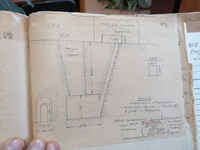 The image contains the sketch of the underground shelter built by Archangelist leaders, Alexandru and Grigore Culiac, and by their followers in Vadul-Leca village, Moldova. The sketch was produced by the Soviet state security service in 1945 after a police raid of the Archangelist community on the 3rd of February. The sketch contains technical details regarding the dimensions of the underground space and about the hiding techniques used by Archangelists to protect their leaders. The shelter was built four meters deep under an orchard, and its entrance was hidden by a shed. The underground space was 1.75 meters high, 2.5 meters long and had two airways. From the 1920s the Archangelists developed the technique of building hidden underground spaces being forced to hide their religious life firstly from the Romanian authorities who persecuted them through interwar decades and latter, after the region was occupied by the USSR in 1944, from Soviet regime whose secret police and propaganda apparatus launched systematic campaigns aimed at eliminating this religious movement. The sketch is enclosed in file R-3401-2-4934 from the National Archive of the Republic of Moldova. For related entries see:
 -
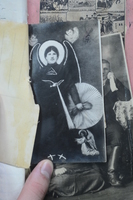 The three images presented here all show variants of the same photo-icon of Alexandru Culeac portrayed as the Archangel Michael. In the first image he appears alone; in the second image, his photograph appears next to that of Inochentie of Balta, and the third image is a reproduction of the photo-icon that appears inside the front cover of a booklet containing Alexandru Culeac's visions entitled "A vision that appeared in 1920". The presence of multiple examples of this photo-icon in the same file reflects the importance of this devotional image to the Archangelist community. Archangelism formed as a branch of Inochentism under the leadership of the Culeac brothers, the most prominent of whom was Alexandru Culeac (b. 1891). He was considered to be the Archangel Michael returned to earth to battle Satan at the End of Days. The Culeac brothers published and distributed their visionary experiences of divine election and the Final Judgement in the form of brochures and continued the tradition started by followers of Inochentie of Balta of using powerful visual materials to communicate their message, commissioning icons and producing photographs to reinforce their special claims. Alexandru Culeac quickly grasped the power of the image to establish his status as mediator between earthly and heavenly realities and in the image shown here we see how techniques of montage and over-painting have been used to create a striking iconization of Alexandru Culeac. In 1924, the photo-icon was printed on the inside cover page of his booklet of prophetic visions entitled "A vision that appeared in 1920" (image three). In the photo-icon, Alexandru Culeac is pictured with a flaming sword, a shield and a dove at his heart, a sign of his dual identity as both the Holy Spirit and Archangel Michael. Later, during the Soviet period, media reports and propaganda publications continued to draw attention to the significance of the production and distribution of religious images for the success of the Archangelist sect, whilst also ridiculing the crudity of their production. In Alexandru Culeac’s confession which was published in 1959 under the title "Repentance of a Sinner", he explains how important the icon that “looked just like me” was for his career, for the Archangelist movement and for the promotion of his divine status: "I decided then to make an icon with my image. I commissioned it from a painter who painted the Day of Judgement and the Ascension of the Archangel Michael, as well as my ascension to heaven. The icon was a success. And the Archangel Michael looked just like me. I declared this icon holy. And it started here. People threw themselves down on their knees in front of the icon. They kissed it and prayed to it to heal them from illness. I don’t know if the icon cured anyone but in exchange we received a handsome income. They brought us cereals, money, carpets and cattle." Intended to portray Alexandru Culeac as a religious charlatan who fooled his followers into making offerings to him, this extract from his confession (which may well have been extracted under duress) nevertheless offers us an insight into the power of the image in the Moldovan vernacular worldview. These photographs come from the National Archive of the Republic of Moldova – Military Tribunal of the 3rd Army Corps ANRM-TMC3A 738-1-6846. In addition to the materials shown here the file contains several photographs of members of the Archangelist community, two pencil sketches and another booklets entitled "The Lord has Spoken [Dumnezeu a vorbit]. Undated. București: Tipografia “Lupta” N. Stoilă. For related entries see:
 -
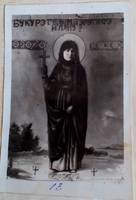 These photographs were confiscated by the secret police of the Moldavian SSR from a community of Archangelists in 1952. Archangelism inherited the iconographic tradition of Eastern Christianity and developed them creatively using modern techniques of photograph, photocopying, collage and multiplication. The first image was produced using the technique of photo collage. The creator of the image has utilised a copy of an Orthodox icon showing a female saint replacing the face of the saint with a photograph of the face of Elena Culiac, venerated by Archangelists as the embodiment of Virgin Mary or the Mother of God as she is more commonly referred to in Orthodox Christianity. She was the wife of Alexandru Culiac, one of the founders of Archangelism who was considered to be the embodiment of the Archangel Michael by the believers. Above the image of Elena Culiac, there is a writing similar to that used on classic orthodox icons that praises her as a saint and as an empress. The other two photographs show two groups of Archangelist women preachers. They are dressed monastic-style robes, holding icons and crosses in a stance similar to those seen in iconographic representations of saints. Archangelism emerged in Bessarabia from mainstream Eastern Orthodox Christianity but one of its distinctive features was the central role that women came to play. Unlike mainstream Christianity where only men can become priests, in Archangelism women hold leadership positions and officiate some religious services. The women had different roles and levels of status inside the community and these hierarchical differences are depicted in their visual representations. Elena Culiac was worshiped as the embodiment of Virgin Mary and she is represented according to sacred iconographic traditions. The first image creates a connection between these older representations of the Virgin Mary and Elena Culiac, encouraging the believer to worship her through this image. The clothes and stance of the women in the second and third photographs, who are shown standing or sitting in distinctive poses, underline their status as preachers. These icon-like images, however, do not gives them the same aura of sanctity associated with Elena Culiac. The small icons held in their hands may be intended to underline this difference. It is unlikely that these photographs fulfilled the same purpose as the photo-icon of Elena Culeac. The women depicted on the second and the third photographs were rather messengers of the embodied saints of the movement. There role was to deliver the word and the icons of the embodied saints to believers. It is no coincidence that three of five icons held by the preachers represent Virgin Mary. The Virgin Mary is the most venerated female saint in Christianity and for Archangelist women the association with her person was the highest mark of respect and status. Not all women in the second and in the third photographs share the same status. According to police records and as the images suggest, one of them held more authority. The women represented seating on the second photograph and sitting on the left side in the third picture held a leadership role in the community. Her status is marked by a special headscarf on the second picture, and by a handkerchief placed on her left lap on the second image. Both the headscarf and the handkerchief are decorated with crosses. On both photographs she is seated on the chair in a central position. These confiscated photographs were used by the police as evidence of the women's involvement in an illegal sect and as a means of identification of other members of the group. Through these photographs the police tried to reconstruct the network of Archangelists in the south of the Moldovan SSR. These photographs are attached to a secret police investigation case file created in 1952. Today the file is preserved under number 3716 at the National Archive of the Republic of Moldova, fond R-3401, inventory 1. It contains a total number of 14 photographs that include one mugshot, one picture showing confiscated religious items produced by the police and 12 confiscated photographs. For related entries see:
 -
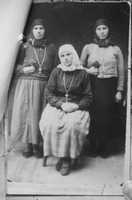 These confiscated photographs come from a 1938 Military Court file from Romanian Bessarabia (today’s Republic of Moldova). On the 25th August 1938, a house search was conducted of the home of Vladimir Draguțan in the village of Recea, county Lăpușna. Amongst the items “used for Inochentist propaganda” discovered at Vlademir’s home were a number of religious booklets, devotional images of Alexandru Culeac, the founder of the movement, and Inochentie of Balta, a number of small crosses and several photographs of the community. The first image shows three women one of whom is named in the case file as Maria Sârbu, who was arrested at the time of the house search; the second image shows two men, one of whom may be Vladimir Draguțan; the third is a group image of what appear to be elders of the community, and the final image is of three of the Culeac brothers, the leaders of networks inspired by Inochentism that emerged in the 1920s following the death of Inochentie of Balta. Vladimir, his father Vasile and Maria Sârbu, were found guilty of Inochentist propaganda on the basis of the evidence gathered during the house search. The two men were both sentenced to six months imprisonment, Maria received a sentence of three months. In the case file, Maria Sîrbu confesses that she had “left her home village ten years previously and had been wandering as a vagabond with Inochentist sectants” ever since. During this period, women in particular are frequently reported as living as travelling preachers or propagandists for the movement, something that the Romanian Gendarmerie and Secret Police struggled to put a stop to. In the safe houses dotted across the Moldovan countryside established by the group, they also devised means to generate income for the community. Vladimir Drăguțan, in whose home Maria Sîrbu was arrested, was found to be making “small crosses from silver, with all the kit necessary for making crosses”; the gendarmes confiscated “three silver coins and five small crosses” and in his statement Vladimir admits to manufacturing them since 1931. The gendarme captain interprets the manufacture of crosses as a means to “cheat believers and sectants and with the sale of the crosses attract them from the Orthodox religion to the Inochentist sect.” In the photographs presented here we can see that all members of the community wore silver crosses very prominently outside their clothing on long chains. From the fairly large corpus of photographs of Archangelists preserved in Military Court and Gendarme files, it is evident that this was a characteristic and distinctive practice of the group. In the absence of Archangelist written testimonies from this period, the materials found in the Military Court files present us with an important record of Archangelist material cultural practices from this time. We can look upon Maria Sîrbu represented in the way she chose to be seen alongside her sisters in faith. In the first image, one of the women is seated – we cannot be sure but this one appears to be Maria as she is the place of honour – while the other two women standing behind her hold wooden crosses in their right hands, the symbol of a martyr in Orthodox iconography and a direct infringement of Orthodox canonical norms regarding visual representations of people who are not saints. Inochentie of Balta, the founder of Inochentism, also frequently appears in photographs in this pose and since his time it has served as visual marker of Inochentist identity. These photographs come from the National Archive of the Republic of Moldova – Military Tribunal of the 3rd Army Corps ANRM-TMC3A 738-1-6846. In addition to the photographs shown here the file contains a further three devotional photographs of Alexandru Culeac and Inochentie of Balta, two pencil sketches and two booklets, one entitled A Vision that appeared in the Year 1920 [O vedenie ce s’a arătat în anul 1920]. 1924. Iaşi: Institutul de Arta Grafice “Versuri şi Proză” and the other, The Lord has Spoken [Dumnezeu a vorbit]. Undated. București: Tipografia “Lupta” N. Stoilă. For related entries see:
 -
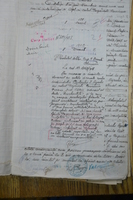 The images show an inventory and confiscated photographs included in a case file forwarded to the Romanian 3rd Army Military Court on 2nd December 1938. The first image shows the inventory of items found in the house, which was located in Fălciu county. The officer lists the following Inochentist "propaganda" materials: "1. A brochure entitled 'The Deeds of the Archangel Michael', 2. a small icon of saint Paraschiva, 3. a cross sculpted from wood, 4. three photographs of Culeac dressed in white with a cross on his chest, 5. a photograph of Culeac dressed in vestments." The second image shows one of the photographs of "Culeac" dressed in white described in the inventory. The third image is the photograph of "Culeac dressed in vestments". The fourth image shows the first page of the brochure 'The Deeds of the Archangel Michael'. The diligent way in which the items were listed and collated by the Romanian Gendarmerie in this case reflects the importance that the Romanian authorities placed on the prevention of the spread of Inochentist "religious propaganda materials" and their important use as evidence in anti-sect trials in this period. On the 21st April 1937, the Ministry of Religions and Arts had issued Ministerial Decision no. 4.781 “Regarding banned sects and religious associations” in which it was stated explicitly that the administrative and police agencies were to stop every form of “propaganda of religious prosleytism, whether this is done verbally, in the form of writing, through brochures and journals etc. by colporteurs, or members of the illegal sect.” The police were also to confiscate all religious materials and send them together with the completed documents to the Ministry of Internal Affairs (Deciziunea 4.781 1937, 3-4). This policy ensured that many Inochentist brochures, photo-icons and photographs were preserved in the case files and penal files of individuals arrested at this time. In the case featured here, the items did not result in a successful prosecution as the accused stated that the materials belonged to his daughter-in-law and that he had no knowledge of their contents or meaning. These images come from the National Archive of the Republic of Moldova – Military Tribunal of the 3rd Army Corps ANRM-TMC3A 738-1-6849. For related entries see
 -
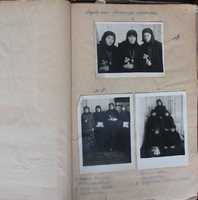 This page from an MGB investigation file from 1947 from Soviet Moldavia shows three images of women preachers from the Archangelist movement, a branch of Inochentism. The first image portrays the women holding crosses in their right hand, facing the camera and cut off at waist height. The composition and symbolism of this image reproduce the visual language of icons. Images of this kind could offend the sensibilities of Orthodox believers. The two lower images carry the same imagery but in a less obvious way. The women are dressed conservatively in dark clothes that are inspired by monastic dress, a common practice among all branches of Inochentism. The role of these photographs, which were found on the persons of the arrested individuals, were used by the secret police to both prove membership of the illegal religious group and to identify further members of the community. In the first image the central figure is identified by name as one of the significant women preachers of the group. In the lower two pictures, in a similar fashion, the secret police highlight certain individuals identified by name. Interrogation stenographs from other cases reveal that these types of images were produced by group members as mementos of group meetings. We do not know the circumstances in which the photographs were taken, but from the setting and the quality we can suppose that the photographer was invited to the community. This type of photographic practice was common and it appears to be important for the Archangelists of this period. The leader of the movement, Alexandru Culeac, produced numerous photographs of himself in large numbers to distribute to his followers. The Archangelist movement grew out of the earlier Inochentist movement in 1920s Bessarabia (present day Republic of Moldova) under Romanian rule and is one of a branches of the movement. It represents a form of local vernacular Orthodoxy drawing heavily on the conservative monastic tradition. When the territory of Bessarabia was (re)occupied by Soviet forces in 1944, Archangelists once again became a target due to their maintenance of values opposed to Soviet policies applied in the countryside. Accusations included resistance to mobilization to army, mass mobilization to work on Sundays, vote in elections, join the Communist Youth Organizations. In the context of collectivization of agriculture and the recent famine in Moldova, Archangelists shared a culture of apocalyptic rumor with many other religious groups in rural Russia and Ukraine. Beside the above-mentioned photographs, the quoted file (ASIS, 019520, vol.2) contains two Archangelist-Inochentist icons, a photograph of an Archangelist hagiographic icon and one brochure. For related entries see:
 -
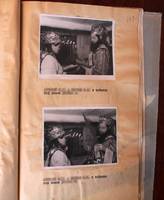 This photograph which was taken by Soviet secret police officers appears to capture a ritual performed by Archangelists (a branch of the Inochentist movement) in one of their underground chapels. On closer inspection, however, it is evident that this is not a surveillance photograph but rather a staged reenactment performed for the camera. The framing, camera angle, lighting and mood of the photograph were all determined by the secret police photographer with the intention of creating a powerful image for use by the regime. Indeed, the two Archangelists, shown wearing ritual clothing and holding sacred objects, may not be performing a genuine ritual at all. The images from this secret police photo shoot, which later appeared in Moldovan newspapers alongside a dramatized account of the dangerous and subversive activities of this group of Archangelists, demonstrate the close co-operation between the secret police and the state media organs at the time. Re-stagings of religious ritual seem to have been produced consciously as both evidence for use in trials and as propaganda tools. With access to state security files on religious groups, the close cooperation between the state security and Soviet public media and propaganda organs becomes evident as the files clearly demonstrate how the secret police collected, produced and curated images of religion for popular consumption. The file in which these images appear contains photographic materials from several cases and seems to have been made available to journalists and authors for use in their works. These photographs can be found in ASISRM-KGB 020193. Altogether, this file contains 39 photographs, 6 loose pages handwritten and two handwritten notebooks with religious texts. The materials are derived from several different cases. For further reading see: Kapaló, James A. Inochentism and Orthodox Christianity: Religious Dissent in the Russian and Romanian Borderlands. Routledge, 2019. For related entries see: