
Inochentism
Item set
- Title
- Inochentism
- Description
-
Inochentism is the name given to a religious movement that emerged in the border regions between Romania and Russia in the first decade of the twentieth century. The name of the movement derives from the name of its founder, the monk Inochentie (Innocent) of Balta (1875-1917) who attracted a large following of pilgrims to the site of the relics of a nineteenth century holy man named Feodosie Levitsky. The Russian Orthodox Church and the Tsarist authorities became concerned about the mass movement that attracted mainly ethnic Moldovans (Romanian speakers from the Russian provinces of Bessarabia, Kherson and Podolia) and took measures to prevent Inochentie from preaching his fervent message of repentance and the impending End of Days. Inochentie was exiled to the Russian far north from 1913 to 1917 during which time his followers built a utopian underground community near the town of Balta (today in Ukraine). During the Russian revolution, Inochentie was released and returned to Balta but died soon after. In the years that followed, both the Soviet and Romania authorities took extreme repressive measures to eliminate the diverse communities that had formed due to Inochentie's legacy. Inochenism is often classed alongside other Orthodox dissent movements that emerged during the first decades of the twentieth century such as the Ionnites (followers of John of Kronstadt).
For further reading see:
James A. Kapaló, Inochentism and Orthodox Christianity: Religious Dissent in the Russian and Romanian Borderlands (London and New York: Routledge, 2019).
Related online resources: - Gheorghe Zgherea collection at SIS Archive Moldova
- Creator
- James Kapalo and Dumitru Lisnic
- Bibliographic Citation
- James A. Kapaló & Dumitru Lisnic, "Inochentism"
- http://hiddengalleries.eu/digitalarchive/s/en/item-set/179
- Date Created
- 2018
Items
-
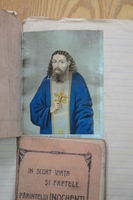 This postcard icon portrays Feodosie Levițchi (Romanian spelling) or Teodosie Levitsky (in Russian) (1791-1845), of Balta (today’s Odessa Oblast, Ukraine). It was confiscated from a Bessarabian peasant in 1938 who had been charged with Inochentist propaganda and sentenced to 45 days imprisonment. Feodosie was an important figure for the Inochentist movement as Inochentie of Balta (1875-1917) was instrumental in sponsoring the cult of his deceased predecessor and distributed mass produced icons (like the one seen here) and miracle stories across Ukraine and Bessarabia to encourage pilgrims to visit for the tomb and then later the monastery of Feodosie Levițchi founded to house his relics. Levițchi was eventually canonised by the Russian Orthodox Church in 2009, over 100 years after the the campaign for his canonisation was first launched. Levițchi was born in the village of Korytna in Podolia, today’s Ukraine. He became a priest in 1815 and was ordained in the Church of Saint Nicholas in Balta. Levițchi soon became known for the power of his improvised preaching and, following the death of his wife in 1818, he dedicated himself to delivering increasingly apocalyptic sermons. He lived as a hermit and spent long hours in prayer, eventually writing a study which he sent to Tsar Alexander I via Alexander Nikolayevich Golytsin, the Tsar’s conservative Education minister. The Tsar enjoyed the work so much that on the 3rd May 1823 Levițchi was invited to Saint Petersburg. Levițchi seems to have had a powerful effect on Golytsin and he became a regular visitor to the priest who was soon presented to the Tsar who was reported to have been “very happy and grateful for his work in the name of God” and gave him permission to continue to spread his teachings. In the summer, he left Saint Petersburg but continued to write to the Tsar. Levițchi’s fame grew but his association with Golytsin, who was accused by powerful enemies of being a Freemason was to be his downfall. Levițchi asked for permission to return to Podolia but his request was denied and he was instead exiled to a monastery on an island on lake Ladoga where he was kept under close supervision. When he was eventually released in 1827 following the death of Alexander and enthronement of Nicholas I, he returned to Balta. There he returned to his old position in the Church of Saint Nicholas. He built a modest hostel there to offer shelter to the poor, orphans and the sick. He died on 9th March 1845. In 1909, under unusual circumstances, Inochentie of Balta, took charge of removing Levițchi’s relics from his family plot to the sanctuary of the new monastery in Balta. From this point forward, the cult of Levițchi grew exponentially under the direction of Inochentie of Balta. For related entries see:
 -
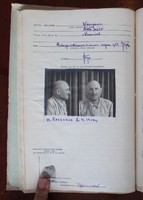 The mugshot is one of the main visual materials produced by the secret police during their investigations. Together with fingerprints and personal information, mugshots connect the police image of the alleged enemy to an actual person, whom they show stripped of personal dignity and agency, often head-shaven, dejected, pensive and nervous. Mugshots are contained in almost all secret police criminal investigation case files and were produced according to a very precise set of rules which makes them very similar from one case to another. Although at a first glance they seem less interesting than other types of visual material, their use in fieldwork can bring unexpected results. During a fieldwork trip to the village of Odaia in Moldova in the summer of 2018, we offered local believers the possibility of viewing the mugshots from the criminal case file of Dumitru Busilcov, Gheorghe Mârza, and Ermolae Croitor, the spiritual fathers of the local community. They had been arrested in 1953 accused of organising a sectarian commune of followers of Ioan Zlotea (a monk and spiritual father who attracted a large following in Bessarabia in the interwar period) and Inochentie of Balta (the founder of the religious movement commonly referred to as Inochentism), and of collaboration with German and Romanian authorities during the war and were condemned to 25 years of labour camp. The interviewed believers were surprised and slightly shocked by the photos of their spiritual leaders whose archival images differed from the way their detention in the prison camp have been imagined by the community. The mugshot photographs elicited many stories about the detention of their leaders and about the miracles they had worked in the prisons. For these believers, the mugshot made the connection between the religious leaders they knew at home in the community and their fabricated identity created by the police. Showing such images to descendent communities entails certain risks that need to be carefully balanced. The mugshots, when viewed outside of their archival context, came to possess a new agency with the potential to be both traumatic and liberatory for the community. However, the continued enclosure of Communist-era anti-sect case files in the archives and their separation from and lack of accessibility for the targeted communities also has the potential to cause future harm to minority religious groups. The disclosure of archival images represents an important means through which numerous propaganda myths about allegedly harmful sects can be deconstructed. Without the inclusion of the voices of members persecuted groups, the analysis and re-interpretion of the textual and visual materials stored in the police archives will always remain incomplete. For related entries see:
 -
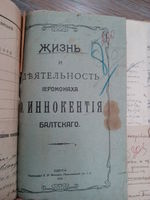 The image depicts the cover page of a booklet published in 1918 in Odessa by the followers of Inochentie of Balta. It was confiscated by the Soviet secret police in 1921 from the Inochentist community of the village of Lipetskoe (Balta county, Odessa Governorate). The village of Lipetskoe was a spiritual center of Inochentism, where the followers of Inochentie of Balta built an underground monastery and established an utopian communal society called Gradina Raiului, the Garden of Paradise. The booklet contains 19 pages which describe the life of Inochentie of Balta, the founder of the Inochentist religious movement, which emerged at the beginning of the 20th century. From the perspective of the secret police, the collection of this kind of literature was important because it allowed the officers to construct a clearer understanding of this new religious movement and to formulate more efficient strategies to repress it. The booklet narrates a unique version of the life and deeds of Inochentie of Balta, different from the accounts found from other textual and oral sources. The secret police archives contain textual materials produced at different stages of the history of religious groups, many of which cannot be found in other repositories or in personal collections. The booklet is attached to the file number 27146 that is preserved in the Archive of SBU Office in Odeska Oblast of Ukraine. The file contains 11 photographs and icons, one booklet and a number of flyers produced by Inochentists and a propaganda flyer of the White Movement with the image of Alexander Kolchak. For related entries see:
 -
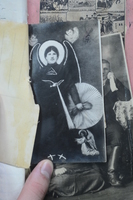 The three images presented here all show variants of the same photo-icon of Alexandru Culeac portrayed as the Archangel Michael. In the first image he appears alone; in the second image, his photograph appears next to that of Inochentie of Balta, and the third image is a reproduction of the photo-icon that appears inside the front cover of a booklet containing Alexandru Culeac's visions entitled "A vision that appeared in 1920". The presence of multiple examples of this photo-icon in the same file reflects the importance of this devotional image to the Archangelist community. Archangelism formed as a branch of Inochentism under the leadership of the Culeac brothers, the most prominent of whom was Alexandru Culeac (b. 1891). He was considered to be the Archangel Michael returned to earth to battle Satan at the End of Days. The Culeac brothers published and distributed their visionary experiences of divine election and the Final Judgement in the form of brochures and continued the tradition started by followers of Inochentie of Balta of using powerful visual materials to communicate their message, commissioning icons and producing photographs to reinforce their special claims. Alexandru Culeac quickly grasped the power of the image to establish his status as mediator between earthly and heavenly realities and in the image shown here we see how techniques of montage and over-painting have been used to create a striking iconization of Alexandru Culeac. In 1924, the photo-icon was printed on the inside cover page of his booklet of prophetic visions entitled "A vision that appeared in 1920" (image three). In the photo-icon, Alexandru Culeac is pictured with a flaming sword, a shield and a dove at his heart, a sign of his dual identity as both the Holy Spirit and Archangel Michael. Later, during the Soviet period, media reports and propaganda publications continued to draw attention to the significance of the production and distribution of religious images for the success of the Archangelist sect, whilst also ridiculing the crudity of their production. In Alexandru Culeac’s confession which was published in 1959 under the title "Repentance of a Sinner", he explains how important the icon that “looked just like me” was for his career, for the Archangelist movement and for the promotion of his divine status: "I decided then to make an icon with my image. I commissioned it from a painter who painted the Day of Judgement and the Ascension of the Archangel Michael, as well as my ascension to heaven. The icon was a success. And the Archangel Michael looked just like me. I declared this icon holy. And it started here. People threw themselves down on their knees in front of the icon. They kissed it and prayed to it to heal them from illness. I don’t know if the icon cured anyone but in exchange we received a handsome income. They brought us cereals, money, carpets and cattle." Intended to portray Alexandru Culeac as a religious charlatan who fooled his followers into making offerings to him, this extract from his confession (which may well have been extracted under duress) nevertheless offers us an insight into the power of the image in the Moldovan vernacular worldview. These photographs come from the National Archive of the Republic of Moldova – Military Tribunal of the 3rd Army Corps ANRM-TMC3A 738-1-6846. In addition to the materials shown here the file contains several photographs of members of the Archangelist community, two pencil sketches and another booklets entitled "The Lord has Spoken [Dumnezeu a vorbit]. Undated. București: Tipografia “Lupta” N. Stoilă. For related entries see:
 -
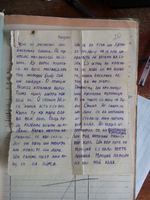 The images show an Inochentist handwritten hymn found by the Soviet secret police officers on an arrested Inochentist preacher in 1952 in Moldova. The hymn describes Jesus's preaching to his followers on the Mount of Olives about the End Time. The Apocalypse, according to the hymn, will begin when people would abandon the church. Then, according to the narrative, the wrath of God would descend on sinners and only those who do not abandon the true faith will be saved. The hymn is written in Romanian using the Cyrillic script. The preacher, who may not be the author of the text but was probably the copyist, wrote his surname at the end of hymn under a decorative drawing. The hymn served as evidence in the case file of the Inochentist preacher on whom it was found. The preacher was charged with sedition and anti-soviet propaganda and was sentenced to 25 years in a labor camp. From the perspective of the police investigation, the Inochentist narratives about the End Time were useful for their investigations because they labeled those “who left the Church” as sinners who were about to be struck down by God’s wrath. The officers perceived the hymn as an attempt by the Inochentist preachers to exploit the “religious superstitions” of the peasantry in order to label the Soviet regime and its representatives as “sinners” that were about to be punished by God. The hymn is attached to file number 3815, fond R-3401, from the National Archive of the Republic of Moldova. The file contains two mugshots and the above mentioned hymn. For related entries see:
 -
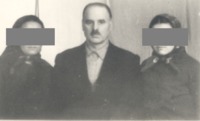 This confiscated photograph was included in a personal file of an Inochentist leader alongside several others collated by the Romanian Securitate. The image shows the male leader flanked by two women from the community. Such group and community photographs feature heavily amongst the corpus of confiscated images in the secret police archives in Romania as for the secret police they were a convenient means of tracing networks and personal relationships of the religious underground. The case file does not state when the images were confiscated but from an Informer Report that appears elsewhere in the personal file we learn that in February 1965 the members of a “sisterhood” of Inochentist women were being investigated by the Securitate because of their links to the leader in the photograph, a “Saint” referred to by his flock as the prophet “Elisha” with the initials C.A. The informer, “Dan Gheorghe” (not his real name), who had either infiltrated the group or been recruited from within it, after a conversation with the “sisters” reported the following: “She [one of the leaders of the group] told me that the militia man [who lived next door to her] got hold of a photograph of her with C. A. and M. and that if she is asked by the militia if she knows C. A., that she won’t say no because the militia have the photograph, but if she is asked about other “brothers” in the group she will say nothing even if they cut her into pieces. I asked her how the photograph reached the militia and she told me that she was photographed together with those I mentioned above, then she sent the photograph to C. A. through the post and in this way the militia had made a copy of the photograph” (CNSAS I 237454, vol. 3, 57.). This short extract from the Informers Report tells us a lot about the biography of this particular photograph revealing how the image was produced by members of the community, how it was shared, how it was intercepted by the secret police and finally how it was transformed into incriminating evidence that could be used to identify members of the underground community. This example serves to illustrate the text/image relationship as the Informers Report engages the photograph as evidence of the meeting with C.A. The image, however, is in stark contrast to the text that describes it; the text incriminates and implicates the image in a conspiratorial narrative, whereas the intention of the producers of the image was to commemorate a significant act of devotion to the group’s spiritual leader, which they preserved despite the risk that the photograph posed to the community. Three copies of a photograph, together with a number of others, appear compiled on a single page of the secret police file and are described as “photographs of the elements [meaning the individuals under surveillance] from the operation of group no. 70.” For related entries see:
 -
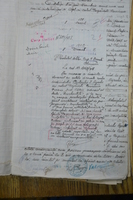 The images show an inventory and confiscated photographs included in a case file forwarded to the Romanian 3rd Army Military Court on 2nd December 1938. The first image shows the inventory of items found in the house, which was located in Fălciu county. The officer lists the following Inochentist "propaganda" materials: "1. A brochure entitled 'The Deeds of the Archangel Michael', 2. a small icon of saint Paraschiva, 3. a cross sculpted from wood, 4. three photographs of Culeac dressed in white with a cross on his chest, 5. a photograph of Culeac dressed in vestments." The second image shows one of the photographs of "Culeac" dressed in white described in the inventory. The third image is the photograph of "Culeac dressed in vestments". The fourth image shows the first page of the brochure 'The Deeds of the Archangel Michael'. The diligent way in which the items were listed and collated by the Romanian Gendarmerie in this case reflects the importance that the Romanian authorities placed on the prevention of the spread of Inochentist "religious propaganda materials" and their important use as evidence in anti-sect trials in this period. On the 21st April 1937, the Ministry of Religions and Arts had issued Ministerial Decision no. 4.781 “Regarding banned sects and religious associations” in which it was stated explicitly that the administrative and police agencies were to stop every form of “propaganda of religious prosleytism, whether this is done verbally, in the form of writing, through brochures and journals etc. by colporteurs, or members of the illegal sect.” The police were also to confiscate all religious materials and send them together with the completed documents to the Ministry of Internal Affairs (Deciziunea 4.781 1937, 3-4). This policy ensured that many Inochentist brochures, photo-icons and photographs were preserved in the case files and penal files of individuals arrested at this time. In the case featured here, the items did not result in a successful prosecution as the accused stated that the materials belonged to his daughter-in-law and that he had no knowledge of their contents or meaning. These images come from the National Archive of the Republic of Moldova – Military Tribunal of the 3rd Army Corps ANRM-TMC3A 738-1-6849. For related entries see
 -
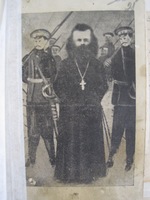 The images show postcards and mass produced photographs confiscated from a group of arrested Inochentists in February 1942 in the village of Cuibușor, in Romanian-occupied Transnistria. Image 1 and 2 show the front and reverse of a postcard. On the front, the monk Inochentie (1875-1917) is shown in a scene from his vernacular hagiography in which he is under arrest, surrounded by Tsarist soldiers after his attempted to escape from exile on Solovetsky island. The reverse of the postcard, comprises short quotes and adaptations from the New Testament. Here text and image were configured in a relationship designed to establish a parallel between Inochentie’s suffering and the passion of Jesus Christ. The text opens with an abridged and slightly altered version of Jesus’ discourse on the Good Shepherd from John 10: 14-16. In the section of the text that follows, this is taken one stage further with the torments suffered by Inochentie being equated to Christ’s passion. “Behold, the good shepherd whose life was given and is not given back. By his spiritual brothers, chased, cursed, shot [with a gun], insulted, given poison to drink, with hands tied behind his back, put in prison because he revealed the truth, not heeding what the Apostle says: Whoever hates his brother is a murderer, and the murderer will not enter the Kingdom of God (1 John 3: 15).” Image 3 is a photograph-icon of Inochentie that shows him with angels wings and a dove at his heart, a symbol which indicates his association in Inochentist belief with the third person of the Trinity, the Holy Spirit. This type of mass produced photo-postcard image were widely used by Inochentists to spread their message. These were carried from village to village across the Moldovan countryside, easily concealed about their person. There are reports of them being sold on markets from suitcases. Hidden under officially sanctioned religious icons and booklets, they were sold to knowing customers ‘on-request’ for the price of 10 lei. The Holy Synod took very seriously the danger posed by these subversive and heretical images and texts being produced by religious dissenters, not only Inochentists but also Old Calendarists, and passed a ruling in 1936, to be enforced by the Ministry of Internal Affairs through the Gendarmerie, requiring all religious icons, crosses and religious publications to be approved by the Church. Arrests were frequently made on the basis of possession of illegal icons and Inochentists were, by the 1940s, routinely sent to the military courts where they received anything between a small fine to 6 months in a labour camp. The file from which these items come reports the arrest of a group of 41 Inochentists, 9 men and 32 women, in an illegal “prayer house” in the village of Cuibușor. The village was located adjacent to the underground Inochentist complex of Gradina Raiului (the Garden of Paradise) that had been destroyed by the Bolsheviks in 1919/20. The area had recently been occupied by Romania following the Axis invasion of the Soviet Union in June 1941. In the 1942, there were a series of arrests of Inochentists from Bessarabia (which had become part of Greater Romania following the First World War) as they began to gather around their sacred centres of Balta and Gradina Raiului. It was illegal for Bessarabians to travel to the occupied territories without travel papers. The Romanian authorities noted that the rumour of deportation of sectants from Romania to Transnistrian concentration camps alongside Jews and Roma (Gypsies) seemed to have inspired some Inochentists to relocate to the place of origin of their movement. Both the postcard and the groups relocation to their sacred centre are expressions of the apocalyptic expectations of the group that intensified with the start of World War Two. These images come from the National Central Historical Archives of Romania [Archiva Naționale Istorice Centrale – fond. Inspectoratul General al Jandarmeriei (Romania) [Central National Historical Archive – General Inspectorate of the Gendarmerie], dosar. 120/1942, pp. 22-26. Alongside the two items reproduced here, there is a third postcard-icon and a brief description of other religious materials found at the hidden prayer house. For related entries see:
 -
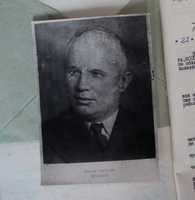 These mass produced postcard-sized portraits of three soviet leaders, Nikita Khrushchev, Lavrentiy Beria and Anastas Mikoyan, have been torn and inserted into an envelope as evidence in a secret police personal file referring to a collective penal case. They were found during the search of a house of an Inochentist leader on February 11th 1953, a few weeks before Stalin’s death. From the perspective of secret police, the disrespectful attitude towards the abovementioned leaders of those who had torn these pictures equated to an anti-Soviet act. The origin of the defaced images is open to a number of possible interpretations. Given the fact that the secret police officers claimed to have found the small portraits in the attic of the Inochentist leader’s house, the size of the portraits and the fact that the Soviet leader Joseph Stalin is missing from amongst them, the photographs may constitute fake evidence created by the secret police or somebody in collaboration with them. However, the tearing of the image of any of the Soviet leaders would have been a risky strategy even for high ranking secret police officers. Alternatively, the portraits may have been torn by the Inochentist community themselves. The case against the leaders of the community does not mention the torn pictures but instead translates the group’s actions into the language of the Soviet criminal code. The leaders of the group were convicted for creating an anti-Soviet sect, organizing illegal religious meetings and encouraging peasants not to fulfil their obligations towards the state. One of the two on trial was also convicted for having formerly collaborated with Nazi forces. This file is a good example of how problematic interpreting secret police files can be and the often ambiguous nature of the evidence presented within them. The Soviet regime had its own iconographic tradition, which aimed at dominating the gaze of Soviet citizens who were supposed to participate in the building of Socialism in USSR. Soviet policy in the Moldavian countryside was not only a project of transforming the social and economic life of the villages, but also aimed at replacing the culture of traditional peasant communities with a new Stalinist culture in which there was no place for religion. The Inochentist communities, which were perceived as anti-Soviet sectarians, represented an obstacle towards the projects of the Soviet state. As with Eastern Orthodoxy more generally, the vernacular tradition of the Inochentists attributed a major role to icons. The intrusion of atheist Soviet iconography into the everyday life of villages seriously disturbed Inochentist sensibilities. Later in the case file, a few days after Stalin’s death one of the witnesses reported having heard one of the Inochentist leaders saying “why do you hang his portrait, is he a saint to be viewed by everyone, or what?” This case nicely illustrates the battle to dominate the gaze of Soviet peasantry. Inochentism represents a form of local vernacular Orthodoxy drawing heavily on the conservative monastic tradition. During the first decades of the 20th century several versions of Inochentism emerged in Bessarabia. The abovementioned case refers to the followers of Ioan Zlotea. When the territory of Bessarabia was (re)occupied by Soviet forces in 1944, Inochentists once again became a target due to their maintenance of values opposed to Soviet policies applied in the countryside. Accusations included refusing the draft to the army, resisting mobilization for work on Sundays, refusing to vote in elections and refusing to join the Communist Youth Organizations. In the context of collectivization of agriculture and the recent famine in Moldova Inochentists shared a culture of apocalyptic rumor with many other religious groups in rural Russia and Ukraine. These images can be found in the file ASIS, 023171, Vol. 1-2. This file also contains nine mugshots of one arrested Inochentist and two other unknown persons produced by secret police and used in the secret police lineup. The identification of the arrested Inochentist took place in Soviet Ukraine, in the village where, according to the file, he served as a policeman during the German occupation. In addition, the file contains three mugshots of sentenced Inochentist leaders taken by secret police officers as a standard procedure during registration of the identity of the arrested persons. For related entries see:
 -
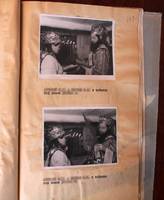 This photograph which was taken by Soviet secret police officers appears to capture a ritual performed by Archangelists (a branch of the Inochentist movement) in one of their underground chapels. On closer inspection, however, it is evident that this is not a surveillance photograph but rather a staged reenactment performed for the camera. The framing, camera angle, lighting and mood of the photograph were all determined by the secret police photographer with the intention of creating a powerful image for use by the regime. Indeed, the two Archangelists, shown wearing ritual clothing and holding sacred objects, may not be performing a genuine ritual at all. The images from this secret police photo shoot, which later appeared in Moldovan newspapers alongside a dramatized account of the dangerous and subversive activities of this group of Archangelists, demonstrate the close co-operation between the secret police and the state media organs at the time. Re-stagings of religious ritual seem to have been produced consciously as both evidence for use in trials and as propaganda tools. With access to state security files on religious groups, the close cooperation between the state security and Soviet public media and propaganda organs becomes evident as the files clearly demonstrate how the secret police collected, produced and curated images of religion for popular consumption. The file in which these images appear contains photographic materials from several cases and seems to have been made available to journalists and authors for use in their works. These photographs can be found in ASISRM-KGB 020193. Altogether, this file contains 39 photographs, 6 loose pages handwritten and two handwritten notebooks with religious texts. The materials are derived from several different cases. For further reading see: Kapaló, James A. Inochentism and Orthodox Christianity: Religious Dissent in the Russian and Romanian Borderlands. Routledge, 2019. For related entries see: