
Old Calendarists
Item set
- Title
- Old Calendarists
- Description
-
Old Calendarists, also called Stilists in some sources (referring to “old style”), are members of the Orthodox Church, mainly from the eastern provinces of Moldavia and Bessarabia, who refused to accept the reform of the religious calendar introduced in by the Romanian Orthodox Church in 1924. The solar aspect of the Revised Julian Calendar was adopted by a number of Orthodox Churches at this time including Constantinople and Greece (similar Old Calendarist movements arose within the jurisdictions of these Churches too). The Old Calendarists also opposed perceived religious syncretism, ecumenism and Freemasonry within the Orthodox Church. The movement became very popular in rural communities and their leaders were mostly Orthodox priests and monks who continued to adhere to the pre-reform Calendar. The Old Calendarist Church and communities of believers were the target of severe persecution at the hands of the state during the interwar period, often encouraged by the official Orthodox Church.
Old Calendarist leaders and communities were continuously harassed and pursued by the secret police and the gendarmerie culminating in violent clashes, especially between 1934 and 1936, which led to the death and arrest of many Old Calendarist believers; these incidents were described by the authorities as "rebellions".
After a short period when the Old Calendarist Orthodox Church was recognized legally by the Romanian state in 1945 under the title The Traditionalist Christian Denomination (Cultul Creștin Tradiționalist) the new communist framework for religious life introduced in 1948 no longer recognized the Church. The persecution of the Old Calendarist Orthodox Church and its members continued during the communist period. Several Romanian Orthodox Church priests and monks joined the Old Calendarist Orthodox Church including bishop Galaction Cordun who consecrated bishops providing the church with its own hierarchy. The leadership of the Church, its clergy and lay members of the community were harassed, repeatedly imprisoned and placed under constant secret police surveillance. However, the Old Calendarist Church managed to maintain a continuous and functioning religious life. During the communist period the Church made multiple unsuccessful attempts to gain legal recognition.
- Creator
- Iuliana Cindrea
- Publisher
- This project has received funding from the European Research Council (ERC) under the European Union’s Horizon 2020 research and innovation programme No . 677355
- Contributor
- Anca Sincan
- Bibliographic Citation
- Iuliana Cindrea & Anca Sincan, "Old Calendarists"
- http://hiddengalleries.eu/digitalarchive/s/en/item-set/173
- Date Created
- 2018
Items
-
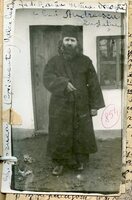 These two photographs were confiscated in 1936 by the police from an Old Calendarist monk, Gheorghe Ștefan Dorneanu, also known as father Grichentie. The first photograph shows Dorneanu dressed in monastic clothes in front of what seems to be a small house or a skete. The left and upper edges of the photograph contain a handwritten text that states: „Gh. Dorneanu (Grichentie) Valea lui Ion jud. Bacău mâna dreaptă a lui Andreescu Eustațiu,” which can be translated as „Gh. Dorneanu (Grichentie) Valea lui Ion, Bacău County, the right hand of Andreescu Eustațiu.” The second photo depicts a group of Old Calendarist believers, and we can see a small hand-drawn cross that was meant to identify Corneanu. Both the small cross and the text were most probably written by the agent that confiscated the photographs from Corneanu’s house when it was searched. In addition to these photos, the agent also confiscated letters that the monk exchanged with numerous other Old Calendarist monks that were being looked for by the police or who have already been imprisoned. One of the monks that frequently wrote to Dorneanu was Eustațiu Andreescu himself. The latter had been arrested in 1936 and sent to Iezeru Monastery from where he wrote letters to Dorneanu in order to encourage him to continue with the construction of the Old Calendarist church in Zănești, Neamț County, and to ask him for help, food, and clothes. In one of the letters, Andreescu disclosed to Dorneanu the place where he had hidden some money, that was also confiscated by the police. Gheorghe Corneanu was accused of conducting illegal church services, as well as spreading false information against the new calendar. He was arrested in 1936 and sent to Cheia Monastery, Prahova County. The Holy Synod of the Romanian Orthodox Church officially decided in October 1936 that the fate of the Old Calendarist nuns and monks was to be sent to detention at isolated sketes, where they were forced to accept the new calendar. One of the monasteries where Old Calendarist nuns were sent in order to correct their behaviour and, presumably, accept the new calendar, was Vărzărești Monastery, while the monks were sent to Cheia or Iezeru Monastery. Based on archival information such monasteries also existed in other places in the country, however, details related to those cases are either insufficient or unavailable to scholars, for the time being. These photgraphs can be found in the file CNSAS, D 015261. Apart from these photos, the file also contains police reports, lists of names, letters, and statements. For related entries see:
 -
 These images show a church songbook that was carefully handwritten by nun Olimpiada Petreanu sometime in 1940. The first image depicts the cover of the songbook. It conveys important information such as the owner of the songbook, the fact that it was a church songbook, “cântări bisericești”, and, in faded letters, the year when the songbook was written. The second and the third images show a small part of the content of the songbook, namely the so-called “canon of the soul”, which was dedicated to the Virgin Mary, and the Akatist of Jesus Christ. These are both important hymns and hymnal elements of the Orthodox tradition. The last image shows a short poem, or proverb, that states: “man is like a flower that is here and gone tomorrow, he now laughs and parties, tomorrow he lays in his grave.” It also shows the date, March 12 1940, and the signature of nun Olimpiada. These images illustrate the effort and care that was put into writing the songbook, which is colourful and carefully organized. Moreover, at a time when most women were illiterate, nun Olimpiada Petreanu was able to handwrite, draw and put together such a wonderful songbook that, fortunately, survived until today. Born in Răucești, Neamț county, Olimpiada Petreanu, whose lay name was Safta, is one of the nuns that was imprisoned at Vărzărești Monastery, in 1937. Vărzărești was one of the main places where Old Calendarist nuns were brought and, according to some Old Calendarist literature, they were forced to accept the New Calendar there. She wrote her first postcard from Vărzărești in May 1937, asking her parents to send her some food, her watch, some clothes and money. From the onset, we learn that she used to live at Old Agapia Monastery as she compares the location of Vărzărești Monastery with its location, and that she had partially lost sight in her right eye, an issue that is constantly mentioned in her correspondence with her family and acquaintances. According to the declaration of her father, she joined the monastery more than ten years prior to 1937, and after the Neamț Old Calendarist rebellion she allegedly lost the support of her family who chose to follow the new calendar. Based on the concerned tone of the postcards that she received from them, as well as the fact that they continued to send her packages and whatever she needed in order to make her detention easier to endure, it is difficult to believe that such was the case. The time of her release is uncertain and what we know about the rest of her life is based on the information gathered during ethnographic research. After her release, she was allegedly sent to Oniceni, Buzău county, where she founded a skete for nuns at Drăgușeni with the help of Glicherie Tănase, an important Old Calendarist bishop. She became the mother Superior of the skete and spent the rest of her life there. She died in January 2002 and left behind this songbook. These images were provided to the Hidden Galleries research team by the nuns of Mănăstirea „Buna Vestire”, Valea Roșie. For related entries see:
 -
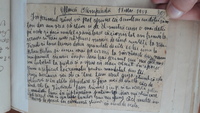 These images show the front and reverse of a postcard that was sent to nun Olimpiada Petreanu by her brother whilst she was incarcerated at Vărzărești Monastery. The postcard is of particular interest as it mentions the difficulties that the families of imprisoned Old Calendarist nuns encountered in their efforts to contact them. The first image shows the front of the postcard and contains references to one of the most important issues that the nuns and their families experienced. One of the constant complaints of the nuns, as well as of their families, was that the postcards, letters and packages often went missing or were delivered late. Olimpiada Petreanu’s brother expresses his concern about the fact that their communication was made difficult by unknown causes: “we sent you many letters but you have not responded since you arrived at Vărzărești [...] we asked at the post office but they said that there was nothing for us, so we made a complaint [...] I don’t know the reason for this, maybe because of the lack of money, but many letters are not sent, they stop them.” Similar concerns are expressed by other nuns’ family members in their letters and this continuous state of confusion seems to have been intentionally maintained by the authorities entrusted with the incarcerated nuns supervision. By controlling every package and letter the nuns and their families received, the authorities hoped to destroy the nuns’ will to resist the religious calendar reform and with it undermine the entire Old Calendarist movement. Moreover, we learn from similar correspondence that the lack of communication triggered a fear of abandonment, of having been forgotten and a struggle to come to terms with a difficult situation. The second image shows the back of the postcard. It contains important information about nun Olimpiada, namely that she had a problem with one of her eyes, as her brother asks her if her eye had healed; from other postcards we learn that she had partially lost sight in her right eye. On the upper edge of the back of the postcard her brother wrote a note asking her about a certain nun Anica and if she had received her packages. This note demonstrates that such events were not isolated and that other Old Calendarist nuns and their families suffered due to the fact that communication was rendered difficult. Written in 1937, this postcard is important proof of the waves of arrests that followed the so-called "rebellions" in Besserabia, in 1936. Many Old Calendarist nuns were sent to detention where they suffered numerous hardships, hunger and cold. Vărzărești Monastery was one of the main places where Old Calendarist nuns were brought and, according to some Old Calendarist literature, they were forced to accept the New Calendar there. The intimate and private lives of the nuns in detention revealed by these postcards contrasts sharply with the way they were portrayed in the press of the time as dangerous and rebels. These images can be found in the file ANIC, Insp. Gen. al Jand., D 23/1937. Apart from this postcard, this file contains many more letters and postcards sent or received by Old Calendarist nuns that were detained at various Orthodox Monasteries. For related entries see:
 -
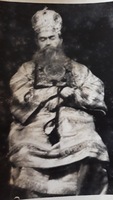 The two photographs are related to the death of the Old Calendarist Romanian Orthodox Bishop Evloghie Oța and come as a result of extensive ethnographic fieldwork amongst Old Calendarist on-line communities and monasteries in Bucharest and Sibiu. The first picture represents Bishop Evloghie Oța before he was interred by his monastic brothers inside the underground church in Televiziunii street, 13 in February of 1979. From several descriptions given by informants of the Secret Police and in interviews with surviving witnesses, Bishop Evloghie Oța was interred sitting on the Bishop’s throne, dressed in episcopal vestments and holding the Holy Scripture and prayer beads. This picture, which is not found in Oța’s secret police file, fits perfectly the written description in the documents and the interviews with witnesses of the funeral. I first come across the picture in a Facebook group called Imagini de Arhivă ale Bisericii Ortodoxe de Stil Vechi (Archival images of the Old Calendarist Orthodox Church) where it was posted by Sebastian Hriscu who tagged the picture with a description "Pictured found in my grandmother’s archive". Further discussions revealed that the picture circulated amongst Old Calendarist communities throughout the country after the bishop’s death. I later acquired two other scanned copies of the same image from the monks at the Monastery of the Dormition of the Mother of God, Bucharest (Mănăstirea Adormirea Maicii Domnului a Bisericii Ortodoxe Române de Stil Vechi) where bishop Evloghie Oța was initially buried. In 1983, the Secret Police, in an attempt to destroy the monastic community in Televiziunii street, arrested the monks. The body of the Bishop was exhumed and taken away. The church and the monastic complex have been tore-down, and the believers and monks were forbidden to return to the site. According to interviews with members of the church, the area was levelled and the land was used for agriculture until 1989. The whereabouts of the body of the bishop remain unknown. The second picture represents a string of religious beads displayed in the Hidden Galleries project exhibition (Imagini din galerii secrete: religia clandestină în arhivele poliției secrete/ Rejtett galériák: Az üldözött vallásosság képei a titkosszolgálati levéltárakban) at the Art Museum in Cluj Napoca, Romania. The beads (metanii) belong to Bishop Flavian Bârgăoanu who, in an interview from April 2019 spoke about Bishop Oța beads that had been buried with him but were lost when the bishop was exhumed and his body and everything he was buried with were taken away by the Secret Police. He explained that a few months after the revolution when he and several monastic brothers returned to Televiziunii street he received a visit from a man that had helped with exhumation of bishop Oța's body. He brought with him the beads and told Bishop Flavian that they had been on the body of the bishop and that he had taken them away but so many bad things happened to him afterwards that he is now returning them to the monastery. Bishop Flavian loaned the religious beads to be exhibited in Cluj for the duration of the exhibition. Description of the burial of bishop Evloghie Oța and the details of his interment can be found in the CNSAS file I0161965 vol 1
 -
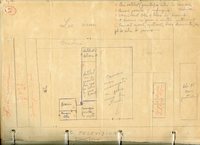 The two images are part of an individual file opened by the secret police on Bishop Evloghie Oța of the Old Calendarist Orthodox Church following his release from prison in 1964 in the general Amnesty Decree. The images show house layouts that were drawn by the police during their surveillance operation. Two handwritten documents precede the two drawings of the house layouts. They are from two successive years and originate from the street/ local policemen (sectorist) that supervised the area where Bishop Evloghie Oța established his community and built his church in Televiziunii street. The first document from December 1964 represents the first meeting of the local policeman with the new neighbors that he describes as “people dressed in monastic uniforms” and the second following soon after was a more detailed account by a lieutenant who entered the house to ask for the house documents and encountered four persons, Bishop Evloghie among them, in a “prayer session, in possession of religious books, religious vestments and icons representing church figures”. One can safely assume that first house layout drawing was created to this lieutenant. The document, in which he asked for further instructions, was sent to his superiors and ended up with the Secret Police to later be used during the first destruction of the Old Calendarist Orthodox Church in Televiziunii street. The house layout drawing is thorough. It has an explanatory legend and uses different colors to distinguish between important and less important areas. At number 4 in the legend we find the church room that is adjacent to the bishop’s room. The plan also shows that a policeman lived in a house across the street from the underground house church. Based on this initial layout a slightly different one was made. The second house layout acknowledges Bishop Oța’s ownership of the house. This layout also presents the way, using blue arrows, in which the house can be entered. This layout was used in the later secret police operation when the church was destroyed and the bishop arrested. The images come from file CNSAS fond Informativ, I 161963, Vol. 1. The Informative file includes several other evidence photographs, notes from informants, intercepted letters, secret police reports on the everyday activity of Evloghie Oța and the Old Calendarist Orthodox Church community in Bucharest.
 -
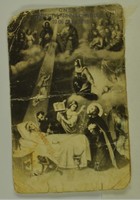 These images depicts a small icon that was confiscated by the secret police from an Old Calendarist believer. The first image shows the front of the icon, which portrays what seems to be the fight between good and evil, the holy trinity, angels, saints, numerous religious symbols, as well as two priests that are praying for the soul of a dying man. The second image shows the back of the small icon which has a short text. The first part of the text is indecipherable, but the second part states: “[...] Pray this prayer and feel that fear comes into your blood and body. Look at the dead man and how his soul is going up, towards the heavens.” It also mentions the name of the person to whom the icon belonged, which was “Păun”. According to the police reports included in the file, Păun was a “mystical person, a fanatic for his faith which was the old style,” referring to his adherence to the pre-reform Julian Calendar. He sent numerous requests to the state authorities, asking for the reopening of the Old Calendarist church in Păunești, Vrancea county. The church was closed in 1971, at which point Păun began sending letters in which he pleaded for the legalization of the Old Calendarist church. Apart from this small icon, the file contains a few papers on which he wrote Psalms and prayers. It is not certain if these items were confiscated from him by the police or if he attached them to the letters that he sent to the authorities. However, the reports state that he was threatened by the police on numerous occasions due to his insistent letters in which he would sometimes include “mystical materials.” This image can be found in the file CNSAS, I 1075010, vol. 4. Apart from this photo, the files also contains police reports, lists of names, three more photos and other items that belonged to Păun. For related entries see:
 -
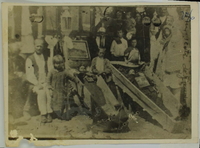 This photograph was taken in 1934 or 1935 in the village of Toporăști in the county of Vaslui. It depicts the funeral of two victims of the Romanian Gendarmerie following an attack on their church in an attempt to arrest the community's priest. The first image shows a few Old Calendarist believers surrounding the coffins of two people, a man and a woman. They seem to have two icons placed on their chests and we can see that three of the children present in the photo have their hands on the coffins, implying that this is their parents' funeral. There is a short note on the right edge of the photo that states: “Shot by the Gendarmes”, suggesting that they were killed during a direct confrontation with the Gendarmes. The second image shows the back of the photo which has a short text describing the event in the photo. The text states as follows: “From the massacre in Toporăști- Vaslui. Mother and father shot by the Gendarmes of the former regime for this belief,” referring to the Old Calendarist belief. It is unclear to whom the photo belonged or how it ended up in the file. The events that happened in Toporăști in 1934 are similar to the events in the village of Cucova, and mark the beginning of a series of confrontations between the Old Calendarists and the Gendarmes. Described as massacres, these attacks were meant to dissipate the Old Calendarist communities in the region. Even though it is not very clear what caused the incident in Toporăști, it seems that the Gendarmes surrounded the church in an attempt to arrest the Old Calendarist priest present there. Based on some archival documents and other sources, 12 Old Calendarists and 4 Gendarmes were wounded and 3 Old Calendarists were killed during the confrontation. In 1936, two years after this event, police reports state that the Stilist movement was no longer active in the region. This image can be found in the file CNSAS, I 1075010, vol. 4. Apart from this photo, the file also contains police reports, lists of names, two more photos and other confiscated items from an Old Calendarist believer. For related entries see:
 -
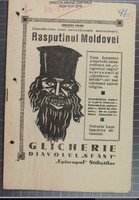 These four images are part of a brochure written in or around 1936 by Grigore Spiru, a well known Romanian journalist of the interwar period. The brochure, whose main characters are Glicherie Tănase and his alleged mistress, Maria Gârleanu, was meant to combat Old Calendarist ideas and to portray the Stilists (referring to "old style"), as Old Calendarists were referred to, in a negative manner. The first picture depicts the cover of the brochure, entitled “The Rasputin of Moldova. Glicherie, the holy devil and the Stilist bishop”, as well as a caricature of Glicherie. The comparison with the famous Rasputin was not coincidental and it mainly referred to Glicherie’s power of attracting large crowds of peasants, many of whom were women. The text also calls him “the black monk” and it makes references to the activities that were supposedly happening in various Old Calendarist churches, such as orgies, fake miracles and the use of real blood during the Eucharist. The second picture can be found on the inside of the brochure and it depicts a caricature of Glicherie, as well as the title “The childhood and…monasticism of Glicherie”. The caricature itself, as well as the term bishop written between quotation marks, are meant to mock Glicherie’s status amongst the Old Calendarists. The text goes on to describe Glicherie’s childhood in a very different manner from the way that it is recorded by the Old Calendarist church, portraying him as a charlatan from a very young age and motivated in his choice of the monastic path by financial reasons. The third picture can also be found on the inside of the brochure and it depicts a caricature of Maria Gârleanu. She was often described as the mistress of Glicherie Tănase, as well as his accomplice, especially in Glicherie’s attempts to stage various miracles in order to impress the peasants. In the brochure, Spiru depicts Maria Gârleanu as an adventurous woman, fascinated by various monastic figures, especially by Rasputin, whom Glicherie is said to have resembled. The forth picture depicts a caricature of Glicherie holding a bottle of alcohol, pointing to the Old Calendarists’ alleged immoral behaviour. Spiru goes on to describe how the Old Calendarist priests received gifts from naïve believers whilst spending their time drinking alcohol and luring young women. The brochure, which appeared in 1936, was meant to combat the Old Calendarist ideas and was part of a narrative that was encouraged and propagated by the Orthodox Church. These images, along with the brochure, can be found in the file CNSAS, D 013408, vol. 1. Apart from this brochure, it contains police reports, lists of names and newspaper articles that refer to the so-called Stilist rebellions from 1935- 1936. For further readings see: ”Isprăvile lui Glicherie episcopul stiliștilor” in Universul, No. 257, September 17, 1936. For related entries see:
 -
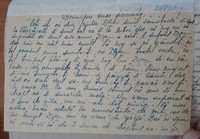 These images show a postcard sent by an Old Calendarist nun to her family whilst in detention. It is a particularly sensitive letter as it conveys the struggles of the nun who appears to have been rejected by her parents for reasons that are not clear from the information we have. The first image shows the face of the postcard and it contains references to the sufferings that the nun had endured for the last two years. From the message that she wrote to her parents, she seems to accuse them of having forgotten about her during these hardships and she reminds them that she is still their daughter and shares the same rights as her other sisters. The reason for her being treated like this by her parents are not described in the postcard but she makes a statement that might hint at it: “ I always cry and pray to God that He won’t abandon you, that you will get to know the good and the bad.” The statement could imply that her parents were religious and disagreed with her decision of becoming a nun or that they might have accepted the New Calendar, thus putting them at odds with her adherence to the Old Calendar. The second image shows the back of the postcard. It contains information that makes it clear that the postcard was sent from Vărzărești Monastery, one of the Orthodox monasteries where Old Calendarist nuns were detained and, according to some Old Calendarist literature, forced to accept the New Calendar. The nun asks her family to come and visit her, she wishes them happy holidays and asks for forgiveness. This postcard offers us a glimpse of the emotions and personal challenges faced by nuns and women who rejected the Orthodox Church calendar reform. This is contrasted by the very different image of Old Calendarist women that was portrayed in the press and Orthodox Church publications of the time. The author of this postcard chose to suffer because of her religious convictions. Although the archives do not preserve a reply to her postcard and we are not aware of her fate, she seems convinced that there is reason to her suffering for her faith. This is a recurrent theme in the letters and postcards written by Old Calendarist women in detention. These images can be found in the file ANIC, Insp. Gen. al Jand., D 25/1937. Apart from this postcard, it contains many more letters and postcards sent or received by Old Calendarist nuns that were detained at various Orthodox Monasteries in Romania. For related entries see:
 -
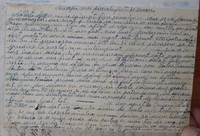 These images show a postcard sent by an Old Calendarist nun to her family in which she describes how she was arrested and sent to an Orthodox Monastery. The postcard was confiscated and attached to a file that contains many such postcards. They all date from approximately same period of time between 1936 and 1937. The first image represents the face of the postcard and includes important details about the fate of the nun. She describes to her family how she was arrested, where she was taken and what the conditions at the Monastery were like. Arrested by the Gendarmes on her way to the post office, the nun was taken from Oniceni (Neamț county) to Ciolanu Monastery (Buzău county), where all her things were confiscated. There were 70 nuns there altogether who were put into four rooms. She had to share a room with 20 other nuns. The second image shows the reverse of the postcard. It offers important information about the regime that the nuns lived under at the Monastery. She asks her parents to write back to her, but carefully, as their letters are first read by someone else implying that she may suffer consequences if the letter contained anything compromising. The image shows how the nun filled the entire postcard writing in order to convey as much information as possible. On the right edge of the back of the postcard she wrote a cramped note asking her family who was still alive in the village. This may have been due to her wish to pray for anyone that was deceased, or it might be a direct hint at the policy of violent repression and arrests that the Old Calendarist church was subjected to on the part of the Gendarmes. Written in 1937, a short time after a series of so-called Stilist "rebellions" in Besserabia, this postcard is proof of the waves of arrests that followed these events, which sometimes included nuns and Old Calendarist women. When caught by the Gendarmes in the woods, or during Silist agitations, women were arrested and most of the time fined or sent to detention in Orthodox Monasteries. Vărzărești Monastery was one of the main places where Old Calendarist nuns were brought and according to some Old Calendarist literature, they were forced to accept the New Calendar there. The intimate and private lives of the nuns in detention revealed by these postcards contrasts sharply with the way they were portrayed in the press of the time as dangerous and rebels. These images can be found in the file ANIC, Insp. Gen. al Jand., D 25/1937. Apart from this postcard, it contains many more letters and postcards sent or received by Old Calendarist nuns that were detained at various Orthodox Monasteries. For related entries see:
 -
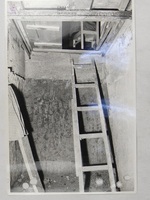 The 4 images are taken from a secret police personal file and were used as evidence of an Old Calendarist underground monastery in Bucharest. The community was led by the Old Calendarist bishop Evloghie Oța. According to the communist state legal framework, the Old Calendarist Orthodox Church was an illegal entity. These pictures documented a sweep operation of the secret police that ended in the destruction of the underground church and the arrest of the bishop. We cannot date the pictures precisely because the community kept rebuilding the underground chapel and the secret police destroyed it each time from 1965 until 1983. The community dated from 1964 when their bishop was released from prison and was held together under his charismatic leadership. During the 26 years of the community existence under communism their number increased gradually. They had several brothers in the monastery and a parish that consisted of regular church goers and people that came from time to time from various places across Romania. The bishop visited and maintained a correspondence with the geographically distant members of his flock. This form of parish is typical for an Old Calendarist community in the communist period but not typical for a regular Romanian Orthodox Church parish. For this reason the numbers of believers cannot be accurately assessed. The file contains several other pictures (14 in total) and two maps of the house and the underground chapel. The pictures follow standard crime scene photographic principles, illustrating the exterior, means of entry to the underground chapel as well as the main incriminating evidence and close up details of particular elements that elucidate the crime. They also show the methods by which the building was transformed from a house into an illegal underground chapel including photos linking the bishop and parishioners to the site. The pictures selected here, illustrate common tropes of illegal religious activity: the route of entry via a ladder to the underground chapel; the ritual space; and the means by which the community financed itself. The third picture reveals the altar table and icons surrounding it together with religious service books, candles and items of from episcopal paraphernalia. Note particularly the crosier and the mitre, both elements that indicate the rank of the officiant that is not present in the picture. The forth picture in this entry shows the money next to several diptychs (several lists of names for whom religious service has to be held are observable in the picture). A stole and a censer can also be seen in this picture, religious objects and garments effectively linking the money to the religious service provided. Although the secret police implied that the community was hiding underground the Old Calendarist subterranean religious spaces and/ or underground chapels were not necessarily used for hiding in. There is an Orthodox Christian monastic tradition of locating sites of worship in cave and subterranean spaces. For related entries see:
 -
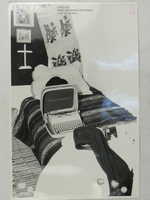 The two photographs are part of an evidence file of an underground Old Calendarist community. They are successive images of a typewriter and the typewriter with its owner taken by the Securitate for an evidence file constructed against the underground group. The first photograph has the typewriter placed near a Kalimavkion (monastic head gear in the Orthodox Church) which visually links the object with the owner. They are placed in the dormitory on the bed and what appears to be some literature is visible next to the typewriter. The second picture presents the owner of the typewriter with the open typewriter. The room is more visible in this image and on the bed several leaflets and books are spread to reinforce the link between the person, the typewriter and the use to which it was put. The person, identified in the file as Evloghie Oța was dressed in a cassock and has a bandage on his left hand which may indicate he may have been subject to physical violence at an earlier stage. It was common practice for the secret police to bring suspects back to the (crime) scene in order to produce stage photographs as incriminating evidence. In interviews with Old Calendarist Orthodox monks that knew bishop Evloghie it appears that his hand was broken at the time and this was not an outcome of his imprisonment. Evloghie Oța is described in the secret police file as a Stilist Bishop. The typewriter along with other equipment used to disseminate information and proselytize (i.e. tape recorder, magnetophone, video recorder, video player) was among the clearest evidence to demonstrate illegal creation, production and reproduction of materials. These types of images are recurrent in evidence files. The Romanian legislation during the communist period incorporated rules for typewriter ownership. Every typewriter was registered with the state administration and a page with the typewriter’s letters and signs was kept in a police file so the user could easily be identified. The images come from file CNSAS fond Informativ, I 161963, Vol. 1. The Informative file includes several other evidence photographs, notes from informants, intercepted letters, secret police reports on the everyday activity of Evloghie Oța and the Old Calendarist community in Bucharest. For related entries see:
 -
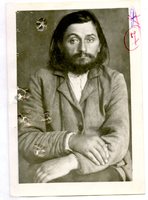 These mugshots were confiscated in 1952 by the Securitate from Onofrei V. Onofrei, an Old Calendarist monk, who was also the secretary of the Old Calendarist community. The mugshots of Glicherie Tănase, one of the most important Old Calendarist leaders, were taken in 1936, when he was arrested after the first confrontations between the Old Calendarists and the state authorities in Neamț county. He was arrested again, in 1952, and numerous attempts were made by members of the group to set him free. According to the penal file of Onofrei V. Onofrei, described as one of the youngest members of the group and also as a mystical member, he obtained these mugshots from a militiaman, who was working in Neamț county, and managed to make copies of them at a photostudio in the same county. Even though this is a police photograph, it was distributed as a devotional material. Onofrei made 45 copies of the mugshots in an attempt to encourage the community to remember their imprisoned spiritual leader . He went on to distribute 25 of these images to the monks of Slătioara Monastery, the largest Old Calendarist monastery, and to other Old Calendarist members. In this file the police report that they managed to confiscate four copies, two of which were included in this file. However, other copies of the same image can be found in his second penal file, P 0068482. Onofrei's actions were considered dangerous by the state and seen as an attempt to agitate the Old Calendarists against the regime. He was arrested and measures were taken in order for the rest of the copies to be confiscated from all the individuals he had managed to distribute them to. These images can be found in the file CNSAS, P 0022247, which is one of the penal files of Onofrei V. Onofrei. Copies of the same photos can be found in his second penal file, P 0068482. Apart from these two images, the file contains other pieces of evidence against Onofrei V. Onofrei, mostly in the form of declarations taken from people that were approached by him and even from the photographer that helped him replicate the mugshots. For related entries see:
 -
 This photograph, reproduced as a postcard, was confiscated by the police in 1936, from Pavel Caras, a former monk, who was wandering the villages in Bessarabia distributing these post cards to people. The photo was taken during the 1930s in Albineț, Bessarabia(today Republic of Moldova), which was one of the most important centres of Old Calendarist activity during the period. It depicts the Old Calendarists from Albineț standing in front of their church which appears to be under construction. The photo contains a small description in the lower right hand corner which states: ”In memory of the Church in Albineț, followers of the old calendar”, without mentioning the specific date or year when the photo was taken. Even though little information is given about its context, there are small details that reveal important aspects about the community and about the event captured in the photo. We can see that one man holds a bucket in his hand, which may contain holy water, that could indicate that the community was celebrating the consecration of their church. Considering the opposition that the Old Calendarists were facing during the 1930s, the priest in the photo might have been a local one, or he might have traveled to Albineț from a nearby village. It was common practice at this time for priests to move from one village to another. These activities were followed closely by the secret police. The composition of the photograph suggests that the members of this Old Calendarist church cooperated with the photographer, as all of them face the camera, while some of them are even smiling, preparing to capture this important event in the life of their small community. Even though this photograph seems to depict a peaceful and relatively small community of Old Calendarist believers, the reality is that Albineț was considered one of the most dangerous places in Bessarabia during the 1930s. The Old Calendarists in the area were deemed rebellious and dangerous, defenders of Nicolae Climovici and Ieremia Pletosu, two of the most important priests, looked for by the Gendarmerie. According to the archival documents, the photo was used by the Old Calendarist church in Albineț as a propaganda tool, in an attempt to draw attention to itself, for which reason they chose Pavel Caras as their main colporteur. These images can be found in the ANIC, Inspectoratul General al Jandarmeriei, D 25/ 1935. Apart from these images, the file also contains declarations, newspaper articles and Gendarmerie reports about the problems caused by the Old Calendarists in Bessarabia. For related entries see:
 -
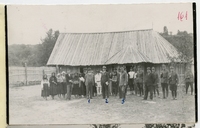 These photographs were taken in 1935, in the village of Cucova, in the county of Putna (nowadays Bacău), as evidence of the rebellions and problems caused by the Old Calendarists in the region. The term "Stilists" was also used by the state and the press in order to label them, referring to the fact that they were following the "old style" dates and calendar. The first image depicts some gendarmes, a few members of civil authorities and mainly women members of the Old Calendarist community, all of whom were arrested. The photograph was taken in front of the Old Calendarist wooden church, which was also surrounded by a wooden fence. The number of women depicted in this photograph supports the contemporary view that women played an important role in the Old Calendarist communities. The same assertion is supported by both secret police reports and numerous newspaper articles that accuse Old Calendarist women of attempting to lure and trick people into becoming members of the community. The second photograph offers a clear picture of the wooden church and the surrounding fence. The window frames of the church appear to have been removed, which could indicate the intention of the authorities to completely destroy it but keep the valuable material. According to the narratives of the Old Calendarists, the church was destroyed soon after this event. The third photo depicts the interior of the church and is of great value due to the fact that it allows us to see how objects and icons were originally displayed. It was taken from the inside of the church and captures the intrusive gaze of the three gendarmes (shown in the centre of the photo) into the sacred space. Large icons appear to have been removed from the wall and there are other numerous small icons. The random character of the small lithograph objects suggests that they were donated by members of the community. The events at Cucova, that were labelled by the authorities as rebellions, were part of a general religious dissent that began with the introduction of the calendar reform in Romania. It gave birth to a movement in the Eastern Romanian provinces of Moldova and Bessarabia which became known as Old Calendarists or Stilists, after the Romanian term “old style,” referring to their opposition towards the acceptance of the new Gregorian calendar. The context in which these photographs were taken is a very important one, especially for the history of the Old Calendarist church. The incidents that took place in Cucova, in 1935, are described as a massacre in various narratives of the Old Calendarists, while the archival documents portray the event in a different light, making the Old Calendarists appear as rebels and troublemakers. Even though it is not very clear what caused the incident, the fact that Cucova became a point of attraction for Old Calendarists from different places might have been a reason for the authorities’ intervention. Police reports mention that the Old Calendarist believers hid in their improvised church and soon became violent, forcing the Gendarmerie to use firearms. Based on some archival documents and other sources, five people were killed, 28 wounded and 40 arrested. In 1936, one year after this event, police reports state that the Stilist movement was no longer active in the region. Even though the wooden church in Cucova was destroyed in 1935, an Old Calendarist monastery was later rebuilt on the approximately same place, where it still stands today. These images can be found in the file CNSAS, D 015305. Apart from these 3 images, it contains 6 more photographs depicting what happened in Cucova, as well as more documents regarding the problems generated by the changing of the calendar, especially among the peasants. For further readings see: Andreea PETRUESCU, Mișcarea stilistă în Basarabia, 1935-1936. Cauze și soluții. Perspective locale (Stylist movement in Bessarabia, 1935-1936. Causes and solutions. Local perspectives), in Caietele CNSAS, Anul IX, nr. 1-2 (17-18)/2016, Editura CNSAS, Bucureşti, 2017. ”Anchetarea rebeliunii stiliste din Piatra Neamț” in Dimineața, No. 10683, September 19,1936, ”Femeile au un rol important în mișcarea stilistă” in Capitala, No.191, September 24, 1936. ”Încăierare cu stiliștii într-o comună din județul Putna. Doi morți și șapte răniți” in Universul, May 29, 1935. For related entries see:
 -
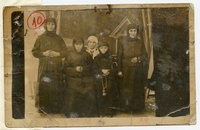 This photograph was confiscated in 1941 by the Siguranța, the Romanian secret police prior to Communism. It depicts four Old Calendarist nuns, also referred to as Stilists. A short handwritten text on the reverse states that it was taken on September 1st, 1939. The nuns are dressed in standard monastic clothes, their heads are covered and their black tunics entirely cover their bodies. In their hands, they hold “metaniere”, Eastern Orthodox prayer ropes. The “metaniera” is an important part of monastic dress and is used during prayer to aid concentration. The composition of the photograph and the screen with painted architectural features tells us that it was taken in a photo studio. Because the dress of Old Calendarist nuns was not distinguishable from those of Orthodox nuns from legally recognised monasteries, the women were able to travel freely without drawing undue attention of the authorities. The photograph was confiscated by the police from two nuns, Steliana Geancu and Anica Măzărel. They were discovered hiding in a hut, in the Pralea Woods, Bacău county. It was added to their penal file but it is unclear to which one of them it originally belonged. A short text on the reverse of the photograph suggests that it was used as a personal memento: “Aminitire, această fotografie este amia, Singlitichia, scoasă la 1 septembrie 1939. Aici este Ma. Chirichoia și Ma. Melania și Sara Iliana și M Singliticia Păcătoasa,” translated as “Memory, This photo is mine, Singlitichia, developed on September 1st 1939. Here are M. Chirichoia, M. Melania and Sara Iliana and M. Singlitichia the Sinner.” Both Steliana Geancu and Anica Măzărel were arrested and tried for Stilist propaganda in 1941. Old Calendarists emerged in 1924 after the introduction of the new calendar by the Orthodox Church. They were a group of Orthodox believers who rejected the newly adopted Gregorian calendar and went on to organize their religious life according to the “old style”, hence the name Stilists. They were condemned by both the Orthodox Church and state authorities which collaborated in identifying and prosecuting them. Often on the basis of local information provided by the Orthodox Church, the state deployed its security agencies, the police, the Gendarmerie and the Siguranța, to prevent Old Calendarist gatherings, arrest their leaders and disrupt the life of the community. In a number of cases, the intervention by the security services resulted in violence and casualties. State security archival sources report that the “Stilist phenomenon” had faded by 1940 and indeed, leading up to 1936, the most important leaders of the group had been arrested. However, the community continued to exist underground. Some began meeting in attics, cellars, or other secluded places, while others fled in the woods, where they hid in caves and huts. In this period the term “vagabond priests and nuns” was used to refer to those Old Calendarist members who wandered from community to community to avoid arrest. The photo image is found in the file CNSAS, P 096704. Together with the photo included in this entry, the police also confiscated Steliana Geancu’s and Anica Măzărel’s personal letters, icons and other objects. Of these, the letters, a handwritten prayer and a list of personal sins are included in the penal file. For further readings see: ”Primejdia stilismului în Basarabia și Moldova” in Universul, No. 52, February 22, 1936. For related entries see: