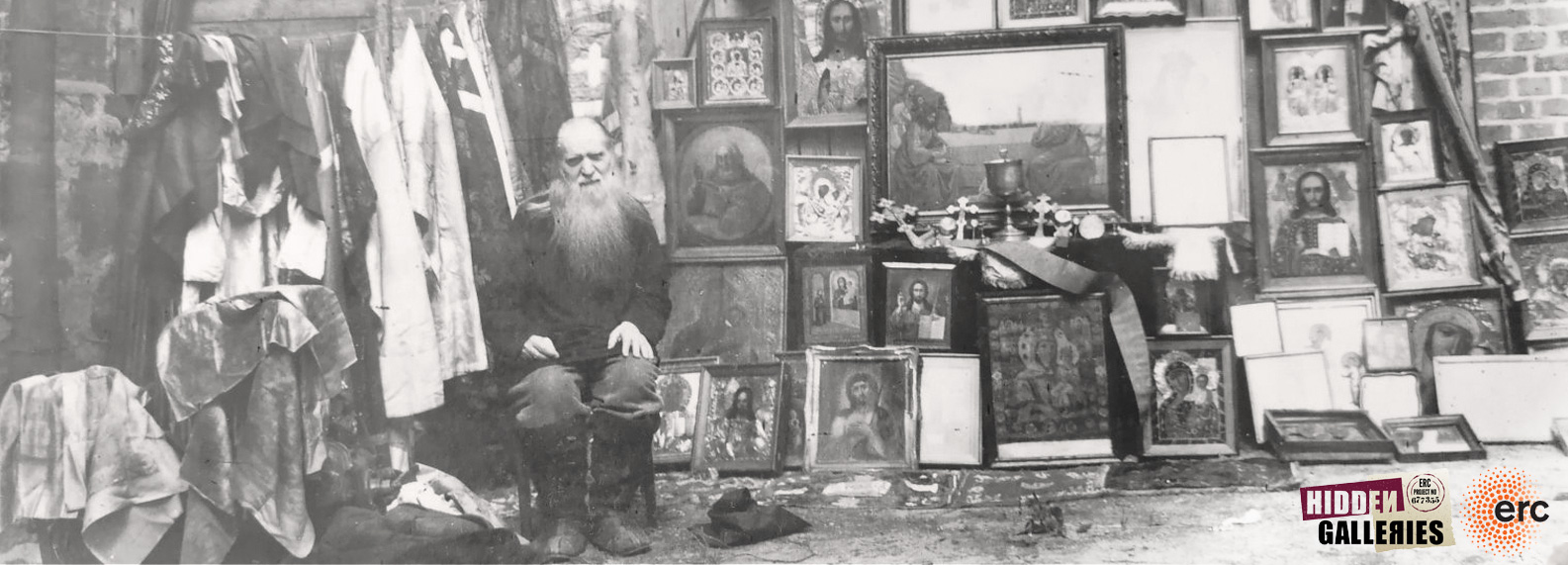
Religious manuscripts
Item set
- Title
- Religious manuscripts
- Description
-
Religious manuscripts were actively searched out by the secret police and used as incriminating evidence against believers. Handwritten copies of religious hymns, poetry, prophecies, homilies, heavenly letters, magical letters of happiness, as well as music scores and handwritten copies of religious books circulated within communities when published materials were not available. The secret police often confiscated religious manuscripts and registered them within criminal files which were later stored in archives. Few such religious manuscripts survive in secret police archives today as most of them were destroyed by the secret police following the completion of operations and the conclusion of trials. In addition to the surviving examples in secret police archives, some confiscated religious manuscripts were transferred to museums of atheism or anti-religious exhibitions popular in some socialist countries.
Most of the religious manuscript materials included in this digital collection are unique of their kind. - Creator
- Tatiana Vagramenko
- Publisher
- This project has received funding from the European Research Council (ERC) under the European Union’s Horizon 2020 research and innovation programme No. 677355
- Bibliographic Citation
- http://hiddengalleries.eu/digitalarchive/s/en/item-set/342
- Date Created
- 2018
Items
-
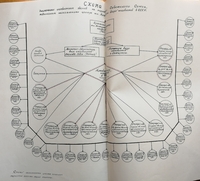 This network scheme of the Jehovah’s Witness organization comes from a four-volume top-secret file titled LKB, Legendirovannoe Kraevoe Biuro (Regional Bureau Covert Operation). It was produced by the Ukrainian secret police in 1953 and shows Jehovah’s Witness districts and circuits located in the Soviet Union with the organization’s country committee (called by that time the Regional Bureau) as the governing body of Soviet Jehovah’s Witnesses. The scheme shows the connections of Soviet-based groups of believers with the Jehovah’s Witness organization abroad: the East-European Bureau in Poland, the Romanian branch, the European centre in Switzerland and the Jehovah’s Witness headquarters in the USA on top of the network scheme. The secret operation (Regional Bureau Covert Operation) was launched by the Ukrainian MGB office in 1951, the same year the state organized a large-scale deportation of Witnesses from the western borderlands. It was suspended in 1954, soon after Stalin’s death. The operation aimed at infiltrating the Jehovah’s Witness underground organization in Ukraine (and later the entire Soviet Union) and to organize a Witness country committee as a covert operation. The plan was designed such that the Soviet security service became the head of the Jehovah’s Witnesses organization, and the headquarters of the official Watch Tower Bible and Tract Society (hereafter the Watch Tower Society), located in Brooklyn, became a channel in their counter-intelligence operations against the US. The scheme comes from the SBU Archives, fond 2, sprava 2432. The file also contains correspondence between the MGB office in Kiev and regional offices in western Ukraine, agent reports, surveillance reports, information on the structure of the Jehovah’s Witness organization in Ukraine, intercepted letters and samizdat publications. More about the secret operation and agent infiltration of Jehovah’s Witnesses in Soviet Ukraine see: Tatiana Vagramenko, KGB “Evangelism”: Agents and Jehovah’s Witnesses in Soviet Ukraine. Kritika: Explorations in Russian and Eurasian History, (forthcoming 2021) For related entries see:
 -
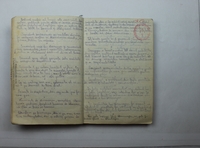
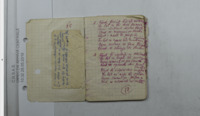 These images show a handwritten songbook that was confiscated from a Tudorist believer during a luggage inspection in 1975 whilst he was doing his military service. The first image shows the inside cover of the songbook, containing a short verse that reads: “And then, the whole eternity will be your prize, Because you were patient and kept yourself pure, For Him, and many hardships you have endured, But you kept yourself white and pure.” We also catch a glimpse of the first verses of a religious song. The following two images show other religious songs that he had handwritten. Because the songs are numbered we learn that there are 49 songs that he had collected and handwritten. The second image shows a song written by Nicolae Moldoveanu, entitled “Remain in Me” (Rămâneți în Mine). The third image represents the continuation of the short verse written on the inside cover. We learn, thus, that the song is called “Beloved Lily” (Crin iubit) and is a song written by Traian Dorz. Both Nicolae Moldoveanu and Traian Dorz were well-known religious figures and members of the Lord’s Army (Oastea Domnului) that suffered imprisonment and persecution during communism. The songs and hymns that they wrote are still valued and highly regarded by various religious communities, including the Tudorists and Neo-protestant communities. The size of the songbook is quite small, suggesting that its owner was trying to keep it secret or hidden. From a report that was composed following the event, as well as from a letter that the Tudorist believer had written, we learn that the songbook was found in one of his pieces of luggage during an inspection. It was confiscated along with a notebook, of which only the covers were attached to his file, as well as other religious books. The Tudorist believer was labelled as a “religious fanatic” and was accused of smuggling religious materials into the army. The fact that all these materials were attached to his file suggests that he was closely monitored by his peers during his military service. This songbook can be found in the file CNSAS, I 0456045. It also contains some personal letters, as well as reports and declarations of the people who were giving information about the Tudorist believer. For related entries see:
 -
 These images show a church songbook that was carefully handwritten by nun Olimpiada Petreanu sometime in 1940. The first image depicts the cover of the songbook. It conveys important information such as the owner of the songbook, the fact that it was a church songbook, “cântări bisericești”, and, in faded letters, the year when the songbook was written. The second and the third images show a small part of the content of the songbook, namely the so-called “canon of the soul”, which was dedicated to the Virgin Mary, and the Akatist of Jesus Christ. These are both important hymns and hymnal elements of the Orthodox tradition. The last image shows a short poem, or proverb, that states: “man is like a flower that is here and gone tomorrow, he now laughs and parties, tomorrow he lays in his grave.” It also shows the date, March 12 1940, and the signature of nun Olimpiada. These images illustrate the effort and care that was put into writing the songbook, which is colourful and carefully organized. Moreover, at a time when most women were illiterate, nun Olimpiada Petreanu was able to handwrite, draw and put together such a wonderful songbook that, fortunately, survived until today. Born in Răucești, Neamț county, Olimpiada Petreanu, whose lay name was Safta, is one of the nuns that was imprisoned at Vărzărești Monastery, in 1937. Vărzărești was one of the main places where Old Calendarist nuns were brought and, according to some Old Calendarist literature, they were forced to accept the New Calendar there. She wrote her first postcard from Vărzărești in May 1937, asking her parents to send her some food, her watch, some clothes and money. From the onset, we learn that she used to live at Old Agapia Monastery as she compares the location of Vărzărești Monastery with its location, and that she had partially lost sight in her right eye, an issue that is constantly mentioned in her correspondence with her family and acquaintances. According to the declaration of her father, she joined the monastery more than ten years prior to 1937, and after the Neamț Old Calendarist rebellion she allegedly lost the support of her family who chose to follow the new calendar. Based on the concerned tone of the postcards that she received from them, as well as the fact that they continued to send her packages and whatever she needed in order to make her detention easier to endure, it is difficult to believe that such was the case. The time of her release is uncertain and what we know about the rest of her life is based on the information gathered during ethnographic research. After her release, she was allegedly sent to Oniceni, Buzău county, where she founded a skete for nuns at Drăgușeni with the help of Glicherie Tănase, an important Old Calendarist bishop. She became the mother Superior of the skete and spent the rest of her life there. She died in January 2002 and left behind this songbook. These images were provided to the Hidden Galleries research team by the nuns of Mănăstirea „Buna Vestire”, Valea Roșie. For related entries see:
 -
 The three images show the personal notebook of Constantin Voicescu (1924-1997) that was confiscated by the Securitate after his second release from prison (1954. It contains 33 aphorisms and 17 religious poems that circulated within the Communist prisons especially among the legionary group labeled by the Communist authorities as "the mystics". The notebook contains four pages of short sentences (aphorisms) written in black crayon about religious experiences, how to achieve personal redemption through self-sacrifice or the imminent victory of Christianity over the armies of Satan (Communism). Most probably, these sentences belonged to the group of legionary prisoners (“the mystics”) who abjured their legionary convictions in favour of an intense commitment to religious life. Under the impact of prison life, these legionaries renounced their political activism in favour of incessant prayer to expiate the sins of the Nation and to convert people to non-violence. Attributed to Ion Ianolide, one of the members of the circle of legionary mystics, most of the sentences are very similar to those voiced by other mystics such legionary commander Traian Trifan (1899-1990), the leader of the group, and Valeriu Gafencu (1921-1952), one of his closest disciples, who Voicescu encountered during their stay in the prison-sanatorium at Târgu-Ocna. The second section comprises of 17 poems written in blue ink belonging to Valeriu Gafencu (Dor, Mi-s ochii triști, Rămas bun, Imnul învierii, În Noaptea Sfântă, Colind, Dar, Chemare, Cântec de leagăn, Frate bun, etc.) and Nichifor Crainic (Laudă, Potirul, Unde sunt cei ce nu mai sunt). In the case of Valeriu Gafencu’s poems, with a few exceptions (Chemare, Cântec de leagăn), all are structured explicitly as Christmas carols or with a chorus that lead us to think that most of these poems circulated in the prisons as songs. The transmission through music of these poems and, therefore, of the legionary religious message to absolve the sins of the Nation through self-sacrifice and passive acceptance of any sufferings, had both a mnemonic and missionary component. Mnemonic, to preserve the legionary message among the inmates and missionaries because one of the key points of the mystics’ program was that of spreading the gospel of legionary non-violence and the primacy of self-sacrifice for Fatherland through prayer and a quasi-monastic life. The images selected were part of a single surveillance file of several members of the group of legionary mystics questioned by Securitate officers in 1958-1959. Variants of these poems can be found in Orthodox and Greek Catholic communities today leading to the conclusion that after 1989 they became widespread inside Orthodox underground communities, and thus a useful method of passing information on the community through musical rather than textual means. The three images come from file CNSAS Penal fond P0000327, vol. 5. The penal file also contains surveillance photographs, intercepted correspondence, notes from informants, religious texts and samizdat.
 -
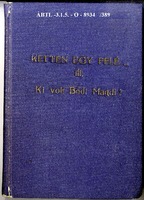 The first image depicts the cover of the samizdat book entitled Ketten egy felé… III. Ki volt Bódi Magdi (Two towards one… III. Who was Magdi Bódi?). The second image is the inside cover of the book with the text: Ketten egy felé… Szent Goretti Mária és Bódi Magdi utja. 1956, Karácsonyán. – Kézirant gyanánt.- (Two towards one… The life of St. Maria Goretti and Magdi Bódi. 1956, Christmas. -As manuscipt). The third image is a photograph of Magdi Bódi from the book with the caption below the image reading “Fűzfő angyala”, “The Angel of Fűzfő.” The last image is of page 204 of the confiscated book and depicts the tomb of Magdi Bódi in the village of Litér and the caption reads: A litéri sír… Magdi! – Élsz Krisztusban!...(The tomb in Litér… Magdi! You live in Christ!). The typewritten book is an account of Mária Magdolna Bódi (1921-1945), a working-class girl from Balatonfűzfő. Her life story is paralleled with that of the martyr St. Maria Goretti. Magdi Bódi was a young Catholic girl who had made a vow of chastity to Christ. She was active in organizing faith life in Balatonfűzfő having initiated the local group of the Hungarian Catholic Working Women’s Movement. According to the book, Magdi Bódi’s parish priest instructed her to always keep a knife or scissors with her in order to be able to defend herself against the violence of the Soviet soldiers. In 1945 a Soviet soldier shot her as she was trying to protect herself from sexual assault. The typewritten book contains original photograph illustrations of Magdi, some with her family and one of her tombstone with a crucifix. In the dossier, the tomb of Magdi Bódi is discussed as a place of gathering of reactionary priests and sisters. The samizdat book was written by a Catholic abbot, Dr. Miklós Galambos, in 1955. He had heard of Magdi Bódi’s martyrdom while imprisoned in Veszprém. The book is the third part of a series. The first two parts of the book series tell of the life of St. Maria Goretti. The content of the book is discussed in the dossier as anti-Soviet content in the guise of religion. The book was confiscated from Dr. István Kiss, professor of theology and vice-director of the Theological College of Eger. Dr. Kiss was the target of the operative dossier in which the book is located as he was a representative in the Hungarian National Assembly for the Independent Smallholders’ Party and had strong connections with the high clergy and the democratic opposition leaders between 1945-48. Authorities judged him to be reactionary and he was under surveillance from 1951 onwards. His name occurs in several other secret police dossiers as he was openly anti-communist and is accused of educating the seminary students of the Theological College in this mentality. Dr. Kiss was interrogated in 1958 and on several other occassions for spreading the illegal samizdat entitled “The Angel of Fűzfő.” His ownership of the book was used as evidence against him. After 1989 there has been a growing cult of Magdi Bódi, especially in her home town where she was buried. Her beatification process was initiated by the Hungarian Catholic Church in 2017. The images and the book are found in ÁBTL 3.1.5. O-8934 along with intercepted letters to Dr. Kiss, an operative plan to disclose the details of the circulation of the illegal book and interrogation reports.
 -
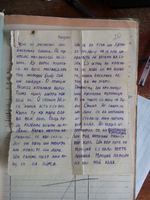 The images show an Inochentist handwritten hymn found by the Soviet secret police officers on an arrested Inochentist preacher in 1952 in Moldova. The hymn describes Jesus's preaching to his followers on the Mount of Olives about the End Time. The Apocalypse, according to the hymn, will begin when people would abandon the church. Then, according to the narrative, the wrath of God would descend on sinners and only those who do not abandon the true faith will be saved. The hymn is written in Romanian using the Cyrillic script. The preacher, who may not be the author of the text but was probably the copyist, wrote his surname at the end of hymn under a decorative drawing. The hymn served as evidence in the case file of the Inochentist preacher on whom it was found. The preacher was charged with sedition and anti-soviet propaganda and was sentenced to 25 years in a labor camp. From the perspective of the police investigation, the Inochentist narratives about the End Time were useful for their investigations because they labeled those “who left the Church” as sinners who were about to be struck down by God’s wrath. The officers perceived the hymn as an attempt by the Inochentist preachers to exploit the “religious superstitions” of the peasantry in order to label the Soviet regime and its representatives as “sinners” that were about to be punished by God. The hymn is attached to file number 3815, fond R-3401, from the National Archive of the Republic of Moldova. The file contains two mugshots and the above mentioned hymn. For related entries see:
 -
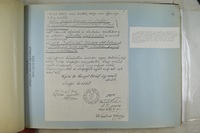 The first image comes from a photo album compiled by the Securitate on the Hungarian Calvinist Church Choir in the town of Ocna Sibiului (Vízakna). It shows a photocopy of a confiscated document, the last page of the choir’s president’s celebratory speech performed at the choir’s 80th anniversary. As with many of the group’s documents, it bears the official stamp of the choir. The second photo shows a document with a hand drawn replica of this stamp. This document, which is the last page of a handwritten copy of the choir’s Rules and Regulations from 1974 (its original was written in 1956), is still kept in the local Calvinist church. The stamp, along with a large part of the choir’s documentation was taken during a secret police raid in 1973 when authorities accused the choir of nurturing nationalist-irredentist ideals behind the façade of their church functions and of being hostile to the socialist Romanian state. It was claimed that the choir’s real aim was to maintain the national identity of the local Hungarian minority and to instil Hungarianess in the next generation. Although the choir was allowed to operate after the raid, it was “robbed of its past” since none of the confiscated items were returned. Some attempts were made to compensate for this loss: for example, several documents were recreated by the choir’s former secretary who, in lieu of the missing stamp, created a hand-drawn replica when necessary. This practice serves as an example of how groups that had been pursued by the secret police tried to cope with the loss of their belongings: in this case the loss of the choir's recorded history and an important symbol of its legitimacy, its stamp. The Ocna Sibiului Calvinist Church Choir was founded in 1889. From 1907 it officially operated as an association with a president, secretary, accountant and had its own banner and stamp. Its main task was to sing at the funerals of congregation members and at church services but was also central to organising community life for local Hungarians. The choir still functions today. The first image comes from file CNSAS D 015847. The second was taken during ethnographic fieldwork in 2018. For related entries see:
 -
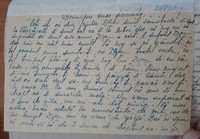 These images show a postcard sent by an Old Calendarist nun to her family whilst in detention. It is a particularly sensitive letter as it conveys the struggles of the nun who appears to have been rejected by her parents for reasons that are not clear from the information we have. The first image shows the face of the postcard and it contains references to the sufferings that the nun had endured for the last two years. From the message that she wrote to her parents, she seems to accuse them of having forgotten about her during these hardships and she reminds them that she is still their daughter and shares the same rights as her other sisters. The reason for her being treated like this by her parents are not described in the postcard but she makes a statement that might hint at it: “ I always cry and pray to God that He won’t abandon you, that you will get to know the good and the bad.” The statement could imply that her parents were religious and disagreed with her decision of becoming a nun or that they might have accepted the New Calendar, thus putting them at odds with her adherence to the Old Calendar. The second image shows the back of the postcard. It contains information that makes it clear that the postcard was sent from Vărzărești Monastery, one of the Orthodox monasteries where Old Calendarist nuns were detained and, according to some Old Calendarist literature, forced to accept the New Calendar. The nun asks her family to come and visit her, she wishes them happy holidays and asks for forgiveness. This postcard offers us a glimpse of the emotions and personal challenges faced by nuns and women who rejected the Orthodox Church calendar reform. This is contrasted by the very different image of Old Calendarist women that was portrayed in the press and Orthodox Church publications of the time. The author of this postcard chose to suffer because of her religious convictions. Although the archives do not preserve a reply to her postcard and we are not aware of her fate, she seems convinced that there is reason to her suffering for her faith. This is a recurrent theme in the letters and postcards written by Old Calendarist women in detention. These images can be found in the file ANIC, Insp. Gen. al Jand., D 25/1937. Apart from this postcard, it contains many more letters and postcards sent or received by Old Calendarist nuns that were detained at various Orthodox Monasteries in Romania. For related entries see:
 -
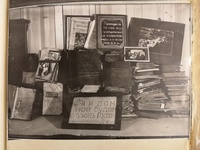 The images come from a 2-volume criminal case against fourteen followers of the Reformed Adventist movement in the provincial town of Bila Tserkva, Ukraine dating from 1952. All of the arrested believers were poor, barely literate Ukrainian peasants who practiced their faith privately in their homes. All of them were found guilty of anti-Soviet activity and refusal of military service and were deported to the Gulag. The photographs show religious manuscripts, books and photographs confiscated during their arrest. The images of the confiscated items were included in the file as evidence of the criminal activity of the group. The original books and photographs were later destroyed (a full list of confiscated items is included in the file). In the first image, along with the pile of manuscripts, we can see several photographs, including one picturing a collective baptism. The second image shows two photographs pasted over a sheet of a file. The upper photograph depicts handwritten manuscripts and published books and journals; in the bottom photograph we can see nicely framed posters with religious passages and citations from the Bible that seemingly were hung on the walls of their houses. The third image depicts confiscated journals with sheet music. It remains unclear why a group of believers defined in the criminal case as almost illiterate possessed such large number of religious books and manuscripts. These photographs come from the State Archive Branch of the Security Services of Ukraine in Kyiv, f. 6-fp, spr.58859. The file contains six photographs, arrest forms of the repressed believers with their arrest photographs, numerous interrogation reports, the indictment and other documents. More about this case see: Kuromiya, Hiroaki. Conscience on Trial. The Fate of Fourteen Pacifists in Stalin’s Ukraine, 1952-1953. University of Toronto Press, 2012. For further readings about the Adventist Church in Ukraine and the Soviet Union see: Lohne, Alf. Adventists in Russia. Washington, DC: Review and Herald Pub. Association, 1987. Parasei A.F. and N.A. Zhukaliuk. Bednaya, brosaemaia bureiu… Istoricheskie ocherki k 110-letnemu iubileiu Tserkvi adventistov sed’mogo dnia v Ukraine. Kiev: “Dzherelo zhittia”, 1997. Sapiets Marite. True Witness: The Story of Seventh-day Adventists in the Soviet Union. Cambridge: Keston Institute, 1990. Teppone, Vladimir. Iz istorii Tserkvi adventistov sed’mogo dnia v Rossii. Kaliningrad: Tserkov Khristian ASD, 1993. For related entries see:
 -
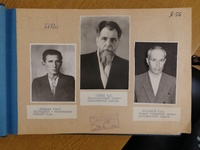 These photographs come from a KGB internal publication which is in the form of a photo album. It features arrested Ukrainian Greek Catholics, Josyf Slipyi, Ilia Blavatsky and Vasyl Kavatsiv and was published in Krasnoyarsk in 1958. The photographs of the arrested persons open the photo album (Image 1). The image of the metropolitan Josyf Slipyi, the head the Ukrainian Greek Catholic Church, is placed in the centre. Vasyl Kavatsiv (left), an underground priest and a secret monk, is defined under his photo as a nationalist, closely linked to Blavatsky. Ilia Blavatsky (right) was a Greek Catholic priest and one of the most trusted of Slipyi’s companions. The second image shows Slipyi’s desktop with manuscripts and newspaper cuttings confiscated during the police search. The third image shows Slipyi’s manuscript of the 5th volume of “The History of the Church in Ukraine” which was used as incriminating evidence against him. It was found by the police in the house of one of Slipyi’s friends. The fourth image shows religious items found by the police in Blavatsky’s house. The final image shows a barrack where Ilia Blavatsky, together with his parents and sisters, lived in exile. The house was located in a special settlement for exiled people in Krasnoyarsk (Eastern Siberia). Before it was moved to the secret police archive, the photo album had been kept in the internal “Chekist library” and seemingly served as an educational manual. It contains photographs of the police search with copies of confiscated manuscripts, correspondence and ritual items, as well as photographs of houses in the Siberian special settlements where religious leaders lived in exile after their release from prison. Apparently the photo album was based on the materials from a penal case against Josyf Slipyi, as most of the photographs place the police search of Slipyi’s residence in the home for disabled people in the Krasnoyarsk region in 1958. The police search was followed by his arrest and second imprisonment in 1959. He spent in total 18 years in labour camps. During the 1940-1950s, the organization of the Ukrainian Greek Catholic Church was virtually wiped out in the Soviet Union. The church was suppressed as it was accused of being closely related to the Ukrainian Insurgent Army (UPA) and the Organization of Ukrainian Nationalists (OUN), illegal in the Soviet Union. In 1945-1946, the Soviet authorities initiated a forced reunification of the Ukrainian Greek Catholic Church with the Russian Orthodox Church, Moscow Patriarchate. Stalin signed the directive on the liquidation of the church and the secret police were placed in charge of the operation. As a means of intimidation, all Ukrainian Greek Catholic bishops, the metropolitan and over 800 priests were arrested during the liquidation campaign. Those clergy and faithful believers that refused to a forced conversion to Orthodoxy were driven underground, forming the largest catacomb church in the Soviet Union. By the time of its liquidation, the Ukrainian Greek Catholic Church had 4 dioceses, one metropolitan, 7 bishops, over 2,400 priests, 1600 monastics, and nearly 4 million believers with only 30% of clergy having accepted the reunification with the Russian Orthodox Church. Believers and clergy were persecuted throughout the entire Soviet period. Thousands of them, including metropolitan Josyf Slipyi, were sent to GULAG or deported. The church received legal recognition only in 1989 during Perestroika. The images come from the State Archive Branch of the Security Services of Ukraine in Kiev. The file reference is: fond 13, sprava 584. For related entries see:
 -
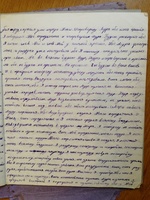 This is a manuscript with a Pentecostal prophesy confiscated in 1953 from an arrested Ukrainian woman, who was known as a Pentecostal prophetess. The prophecy is handwritten in a notebook and is 15-page long. It narrates the coming death of Ashur, who will be overthrown from his throne by God and will be shot dead. After his death, all the prisoners will be released and people will live in freedom. The prophecy also stresses a special religious role of Ukraine and Kiev, its capital, that will become a place of great spiritual awakening. The item comes from the 1953 MGB penal case against four Pentecostal believers, all Ukrainian women. The manuscript with the prophecy was used by the MGB as incriminating physical evidence of their “anti-Soviet propaganda”, including “dissemination of libels against Soviet leaders”. The “Anti-Soviet Agitation and Propaganda”, the infamous article 58 of the Penal Code, was a common criminal offence used to incriminate to religious believers in the Soviet Union. Officially believers could not be persecuted for their religious beliefs, as the Soviet Constitution granted religious freedom on paper. Penal cases against religious believers were fabricated in terms of extreme politicisation of religious practices. A KGB report from 1963 states, “We do not fight against believers or religion, but we do fight against the use of religion by anti-Soviet elements… in hostile to the Soviet state purposes”. The image of Ashur resembles Stalin, however, in one place of the prophecy Ashur is called Vyshinsky – the minister of foreign affairs in 1949-1953 and one of the main organizers of Stalin’s great terror, who signed thousands of death penalties in the 1930s. On the second image, the following sentences were underlined by an MGB officer, as supposedly having a distinct anti-Soviet meaning: “And liberty [volia] and freedom will follow soon; the days of freedom are approaching. For Ashur will be overthrown. And people will be called. I will call up people from many countries, and they will arrive and will [condemn] Ashur. The end has come, they call Ashur to death, for Ashur will be shot dead. Oh, oh, oh the storm will arrive for there will come the great bloodshed..." The prophecy goes on to recount how all prisoners will be released and how Kiev, the capital of Ukraine, will become the new Jerusalem. The "wandering prophetess", as she was described by the MGB, led a Pentecostal community in Kiev and travelled throughout Ukraine and as far as Siberia, preaching among religious communities. She was arrested in 1953 along with three other women pentecostal believers and sentenced to 25 years in labour camps. At this time there were a number of “illegal” religious groups in Soviet Ukraine referred to as the “religious underground”. They were regarded “harmful for the state by the very fact of their existence and the character of their activity”. In 1944, the All-Union Council of Evangelical Christians-Baptists was formed as the only recognised umbrella church body of all branches of Evangelical Christians. The communities that refused to enter the Council, including many Pentecostal groups, were considered criminal. Ukraine was the hotspot of Soviet-era religious persecutions as it was the place of the largest Christian Evangelical communities in the entire Soviet Union. Ukrainian Pentecostalism developed a particular culture of prophets, who were wondering across the wider region, preaching and gathering new communities. By the time of this penal case in 1953, according to the Soviet authorities, there were approximately 200 unregistered Pentecostal communities in Ukraine with over 200 prophets and prophetess. This manuscript comes from the State Archive Branch of the Security Services of Ukraine, fond 6, spr. 60259. The file contains records of arrest and transcripts of interrogations of four Pentecostal women on trial, transcripts of interrogations of witnesses, as well as a closing indictment, court records and a final court sentence. Two women (including the author of the manuscript) were sentenced to 25 years and two others to 10 years in labour camps. Alongside the manuscript reproduced here, the file contains one more notebook with handwritten religious writings and a press-cutting with an image of the American President Harry S. Truman. These confiscated items were also used as incriminating physical evidence against the arrested women. Twenty confiscated photographs and twenty one personal letters of believers were later destroyed as having no relevance to the case. For related entries see: