Religious minorities in Ukraine: Irish Research Council project
Item set
- Title
- Religious minorities in Ukraine: Irish Research Council project
- Релігійні меншини в Україні: проект Ірландської Дослідницької Ради
- Description
-
This collection of entries is funded by Irish Research Council, Government of Ireland as part of the project “Religious Minorities in Ukraine from the Soviet Underground to the Euromaidan: Pathways to Religious Freedom and Pluralism in Enlarging Europe” (GOIPD/2017/764), PI – Tatiana Vagramenko, University College Cork.
The project traces the continuity and transformation of the social and political agency of religious minorities in Ukraine: from their withdrawal into fundamentalist underground in the Soviet period, to their legalization and public resurgence in post-Soviet Ukraine, and transformation into a visible and vocal public force during the Euromaidan Revolution.
The project utilizes recently opened files of the Soviet secret police in Ukrainian archives. These secret documents contain unique data that can shed light on the cultural life of popular religious movements that have remained largely unknown due to restricted access to archival materials. Access to these archives has only become possible because of the political changes that Ukraine has undergone in the post-Maidan period. -
Ця колекція була зібрана завдяки фінансуванню Ірландської Дослідницької Ради, уряду Ірландії, в рамках проекту “Релігійні меншини в Україні від радянського підпілля до Євромайдану: Шляхи до релігійної свободи і плюралізму у зростаючій Європі” (GOIPD/2017/764), дослідник – Тетяна Ваграменко, Університет Корка.
Проект досліджує історію та соціальну і політичну трансформацію релігійних меншин в Україні: від їхнього вигнання у фундаменталістське підпілля за часів Радянського Союзу, до легалізації і публічного відновлення у пост-радянській Україні, а також їх трансформацію у видиму і відчутну соціальну силу під час революції Євромайдану.
Проект використовує нещодавно розсекречені матеріали з українських архівів радянської таємної поліції. Ці документи містять унікальну за значенням інформацію, що допомагає пролити світло на культурне життя народних релігійних течій, що до цього часу лишались невідомими через обмежений доступ до архівних матеріалів. Розсекречення цих архівів стало можливим тільки завдяки політичним змінам, що Україна пережила у період після Майдану. - Creator
- Tatiana Vagramenko
- Publisher
-
This project has received funding from the European Research Council (ERC) under the European Union’s Horizon 2020 research and innovation programme No . 677355
The research for this collection was funded by Irish Research Council, GOIPD/2017/764 - Bibliographic Citation
- http://hiddengalleries.eu/digitalarchive/s/en/item-set/293
- Date Created
- 2018
Items
-
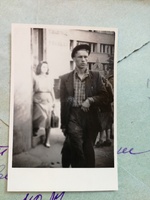
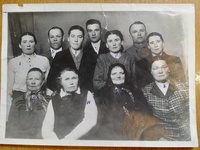 This photograph was enclosed in a KGB surveillance file from 1952-1955 on Jehovah’s Witnesses in the Rivno region, western Ukraine. The image pictures a group of Jehovah’s Witnesses from the Rivno region. It was enclosed in an envelope along with 6 other confiscated or intercepted photographs. Each depicted person was marked with a number and on the reverse side a secret police officer wrote their names, date of birth, information on their origin and place of residence, as well as their role within the Jehovah’s Witness organization, such as: “ordinary member of the underground,” “active Jehovist,” preacher, group elder, or “courier of the Jehovist underground”. Nearly all of them were marked as objects of surveillance as part of the agent operation “Zavet”. Another envelope enclosed copies of intercepted Jehovah’s Witness literature: several booklets and 12 issues of the Watchtower journal. As evidenced from one of the documents, it was an informer under a codename Poliakov (a Jehovah’s Witness recruited by the KGB) who passed the literature to the secret police. From his report we learn that he met a Witness courier named Varvara Senkevich (marked 5 in the photograph) and several other believers in Rivno. Senkevich gave this literature to a believer not knowing that he was a KGB informer. She asked him to distribute the Watchtower journals among brothers and sisters. The agent meeting with Senkevich and her co-believers in Rivno was part of a secret operation “Zavet”, the aim of which was to recruit Witnesses as agents and informers in order to intercept detailed information on the organization’s leadership in western Ukraine, disclose underground printing presses in the region and believers’ communication channels with exiled or imprisoned Jehovah’s Witnesses, as well with those living in other regions or abroad. Senkevich herself was also a potential target for recruitment by the KGB because her role as a Jehovah’s Witness courier could reveal sensitive information on clandestine communication channels within the organization. In the 1950s, the Ukrainian secret police launched several secret operations that targeted Jehovah’s Witness leadership and aimed to disclose Witness clandestine groups and their system of communication. The agent network was believed to be the main weapon in the fight against the religious dissent. There were about 200 agents and informers working in the Witness underground in the mid-1950s in western Ukraine. Most of them were recruited from within the Witness organization, many had tragic experiences with their close families imprisoned or exiled. Some of them had been and would be (after their service with the security police) arrested and tried. All of them were recruited by straightforward blackmail. However, as some historical accounts reveal, Witnesses were aware of agent infiltration and KGB surveillance and knew names of many agents and informers. They were also aware of some secret operations carried out against them. While being shadowed by the secret police, they shadowed KGB officers too. Counter-infiltration was another pattern of their everyday resistance. Some believers intentionally entered the informers’ network or were chosen to become collaborators by their own congregations. Appointed agents delivered partial or less sensitive information in exchange for getting to know KGB plans and operations. Other believers wrote fake denunciations to mislead the secret police. The photograph comes from the SBU archives, fond 2, sprava 2592. The file contains materials on several agent operations amongst Jehovah’s Witnesses in the Rivno region, information on agent recruitment, compromising evidence that could be used as blackmail during recruitment, surveillance reports, and correspondence between KGB branches. For related entries see:
 -
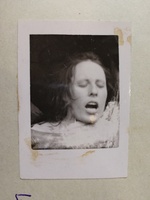 These arrest photographs come from a 1952 secret police penal file on a group of 23 believers who were arrested in the Kiev region of Ukraine. The file contains two versions of their arrest photographs taken by the MGB officers. As the photos were being taken, the believers intentionally closed their eyes, turned their heads away, or sang while the officers tried to restrain them. Their gloved hands are clearly visible in the images. Police officers later tried to correct these “tainted” photographs by removing the evidence of their violent intervention from the prints, which one can see in the spruced-up copies with the hands of the policemen roughly shaded out. The handless photos were used in the formal documentation of the case, while the smaller-size, original photos with the hands were appended to the back of the arrest questionnaires. The MGB official closing indictment charged the group with conducting anti-Soviet activity and propaganda as members of the “ecclesiastical-monarchist organization ‘the True Orthodox Church.’” However, no one knew much about them. Their co-villagers described them as Stundists or Baptists and knew nothing more than the fact that, even though they displayed Orthodox icons, crosses and church books in their homes, they never went to Orthodox Church and did not recognize Orthodox priests. The members of the group lived isolated lives; they rarely talked to their neighbours, avoided representatives of the Soviet authorities and never discussed their faith except to repeat the phrase: “God knows” (Bog znaet). All we know about them now is that they were poor peasants who gathered for prayer in secret in their homes, sometimes travelling between villages to pray together. They refused to enroll in local collective farms or to work at other state enterprises, never paid taxes or registered for other Soviet documents, and never used money (“the mark of the dragon”) or sent their kids to public school. The pre-trial review of the believers was brief: a mere three days of interrogations and then an additional night of twenty-two orchestrated confrontations between the arrestees and witnesses (conducted from 9pm until 4am). During the review, the believers refused to answer questions, responding to everything by saying simply “God knows” or “I will only answer to the Judgment of God.” During the whole process they never stopped singing and praying. They continued when the police came for them, as their arrest photographs were being taken, during the interrogations that preceded their trial and even during the court hearing. The case lasted 9 days between the arrests and the court hearing with the final decision of 25 years in labour camps handed down to most of the defendants. For more about the case see: Tatiana Vagramenko, Gabriela Nicolescu, The Hand at Work or How the KGB File Leaks in the Exhibition. In Martor Journal (forthcoming, 2021). For related items see:
 -
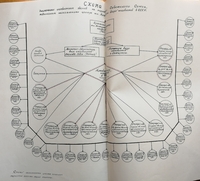 This network scheme of the Jehovah’s Witness organization comes from a four-volume top-secret file titled LKB, Legendirovannoe Kraevoe Biuro (Regional Bureau Covert Operation). It was produced by the Ukrainian secret police in 1953 and shows Jehovah’s Witness districts and circuits located in the Soviet Union with the organization’s country committee (called by that time the Regional Bureau) as the governing body of Soviet Jehovah’s Witnesses. The scheme shows the connections of Soviet-based groups of believers with the Jehovah’s Witness organization abroad: the East-European Bureau in Poland, the Romanian branch, the European centre in Switzerland and the Jehovah’s Witness headquarters in the USA on top of the network scheme. The secret operation (Regional Bureau Covert Operation) was launched by the Ukrainian MGB office in 1951, the same year the state organized a large-scale deportation of Witnesses from the western borderlands. It was suspended in 1954, soon after Stalin’s death. The operation aimed at infiltrating the Jehovah’s Witness underground organization in Ukraine (and later the entire Soviet Union) and to organize a Witness country committee as a covert operation. The plan was designed such that the Soviet security service became the head of the Jehovah’s Witnesses organization, and the headquarters of the official Watch Tower Bible and Tract Society (hereafter the Watch Tower Society), located in Brooklyn, became a channel in their counter-intelligence operations against the US. The scheme comes from the SBU Archives, fond 2, sprava 2432. The file also contains correspondence between the MGB office in Kiev and regional offices in western Ukraine, agent reports, surveillance reports, information on the structure of the Jehovah’s Witness organization in Ukraine, intercepted letters and samizdat publications. More about the secret operation and agent infiltration of Jehovah’s Witnesses in Soviet Ukraine see: Tatiana Vagramenko, KGB “Evangelism”: Agents and Jehovah’s Witnesses in Soviet Ukraine. Kritika: Explorations in Russian and Eurasian History, (forthcoming 2021) For related entries see:
 -
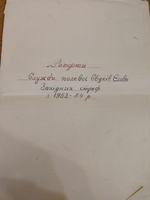 Being surveilled and under constant risk of arrest, many clandestine religious communities developed their own coded language to communicate with each other and with their religious centres. This enabled them to avoid the disclosure of sensitive information in case of arrest and confiscation. Jehovah’s Witnesses were among the groups who developed their own coded system of communication, which they used in their missionary materials and finance reports and tallies. The secret police, in turn, made great efforts to intercept clandestine communication channels and to decipher coded messages. The missionary tallies you can see here were confiscated by the Soviet KGB from a group arrested Jehovah’s Witnesses in Western Ukraine. They report about the so-called “field service” of Witness Western circuits in Ukraine during 1953-1954. The encrypted reports contain information about the number of believers in local groups, the amount of religious literature produced and distributed and hours spent evangelizing, as well as information about prayer meetings and Bible study groups, christenings and other religious events. The confiscated reports were discovered by the police in an underground bunker and were later attached to a case file and were used as an incriminating evidence of organized proselytism by Jehovah’s Witnesses, an illegal sect in the Soviet Union. The images come from the State Archive Branch of the Security Services of Ukraine, fond 5, spr. 42795, vol. 14. The 27-volume case file against seven Witnesses from Ukraine contain hundreds of interrogation records, arrest questionnaires, photographs, confiscated religious materials and personal items. For related entries on:
 -
 These photographs come from a KGB surveillance file on Jehovah’s Witnesses in Ukraine, 1955-1956. The photographs, which were taken with a hidden camera, capture the meeting of a KGB agent with a group of Witnesses in the town of Morshyn, western Ukraine. The agent was a Witness minister recruited by the KGB as an informer. He was appointed by the secret police to meet with members of the Jehovah’s Witness regional committee in Ukraine in order to gain their confidence and to intercept the communication channels of Ukrainian Jehovah’s Witnesses with their headquarters abroad. During one of the meetings, the agent intercepted and copied the country missionary reports sent from Ukraine to the Polish Jehovah’s Witness office and later submitted it to the KGB. The handwritten copies are attached to the file. A month later, two of the Witnesses from the meeting were arrested. After the annexation of western Ukraine in 1939, and particularly with the beginning for the Cold war, the Soviet state launched a full-scale attack against the Jehovah’s Witnesses living in the western borderlands of the country. In the period between 1947 and 1953 alone, the state arrested about 2,000 Witnesses in western Ukraine, confiscated hundreds of thousands of journals and leaflets and destroyed several underground printing presses. Alleged emissaries of the American intelligence services, Ukrainian Jehovah’s Witnesses faced two mass deportations in 1949 and 1950. The repression nearly wiped out the organizational structure of the Jehovah’s Witnesses and fractured their coherent network of close-knit communities in Ukraine. As part of the plan to repress them, the KGB carried out several secret operations that aimed to infiltrate the Jehovah’s Witness leadership with KGB agents and informers. There were about 200 agents and informers working in the Witness underground in western Ukraine in the mid-1950s. Several KGB informers became important figures within the Jehovah’s Witness organization, entered the country committee, travelled abroad and established communication with higher level Witness centres in Poland and Switzerland. Many Witness couriers who smuggled information from the Soviet Union abroad were under the control of the KGB. This is how the secret police obtained detailed and up to date information about the religious underground. The subsequent history of the Jehovah’s Witnesses in the Soviet Union, however, demonstrates that neither KGB agent infiltration nor mass deportation prevented the survival or indeed the steady growth of the organization. The images come from the State Archive Branch of the Security Services of Ukraine, fond 2, op.1, spr. 2677. Along with 6 photographs, the file contains numerous reports on surveillance and informer recruitment, reports on the arrest of Witness leaders, agent reports, character assessments of informers, copies of interrogation reports, fragments of intercepted letters and tallies of Jehovah’s Witness membership. For related entries see:
 -
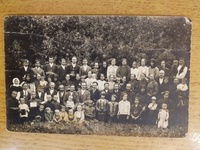 This photograph was confiscated in 1948 by the Soviet secret police from a Romanian peasant repressed as a follower of the Reformed Adventist Church in Chernivtsi oblast (former Northern Bukovina), Ukraine. The photograph was included in his criminal file. It pictures a community of Romanian Adventists who are festively dressed with most of them holding Bibles as a symbol of their faith. Apart from this photograph the police also confiscated a notebook with religious songs handwritten in Romanian language. According to the file, Vasilii Litvan was a poor, illiterate Romanian peasant who lived in the small village of Pripruttia all his life. He was born at the time when Northern Bukovina was part of Romania and he was baptised by a Romanian Adventist missionary in 1924. In 1931, following the teachings of missionaries from Transylvania, he joined the Reformed Adventist movement. Before the annexation of Northern Bukovina by the Soviet Union and during WWII, when Romania temporarily regained Northern Bukovina, Litvan was twice sentenced for his beliefs by the Romanian courts. His third sentence in 1948, was received from a Soviet court. This time he was sentenced to 10 years in a labour camp. As evidenced from the file, the secret police also created a separate criminal case against 17 other of Litvan’s fellow-believers from his village, including his wife. The Reformed Adventist movement, which had split from the Church of the Seventh-Day Adventists, was banned in the Soviet Union. Its followers rigorously followed the sixth commandment “Thou shalt not kill” and therefore refused military service, obligatory in the Soviet Union. They also had specific dietary restrictions and were vegetarians. Most of the repressed Reformed Adventists in the Soviet period were charged for their refusal to serve in the Red Army and for so-called anti-Soviet activity and propaganda. This photograph comes from the Archive of the Security Services of Ukraine in Chernivtsi oblast, spr. 5821-П. Apart from this image, the file contains Vasilii Litvan's arrest form with his mugshot arrest photograph, interrogation reports, the indictment, a confiscated notebook and a document relating to his rehabilitation issued in 1992. For further readings see: Kuromiya, Hiroaki. Conscience on Trial. The Fate of Fourteen Pacifists in Stalin’s Ukraine, 1952-1953. University of Toronto Press, 2012. Lohne, Alf. Adventists in Russia. Washington, DC: Review and Herald Pub. Association, 1987. Parasei A.F. and N.A. Zhukaliuk. Bednaya, brosaemaia bureiu… Istoricheskie ocherki k 110-letnemu iubileiu Tserkvi adventistov sed’mogo dnia v Ukraine. Kiev: “Dzherelo zhittia”, 1997. Sapiets Marite. True Witness: The Story of Seventh-day Adventists in the Soviet Union. Cambridge: Keston Institute, 1990. For related entries see:
 -
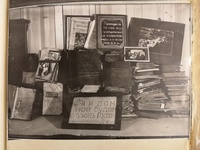 The images come from a 2-volume criminal case against fourteen followers of the Reformed Adventist movement in the provincial town of Bila Tserkva, Ukraine dating from 1952. All of the arrested believers were poor, barely literate Ukrainian peasants who practiced their faith privately in their homes. All of them were found guilty of anti-Soviet activity and refusal of military service and were deported to the Gulag. The photographs show religious manuscripts, books and photographs confiscated during their arrest. The images of the confiscated items were included in the file as evidence of the criminal activity of the group. The original books and photographs were later destroyed (a full list of confiscated items is included in the file). In the first image, along with the pile of manuscripts, we can see several photographs, including one picturing a collective baptism. The second image shows two photographs pasted over a sheet of a file. The upper photograph depicts handwritten manuscripts and published books and journals; in the bottom photograph we can see nicely framed posters with religious passages and citations from the Bible that seemingly were hung on the walls of their houses. The third image depicts confiscated journals with sheet music. It remains unclear why a group of believers defined in the criminal case as almost illiterate possessed such large number of religious books and manuscripts. These photographs come from the State Archive Branch of the Security Services of Ukraine in Kyiv, f. 6-fp, spr.58859. The file contains six photographs, arrest forms of the repressed believers with their arrest photographs, numerous interrogation reports, the indictment and other documents. More about this case see: Kuromiya, Hiroaki. Conscience on Trial. The Fate of Fourteen Pacifists in Stalin’s Ukraine, 1952-1953. University of Toronto Press, 2012. For further readings about the Adventist Church in Ukraine and the Soviet Union see: Lohne, Alf. Adventists in Russia. Washington, DC: Review and Herald Pub. Association, 1987. Parasei A.F. and N.A. Zhukaliuk. Bednaya, brosaemaia bureiu… Istoricheskie ocherki k 110-letnemu iubileiu Tserkvi adventistov sed’mogo dnia v Ukraine. Kiev: “Dzherelo zhittia”, 1997. Sapiets Marite. True Witness: The Story of Seventh-day Adventists in the Soviet Union. Cambridge: Keston Institute, 1990. Teppone, Vladimir. Iz istorii Tserkvi adventistov sed’mogo dnia v Rossii. Kaliningrad: Tserkov Khristian ASD, 1993. For related entries see:
 -
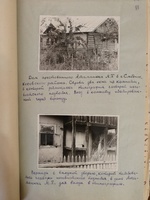 These images were included in a 14-volume criminal file against seven Jehovah’s Witnesses (JW) leaders from western Ukraine (former Drohobych and Stanislav region), 1955-1956. The photographs were produced during a police raid of an underground bunker printing press operated by the Witnesses in a rural location. The photographs were used as incriminating evidence of their clandestine illegal activities. The first image shows a rural private house in Smodne village under which the bunker was constructed. The place was also used as a safe house where several members of the JW organisation were hiding to avoid arrest. The top photograph from the second image shows a bunker air-way masked with sheaves. The third image shows the evidence found as a result of the police search: confiscated printing equipment (rotator, wax stencil, paper, typeface, and ink), samizdat religious materials, as well as an entrance box from the bunker. The bottom photograph on the third image pictures an arrested believer (and the owner of the house) sitting with the confiscated items. The bunker printing press was discovered by the police in 1955 as a result of a major secret operation against the JW leadership in Ukraine. Among the arrested persons was Bogdan Terletsky, the leader of the Jehovah’s Witnesses in the Soviet Union from 1953-1955, who had been on a secret police wanted list since 1950. Under intense pressure and after numerous interrogations, Terletsky’s spirit was broken and he agreed to cooperate with the secret police. Later, during the 1960s, he would give evidence in trials against other Jehovah’s Witnesses. The Soviet authorities considered the Witnesses an anti-Soviet organisation and denied it legal recognition. The Soviet secret police conducted mass arrests of the Witnesses, carried out two major deportations of the Witnesses and their families from the western Ukrainian borderland and Moldova (in 1949 and 1951), and ran numerous secret operations to disclose their complex underground networks. Despite state repression, the Witnesses in the Soviet Union proved remarkably resilience, with the number of members steadily growing throughout the entire Soviet period (see Baran 2014). The repression they endured made the Jehovah’s Witnesses in the Soviet Union an insular organisation, with internal hierarchy and leadership, a coded reporting system and finances, smuggling operations, and clandestine communication channels. They also ran a complex underground network of printing presses that were of particular targets to the secret police. The images come from the State Archive Branch of the Security Services of Ukraine in Kyiv. The file reference is: fond 5, sprava 42795, tom 13. The file consists of fourteen volumes and contains interrogation records of arrestees and witnesses, reports of the police raid, decisions of a commission of experts regarding the anti-Soviet message of confiscated religious literature, etc. The whole volume (No. 14) consists of confiscated Jehovah’s Witnesses material: coded financial and missionary reports, internal instructions, a list of names of arrested Witnesses with addresses of detention places, personal correspondence and photographs. For further readings see: Baran, Emily. 2014. Dissent on the Margins: How Soviet Jehovah's Witnesses Defied Communism and Lived to Preach About It. Oxford University Press. Berezhko, K.A. 2012. Istoriia Svidkiv Egovy v Ukraini: u 5 tomakh. Feodosiia: Art-Life. Ivanenko, S.I. 2002. Svideteli Iegovy – traditsionnaia dlia Rossii religioznaia organizatsiia. Moscow: Art-Busines-Center. For related entries see:
 -
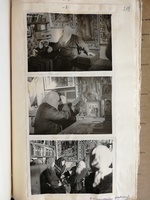 The photographs come from a 1959 KGB criminal case against three members of an Ioannite community in Cherkasy region, Ukraine. The images were designed as a photo album pasted into the secret police file. They portray father Mitrofan, the priest of the community in his house, which had been turned into a clandestine chapel. The first photo collage shows father Mitrofan dressed in Orthodox vestments against a background of icons, performing a religious service and talking to women, seemingly his followers. The second photo collage records the ritual washing of feet, also performed in father Mitrofan’s home. These photographs differ from typical secret police arrest or surveillance images. They intend to depict religious community life in an apparently natural context. At the same time the good quality of the photos, taken with a bright artificial light, indicate that these representation of rituals were staged. The last three images show the results of a police search of the clandestine chapel. The photos of cash confiscated during the police search and a table nicely served with food and drinks were used as incriminating evidence of the priest’s profiting from illegal economic activities. An image of a coffin and shelves with religious literature were intended to demonstrate the esoteric and fanatically sectarian nature of a repressed community. The last image constitutes a valuable source for the study of folk icons and handmade religious images circulated in the Soviet-era religious underground. It depicts confiscated and later destroyed icons used by the community. Apart from the portrait of father Mitrofan himself, there is an image of father John (Ioann) of Kronstadt, a famous Russian priest venerated by the community as a saint (hence the name of believers, the Ioannites). There is also a picture of Ambrose of Optina, placed together with the portrait of father John of Kronstadt in the same frame. Hieroschemamonk Ambrose was one of the most famous starets in Optina Monastery. He is pictured here on his deathbed. The choice of that image appears to be meaningful, as death and the afterlife were particularly sensitive issues for the community. The believers even built a clandestine Christian cemetery called “New Jerusalem”, photographs of which are also present in the secret police file as incriminating evidence. Ioannitism was a popular apocalyptic and chiliastic movement that emerged from the Russian Orthodox tradition at the beginning of the 20th century. The Ioannites were mainly peasant believers from the Russian and Ukrainian countryside, who venerated father John of Kronstadt (1829-1909), an archpriest from a town near St. Petersburg, one of the most popular religious personalities in late imperial Russia. A charismatic preacher, he was known as a blessed healer and wonder-worker, “the first modern Russian religious celebrity, with his image in souvenir scarves, mugs, placards, and postcard” (Kizenko 2000:2). During his lifetime, the pilgrimage to Kronstadt became a mass phenomenon, as thousands of believers all over Russia travelled to Kronstadt to see the “prophet.” Ioannitism, however, never constituted a unified religious movement, neither theologically, nor organisationally. It was rather constituted of dispersed peasant communities and individual wondering book-sellers, prophets and prophetess united by the common apocalyptic vision of the world, and centred around the figure of father John. Some believers remained within the Russian Orthodox Church, venerating father John as a blessed worshiper; others worshiped father John as the prophet Elijah or the embodiment of the Trinity, or Jesus Christ himself, thus, cutting themselves off from the official Church structures. In the early Soviet period, the Ioannites were persecuted as harmful ecclesiastic-monarchist sectarians. Driven underground, Ioannite communities built clandestine chapels and continued to live as underground monastic communities scattered from Western Siberia to Ukraine. Repression and shared underground experience drew the Ioannites together with catacomb True Orthodox communities. In the later years, this was even further facilitated by the Soviet secret services that made no distinction between the Ioannites and the True Orthodox Christians. Thus, the arrested believers in this criminal case were charged as the members of the True Orthodox Church. Father Mitrofan was known among believers as a miraculous healer. The village of Osytniazhka, where he lived, attracted numerous pilgrims who sought his blessing and spiritual help. The trial of father Mitrofan and his followers in 1959 was widely publicised. Apart from the official trial, a show-like civil trial was also held, which was recorded and later turned into a propaganda film titled “The End of a Spider.” The verbatim record of the civil trial is attached to the secret police file. Some photos found in the secret police file also appear in the film, which proves that the film was made under the direct supervision of the secret services. The photographs in this entry come from the State Archive Branch of the Security Services of Ukraine in Kyiv. The file reference is: fond 6, sprava 75174. The file consists of three volumes. Along with the photographs presented in this entry there are other images of the community and their religious artefacts. The file contains also numerous interrogation records of arrestees and witnesses. Three original Ioannite handwritten manuscripts of “The Dream of Father John of Kronstadt” are also attached to the file. Other confiscated religious writings, such as “The Explanation of the Apocalypse”, the brochure “Life story of starets father Mitrofan”, and Mitrofan’s homilies were destroyed as they are absent in the file. Their images, however, appear in the above mentioned propaganda film. For further readings see: Kizenko, Nadieszda. A Prodigal Saint: Father John of Kronstadt and the Russian People. Pennsylvania State University Press, 2003 Tepliakov, A.G. Ioannity Zapadnoi Sibiri v dokumentakh VChK-OGPU-NKVD (1920-1940 gody). Vestnik Tverskogo gosudarstvennogo universiteta. Seria: Istoria, 2010, vol. 30(4):128-136 Shugaeva, L. Ioannity: Techiia khiliastychno-eskhitalohychnoho spriamuvannia pravoslavnoho pokhodzhennia. Ukrainske relihieznavstvo. 2006, vol. 39:145-153 For related entries see:
 -
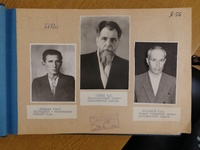 These photographs come from a KGB internal publication which is in the form of a photo album. It features arrested Ukrainian Greek Catholics, Josyf Slipyi, Ilia Blavatsky and Vasyl Kavatsiv and was published in Krasnoyarsk in 1958. The photographs of the arrested persons open the photo album (Image 1). The image of the metropolitan Josyf Slipyi, the head the Ukrainian Greek Catholic Church, is placed in the centre. Vasyl Kavatsiv (left), an underground priest and a secret monk, is defined under his photo as a nationalist, closely linked to Blavatsky. Ilia Blavatsky (right) was a Greek Catholic priest and one of the most trusted of Slipyi’s companions. The second image shows Slipyi’s desktop with manuscripts and newspaper cuttings confiscated during the police search. The third image shows Slipyi’s manuscript of the 5th volume of “The History of the Church in Ukraine” which was used as incriminating evidence against him. It was found by the police in the house of one of Slipyi’s friends. The fourth image shows religious items found by the police in Blavatsky’s house. The final image shows a barrack where Ilia Blavatsky, together with his parents and sisters, lived in exile. The house was located in a special settlement for exiled people in Krasnoyarsk (Eastern Siberia). Before it was moved to the secret police archive, the photo album had been kept in the internal “Chekist library” and seemingly served as an educational manual. It contains photographs of the police search with copies of confiscated manuscripts, correspondence and ritual items, as well as photographs of houses in the Siberian special settlements where religious leaders lived in exile after their release from prison. Apparently the photo album was based on the materials from a penal case against Josyf Slipyi, as most of the photographs place the police search of Slipyi’s residence in the home for disabled people in the Krasnoyarsk region in 1958. The police search was followed by his arrest and second imprisonment in 1959. He spent in total 18 years in labour camps. During the 1940-1950s, the organization of the Ukrainian Greek Catholic Church was virtually wiped out in the Soviet Union. The church was suppressed as it was accused of being closely related to the Ukrainian Insurgent Army (UPA) and the Organization of Ukrainian Nationalists (OUN), illegal in the Soviet Union. In 1945-1946, the Soviet authorities initiated a forced reunification of the Ukrainian Greek Catholic Church with the Russian Orthodox Church, Moscow Patriarchate. Stalin signed the directive on the liquidation of the church and the secret police were placed in charge of the operation. As a means of intimidation, all Ukrainian Greek Catholic bishops, the metropolitan and over 800 priests were arrested during the liquidation campaign. Those clergy and faithful believers that refused to a forced conversion to Orthodoxy were driven underground, forming the largest catacomb church in the Soviet Union. By the time of its liquidation, the Ukrainian Greek Catholic Church had 4 dioceses, one metropolitan, 7 bishops, over 2,400 priests, 1600 monastics, and nearly 4 million believers with only 30% of clergy having accepted the reunification with the Russian Orthodox Church. Believers and clergy were persecuted throughout the entire Soviet period. Thousands of them, including metropolitan Josyf Slipyi, were sent to GULAG or deported. The church received legal recognition only in 1989 during Perestroika. The images come from the State Archive Branch of the Security Services of Ukraine in Kiev. The file reference is: fond 13, sprava 584. For related entries see:
 -
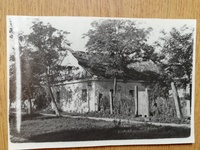 These photographs were taken during a raid on an underground monastery by the Soviet secret police, the NKGB in 1945. The images provide visual representations of a vernacular subterranean architecture developed by True Orthodox Christian communities in Soviet-era Ukraine. The monastery was located in the underground vault dug out under a private house (see the first image) in the small town of Chuguev, near Kharkov, northeast Ukraine. The twenty two photographs enclosed in the secret police file give a detailed description of the underground construction. Images 2 and 3 depicts two entries to the hidden religious space. The main entry (image 3) was concealed within the wall of a vault by a wooden structure. Inside, the monastery had several bedrooms, a storage space with a stove and a mill, and an archway gallery (image 4) leading to an underground church. The last photograph shows the altar of the church. Apparently, this was not the only underground monastery in the region. As other secret police files on the True Orthodox Church reported, there was a network of underground churches and monasteries constructed in caves and underneath rural houses in the region. In the short period between 1945 and 1947, the Soviet security services discovered 14 similar monasteries and churches. In later years, at least until the 1960s, the police reported more underground True Orthodox communities and their hidden dwellings and places of worship. When the police raided the underground monastery in 1945, there were some 20 people (mostly monks and nuns) gathered for a religious service; nine of them were arrested and brought to trial. Among the arrested was hieromonk Seraphim (Shevtsov), the leading figure in the religious underground of the True Orthodox Church in that area. Records of his interrogations give a detailed account of how underground churches and monasteries were constructed and how the religious life of communities of dissenters was organised. Seraphim claimed that there were about 2000 believers under his leadership, from different parts of eastern Ukraine and southern Russia. The underground church could fit up to 300 people at a time, with a core group of 10-15 monastics who permanently lived there under the spiritual guidance of father Seraphim. Even in the religious underground, there was a constant mobility. As more people came, the subterranean structure was expanded and modified. When a place was discovered or became unsafe, believers built new underground churches, moving from village to village. In the interrogation report, Seraphim explains about an incident that happened in the underground monastery in 1941. The subterranean structure partly collapsed when a group of believers gathered for prayer. The tragedy took the life of four people who were then secretly buried in the same underground church where they died. Monks and nuns belonging to the community were also buried inside the underground church. Not all the monastics of the True Orthodox communities lived underground, many of them practiced secret monasticism. As Seraphim reported, he personally tonsured some fifty people into secret monasticism. For reasons of safety, new monks and nuns did not receive new monastic names (as is the tradition in Orthodox Christianity). Continuing to live in the secular world, they followed the monastic code (prayers, celibacy, asceticism, non-possession of material goods and monastic obedience). They kept their monastic vows in secret even to their immediate circle of family and friends and never spoke about their monastic life with anyone (for more on secret monasticism see Wynot 2002). The police continued to arrest Seraphim’s followers after his detention. In 1948, the MGB reported the arrest of a group of wondering monastics left uprooted after Seraphim’s imprisonment and the closure of the underground monastery. Seraphim returned to his community after his release in 1952 and continued to build more underground churches. He was secretly buried in one of them in 1955. The images come from the State Archive Branch of the Security Services of Ukraine, fond 6, sprava 75976, SBU Archive (Kiev, Ukraine). The two-volume file contains interrogations protocols, formal notes on the police search and confiscation, with the detailed list of confiscated religious items and valuables from the underground monastery, closing indictment and the final sentence. Several confiscated (unidentified) personal photographs are also attached to the file. For related entries see:
 -
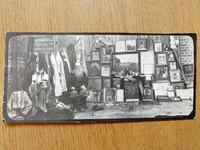 In 1945, the police raided an underground monastery of True Orthodox Christians (TOC). It was located in a vault under a private house in the town of Chuguev, near Kharkov, Ukraine. As a result, nine believers (most of them nuns and monks) were arrested with hieromonk Seraphim (Shevtsov) amongst them. All religious artefacts belonging to the community were confiscated and most of them were later destroyed. The photographs presented in this entry were taken during the raid and were later attached to a NKGB criminal file as incriminating evidence. The images portray confiscated church property at the same time inscribing an arrestee, father Seraphim, into the “crime scene”. The first photograph shows father Seraphim surrounded by church utensils, antiminses and icons found by the police in the underground church. In the second photograph, he sits with confiscated valuables and a clock. The last image shows the right side of the underground church, with a part of the altar and Seraphim’s bed. Hieromonk Seraphim (1875 – 1955) was a long-term leader of underground churches and monasteries of the True Orthodox Christians in the Kharkov region, northeast Ukraine. For several decades, Seraphim was the focus of close attention from the Soviet secret services, as he was seemingly the only catacomb priest in the region. A special secret operation called “Christoduls”, which continued after Seraphim’s death, targeted his clandestine communities of believers. As a young boy, aged 15, Daniil Shevtsov was tonsured a monk (adopting the name Seraphim) in Sviatohirsk monastery, a major Orthodox Christian monastery in eastern Ukraine. He continued his religious career as a deacon of the metropolitan Antony (Khrapovitsky), who later fled with the White Army, and together with other bishops in exile he founded an independent church structure called Russian Orthodox Church Outside Russia. Seraphim was among thousands of other monks who were left homeless when their monasteries were closed down by the Bolsheviks. Soon after his monastery was turned into the Renovated (Obnovlencheskaya) church (a movement within the Russian Orthodox Church, sponsored by the Bolsheviks and loyal to Soviet power) Seraphim went underground and joined the catacomb True Orthodox movement. He received his first 5-year sentence in 1934, and was deported to the North of Russia from where he escaped and illegally returned to Ukraine in 1937. Until the date of his arrest on 11th July 1945, he hid in different underground monasteries and churches near the city of Kharkov. Living literary underground, he led catacomb True Orthodox communities (numbering altogether around 2000 believers) in northeast Ukraine and southern parts of Russia. During the WWII, when Ukraine was occupied by the German army and many religious communities were granted relative freedom, Seraphim started to preach openly. For this, of course, he was later accused of collaboration with the Nazis. After his arrest in 1945, Seraphim was sentenced to 7 years in labour camps. He was released in 1952 and went into hiding again, continuing his “illegal” activities. In the following years, the secret police were busy searching for him, trying to recruit informers from his circle and raiding newly revealed underground churches and home communities. They did not know that Seraphim had died and was secretly buried in one of the underground monasteries in 1955 . According to the recollections of Seraphim’s followers, the secret police eventually discovered Seraphim’s grave and exhumed his body in order to prevent a growing pilgrimage movement. The body was unspoiled and the coffin emitted a fragrance of such strength that the policemen complained that a whole bottle of perfume had been poured inside. The Ukrainian secret police targeted the catacomb True Orthodox Church (TOC) throughout the entire Soviet period. The same year Seraphim was arrested, the secret police launched a centralized all-Ukrainian operation called “Hermitage" (Skit), to uncover the growing underground networks of True Orthodox communities. In 1947, the secret police reported the results of the two-year operation: 367 TOC members arrested; 4 underground monasteries, 10 underground churches and 25 “illegal” praying houses disclosed (SBU archive, f. 3, spr. 300, p. 113-114). The images come from the State Archive Branch of the Security Services of Ukraine, fond 6, sprava 75976, SBU Archive (Kiev, Ukraine). The two-volume file contains interrogation protocols, formal notes on the police search and confiscation with a detailed list of confiscated religious items and valuables, a closing indictment and the final sentence as well as other photographs of the underground monastery. For related entries see:
 -
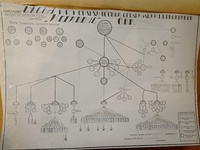 These two images come from two exemplary closing indictments against the so-called "ecclesiastic-monarchist, counter-revolutionary organisation", the True Orthodox Church. They were published as top secret brochures by the Soviet secret police (OGPU) in 1931. Network schemes were carefully and precisely designed and printed using very advanced photo-printing technology for the time. Through complex sets of social links, the schemes represent religious communities as centralised insurgent political organisations. At the very bottom are “local (rural) cells” (sel’skie iacheiki) – basic religious groups located in farms, villages and settlements. A dot (triangle, circle, or rectangle) shows the number of arrested people in a repressed community. A shaded sign signifies a “not liquidated” group that was still under surveillance. The network scheme from the Samara OGPU (image 1) pictures a network of the counter-revolutionary organisation in the Middle Volga region and its complex links of relations between cells and centres. Miniature images of churches indicate “basic cells” (nizovye iacheiki) centred around some churches that remained open. Basic cells are grouped and linked to form regional sets of cells. Circles twice crossed refer to local leaders – a kulak, a priest (pop), a monk, a bishop, or simply indicate surnames with no details. Regional sets of cells are linked to a senior centre of the “counter-revolutionary organisation” in Kashirin region. This link is not direct, but is established through groups of couriers (sviaznoi), schematically pictured as shadowed circles. Through a similar group of couriers, the regional centre is connected eventually to the top – two all-union centres of the counter-revolutionary organisation the “True Orthodox Church” with its political centre in Moscow and administrative centre in Leningrad. Image two shows an all-encompassing representation of the religious network. The scheme is signed by Evgenii Tuchkov, the head of the so-called “Church department” of the OGPU and one of the leaders of the 1920s-1930s anti-religious campaigns who headed security police operations against the ROC and the ecclesiastical underground. The scheme “reveals” the hidden connections of branches and cells in the entire country (Central, Caucasian, Black sea, Central Black Earth, Volga regions, Ukraine etc.). Shadowed circles refer to those cells and branches that had supposedly developed significant insurgent activities. The scheme gives two types of social connection: a direct link between the cells (full lines) and an indirect link (kosvennaia sviaz’, dotted lines). It is unclear what an indirect link means here but it allows for every group, branch and cell in the entire Soviet Union to be interconnected and at the same time subordinates them altogether to regional and superior centres. Two hexagons – two all-union centres in Moscow and Leningrad – crown the scheme. In this way, an ideal and comprehensive image of the insurgent, espionage, terrorist, counter-revolutionary, conspiracy organisation could be fully realised. It is pictured as a vertical network, which is built not as a web but as a vertical hierarchical scheme where all links and dots come to a centre. The documents come from the State Archive Branch of the Security Services of Ukraine, fond 13, sprava 386, 387 (Kiev, Ukraine). Apart from visual materials, the internal publications contain a list of accused persons with information on their social origins, the insurgent political platform and the structural composition of the organisation as perceived by the secret police. Numerous quotations from interrogations of arrestees and witnesses were supposed to prove the point. For related entries see:
 -
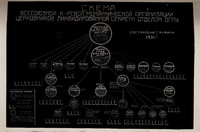 This scheme of a religious network was produced as part of a review of criminal cases against believers of the True Orthodox Church. It was published in 1931 as a top-secret document by the Soviet secret police (OGPU) in Moscow. This image has been given the title "Scheme of the All-Union Counter-Revolutionary Monarchist Organisation of Churchmen (the 'True Orthodox Church'), liquidated by the Secret Political Department OGPU". Schemes such as this one were designed to represent the religious movement as an organised hierarchical structure, where the "ecclesiastical political centre" in Moscow and the "ecclesiastical administrative centre" in Leningrad were connected to religious groups in other towns in Russia, the Caucasus region and Ukraine. These top-secret internal publications were circulated among other branches of the OGPU, including the one in Kiev, as exemplary collective penal cases – a sort of textbook for the OGPU’s struggle against the so-called “ecclesiastical-monarchist underground”. Clichéd citations from the interrogations and false confessions of arrested believers intended to reveal the political conspiracy disguised behind religious practices. It was a typical strategy to translate religious dissent in terms of political insurgency. The main charges against the believers were anti-Soviet agitation and propaganda and counter-revolutionary activities, including inciting the peasants to revolt against collectivisation. The Russian True Orthodox Church, also known as the Catacomb Church, was formed in the early years of the Soviet Union as a reaction against the collaboration of the Russian Orthodox Church hierarchy with the Bolsheviks. After Metropolitan Sergii issued a declaration of loyalty to the Soviet regime in 1927, many Orthodox communities ceased to communicate with the Moscow Patriarchate, renounced the Soviet power and continued their religious life underground. True Orthodox believers were severely persecuted throughout the entire Soviet period. In 1930-1933, the Stalin’s secret police (OGPU) launched the all-Union “liquidation campaign” against the growing Orthodox dissent movements, which they collectively referred to as the “ecclesiastical-monarchist underground”. The True Orthodox Church was the main target. The wave of repression particularly affected religious communities in southern Russian provinces and in Ukraine, where popular religious dissent was notably influential among the peasantry. Hundreds of priests, monks and ordinary believers were repressed as a result of the campaign. This document comes from the State Archive Branch of the Security Services of Ukraine, fond 13, spr. 385 (Kiev, Ukraine). Two internal publications in this archive fond also provide the OGPU's description of the so-called "ecclesiastical-political centre": its origins, political platform, leadership and its supposed "counter-revolutionary, anti-kolkhozes and insurgent activity". The description of religious criminal evidence are corroborated by standardised and formulaic statements of arrested individuals and witnesses. For related entries see:
 -
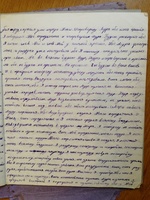 This is a manuscript with a Pentecostal prophesy confiscated in 1953 from an arrested Ukrainian woman, who was known as a Pentecostal prophetess. The prophecy is handwritten in a notebook and is 15-page long. It narrates the coming death of Ashur, who will be overthrown from his throne by God and will be shot dead. After his death, all the prisoners will be released and people will live in freedom. The prophecy also stresses a special religious role of Ukraine and Kiev, its capital, that will become a place of great spiritual awakening. The item comes from the 1953 MGB penal case against four Pentecostal believers, all Ukrainian women. The manuscript with the prophecy was used by the MGB as incriminating physical evidence of their “anti-Soviet propaganda”, including “dissemination of libels against Soviet leaders”. The “Anti-Soviet Agitation and Propaganda”, the infamous article 58 of the Penal Code, was a common criminal offence used to incriminate to religious believers in the Soviet Union. Officially believers could not be persecuted for their religious beliefs, as the Soviet Constitution granted religious freedom on paper. Penal cases against religious believers were fabricated in terms of extreme politicisation of religious practices. A KGB report from 1963 states, “We do not fight against believers or religion, but we do fight against the use of religion by anti-Soviet elements… in hostile to the Soviet state purposes”. The image of Ashur resembles Stalin, however, in one place of the prophecy Ashur is called Vyshinsky – the minister of foreign affairs in 1949-1953 and one of the main organizers of Stalin’s great terror, who signed thousands of death penalties in the 1930s. On the second image, the following sentences were underlined by an MGB officer, as supposedly having a distinct anti-Soviet meaning: “And liberty [volia] and freedom will follow soon; the days of freedom are approaching. For Ashur will be overthrown. And people will be called. I will call up people from many countries, and they will arrive and will [condemn] Ashur. The end has come, they call Ashur to death, for Ashur will be shot dead. Oh, oh, oh the storm will arrive for there will come the great bloodshed..." The prophecy goes on to recount how all prisoners will be released and how Kiev, the capital of Ukraine, will become the new Jerusalem. The "wandering prophetess", as she was described by the MGB, led a Pentecostal community in Kiev and travelled throughout Ukraine and as far as Siberia, preaching among religious communities. She was arrested in 1953 along with three other women pentecostal believers and sentenced to 25 years in labour camps. At this time there were a number of “illegal” religious groups in Soviet Ukraine referred to as the “religious underground”. They were regarded “harmful for the state by the very fact of their existence and the character of their activity”. In 1944, the All-Union Council of Evangelical Christians-Baptists was formed as the only recognised umbrella church body of all branches of Evangelical Christians. The communities that refused to enter the Council, including many Pentecostal groups, were considered criminal. Ukraine was the hotspot of Soviet-era religious persecutions as it was the place of the largest Christian Evangelical communities in the entire Soviet Union. Ukrainian Pentecostalism developed a particular culture of prophets, who were wondering across the wider region, preaching and gathering new communities. By the time of this penal case in 1953, according to the Soviet authorities, there were approximately 200 unregistered Pentecostal communities in Ukraine with over 200 prophets and prophetess. This manuscript comes from the State Archive Branch of the Security Services of Ukraine, fond 6, spr. 60259. The file contains records of arrest and transcripts of interrogations of four Pentecostal women on trial, transcripts of interrogations of witnesses, as well as a closing indictment, court records and a final court sentence. Two women (including the author of the manuscript) were sentenced to 25 years and two others to 10 years in labour camps. Alongside the manuscript reproduced here, the file contains one more notebook with handwritten religious writings and a press-cutting with an image of the American President Harry S. Truman. These confiscated items were also used as incriminating physical evidence against the arrested women. Twenty confiscated photographs and twenty one personal letters of believers were later destroyed as having no relevance to the case. For related entries see:
 -
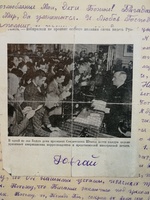 This press-cutting with an image of the American President Harry S. Truman was confiscated from an arrested Pentecostal woman in February 1953 in Ukraine. The first image shows Truman receiving an international delegation of journalists. The picture has a title in Russian, “In one of the halls of the White house, the president of the US receives American and international journalists almost every week”. The press-cutting was taken from an unknown, presumably Russian diaspora journal printed in the USA. The item comes from a 1953 MGB penal case against four Pentecostal believers, all Ukrainian women. The confiscated press-cutting was used as incriminating evidence of their anti-Soviet activities and pro-American propaganda. Reading or possessing an American journal was illegal in the Soviet Union, as the Soviet political censorship banned most foreign media, particularly of diaspora origins. One of the arrested women was known as a Pentecostal prophetess. As the numerous, mostly fabricated, interrogation reports show, the woman preached the advent of Truman, anointed by the Lord to Ukraine and the coming peace and freedom of the country. As Truman was a Baptist and a religious man, she appears to have genuinely regarded him as the liberator of all believers. She preached that Ukraine would become the Millennial Kingdom where all people would receive the baptism of the Holy Spirit. In 1937, the NKVD had arrested her husband, also a Pentecostal believer. The woman never heard of him again. The closing indictment contained in the file, additionally states that, during their religious meetings, the arrested women also read Soviet newspapers one of which included the UN Charter. This was also used to incriminate the group on trial as it stated that the women intentionally “perverted the message” of Soviet newspapers. “Illegal” religious groups and their members were not persecuted expressly for their religious beliefs as, on paper, the Soviet Constitution granted religious freedom. Most of the repressed religious believers were incriminated for “anti-Soviet agitation and propaganda” or “counter-revolutionary activity” and penal cases against them are characterised by an extreme politicisation of religious practices. As a KGB report from 1963 states, “We do not fight against believers or religion, but we do fight against using religion by anti-Soviet elements… hostile to the Soviet state”. This image comes from the State Archive Branch of the Security Services of Ukraine, fond 6, spr. 60259. The file contains records of arrest and transcripts of interrogations of four Pentecostal women on trial, transcripts of interrogations of witnesses, as well as a closing indictment, court records and a final court sentence. Two women were sentenced to 25 years and two others to 10 years in labour camps. Alongside the image reproduced here, the file contains two notebooks with handwritten Pentecostal prophecies and writings that were also used as incriminating physical evidence. Twenty confiscated photographs and twenty one personal letters later destroyed as having no relevance to the case. For related entries see:
 -
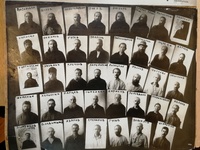 This photo-collage and scheme of a religious network were produced as part of an exemplary collective penal case against members of the catacomb True-Orthodox Church. The photo-collage shows a group of believers put on trial - thirty eight True Orthodox believers headed by Alexii Bui, bishop of the Voronezh diocese (top row, fourth from the left). The network scheme represents the movement as a centralised organisation, uniting religious centres in Leningrad and Moscow with numerous "cells" (as the OGPU called them) in southern regions of Russia (Voronezh, Belgorod, Kursk, etc). It shows repressed communities and those under surveillance, the number of arrested individuals and the names of local leaders. The indictment was published in 1931 as a top-secret document by the Soviet secret police (OGPU) in Voronezh, Russia. The document was then sent to the Ukrainian OGPU, because numerous communities belonging to the religious network were located in Ukraine. This secret publication was supposed to be a sort of textbook in the OGPU’s campaign against the Buevtsy (as the secret police referred to the followers of Alexii Bui). The exemplary indictment provided a structure, linguistic formulas and incriminating political crimes used against believers that could utilised for further repression of the True Orthodox Church in Ukraine. Bishop Alexii (whose birth name was Semion Bui) was one of the leaders of the Russian True Orthodox Church. He united under his leadership communities of True Orthodox Christians in about forty districts in southern provinces of Russia and in Ukraine. Alexii Bui was arrested in 1929 as the leader of the “counter-revolutionary ecclesiastical-monarchist organisation” (as the Soviet secret police referred to dissenting Orthodox communities). After several trials he was sentenced to ten years in labour camps and eventually was shot dead by the NKVD in Sandarmokh, Karelia on 3rd November, 1937. The documents come from the State Archive Branch of the Security Services of Ukraine, fond 13, spr. 390. The file also contains a full list of the convicted persons, the historical outline and the social structure of the True Orthodox Church as perceived by the secret police, and evidence of its politically subversive, counter-revolutionary activities, based on majorly distorted and formulaic statements of arrested individuals and witnesses. For related entries see:
 -
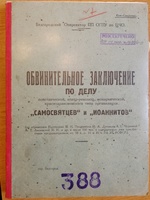 The images are a photo-collage and scheme of a “liquidated” religious network produced as part of a closing indictment in a collective penal case against one hundred believers, followers of underground popular Orthodox movements, referred to as the Samosviatsy and the Ioannits. The group on trial were monks and nuns from closed Orthodox monasteries and ordinary believers from the Ukrainian and Russian countryside. They rejected both Soviet power and the Russian Orthodox Church authority as they believed the Orthodox Church was compromised by collaboration with the Bolsheviks. The network, which was referred to as the Samosviatsy (deriving from the term for "self-consecration"), also included some followers of the Russian Orthodox archpriest Ioann of Kronstadt, referred to as the Ioannits. One of the arrested was a popular charismatic leader, Andrei the Ill (Bolaschii), a prophet and a holy fool (yurodivyi), active in southern Russia and Ukraine. The network scheme and photo-collage show how the Soviet secret police represented dispersed communities of peasant believers and monks from different Ukrainian and Russian towns and countryside. The visual representations portray the community as a hierarchical secret organisation, showing the interconnections and relationships between members. Representing religious groups in this way was part of the typical strategy of politicisation of dissenting religious groups, in order to validate repressive action. The indictment was published in 1930 as a top-secret document by the Soviet secret police (OGPU) in Belgorod, Russia. The document was then circulated among other branches of the OGPU, including the one in Kiev, as an exemplary collective penal case – a sort of a manual of the OGPU’s struggle against the so-called “ecclesiastical-monarchist underground”. On the cover of the file, the Samosviatsy and the Ioannits are defined as "insurgent, counter-revolutionary, monarchical red-dragon-type organisation". As well as the network scheme, it contains material with long citations, in largely formulaic secret police language, taken from interrogations of arrested individuals and witnesses. These were intended to reveal political conspiracies disguised as religious practices. The main charges against the believers were of anti-Soviet propaganda and counter-revolutionary activities, including inciting the peasants to revolt against collectivization. After the Bolshevik Revolution in 1917, political repression turned against the Russian Orthodox Church. The majority of monasteries and churches were closed down and many former priests, nuns and monks continued their religious practises underground, in private houses and apartments, wandering from village to village. The perceived political corruption of the Church, the repression of the Church hierarchy and mass closure of churches and monasteries triggered the development of popular forms of Orthodox dissent. These movements had an apocalyptic vision of a radically changing world. Numerous prophets, holy fools (yurodivye) and former monks and nuns preached the arrival of the Apocalyptic Red Dragon personified by the Communists, hence the name "red-dragon-type organisation". Soviet power was seen as the power of the Antichrist or Satan. In 1930-1933, Stalin’s secret police (OGPU) launched the all-Union “liquidation campaign” against the growing Orthodox dissent movements, which they collectively referred to as the “ecclesiastical-monarchist underground”. Among the repressed groups were numerous communities of the catacomb True Orthodox Church, the Samosviatsy, Ioannits, and many other ordinary believers. The documents come from the State Archive Branch of the Security Services of Ukraine, fond 13, spr. 388, SBU Archive (Kiev, Ukraine). The file also contains a full list of the people put on trial, the historical outline and the social structure of the movement as perceived by the secret police, and evidence of its insurgent, counter-revolutionary activities, based on majorly distorted and formulaic statements of arrested individuals and witnesses. For related entries see: